
The FAA Ground Stop, L3Harris and the $12.5 Billion: Where Did the Money Go, and Could It Be a False Claims Act Case?

Table of Contents
On Friday, November 13, the FAA stopped every departure in the country for nearly five hours. The Transportation Secretary named the contractor whose crew was working on the network when it failed: L3Harris Technologies. By Tuesday the question in Washington had changed from “what broke” to “where did the money go,” and the question in my inbox is whether any of this could become a False Claims Act lawsuit. [1][2]
It was a rough week to be an American adult, because we were treated like children. On Thursday Microsoft Outlook went down and they took away our screen time. On Friday they grounded us. This post is about the grounding, about the money, and about what to believe. Are we being treated like adults with the truth, or spoon-fed a distracting cover story? That is exactly why whistleblowers matter. Beneath the cover stories there may be a fertile False Claims Act case, and a race to the courthouse to file it.
What We Know So Far
The Secretary said an L3Harris crew was replacing copper lines with fiber at an FAA radio site in El Dorado, Arkansas, including installing a new router, when the network was flooded with traffic. A second router at a radar site in Amarillo, Texas, replaced about three weeks earlier, did the same. The FAA says its legacy equipment was hit with about a thousand connection attempts every four to five seconds. Seventeen of the FAA’s 22 en route centers were overloaded, and the agency grounded the country at about 3:30 p.m. Eastern. Departures resumed at 8:15 p.m. More than 12,000 flights were canceled that day. [1][3][4][5]
Both routers are at an L3Harris lab in Florida, with FAA staff and FBI agents on site. The FAA Administrator has said the review will determine whether the router was installed incorrectly, configured incorrectly, or was simply defective. And for all the technology in this story, there is a strikingly low-tech detail: maintenance on this network is logged on paper, so teams had to search paper records to work out where work was even taking place. Hewlett Packard Enterprise, which owns Juniper, the maker of the new router, says the device worked as it was set up to work. Its statement is that the router functioned as configured by the installer and did not fail or act improperly. [2][6][7][8]
Speak with the Lawyers at Brown, LLC Today!
Over $1 billion in aggregate judgments and settlements for our clients in state and federal courts. We fight for maximum damages and results.
Four things are new since the weekend. Senators say L3Harris told their offices the copper-to-fiber transition involves converting 3,648 routers to Juniper devices, that 400 are installed, and that 69 are operational. The company separately says the conversion is more than 70% complete. The FAA has halted installation of those routers and disabled the broadcast feature on the ones already in service. The Secretary, asked why the government keeps using this contractor, said he was stuck with L3Harris until a new system is built. And on November 18, people familiar with the work told CNN that no FAA technician actually monitored the router replacement, which the agency disputes. [8][9][10][11]
Follow the Money
Congress gave the FAA $12.5 billion for air traffic control modernization in July 2025, including $4.75 billion designated for telecommunications. On November 12, the day before the ground stop, the Department and the Office of Management and Budget sent Congress a request for $30.1 billion more. Five days after the ground stop, that request became $50.1 billion. Senators of both parties have pointed at the original $12.5 billion and asked why more is needed. The Secretary says about a third has been spent, that Congress was specific about how he could use it, and that none of it was for a new telecom architecture. Fact-checkers have noted that $4.75 billion of it was designated for telecommunications. That argument is political, and it will be settled in hearings. [8][12][13][14]
The False Claims Act does not follow appropriations. It follows invoices. And there are four streams of them on the public record. This is the heart of any government contract fraud analysis:
- About $1 billion a year that the FAA Administrator says the agency spends sustaining the existing 1980s-era telecommunications network. He said the router work in Arkansas was routine maintenance on that network, not part of the $12.5 billion program. [4]
- $1.5 billion in contract extensions. A February 2024 inspector general audit found that of eleven extensions to the 2002 telecom contract, ten were improperly authorized, adding 57 months and $1.5 billion, with a warning that the agency risked paying more than it should and receiving less than the best-quality results. [10][15]
- The copper-to-fiber conversion itself: 3,648 routers, 400 installed, 69 operational by the senators’ account, and more than 70% complete by the company’s. [8][10]
- The $12.5 billion modernization program, run with a separate integrator, which the FAA says is on track to be spent by the end of 2028. [12][14]
Every payment in those streams started as a claim, and most claims rest on a certification: that work was performed, that a milestone was reached, that a system was tested, that a price was accurate. That is where a whistleblower case comes from.
An Outage Is Not Fraud
I spent years in the FBI, including as lead agent on major investigations, and a good part of that work was learning the difference between a failure and a fraud. The False Claims Act is not a law against things breaking, slow programs, or old equipment. Inspectors general have been writing about this network’s delays since 2006. Delay is not fraud either. [10]
Related: Brown, LLC secured two of the year’s largest individual recoveries — a $950M settlement against Raytheon and $350M against Walgreens. Learn about our False Claims Act practice →
The Act punishes knowingly presenting a false claim for payment, or knowingly making a false statement material to a claim, with “knowingly” covering actual knowledge, deliberate ignorance and reckless disregard. The question is never “did the router fail.” It is what the contractor certified, what it billed, and whether that was true. [16]
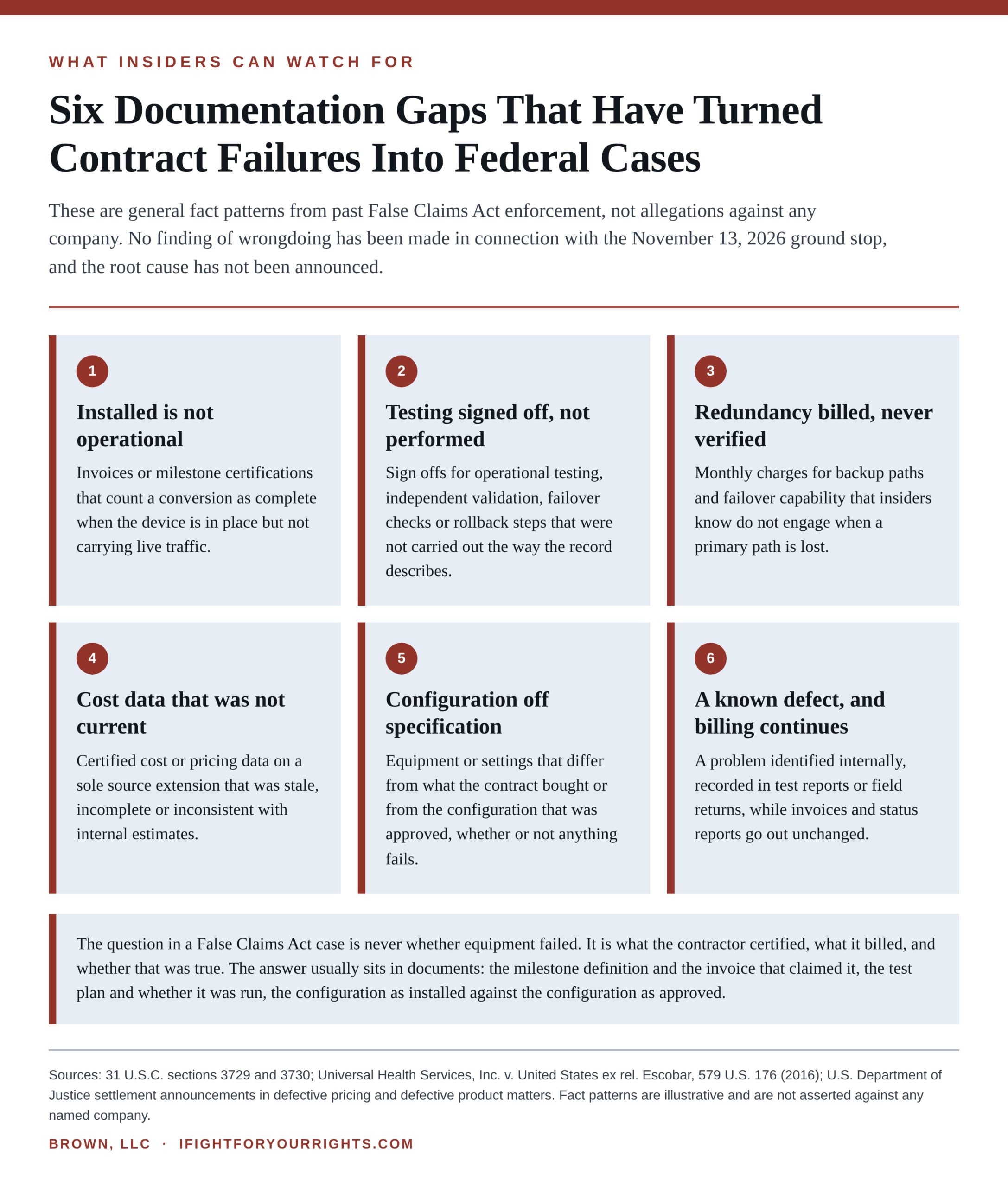
Six Ways This Becomes a False Claims Act Case
I am not saying any of these happened. These are the fact patterns that have turned contractor failures into large recoveries before, and the new facts make each of them a fair question.
1. Billing for Milestones That Were Not Reached
Two numbers are now public: 400 routers installed with 69 operational, and a transition the company describes as more than 70% complete. Those may measure different things, lines against devices, sites against routers. There is a third number in the mix, because the FAA Administrator has described the job as replacing about 2,000 aging routers, while the senators were told the conversion covers 3,648. The False Claims Act question is which measure the invoices and milestone certifications used, and whether it was true. If the government was billed for completed conversions that were installed but not working, the gap between installed and operational is the case. [8][10]
2. Certifying Tests That Were Not Run
The senators were told that the FAA Technical Center tested a sample of the Juniper devices before installation and that the devices passed. Their letter asks whether that testing reflected real operating conditions or evaluated all the failure modes. They then asked the FAA to pause installations until there is improved operational testing, independent validation, verified failover capability and rollback procedures. Those are the things a cutover procedure normally requires before a device carries live traffic. If a crew certified a tested, validated cutover that was not tested or validated that way, the certification is a false statement and the invoice that relies on it is a false claim. A maintenance record kept on paper is where that gap hides. [6][8]
3. Billing for Redundancy That Does Not Work
After the Dallas outage on September 19, 2025, when two cut fiber lines took down the primary and secondary data paths into the Dallas approach control, the FAA said in plain words that oversight by L3Harris failed to ensure that redundancies in the system functioned properly. This week the senators asked how the system lacked the redundancy to recover immediately from a localized failure. Redundancy is something the government pays for every month. A contractor that bills for backup capability it knows is not functioning is submitting claims the government would not pay if it knew, which is what the Supreme Court’s Escobar decision means by materiality. [8][17][18]
4. Defective Pricing on Sole-Source Extensions
When the government extends a contract without competition, the contractor generally has to hand over current, accurate and complete cost or pricing data and certify it. Overstating costs in that data is defective pricing, and defective pricing is a False Claims Act theory. It is the theory behind the $428 million Raytheon settlement, the second-largest procurement fraud recovery in the history of the Act, in which our firm represented the whistleblower. Be precise about what the inspector general did and did not find here. It did not find fraud, and the improper authorizations were the agency’s, not the contractor’s. What the same audit did find is that the FAA could not produce adequate independent cost estimates across its technology and telecom contracts, and that on the 2002 telecom award the government’s own estimate sat 26% above the price it accepted. Whether the prices inside those extensions were supported by accurate data is a question only someone who saw the cost data can answer. [15][19]
5. Installing Something Other Than What the Contract Bought
Product substitution means equipment or a configuration that does not meet the specification or was never approved. The claims are false whether or not the substituted part ever fails. The manufacturer says its device functioned as configured by the installer, which moves the question to how it was configured and whether that configuration was the approved one. Those are the red flags that recur in defense procurement. [7][16]
6. Knowing About a Defect and Billing Anyway
The corporate family history supplies the example. In November 2015, L-3 Communications, a predecessor company that merged with Harris in 2019 to form L3Harris, and its EOTech unit paid $25.6 million to resolve False Claims Act allegations that they sold the Defense Department, Homeland Security and the FBI weapon sights they knew failed in cold and humid conditions, and delayed disclosing the defects for years. The U.S. Attorney said the defendants admitted they knew. The conduct predates the merger and involved a different business, but it is the clearest illustration of the theory. [20][21]
The Oversight Question That Opened This Week
On November 18, CNN reported that an FAA technician escorted the L3Harris engineer into the Arkansas site and then went back to his own work, and that sources described the technician as there to unlock the door, with no monitoring of the installation. The reporting ties this to a March 2025 policy change under which the agency began receiving notifications of planned contractor maintenance rather than requests, with the work proceeding without FAA approval. The FAA Administrator has said the engineer was monitored by an FAA technician and that there is a comprehensive risk management process with every installation. The agency also said in a statement that its technicians were not involved in the upgrades that led to the ground stop. [11]
Those accounts cannot all be right, and that is the point. When a contractor self-certifies work that nobody watched, the paperwork is the only record of what happened. In a False Claims Act case, the paperwork is the evidence.
Whistleblower tip: If you’ve witnessed Medicare or Medicaid billing fraud at your employer, you may qualify as a qui tam relator with a potential share of the government’s recovery. See our Medicare & Medicaid fraud practice →
There is precedent on exactly this. The inspector general traced a 2009 FAA outage, which disrupted facilities across the country, to a technician who misconfigured a router while doing the same kind of fiber transition work. Seventeen years later, the same contract, the same type of job. [10]
What a Case Needs
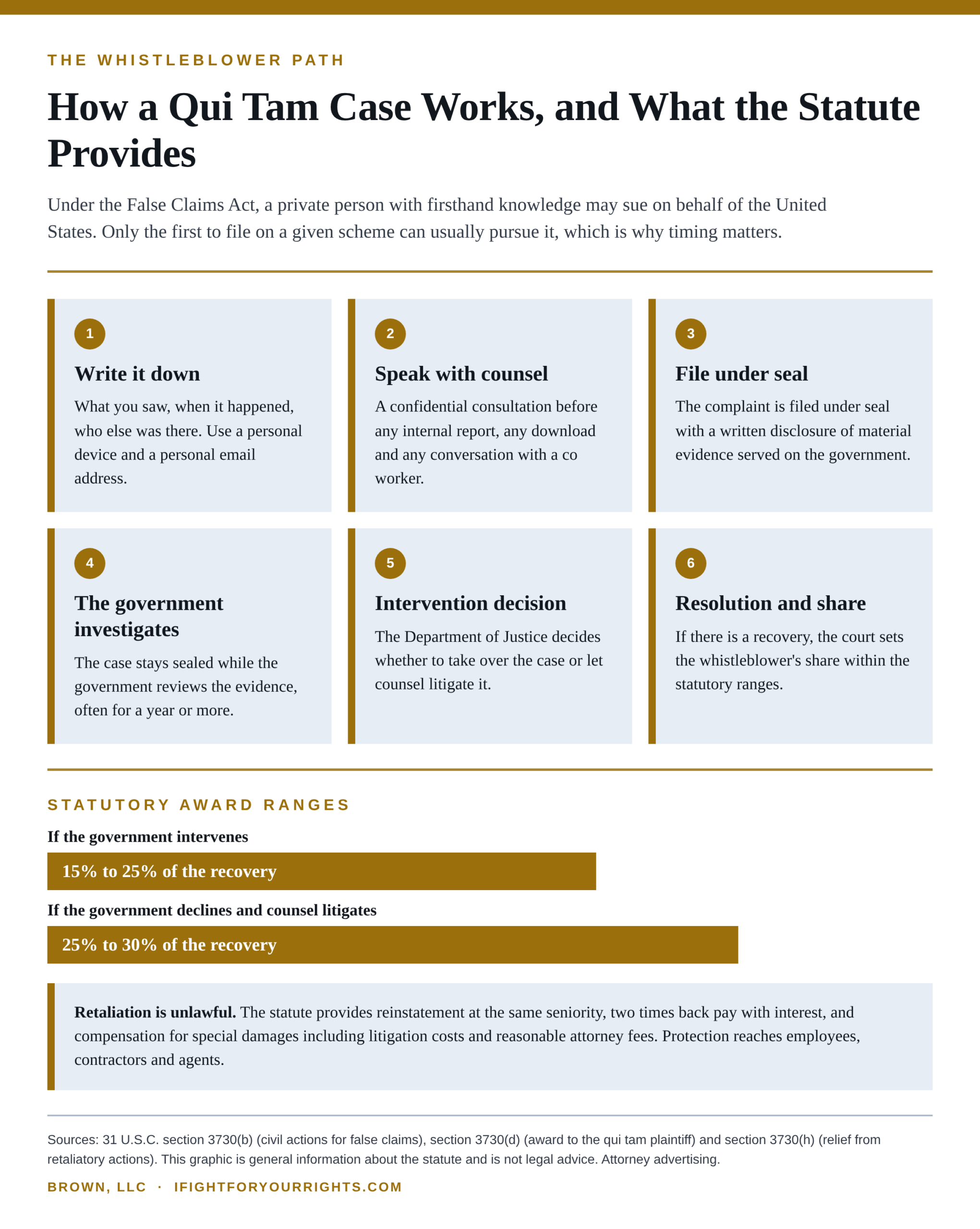
An insider with firsthand knowledge: a network engineer, a field technician, a program or contracts manager, a pricing analyst, a test engineer, someone at a subcontractor or the equipment vendor. Documents: the milestone definition and the invoice that claimed it, the test plan and whether it was run, the configuration as installed against the configuration as approved, the cost data behind an extension, the email where someone raised a concern and someone answered it. Government money at scale, and our firm typically takes False Claims Act cases involving eight figures in government damages, which every stream above clears. And speed, because the first whistleblower to file a sealed complaint on a scheme is usually the only one who can pursue it. [16]
A whistleblower who brings that case may receive 15% to 25% of what the government recovers if the Department of Justice joins it, or 25% to 30% if it declines and the whistleblower’s attorney litigates it. Retaliation is illegal, with reinstatement, two times back pay and special damages as the remedy. If you want the mechanics in plain language first, start with our whistleblower FAQ or our account of the year qui tam filings hit a record. [16]
What I Would Tell an Engineer on That Network This Week
Congress is asking for briefings, and it set a November 23 deadline for answers. The FBI is in the lab. The White House has a team on it. Every one of them is working from what the contractor and the agency choose to hand over. Do not talk to co-workers about what you know. Do not take records you are not authorized to access, and do not delete anything. Write down what you saw, when, and who else was there. Then call a whistleblower lawyer before you do anything else.
The Secretary said this week that contractors take the government’s money and provide poor service. Poor service is a contract problem. A false invoice is a federal case. The difference is in documents that someone reading this may have seen. If those documents concern network security controls rather than billing, the analysis shifts but does not disappear, as we explain in our piece on the Civil Cyber-Fraud Initiative. [10]
If you have firsthand knowledge of how the FAA network was built, tested, certified, priced or billed, request a free, confidential consultation or call (877) 561-0000. Use a personal device and a personal email address. You can also review our record in False Claims Act matters. Watch the video:
Attorney advertising. This post describes public reporting as of November 19, 2026 and general principles of the False Claims Act. It does not allege that L3Harris Technologies, Hewlett Packard Enterprise, Juniper Networks or any other company has violated any law. The cause of the November 13 ground stop is under investigation and no results have been made public. Past results do not guarantee future outcomes. Contacting Brown, LLC does not create an attorney-client relationship.
Sources
- [1] Reuters via The Detroit News, November 14, 2026 (nearly five-hour shutdown; L3Harris named; installer error or faulty router): https://www.detroitnews.com/story/business/2026/11/14/faa-ground-stop-blame-installed-router/92782974007/
- [2] FedScoop, FAA details $50B request as lawmaker pushback grows, November 17, 2026 (routers at an L3Harris lab in Florida with FBI agents and FAA staff on site): https://fedscoop.com/dot-faa-funding-request-atc-lawmaker-pushback/
- [3] IBTimes, FAA Investigates Routers in Two States, November 15 to 16, 2026 (El Dorado, Arkansas and Amarillo, Texas): https://www.ibtimes.co.uk/faa-investigates-routers-two-states-after-nationwide-flight-halt-manufacturer-says-they-did-not-1832436
- [4] Quartz, November 15, 2026 (about 1,000 connection attempts every 4 to 5 seconds; ground stop about 3:30 p.m. with traffic resuming 8:15 p.m.; 12,462 cancellations; routine maintenance, not part of the $12.5 billion; $1 billion a year maintaining the network): https://qz.com/trump-biden-faa-ground-stop-congress-funding-111526
- [5] Reuters via Fulton Sun, November 15, 2026 (17 of 22 en route centers); KYS, November 15, 2026 (Amarillo system replaced about three weeks earlier): https://www.fultonsun.com/news/2026/nov/15/us-aviation-shutdown-may-have-been-fault-of-one/ ; https://kysdc.com/5742189/faa-ground-stop-update/
- [6] AOL/Yahoo News, What to Know About L3Harris, November 14, 2026 (installed or configured incorrectly, or defective; maintenance records kept manually on paper): https://www.aol.com/articles/know-l3harris-company-running-faa-175959000.html
- [7] Hewlett Packard Enterprise statement, as reported by ABC News and The Wall Street Journal, November 16 to 17, 2026 (the device functioned as configured by the installer and did not fail or act improperly): https://abc7.com/live-updates/faa-ground-stop-live-updates-what-know-nationwide-flights-are-grounded/20038887/entry/20042608/
- [8] Senate Committee on Commerce, Science and Transportation, Democratic members’ letter to the Secretary of Transportation and the FAA Administrator, dated November 16, 2026, released November 17 (3,648 routers to convert, 400 installed, 69 operational; a sample tested before installation and passed; request for an immediate pause pending improved operational testing, independent validation, verified failover capability and rollback procedures; redundancy questions; response requested by November 23): https://www.commerce.senate.gov/press/dem/release/commerce-committee-democrats-demand-clear-fact-based-answers-from-dot-faa-on-root-cause-of-nov-13th-nationwide-ground-stop/
- [9] Associated Press via PBS NewsHour, November 17, 2026 (FAA pauses installation of the routers): https://www.pbs.org/newshour/nation/faa-stops-installation-of-routers-it-linked-to-national-ground-stop
- [10] CBS News, Before air travel meltdown, federal transportation officials received years of questions and warnings, records show, November 16, 2026 (2024 OIG audit; audits from 2006; the 2009 outage traced to a misconfigured router during fiber work; stuck with L3Harris; contractors take our money; 70% of the copper-to-fiber switch complete): https://www.cbsnews.com/news/faa-ground-stop-warnings-records/
- [11] CNN, Sources say FAA had little oversight of work that led to nationwide ground stop, November 18, 2026 (the technician was there to unlock the door; no monitoring; the March 2025 shift from maintenance requests to notifications; the Administrator’s contrary account): https://www.cnn.com/2026/11/18/politics/faa-contractor-oversight-ground-stop
- [12] CNN, November 15, 2026 ($4.75 billion of the $12.5 billion for telecommunications; about one-third spent; on track to be spent by the end of 2028): https://www.cnn.com/2026/11/15/politics/congress-additional-funding-request-faa-duffy
- [13] org, Unpacking the Partisan Finger-Pointing Over FAA Funding, November 2026: https://www.factcheck.org/2026/11/unpacking-the-partisan-finger-pointing-over-faa-funding/
- [14] DOT, OMB and FAA joint letter to the appropriations committees, November 17, 2026 ($50.1 billion), and the prior $30.1 billion request of November 12, 2026: https://www.transportation.gov/sites/dot.gov/files/2026-11/Joint%20Letter%20Regarding%20Additional%20ATC%20Funding.pdf
- [15] U.S. Department of Transportation Office of Inspector General, FAA’s Information Technology and Telecommunications Contracting Practices Limit Best Value Outcomes, Report No. ZA2024019, February 26, 2024 (Table 3: the 2002 telecom contract, 11 extensions, 57 months, $1.5 billion, 10 improperly authorized; Table 2: the 2002 award’s government estimate of $2.378 billion against a selected offer of $1.749 billion, a 26% variance; up to $311.6 million estimated at risk from missing price and cost analyses): https://www.oig.dot.gov/sites/default/files/library-items/FAA%20IT%20and%20Telecom%20Contracts%20Final%20Report%202.26.2024.pdf
- [16] 31 U.S.C. sections 3729 and 3730: https://www.law.cornell.edu/uscode/text/31/3729 ; https://www.law.cornell.edu/uscode/text/31/3730
- [17] NBC News, Operations at Dallas airports fully restored after telecommunications outage, September 20, 2025 (FAA statement that oversight by L3Harris failed to ensure that redundancies in the system functioned properly; two cut fiber optic cables affecting primary and secondary data paths): https://www.nbcnews.com/news/us-news/dallas-airports-restored-normal-operations-rcna232637
- [18] Universal Health Services, Inc. v. United States ex rel. Escobar, 579 U.S. 176 (2016): https://www.govinfo.gov/content/pkg/USREPORTS-579/pdf/USREPORTS-579-176.pdf
- [19] U.S. Department of Justice, October 16, 2024, Raytheon resolutions exceeding $950 million including a $428 million civil False Claims Act settlement for defective pricing under the Truth in Negotiations Act (United States ex rel. Atesoglu v. Raytheon, No. 1:21-cv-10690 (D. Mass.)): https://www.justice.gov/archives/opa/pr/raytheon-company-pay-over-950m-connection-defective-pricing-foreign-bribery-and-export
- [20] Reuters via Yahoo, Military contractor L-3 pays $25.6 million to settle U.S. fraud lawsuit, November 24, 2015: https://www.yahoo.com/news/u-files-civil-fraud-lawsuit-against-l-3-170943691–sector.html
- [21] Courthouse News, Contractor to Pay $25M to Settle Fraud Claims, November 2015 (admissions per the U.S. Attorney for the Southern District of New York; the government filed and simultaneously settled): https://www.courthousenews.com/contractor-to-pay-25m-to-settle-fraud-claims/ (link the DOJ SDNY release before publication)