Skip to main content

Golden Dome Missile Defense Oversight and Procurement Fraud Red Flags
Table of Contents
Golden Dome for America is a developing layered U.S. missile-defense architecture. Its oversight risks arise from rapid, distributed procurement, a $151 billion ceiling vehicle, early prototype agreements and limited public visibility, not from any public finding that fraud has occurred. The January 2025 executive order launched the initiative but left the detailed architecture, quantities and long-term cost to later planning.
A review of publicly available official sources found no publicly announced Golden Dome-specific False Claims Act settlement, judgment or unsealed case as of September 17, 2026. Qui tam complaints begin under seal, so the public record cannot establish that no case has been filed.
Bottom line: Oversight gaps, cost growth, failed tests and schedule delays are not automatically fraud. False Claims Act exposure generally requires a knowingly false claim or record that is material to the government’s decision to pay.
Key Takeaways
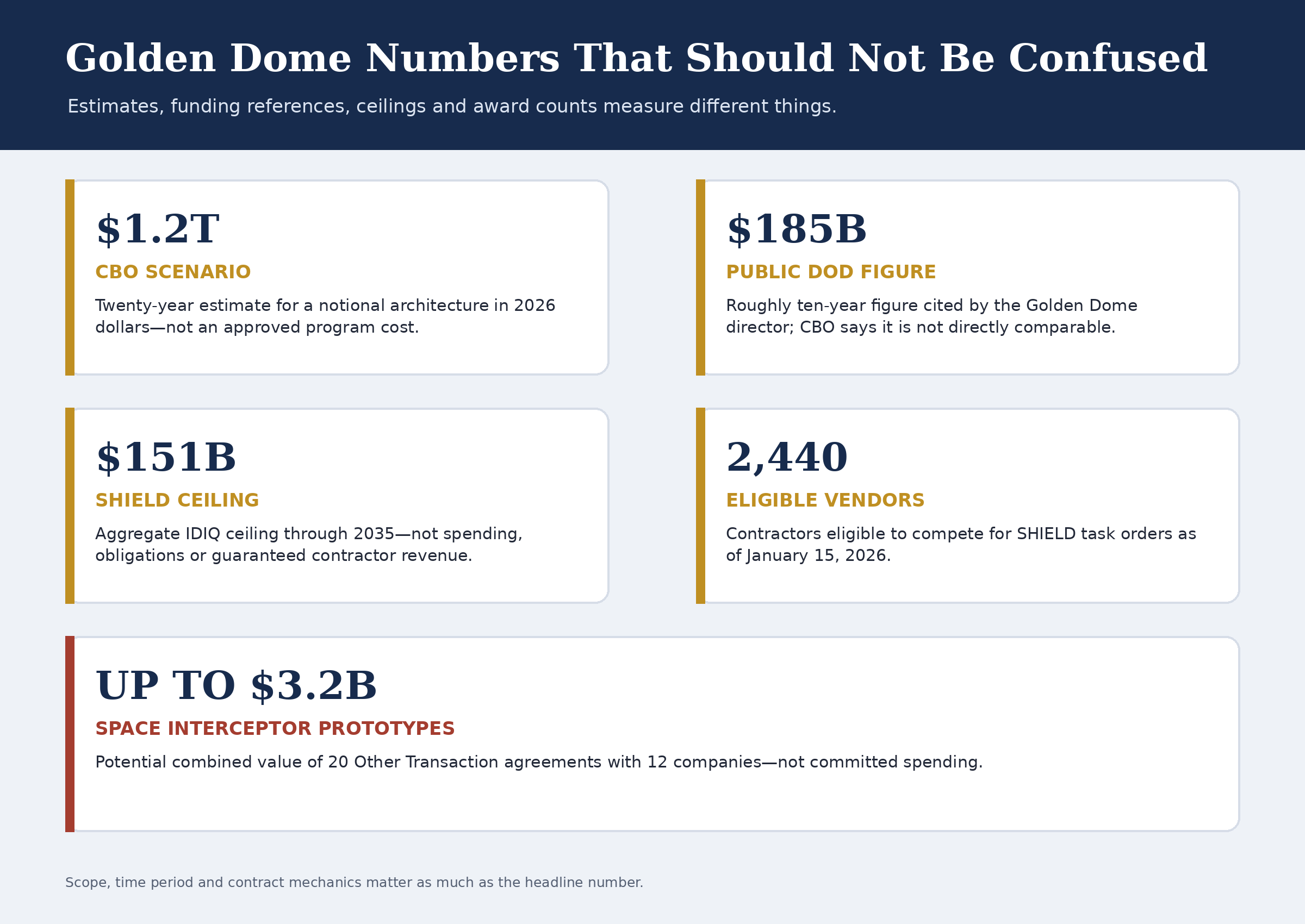
- CBO’s $1.2 trillion figure is a 20-year estimate for a notional architecture, not the price of an approved Golden Dome program of record.
- The $151 billion SHIELD figure is an aggregate IDIQ ceiling through 2035. It is not money already spent, and a place on the vehicle does not guarantee a task order or revenue.
- As of January 15, 2026, 2,440 contractors were eligible to compete for SHIELD orders. MDA has cautioned that the vendor list is not a preview of Golden Dome winners.
- Congress has documented missing budget, schedule, architecture and test information and required additional reporting. That is an oversight concern, not evidence of contractor misconduct.
- High-value evidence in a potential defense procurement fraud matter often includes pricing files, labor charges, test data, parts traceability, cybersecurity representations and milestone certifications.
What Golden Dome Is and What Its Cost Estimates Mean
The executive order calls for a next-generation homeland defense against ballistic, hypersonic and cruise missiles and other advanced aerial threats. It contemplates space-based sensors and interceptors, terminal defenses, nonkinetic capabilities and a secure supply chain. That breadth helps explain why public numbers can be easy to misread.
Related: Brown, LLC secured two of the year’s largest individual recoveries — a $950M settlement against Raytheon and $350M against Walgreens. Learn about our False Claims Act practice →
In May 2026, the Congressional Budget Office estimated that one notional nationwide architecture broadly consistent with the order could cost about $1.2 trillion over 20 years in 2026 dollars. CBO created that scenario because the Defense Department had not published enough information to price the actual objective architecture. Its model includes 7,800 low-Earth-orbit interceptors with five-year service lives; those are CBO modeling assumptions, not confirmed DoD design choices.
The Golden Dome director has separately cited approximately $185 billion over a decade. CBO cautioned that the two figures differ in scope, time period and budget categories and should not be compared as though they price the same system. The fiscal 2027 budget request also seeks $17.1 billion for the Golden Dome Fund plus related construction, but a budget request is not enacted funding or proof of future expenditures.
Congressional researchers described $24.4 billion enacted in 2025 as funding toward related integrated air-and-missile-defense efforts, while fiscal 2026 appropriators later referred to about $23 billion in mandatory Golden Dome funding. Those descriptions may not cover precisely the same funding universe. See the CRS defense primer and the fiscal 2027 budget overview.
How Golden Dome Work Is Being Contracted
The SHIELD IDIQ Vendor Pool
The Missile Defense Agency’s Scalable Homeland Innovative Enterprise Layered Defense vehicle, or SHIELD, is a multiple-award indefinite-delivery, indefinite-quantity contract. The January 15, 2026 contract announcement brought the pool to 2,440 awardees. The vehicle has a shared maximum ceiling of $151 billion through December 2035, and no money was obligated on the base awards. Funding is attached to later task orders.
Whistleblower tip: If you’ve witnessed Medicare or Medicaid billing fraud at your employer, you may qualify as a qui tam relator with a potential share of the government’s recovery. See our Medicare & Medicaid fraud practice →
A SHIELD award therefore means eligibility to compete, not that a company has received Golden Dome work, and not that it will earn any particular amount. SHIELD can also support missile-defense activities beyond Golden Dome. MDA has publicly cautioned that the roster should not be treated as a preview of which companies will receive Golden Dome production work.
Space Based Interceptor Prototype Agreements
Some early space-based-interceptor work is using Other Transaction agreements rather than conventional procurement contracts. On April 24, 2026, Space Systems Command announced 20 agreements with 12 companies, with a potential combined value of up to $3.2 billion. That figure is a maximum potential value, not committed spending.
Other Transactions can accelerate prototyping because their terms are negotiated and are not automatically governed by every Federal Acquisition Regulation, Cost Accounting Standards or certified-pricing clause that may apply to procurement contracts. The exact audit, data-rights, pricing and disclosure protections depend on the statute and agreement. In a September 2025 review, GAO found that DoD’s OTA portfolio generally could reduce insight into contractor costs and that the department lacked data needed to assess transitions and effectiveness. GAO did not make a finding of Golden Dome fraud.
Why Congress Says Golden Dome Oversight Is Incomplete
Fiscal 2026 appropriators wrote that the Defense Department had not provided complete budget justification for about $23 billion in mandatory funding, including a master deployment schedule, cost, schedule and performance metrics, and a finalized architecture with its major components. The congressional record says the missing information prevented effective assessment of resource needs and oversight of planned programs.
Congress required a comprehensive spend plan, an integrated master test plan, quarterly updates and, beginning with the fiscal 2028 request, a separate budget-justification volume. Those requirements may improve traceability across organizations and contract vehicles. They do not establish that an invoice, certification or contractor representation was false.
Procurement Fraud Red Flags in Missile Defense Work
Under the False Claims Act, knowledge can include actual knowledge, deliberate ignorance or reckless disregard. Materiality asks whether the representation had a natural tendency to influence, or was capable of influencing, a payment decision. A breach of contract, honest mistake or technical noncompliance does not automatically satisfy those elements.
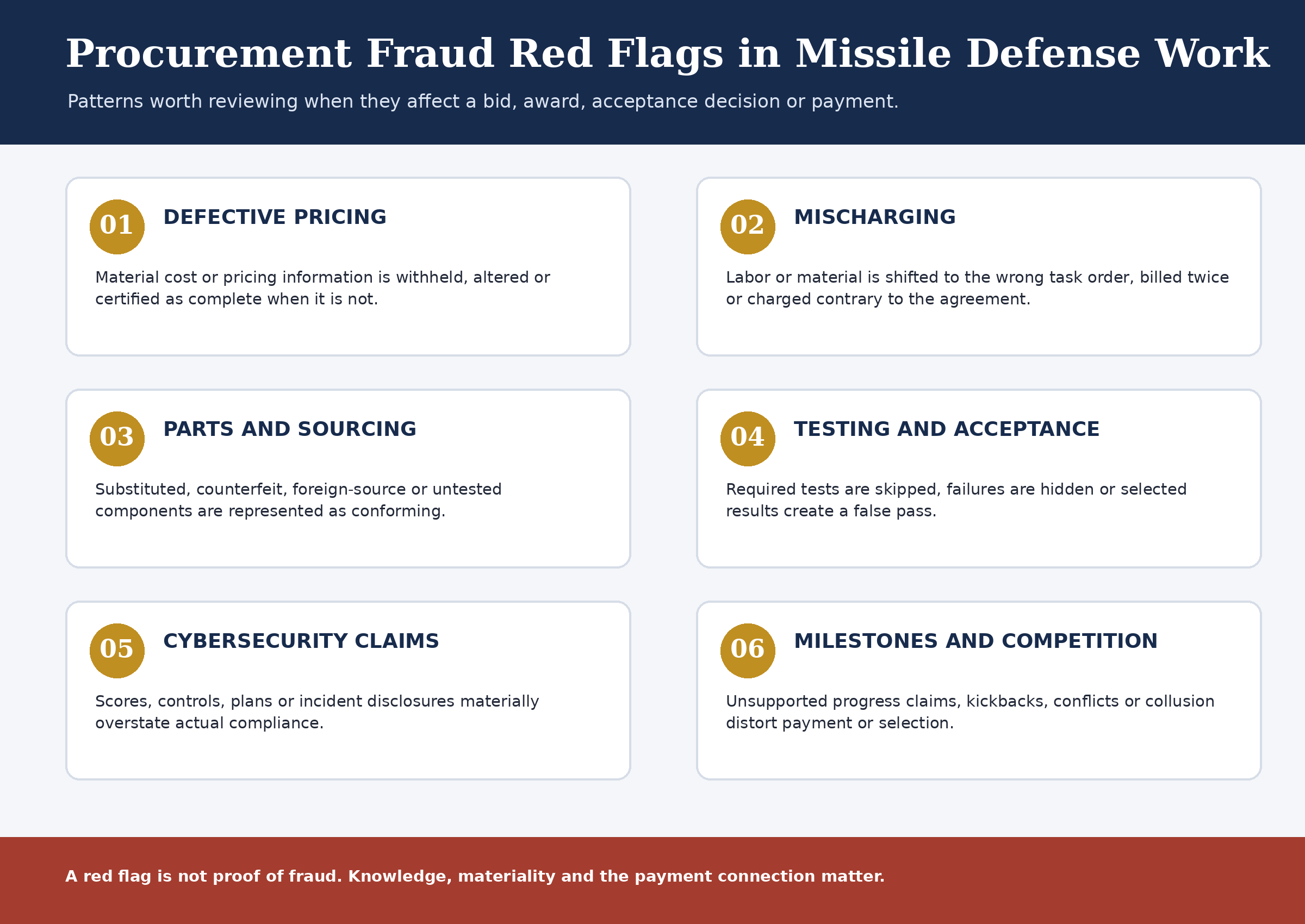
The following patterns can justify closer review when they affect a proposal, award, acceptance decision or payment. They are red flags—not conclusions about any Golden Dome contractor.
Defective Pricing and Omitted Cost Data
Risk can arise when required cost or pricing data is withheld, altered, rendered stale without disclosure or certified as current, accurate and complete when it is not. Relevant evidence may include proposal versions, supplier quotes, estimating workpapers, negotiation memoranda, cost models and internal discussions about information provided to the government.
Cost Mischarging Cross Charging and Double Billing
Potential defense contractor overbilling includes shifting labor to the wrong task order, charging the same work to multiple vehicles, billing an indirect cost again as a direct cost or submitting invoices unsupported by timekeeping and purchasing records. Investigators often compare time entries, job-cost ledgers, journal entries, invoices and task-order statements of work.
Nonconforming or Substituted Parts
A parts issue may become fraud when a contractor knowingly supplies untested, counterfeit, foreign-source or otherwise nonconforming components while representing that they satisfy military specifications, testing requirements, country-of-origin rules or contract terms. Certificates of conformance, inspection records, purchase orders, supplier communications and traceability data may be central.
False Testing and Acceptance Records
Missile-defense development depends on staged tests and technical reviews. Warning signs include skipped test steps, changed pass criteria, suppressed failures, selective presentation of results or milestone invoices submitted before required work is complete. Raw telemetry, test scripts, configuration histories, deviation requests and acceptance records can distinguish a disclosed engineering problem from a materially false representation.
Cybersecurity Misrepresentations
Cybersecurity exposure may arise when a contractor knowingly overstates required control implementation, submits an inaccurate assessment score, conceals a reportable incident or bills while material security representations are false. The legal analysis is contract-specific and turns on what the government required and whether the representation mattered to award or payment.
Kickbacks Conflicts and Bid Coordination
Kickbacks, undisclosed conflicts, bid rigging, price fixing and market allocation can distort competition. Some conduct is primarily criminal or antitrust-related and is not automatically an FCA claim. Communications among bidders, unusual subcontracting arrangements, sham competition and payments to decision-makers may warrant review by the appropriate authority.
What Comparable Defense Fraud Cases Show
Raytheon agreed in 2024 to a $428 million civil False Claims Act resolution involving alleged defective pricing on defense contracts. DOJ described it as the second-largest government procurement-fraud recovery under the Act. The matter illustrates why certified pricing data, internal estimates and information available during negotiations can be decisive.
The executed settlement agreement identifies Brown, LLC lawyers as counsel for the whistleblower in a qui tam action resolved as part of Raytheon’s $428 million False Claims Act settlement, which the Justice Department described as the second-largest government procurement-fraud recovery under the Act.
DRI Relays agreed in 2025 to pay $15.7 million to resolve allegations that it sold electrical relays for military systems without required testing and falsely certified compliance. The settlement resolved disputed allegations, and there was no determination of liability.
Speak with the Lawyers at Brown, LLC Today!
Over $1 billion in aggregate judgments and settlements for our clients in state and federal courts. We fight for maximum damages and results.
MORSECORP agreed in 2025 to pay $4.6 million to resolve allegations that it submitted a false cybersecurity assessment score and failed to implement required controls while performing defense contracts. The example shows how cybersecurity representations can become payment-related FCA issues when they are material.
These cases involved other defense programs. They do not show misconduct by Golden Dome contractors; they identify recurring theories investigators and compliance teams examine.
What Evidence May Matter
The most useful evidence usually connects a representation to an award, acceptance or payment decision and shows what decision-makers knew at the time. Depending on the issue, that may include:
- Proposal drafts, certified cost or pricing data, supplier quotes and negotiation files
- Timecards, job-cost reports, charging instructions, invoices and accounting adjustments
- Purchase orders, bills of material, serial-number traceability and certificates of conformance
- Test plans, raw data, configuration records, failure reports, waivers and acceptance documents
- System security plans, plans of action and milestones, assessment scores and incident records
- Task-order milestones, progress certifications, inspection approvals and payment requests
Handle sensitive information lawfully. Do not access systems beyond your authorization or remove, copy or transmit classified, controlled unclassified, export-controlled, privileged or proprietary material through unapproved channels. The DoD OIG maintains separate instructions for classified complaints.
When a Contract Problem May Become a False Claims Act Case
The FCA is not limited to conventional FAR-based procurement contracts. A claim tied to an Other Transaction, task order, subcontract or other federally funded arrangement may still fall within the statute when its elements are met. The label on the acquisition vehicle does not immunize a knowingly false request for government money, but applicability and materiality are fact-specific.
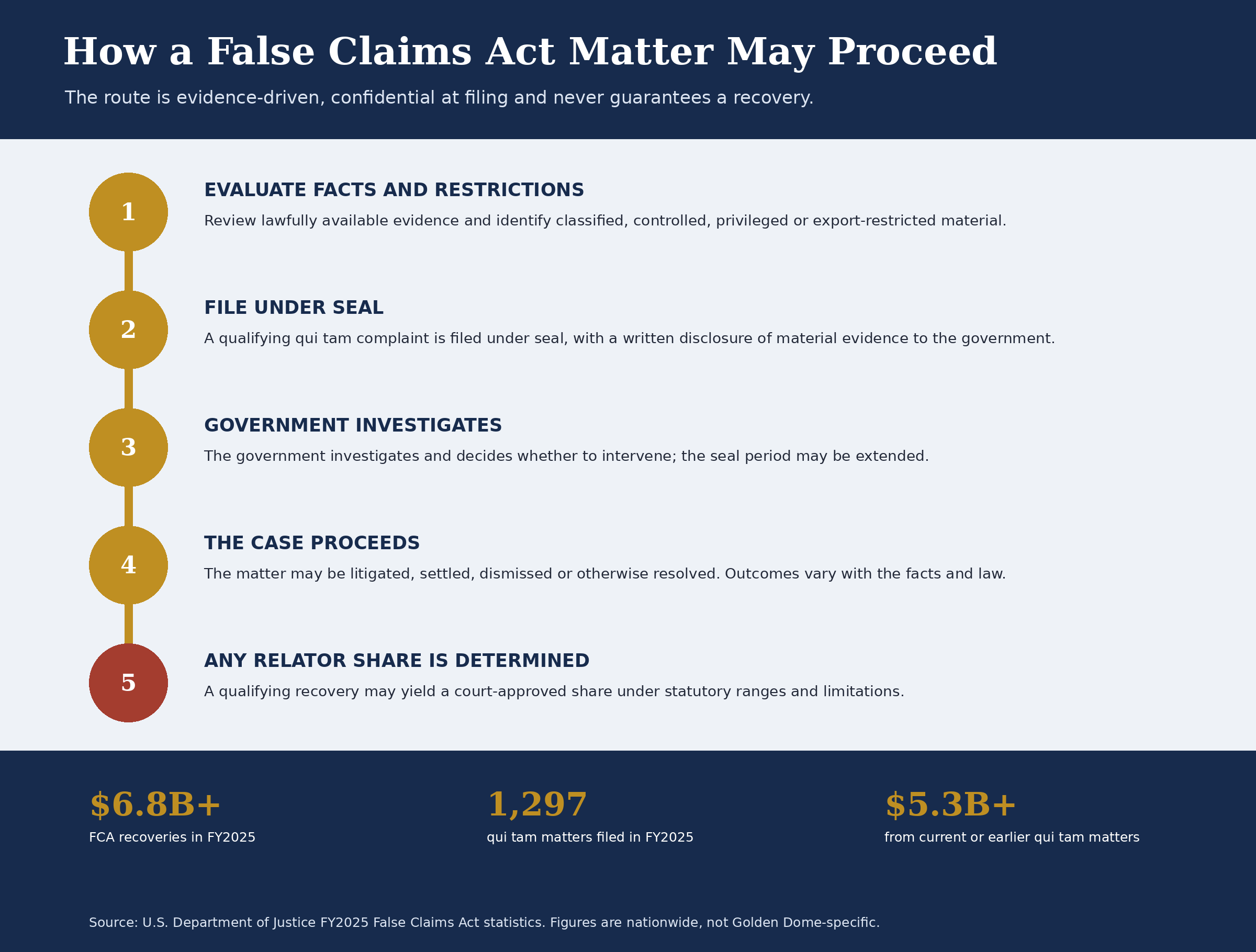
A private person with qualifying information may file a qui tam complaint under seal and provide the government a written disclosure of material evidence. DOJ’s fiscal 2025 statistics reported more than $6.8 billion in FCA recoveries, 1,297 new qui tam filings and more than $5.3 billion recovered from current or earlier whistleblower-initiated matters. Those figures are nationwide and are not Golden Dome-specific.
If the government intervenes, a qualifying relator generally may receive 15 to 25 percent of the recovery; if it declines and the relator proceeds successfully, the general range is 25 to 30 percent. Courts apply statutory limitations, and no award is guaranteed. The statute also contains an anti-retaliation provision for specified lawful efforts to stop FCA violations, but coverage depends on the facts.
How to Report Suspected Golden Dome Fraud
Reporting suspected Golden Dome fraud is not the same as publicly accusing a contractor of wrongdoing. A useful report identifies the contract or task order, the representation believed to be false, who knew the relevant facts and how the representation affected an award, acceptance decision or government payment.
Employees and contractors with firsthand evidence may be considering blowing the whistle on suspected Golden Dome contract fraud. The appropriate route depends on the conduct, the agency, the information’s classification and whether the person is considering a qui tam filing.
- Internal compliance or the contracting chain may be appropriate when the process is trustworthy and the report can be made without compromising evidence or safety.
- MDA’s See It Report It portal accepts reports involving MDA personnel or operations and warns users not to submit classified information through the public tool.
- The DoD Office of Inspector General Hotline accepts allegations including procurement fraud, counterfeit or substandard parts, and cost or labor mischarging.
- The Justice Department and the FBI receive fraud reports. Suspected bid rigging, price fixing or market allocation can also be reported to the Procurement Collusion Strike Force.
- A person considering a qui tam case may consult experienced counsel before copying, removing or transmitting records. A sealed filing has procedural requirements, and public disclosure can create avoidable risks.
Brown, LLC’s defense contractor fraud resource provides additional background on common schemes and whistleblower considerations. This article provides general information and is not legal advice.
Frequently Asked Questions
Has Fraud Been Found in Golden Dome Contracts
The official public sources reviewed for this article did not identify a publicly announced Golden Dome-specific FCA settlement, judgment or unsealed case as of September 17, 2026. Because qui tam complaints begin under seal, that statement cannot establish that no complaint has been filed.
Is the SHIELD 151 Billion Dollar Ceiling Money Already Spent
No. It is the aggregate maximum ceiling for the IDIQ vehicle through December 2035. No funds were obligated on the base awards; money is tied to later task orders.
Does a SHIELD Award Mean a Company Received Golden Dome Work
No. A base award makes a contractor eligible to compete. It does not guarantee a task order, Golden Dome work or revenue, and SHIELD may support other missile-defense requirements.
Can an Other Transaction Agreement Support an FCA Case
Potentially. The FCA can reach qualifying false claims for federal money even when the underlying vehicle is not a conventional procurement contract. The agreement’s terms, the representation, knowledge, materiality and payment connection all matter.
What Evidence Can Support a Defense Contractor Fraud Case
Evidence may include pricing data, invoices, time records, parts traceability, test files, cybersecurity submissions, internal instructions and milestone certifications. The strongest evidence often shows both what the government was told and what responsible personnel knew.
How Do I Report Suspected Golden Dome Fraud
Possible channels include MDA’s reporting portal, the DoD Office of Inspector General, the Justice Department or the FBI. Suspected fraud involving an MDA SHIELD task order may also be evaluated under the False Claims Act when a knowingly false and material representation is tied to federal payment. Use a secure channel appropriate to the information’s classification, and do not submit classified material through an unclassified form.
What Should a Cleared Employee Do With Classified Information
Do not use an unclassified web form, personal email or unauthorized device. Follow approved security procedures and the DoD OIG’s classified-complaint instructions, and consider advice from counsel familiar with clearance and whistleblower issues.
Can a Defense Contractor Retaliate Against a Whistleblower
Federal laws can protect certain employees, contractors and agents who undertake specified lawful efforts concerning suspected fraud. Coverage and remedies are fact-specific, so contemporaneous records of the report and any adverse action may matter.
How Is a False Claims Act Relator Share Calculated
The general statutory range is 15 to 25 percent when the government intervenes and 25 to 30 percent when it declines and the relator proceeds successfully, subject to judicial determination and statutory reductions. A filing does not guarantee a recovery or award.
Primary Sources
- The Iron Dome for America executive order — The White House, January 27, 2025
- Costs of Implementing Golden Dome — Congressional Budget Office, May 12, 2026
- Fiscal 2026 defense appropriations explanatory material — Congressional Record, January 22, 2026
- Contracts for January 15, 2026 — Department of Defense, January 15, 2026