Skip to main content

New Jersey Prevailing Wage Claims: Private Right of Action and False Claims Act Cases

Table of Contents
Key Takeaways
- New Jersey public-works workers can sue directly for unpaid prevailing wages under N.J.S.A. 34:11-56.40, recovering back wages, costs, and reasonable attorneys’ fees, with a six-year lookback under Troise v. Extel Communications.
- An isolated pay error is usually just a wage claim. A pattern of underpayment paired with false certified payroll or false compliance certifications can become a New Jersey or federal False Claims Act case.
- New Jersey now treats knowing certified-payroll falsification as a fourth-degree crime on top of civil exposure, under 2026 legislation signed by Governor Murphy.
- The Ranco Construction settlement ($1.5 million) shows how the federal FCA, the New Jersey FCA, Davis-Bacon, and the NJ Prevailing Wage Act can combine in a single public-works wage fraud case.
- A whistleblower in a viable FCA case may recover 15% to 30% of the government’s recovery, depending on whether the government intervenes.
Short Answer
New Jersey public-works workers have a direct private remedy when they are paid less than the prevailing wage required by the New Jersey Prevailing Wage Act. N.J.S.A. 34:11-56.40 allows an underpaid worker to recover the full prevailing wage owed, less what was actually paid, plus costs and reasonable attorney’s fees as allowed by the court. The same section also allows a worker to maintain the action for similarly situated workers.
That is the worker-side case. A larger and more intentional scheme can be different. If a contractor or subcontractor knowingly underpays workers while submitting false certified payroll records, false contract certifications, or invoices on public projects funded by New Jersey, local government, or the federal government, the case may also implicate the New Jersey False Claims Act, the federal False Claims Act, or both.
Related: Brown, LLC secured two of the year’s largest individual recoveries — a $950M settlement against Raytheon and $350M against Walgreens. Learn about our False Claims Act practice →
The key distinction is this: underpayment is usually a prevailing wage case. Knowing underpayment plus false records or false certifications to obtain public money can become a government-fraud case.
Who This Article Is For
This guide is for laborers, electricians, carpenters, operating engineers, painters, plumbers, HVAC workers, roofers, truck drivers, apprentices, payroll administrators, foremen, project managers, compliance staff, public-entity personnel, and subcontractor employees who suspect that a public-works contractor is not paying the legally required prevailing wage.
It is also for insiders who know the public records do not match reality: certified payroll says one thing, but pay stubs, bank deposits, job logs, text messages, and worker testimony say another.
What New Jersey Prevailing Wage Law Covers
The New Jersey Prevailing Wage Act establishes prevailing wage levels for workers engaged in public works projects. NJDOL explains that covered workers must receive the appropriate craft prevailing wage rate determined by the Commissioner of Labor and Workforce Development, and that rates vary by county/locality and by type of work.
NJDOL describes covered public works as construction, reconstruction, demolition, alteration, repair, or maintenance work, including painting and decorating, done under contract and paid for in whole or in part out of public-body funds, except certain rehabilitation-program work. NJDOL currently lists coverage thresholds of $19,375 or more for contracts awarded directly by municipal government, and $2,000 for all other public entities, including municipal utility authorities and boards of education.
Speak with the Lawyers at Brown, LLC Today!
Over $1 billion in aggregate judgments and settlements for our clients in state and federal courts. We fight for maximum damages and results.
The practical lesson is simple: do not assume a project is private just because a private contractor is running the jobsite. If public money funds the project in whole or in part, or a public entity is the contracting body, prevailing wage issues may exist.
The Private Right of Action Under N.J.S.A. 34:11-56.40
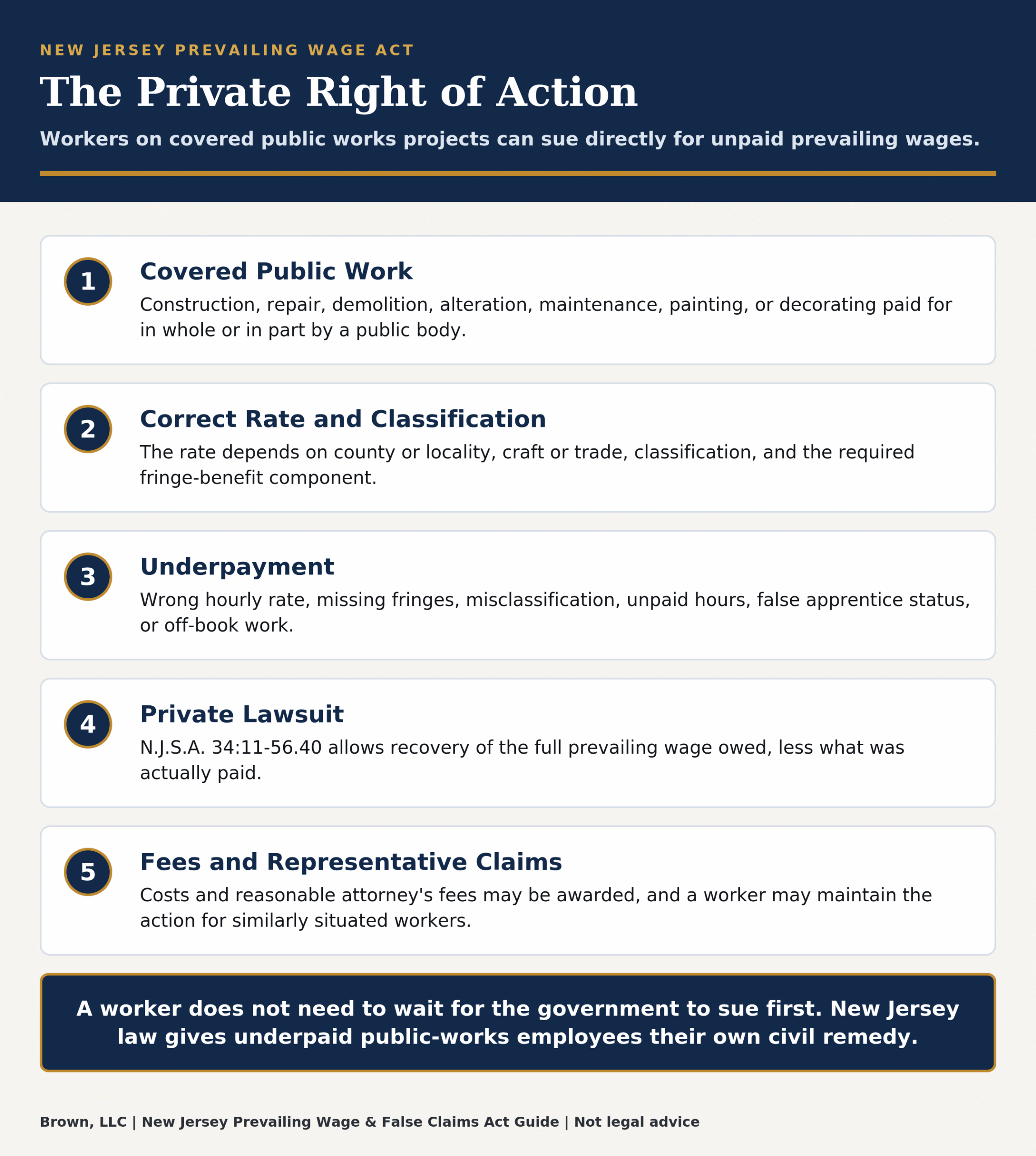
New Jersey law gives underpaid public-works workers their own civil action. The statute says that if a workman is paid less than the prevailing wage to which the worker is entitled, the worker may recover in a civil action the full amount of the prevailing wage less what was actually paid, together with costs and reasonable attorney’s fees as allowed by the court. It also states that an agreement to work for less than the prevailing wage is no defense.
That last point matters. A contractor cannot avoid liability by saying the worker agreed to the lower rate, accepted cash, signed a form, or knew what was happening. Prevailing wage is not just a private bargain between employer and worker. It is a statutory requirement attached to public work.
New Jersey courts have held that a worker has six years to bring a private claim for additional wages under the Prevailing Wage Act. In Troise v. Extel Communications, Inc., the New Jersey Supreme Court affirmed that six-year limitations rule.
Certified Payroll Records Are the Pressure Point
Prevailing wage cases often turn on certified payroll records. NJDOL’s statute and regulations require contractors and subcontractors to keep accurate records showing each worker’s name, craft or trade, and actual hourly wage rate. The certified payroll records must be submitted through the NJDOL online process and to the public body each payroll period within 10 days after wages are paid.
Certified payroll is where many cases become serious. If the certified payroll says workers were paid the correct prevailing wage, but the workers were actually paid less, the case may no longer be only a wage dispute. It may involve false records submitted to a public body or the State.
New Jersey has also moved toward stronger enforcement. In January 2026, the Senate Democrats announced that Governor Murphy signed legislation allowing criminal penalties where employers knowingly falsify payroll records or make false statements on employee contracts in violation of prevailing wage law; the announcement describes the offense as a fourth-degree crime with potential 18-month imprisonment, a $10,000 fine, or both.
Common New Jersey Prevailing Wage Fraud Patterns
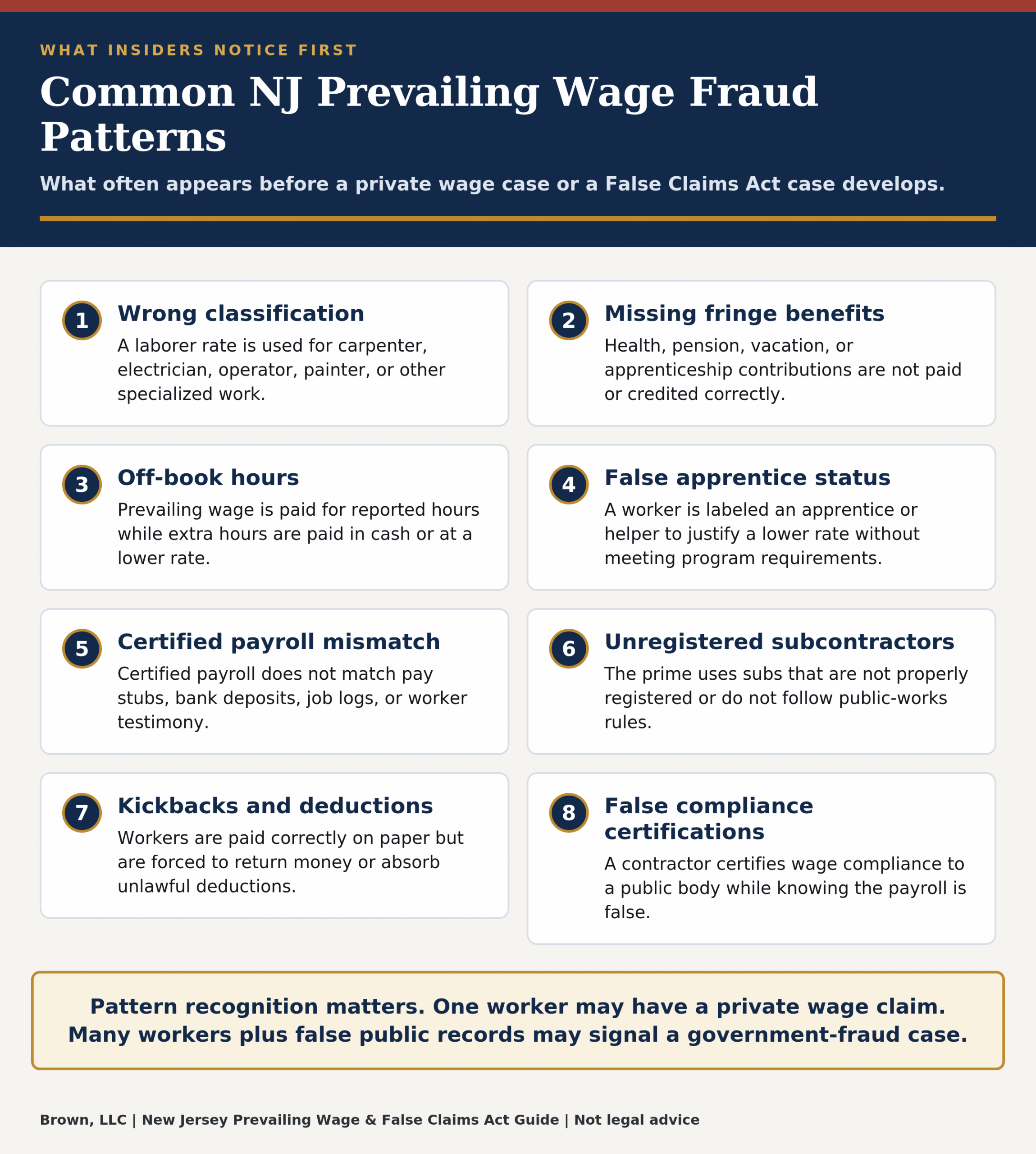
Prevailing wage underpayment does not always look dramatic. It often appears as a set of small payroll decisions repeated across workers and projects. The most common patterns include:
- Using a lower craft classification than the work actually performed.
- Paying the hourly wage but not the required fringe-benefit component.
- Reporting eight hours on certified payroll while workers actually worked ten or twelve.
- Paying the correct rate by check and then requiring a cash kickback.
- Calling workers apprentices, helpers, laborers, or independent contractors to avoid a higher rate.
- Using unregistered subcontractors or lower-tier subs to distance the prime from wage violations.
- Keeping one payroll record for the public body and another record internally.
- Submitting certified payroll records that do not match pay stubs, bank deposits, job logs, or worker testimony.
A one-off mistake may be fixable through a wage claim. A pattern across multiple workers, multiple projects, and multiple payroll submissions may point to something more intentional.
When a Prevailing Wage Case Can Become a False Claims Act Case

The False Claims Act is not triggered by every underpayment. It is triggered by knowingly false claims or false statements that are material to government payment or reimbursement. The federal FCA imposes liability on a person who knowingly presents a false or fraudulent claim for payment, or knowingly makes or uses a false record or statement material to a false claim; it also provides for treble damages and civil penalties.
The New Jersey False Claims Act uses similar concepts. It applies to false or fraudulent claims for payment or approval, false records or statements material to false claims, and reverse false claims. The statute defines “knowing” to include actual knowledge, deliberate ignorance, or reckless disregard, and defines “material” as having a natural tendency to influence, or being capable of influencing, payment or receipt of money or property.
Speak with the Lawyers at Brown, LLC Today!
Over $1 billion in aggregate judgments and settlements for our clients in state and federal courts. We fight for maximum damages and results.
In the prevailing wage context, a False Claims Act theory may arise when a contractor seeks payment from the government while falsely representing that it paid required wages. The theory is strongest where the public contract required prevailing wage compliance, the contractor certified compliance, certified payroll records were false, and public money was paid based on those representations.
Think of the difference this way:
| Scenario | Likely Legal Frame |
| One worker believes the rate was wrong on one paycheck. | Private wage claim or NJDOL issue. |
| Several workers are misclassified across a public project. | Private action for unpaid prevailing wages; possible class/representative claim. |
| Certified payroll says workers received prevailing wages, but actual pay records show less. | Private wage claim plus potential false-record evidence. |
| Contractor repeatedly submits false certified payroll and invoices to a public body. | Potential New Jersey False Claims Act case if State/local funds are involved. |
| Contractor underpays workers on federally funded projects and falsely certifies compliance. | Potential federal False Claims Act case, often tied to Davis-Bacon or related prevailing wage requirements. |
| Projects involve federal, state, and local funding with false payroll certifications. | Potential federal FCA, New Jersey FCA, and Prevailing Wage Act claims in the same matter. |
New Jersey False Claims Act vs. Federal False Claims Act

A New Jersey False Claims Act case generally concerns false claims involving State money, property, services, or programs. The statute’s definition of “claim” includes requests or demands for money or property made to the State, or to a contractor, grantee, or recipient where State money or reimbursement is involved.
The New Jersey False Claims Act also allows a private person to bring an action for the person and for the State, in the name of the State of New Jersey. The complaint remains under seal for at least 60 days and is not served on the defendant until the court orders service. The relator must serve the Attorney General with the complaint and substantially all material evidence and information.
If the New Jersey Attorney General proceeds with and prevails in the action, the relator generally receives 15% to 25% of proceeds depending on contribution. If the Attorney General does not proceed, the relator generally receives 25% to 30% of proceeds, subject to statutory limitations, including reductions for those who planned and initiated the violation and denial if the relator is convicted of criminal conduct arising from that role.
The federal False Claims Act is similar but applies to fraud involving federal money. Under the federal FCA, a relator generally receives 15% to 25% if the government intervenes and 25% to 30% if the government declines and the relator successfully pursues the case.
Real-World Example: Ranco Construction

The Ranco Construction settlement shows how a prevailing wage case can become a False Claims Act case. In 2018, DOJ announced that Ranco Construction, a Burlington County construction company, would pay $1.5 million to resolve allegations that it contracted for public construction jobs while paying workers lower hourly wages than required under state and federal law. DOJ reported that the investigation began after a former Ranco employee filed a qui tam whistleblower lawsuit.
According to DOJ, the relator alleged that Ranco certified to the government that employees were paid wage rates required by federal and New Jersey prevailing wage laws, but systematically underpaid workers and falsified payroll records to disguise the conduct. DOJ said the relator would receive more than $150,000 as his statutory share and to resolve employment-based claims.
Whistleblower tip: If you’ve witnessed Medicare or Medicaid billing fraud at your employer, you may qualify as a qui tam relator with a potential share of the government’s recovery. See our Medicare & Medicaid fraud practice →
The settlement agreement itself states that the United States and New Jersey contended they had claims under the federal False Claims Act, the Davis-Bacon and Related Acts, the New Jersey False Claims Act, and the New Jersey Prevailing Wage Act arising from knowing false certification of compliance and failure to comply with prevailing wage laws on contracts with the Department of Defense, New Jersey, or local government entities funded in whole or in part with federal and/or state funds.
Ranco is a useful roadmap. It involved the worker-rights issue, the payroll-record issue, the public-contract issue, the false-certification issue, and the whistleblower-retaliation issue. Those are the ingredients that can move a case from unpaid wages to public-money fraud.
What Makes a Prevailing Wage FCA Case Strong?
A strong prevailing wage False Claims Act case usually has five elements in practical terms:
- Covered public contracts funded by New Jersey, local public bodies, federal agencies, or mixed public funds.
- A clear prevailing wage obligation in the contract, law, wage determination, or bid documents.
- A systematic underpayment pattern affecting multiple workers, classifications, payroll periods, or projects.
- False certified payroll records, false compliance certifications, false invoices, false registration statements, or false records submitted to obtain payment.
- Evidence that management knew, deliberately ignored, or recklessly disregarded the truth.
The strongest cases are not built on “the company was cheap.” They are built on records showing that the company told the government it was doing one thing while doing something else.
What Workers and Insiders Should Preserve

Before calling counsel, prepare a factual map. Do not hack systems, destroy records, or access files outside your normal authority. Useful information often includes:
- Project name, public body, job location, prime contractor, subcontractors, and project dates.
- Your trade, craft, classification, duties, and whether you were called an apprentice, helper, laborer, or independent contractor.
- Pay stubs, bank deposits, W-2s, 1099s, union or benefit records, and fringe-benefit information.
- Work schedules, job logs, daily reports, photographs, timecards, texts, dispatch records, and foreman instructions.
- Certified payroll records if you lawfully have them or know where they are.
- Bid documents, wage determinations, contract clauses, subcontract flow-down provisions, and registration records if accessible.
- Names of coworkers, payroll staff, foremen, project managers, or public-entity personnel who can corroborate what happened.
The goal is not to take everything. The goal is to give counsel a clear way to compare reality against what the contractor told the public body.
What Not to Do
Do not assume that more documents are always better. Bad evidence handling can damage a good case. Do not alter payroll records, secretly change files, take privileged material, remove restricted documents, impersonate another user, hack systems, or confront management without advice.
Also do not wait too long. Private wage claims have time limits, False Claims Act cases can be affected by first-to-file rules and government investigations, and public works projects close out. Early legal review is often the difference between a clean case and a messy story.
Retaliation and Jobsite Blowback
Prevailing wage workers often fear blacklisting, layoff, reassignment, reduction in hours, threats, or being labeled a troublemaker. If the issue may also involve false public certifications, retaliation may implicate the False Claims Act, the New Jersey Conscientious Employee Protection Act, wage laws, or other remedies depending on the facts.
The timing matters. If you complain internally before speaking with counsel, the contractor may create a performance paper trail, move you off the job, or pressure coworkers. Sometimes internal reporting is appropriate. Sometimes it is strategically dangerous. Talk to counsel before assuming the employee handbook is your legal strategy.
Why Brown, LLC Looks at These Cases Through Two Lenses
Brown, LLC evaluates New Jersey prevailing wage matters through two related but different lenses. First: are workers owed money under the New Jersey Prevailing Wage Act? Second: did the contractor also defraud a public body by submitting false certified payroll records, false compliance certifications, or false invoices?
That distinction matters because a single worker’s underpayment may be a private wage case, while a systematic public-works payroll scheme may support a representative wage action, NJDOL involvement, a New Jersey False Claims Act case, a federal False Claims Act case, or a combined strategy. A focused whistleblower firm should not force every case into the same box. It should determine whether the case is a wage recovery matter, a retaliation matter, a public-contract fraud matter, or all three.
For potential whistleblowers, Brown, LLC focuses on proof: certified payroll, actual pay records, wage determinations, project funding, contract certifications, management knowledge, affected workers, and the public-payment path. The key question is not only “were workers underpaid?” It is also “what did the contractor tell the government to get paid?”
Practical Examples
Example 1: The classification case
A worker performs electrician work on a school district project but is paid a lower laborer rate. If the issue affects one worker and appears isolated, the case may be a private prevailing wage claim. If certified payroll lists many electricians as laborers and the contractor repeatedly bills the public body, the case may require FCA review.
Example 2: The missing fringe-benefit case
A contractor pays the base hourly rate but fails to pay the required fringe-benefit component. If payroll records disclose the shortfall, it may be a wage claim. If certified payroll falsely reports full fringe compliance, the false record may become important evidence.
Example 3: The cash kickback case
Workers receive checks showing prevailing wage compliance but are required to return cash to a supervisor. That can be powerful because the paperwork appears compliant while the actual economic reality is not. The evidence question becomes whether the kickbacks can be proven through witnesses, messages, deposits, surveillance, or admissions.
Example 4: The federal/state-funded project
A contractor performs work on a project funded by both a federal agency and a New Jersey public body. The contractor certifies compliance with federal Davis-Bacon requirements and New Jersey prevailing wage requirements but pays workers less and falsifies payroll. That fact pattern may justify evaluating both federal and New Jersey False Claims Act claims.
FAQ
Can I sue privately for unpaid prevailing wages in New Jersey?
Yes. N.J.S.A. 34:11-56.40 gives an underpaid worker a civil action to recover the full prevailing wage owed less what was actually paid, plus costs and reasonable attorney’s fees as allowed by the court. The statute also allows a worker to maintain the action for similarly situated workers.
Does every NJ prevailing wage violation create a False Claims Act case?
No. A payroll mistake or isolated underpayment may be a wage claim without being a False Claims Act case. FCA exposure usually requires a knowingly false claim, false record, or false statement material to government payment.
What is the most important evidence in a prevailing wage FCA case?
The strongest evidence usually compares actual pay and job duties against certified payroll records, wage determinations, contract certifications, invoices, and public-payment records. The mismatch between what happened and what was certified is often the core of the case.
Can a subcontractor’s underpayment create liability for a prime contractor?
Possibly. The analysis depends on contract language, flow-down obligations, registration rules, knowledge, control, payment practices, and what the prime certified to the public body. Prime/subcontractor structures should be reviewed carefully.
Can I bring both a wage claim and a False Claims Act case?
Sometimes. Ranco is an example where federal and state authorities resolved claims involving the federal FCA, the New Jersey FCA, the New Jersey Prevailing Wage Act, and related employment-based claims.
Should I report to my employer first?
Not automatically. Internal reporting can help in some cases, but it can also trigger retaliation, evidence destruction, or a company narrative blaming the worker. Speak with counsel before deciding the reporting sequence.
What should I bring to a lawyer?
Bring the project name, public entity, job location, dates, trade/classification, hours worked, pay records, coworkers, supervisors, and any lawful evidence showing what workers were actually paid versus what the contractor certified.
Bottom Line
New Jersey prevailing wage law gives underpaid public-works workers a real private remedy. That alone is important. But when a contractor underpays workers while falsely certifying payroll or prevailing wage compliance to obtain public money, the case can become larger than unpaid wages. It can become a False Claims Act matter.
The best cases are built on the gap between reality and the public record: what workers did, what they were paid, what certified payroll said, what the contract required, and what the contractor submitted to get paid.
If you worked on a New Jersey public works project and believe prevailing wages were not paid, or if you have inside information about false certified payroll records on state, local, or federally funded projects, speak with counsel before confronting management, filing forms, or moving documents.
Sources
[1] NJ Department of Labor, Prevailing Wage Rates on Construction-Related Public Works Projects: https://www.nj.gov/labor/wageandhour/prevailing-rates/public-works/
[2] NJ Department of Labor, New Jersey Prevailing Wage Act and Regulations: https://www.nj.gov/labor/wageandhour/tools-resources/laws/prevailingwageact.shtml
[3] N.J.S.A. 34:11-56.40, private civil action for prevailing wages: https://law.justia.com/codes/new-jersey/title-34/section-34-11-56-40/
[4] Troise v. Extel Communications, Inc., six-year limitations period: https://law.justia.com/cases/new-jersey/supreme-court/2002/a-78-01-opn.html
[5] N.J.S.A. 2A:32C-2, NJ False Claims Act definitions: https://law.justia.com/codes/new-jersey/title-2a/section-2a-32c-2/
[6] N.J.S.A. 2A:32C-3, NJ False Claims Act liability: https://law.justia.com/codes/new-jersey/title-2a/section-2a-32c-3/
[7] N.J.S.A. 2A:32C-5, NJ False Claims Act qui tam procedure: https://law.justia.com/codes/new-jersey/title-2a/section-2a-32c-5/
[8] N.J.S.A. 2A:32C-7, NJ False Claims Act relator share: https://law.justia.com/codes/new-jersey/title-2a/section-2a-32c-7/
[9] 31 U.S.C. 3729, federal False Claims Act liability and damages: https://www.law.cornell.edu/uscode/text/31/3729
[10] 31 U.S.C. 3730, federal False Claims Act qui tam and relator share: https://www.law.cornell.edu/uscode/text/31/3730
[11] DOJ, Ranco Construction $1.5 million joint federal/state FCA settlement: https://www.justice.gov/usao-nj/pr/burlington-county-new-jersey-construction-firm-pay-15-million-resolve-joint-state-and
[12] Ranco Settlement Agreement: https://www.justice.gov/d9/press-releases/attachments/2018/05/02/ranco.settlement.pdf
[13] New Jersey Senate Democrats, 2026 prevailing wage criminal enforcement update: https://www.njsendems.org/m/newsflash/Home/Detail/1224
About the Author
Jason T. Brown is the Managing Partner of Brown, LLC, a nationally recognized whistleblower and False Claims Act firm led by a former FBI Special Agent and Legal Advisor. Brown, LLC has represented whistleblowers in nine-figure False Claims Act recoveries, including the $950 million Raytheon and $350 million Walgreens settlements, and is ranked by Lex Machina as the second most prolific False Claims Act filer in the country over a five-year span.
For a free, confidential review of a New Jersey prevailing wage or certified payroll matter, call (877) 561-0000 or contact Brown, LLC online.