Skip to main content

How Do I Report Illegal Transshipment Fraud and Receive a Whistleblower Award?

Table of Contents
Before you contact U.S. Customs and Border Protection, confront the importer, or upload documents to a government portal, determine whether the facts support a sealed False Claims Act qui tam case.
That question became urgent on August 13, 2026. described a new White House study titled The Great Transshipment Scam. The report describes Chinese-origin goods moving through more than 40 using a variety of illegal techniques, including limited assembly, finishing, repackaging, relabeling, re-invoicing, bonded warehouses, free-trade zones, and new origin documents. Under the report’s central scenario, illegal transshipment is associated with an estimated $19 billion to $26 billion in annual federal revenue losses.
The $26 billion headline needs precision. The White House calls the figure a model-based estimate under a central $75 billion annual transshipment scenario. It separately estimates tariff-revenue losses in the tens of billions, with results ranging from about $10 billion to more than $100 billion depending on the transshipment estimate and tariff differential. The report also says that legitimate production, investment, and sourcing explain some changes in trade flows.
Related: Brown, LLC secured two of the year’s largest individual recoveries — a $950M settlement against Raytheon and $350M against Walgreens. Learn about our False Claims Act practice →
The enforcement direction is far less uncertain. On the same day the White House released the report, DOJ’s Fraud Division told prosecutors to prioritize illicit transshipment schemes, country-of-origin fraud, import undervaluation, sanctions evasion, and forced-labor supply chains. Executive Order 14411 already directed tighter importer-of-record requirements, higher bonding and domestic-asset requirements, beneficial-ownership disclosure, and stronger customs penalties. CBP is developing an AI-enabled screening capability it calls “Detective Border,” a proposed analytics system that would compare declared origin, routing histories, product content, ownership, factory capacity, markings, and cargo images.
Transshipment cases are built on the gap between the paper origin and the economic reality. If you can show where the product was actually made, what little happened in the third country, who approved the new origin, and how the declaration lowered the tariff, you may have the core of a False Claims Act case — most often a reverse false claims theory under 31 U.S.C. § 3729(a)(1)(G), and frequently companion claims under §§ 3729(a)(1)(A)-(C) for false records or statements material to a false or fraudulent claim.

The $26 Billion Headline, Accurately Stated
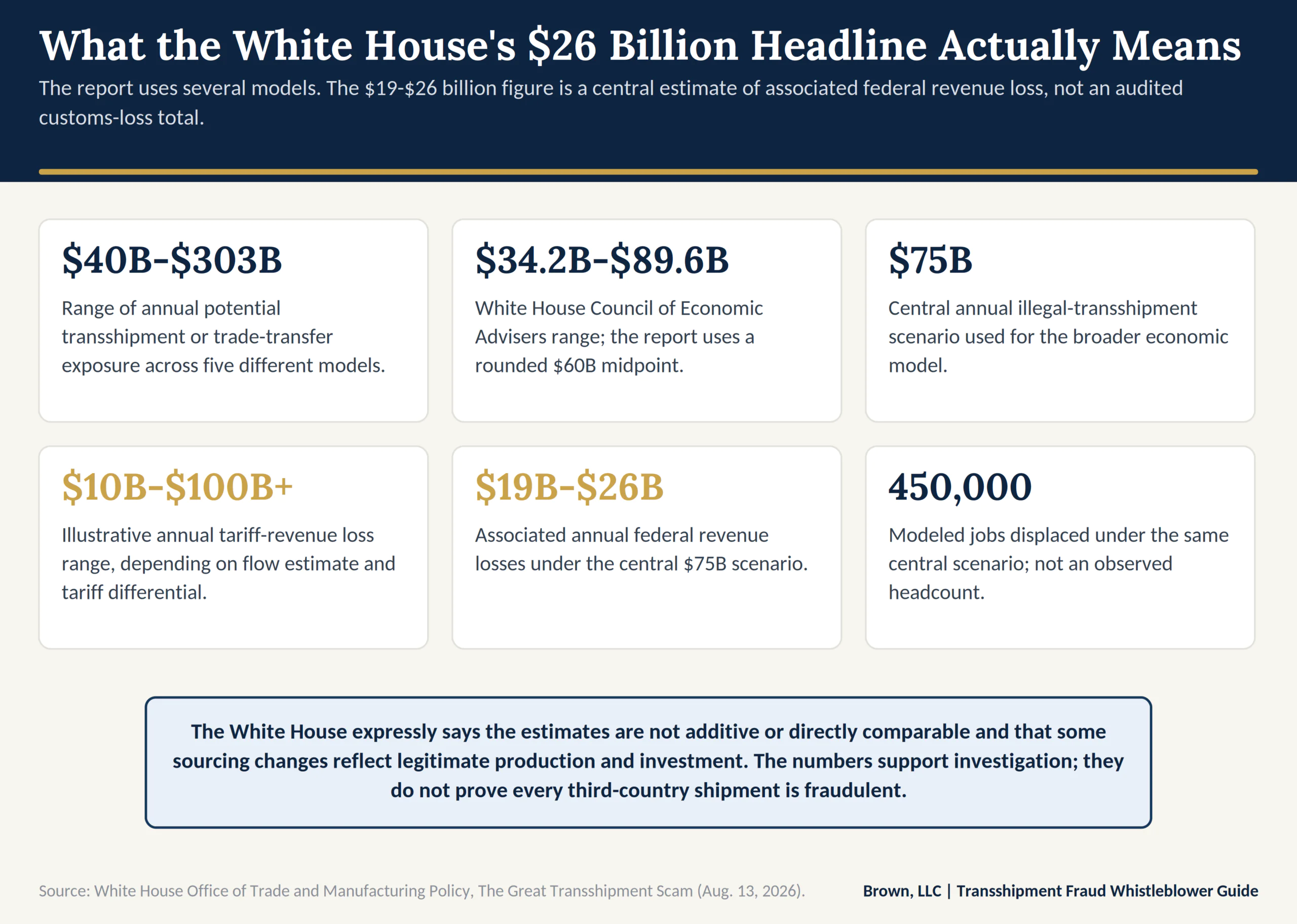
The White House report compares five government and private-sector estimates of potential transshipment or related trade-transfer exposure. The estimates range from approximately $40 billion to $303 billion annually. The methods differ and cannot be added together.
The Council of Economic Advisers estimated potential 2025 illegal transshipment between $34.2 billion and $89.6 billion. The report uses $60 billion as a rounded midpoint. Exiger developed a $75 billion central estimate. The Department of Commerce identified a $109 billion trade-transfer benchmark and separately estimated approximately $67 billion in 2025 illegal transshipment through Mexico, India, and Vietnam, with an estimated $28 billion in tariff loss.
Under the report’s central $75 billion scenario, the model estimates approximately 450,000 displaced jobs, $113 billion to $150 billion in reduced annual GDP, and $19 billion to $26 billion in associated federal revenue losses. The report expressly labels these figures as model-based estimates.
The figures become larger in products covered by antidumping or countervailing duty orders. Those duties can be stacked on top of ordinary tariffs and Section 301 duties. The report cites product categories where combined AD/CVD exposure can exceed 90%, 200%, or more.
For a whistleblower, the lesson is practical. A transshipment scheme involving only a modest volume of goods may still carry a large government-loss number when the avoided duty rate is high.
How Illegal Transshipment Works
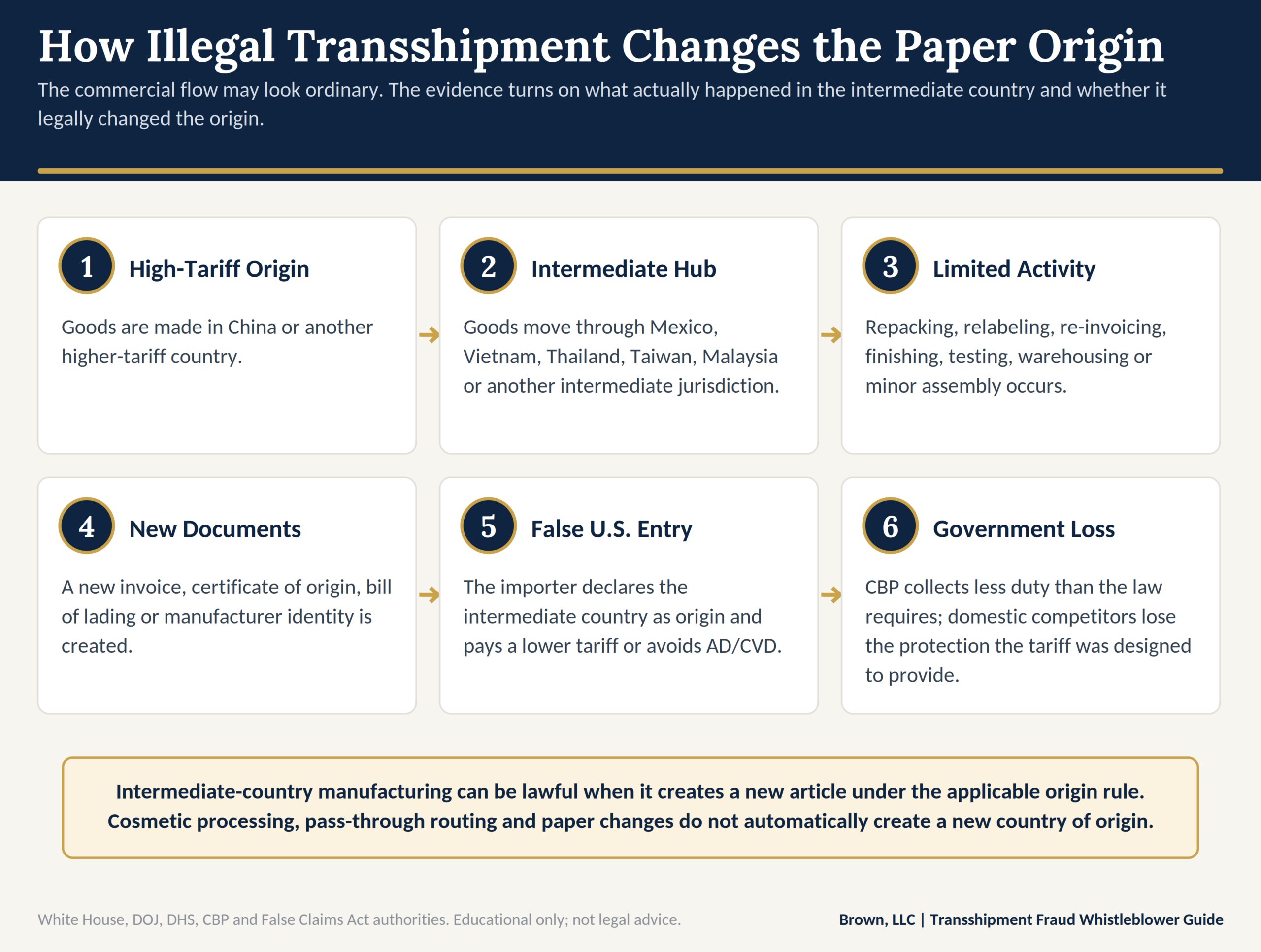
The legal issue is whether the third-country activity genuinely changed origin or merely changed the paperwork.
move through third countries every day for legitimate reasons. A company may relocate real production, add meaningful manufacturing, or perform operations that legally create a new article. Country-of-origin rules are fact-specific and can product, trade agreement, and duty program. They are applied case by case through CBP rulings and judicial decisions rather than by a single origin statute.
Illegal transshipment appears when the commercial facts do not support the origin declared to CBP. The White House report identifies both production-side and logistics-side channels:
- Light assembly, finishing, testing, packaging, labeling, or component integration;
- Routing, consolidation, warehousing, re-invoicing, relabeling, or new export documentation;
- Free-trade zones, bonded warehouses, processing corridors, and re-export centers;
- Third-country entities that lack the machinery, workforce, or capacity to make the declared product;
- A new invoice or certificate of origin that breaks the visible paper trail to China;
- A shell importer or related-party middleman inserted between the factory and the United States.
The most useful question is not simply where the container stopped. Ask what happened to the merchandise there. Did the operation create a new product with a new name, character, or use under the governing origin rule? Or did the third country add a label, box, invoice, screw, inspection stamp, or routing document while the product remained economically and legally the same?
The White House report itself warns that not all displaced Chinese trade was illegally transshipped. Genuine investment and manufacturing exist throughout the countries identified as elevated-risk jurisdictions. A risk designation is a screening signal, not a finding that every export from Mexico, Vietnam, Thailand, Malaysia, Taiwan, India, Canada, the European Union, or another named jurisdiction is fraudulent. [2]
The Administration Has Made Transshipment a Top Enforcement Priority
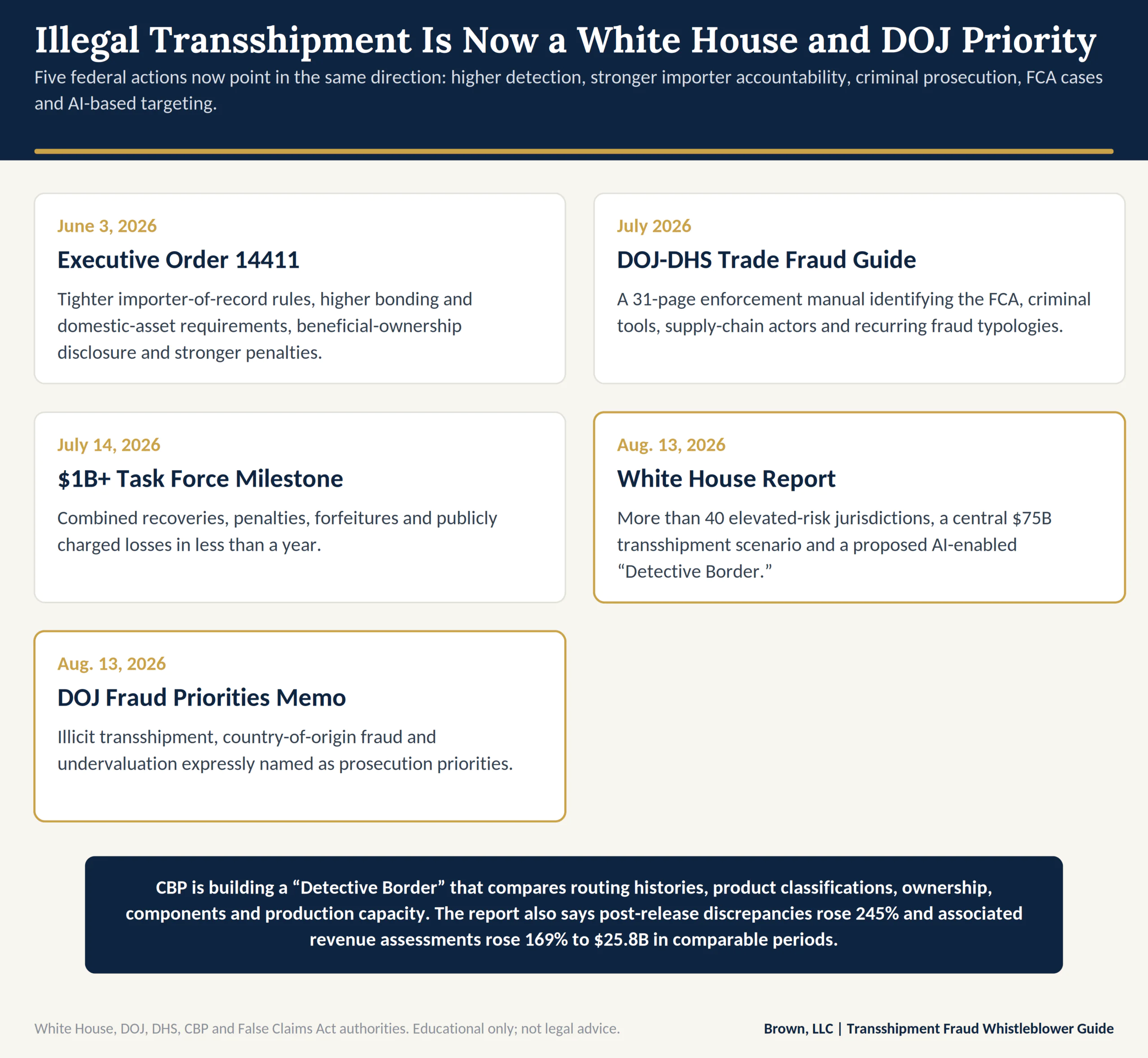
The White House, DOJ, DHS and CBP are now aligned around transshipment, origin fraud, importer accountability and data-driven detection.
The current enforcement structure did not begin with a single news story.
Executive Order 14411, signed June 3, 2026, directs DHS and CBP to tighten importer-of-record eligibility, require more domestic assets or bonding, obtain ownership and business-affiliation information, and increase the consequences of customs noncompliance. The order specifically identifies undervaluation, hidden importer information, and schemes used to avoid duties.
In July, DOJ and DHS published A Resource Guide to Trade Fraud Enforcement. The guide describes a whole-of-government structure involving the Fraud Division, Civil Division, U.S. Attorneys’ Offices, HSI, CBP, asset recovery, and other components. It identifies the False Claims Act as a core civil enforcement tool.
The Trade Fraud Task Force then announced a $1 billion milestone in combined civil and criminal recoveries, penalties, forfeitures, and publicly charged losses. CBP separately reported more than $2.1 billion in commercial trade penalties assessed in fiscal year 2026 to date.
Speak with the Lawyers at Brown, LLC Today!
Over $1 billion in aggregate judgments and settlements for our clients in state and federal courts. We fight for maximum damages and results.
The August 13 Fraud Division priorities memorandum removes any remaining doubt. Prosecutors were directed to prioritize illicit transshipment schemes, country-of-origin fraud, undervaluation designed to evade duties, sanctions evasion, and forced-labor schemes.
The White House report adds technology. Its proposed would combine anomaly detection, link analysis, factory-capacity validation, mirrored trade flows, routing histories, classifications, component content, container imagery, and ownership data. The report states that post-release discrepancies increased 245% and associated revenue assessments increased 169%, from $9.6 billion to $25.8 billion, in the comparison periods it examined.
The insider’s value is changing with the technology. AI can find the anomaly. A knowledgeable witness can explain the contract, factory, routing, invoice, product, and people behind it.
How Illegal Transshipment Becomes a False Claims Act Case
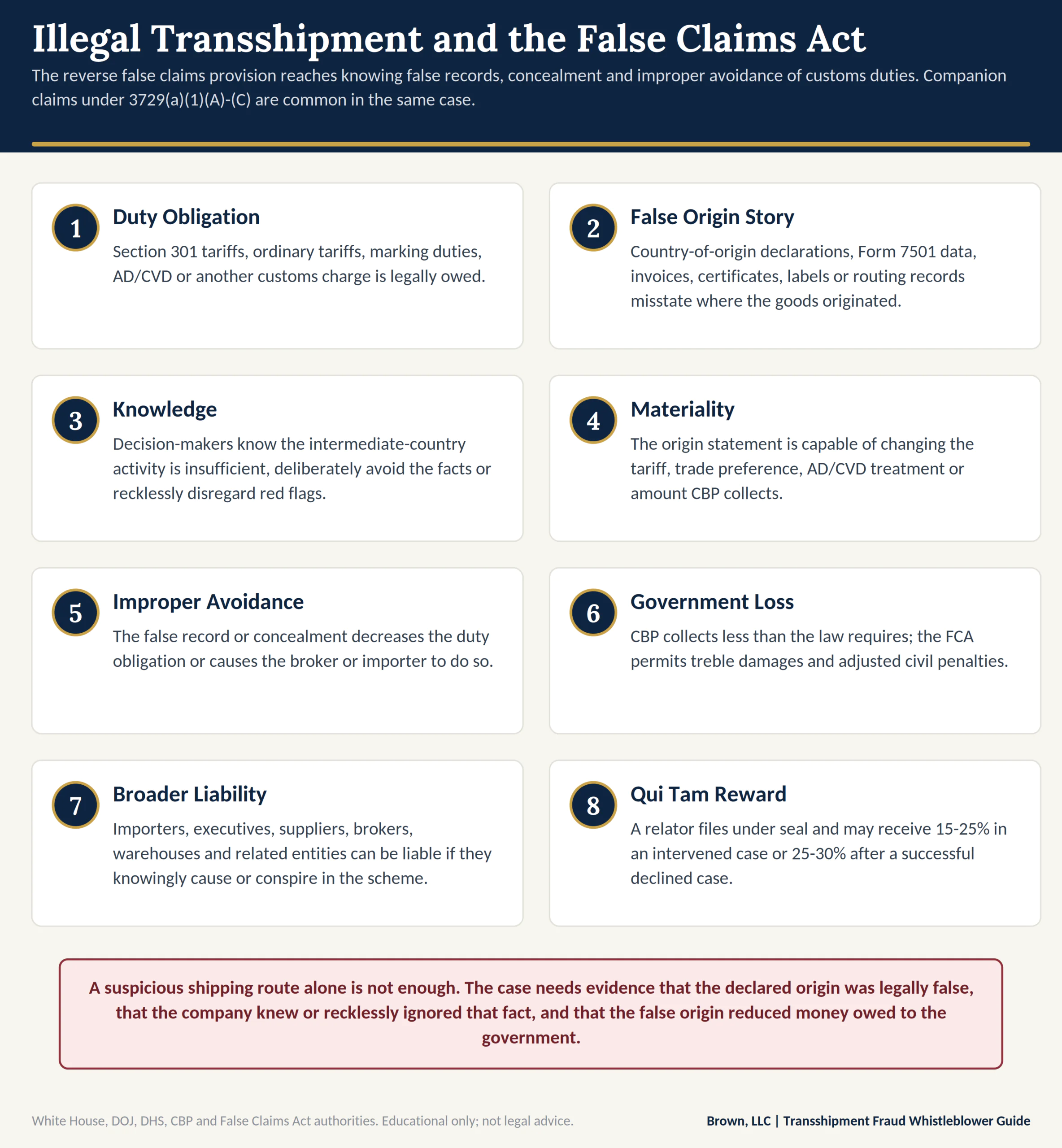
The FCA claim turns on a legal duty obligation, a false origin story, knowledge, materiality, improper avoidance, damages, and the sealed qui tam procedure.
1. The importer owes a duty to the United States
The False Claims Act defines an obligation to include an established duty arising from statute or regulation, whether or not the precise amount has already been fixed. Tariffs, Section 301 duties, marking duties, antidumping duties, and countervailing duties can qualify.
2. The customs record tells a materially false origin story
The false record may be a Customs Form 7501 entry summary, country-of-origin certificate, commercial invoice, bill of lading, manufacturer statement, free-trade certificate, product label, HTS code, or communication supplied to the customs broker.
Concealment can carry the same weight. A company may keep the Chinese factory off the paperwork, hide related-party payments, remove country markings, omit the actual manufacturing steps, or create a third-country shell that appears to be the producer.
3. The company knows, deliberately avoids, or recklessly disregards the truth
The FCA’s knowledge standard includes actual knowledge, deliberate ignorance, and reckless disregard. A specific intent to defraud is not required.
Evidence of knowledge may include that the third-country process was insufficient, a rejected origin ruling, instructions to change labels, a factory-capacity problem, two sets of invoices, pressure on a broker, or a decision to cancel or reroute goods selected for inspection.
4. Origin is material because it changes the duty
Country of origin is usually material when a China-specific tariff, AD/CVD order, marking duty, trade preference, or import restriction depends on it. A false origin can reduce the duty from a high China rate to a lower third-country rate or, in some cases, to zero.
5. The scheme knowingly decreases money owed to the government
Section 3729(a)(1)(G) reaches a person who knowingly makes or uses a false record material to an obligation or knowingly conceals or improperly avoids the obligation. This is the reverse false claim theory. Most transshipment cases are not limited to it: § 3729(a)(1)(B) reaches a false record or statement material to a false or fraudulent claim, § 3729(a)(1)(C) reaches a conspiracy to violate the Act, and § 3729(a)(1)(A) can apply where the same scheme supports an affirmative claim for payment, such as a duty drawback or refund request.
6. The loss can multiply
The starting point is the duty CBP should have collected. The FCA can impose treble damages and adjusted civil penalties. The final case value depends on the affected entries, duty rate, liquidation status, time period, evidence, government position, collectability, and settlement risk.
7. Liability can extend across the supply chain
An importer of record remains responsible for entry accuracy even when a customs broker prepares the paperwork. Brokers, suppliers, executives, related entities, warehouse operators, sourcing personnel, and others can face exposure when they knowingly cause the false declaration or conspire to avoid duties.
8. The relator files under seal and may share in the recovery
A False Claims Act whistleblower files a qui tam complaint under seal on behalf of the United States. If the government intervenes and the case succeeds, the relator generally receives 15% to 25%. If the government declines and the relator successfully proceeds, the range is generally 25% to 30%.
The Transshipment Settlements Already Paying Whistleblowers
Ceratizit is the cleanest public False Claims Act transshipment example. DOJ alleged that Chinese-manufactured tungsten carbide moved through Taiwan and was entered as Taiwan origin to avoid Section 301 tariffs. The same resolution included alleged HTS misclassification and unpaid marking duties. The whistleblower was awarded approximately $9.75 million.
Speak with the Lawyers at Brown, LLC Today!
Over $1 billion in aggregate judgments and settlements for our clients in state and federal courts. We fight for maximum damages and results.
Redi-Bag shows the facts that can turn routing through another jurisdiction into a knowing origin-fraud case. DOJ alleged that China-made plastic bags were transshipped through Hong Kong, declared as Hong Kong origin, stripped or covered of “Made in China” markings, and canceled when inspection was expected. The settlement was $7.3 million, and the relator was allocated approximately $1.332 million. The defendants denied liability.
Perfectus shows the scale available when the avoided duties are enormous. DOJ alleged that Chinese aluminum extrusions were spot-welded into purported finished pallets and entered outside the AD/CVD orders. The civil resolution was $549.5 million, with a 17.5% relator-share arrangement tied to Net Civil Payments.
Who Usually Sees Transshipment Fraud First?
The people closest to the movement of goods often know more than the formal compliance file reveals.
- Customs brokers and entry writers who receive inconsistent origin or manufacturer information;
- Freight forwarders who see the real route, dwell time, bills of lading, and last-minute document changes;
- Sourcing and procurement personnel who know the Chinese factory remained the real producer;
- Warehouse employees who remove labels, repackage goods, split shipments, or stockpile products;
- Salespeople who know the third-country entity has no real customers or production capability;
- Finance personnel who see payment continue to the Chinese supplier despite the new invoice chain;
- Engineers and quality personnel who know the product was unchanged or only lightly processed;
- Compliance personnel whose origin concerns were overruled;
- Competitors and trade associations who can match product specifications, facilities, imports, and pricing;
- Employees at overseas factories or intermediaries who know the real manufacturing steps.
You do not need to have every customs entry in your possession. You need a specific, truthful account of how the goods were made, routed, relabeled, invoiced, and declared, plus a path to the records that prove it.
Transshipment Red Flags and Evidence
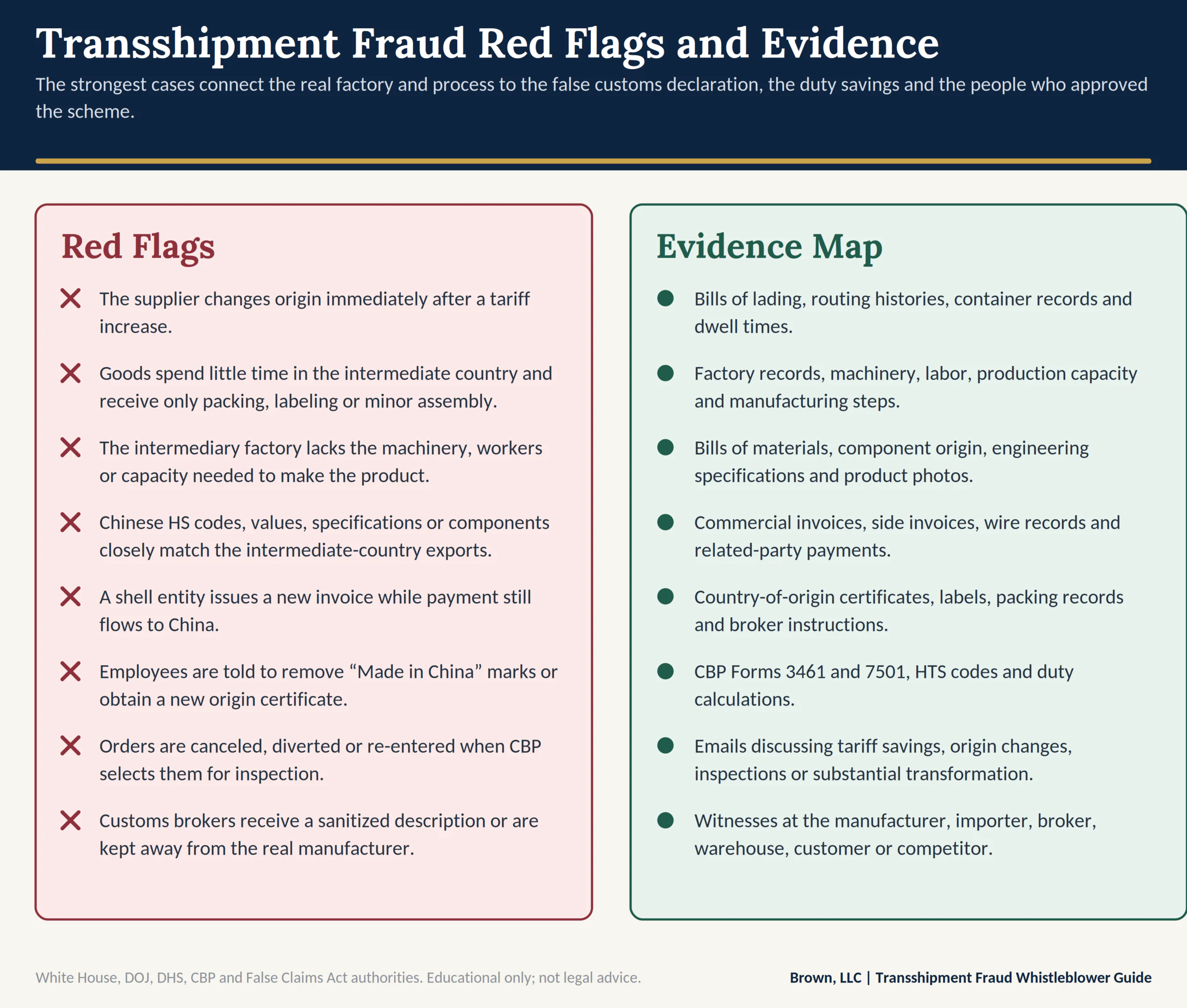
A strong transshipment case connects the real factory, the third-country activity, the new paperwork, the duty effect, and the people who approved it.
A transshipment case should become more concrete as you answer four questions:
- Where was the product actually made?
- What manufacturing occurred in the country?
- What did the company tell CBP?
- How did the new origin change the tariff or trade remedy?
Useful records can include bills of lading, container histories, purchase orders, payment records, factory records, bills of materials, machinery and labor information, product photos, origin certificates, labels, invoices, CBP Forms 3461 and 7501, HTS classifications, broker instructions, customs rulings, inspection notices, and emails discussing tariff savings or origin changes.
Factory capacity is increasingly important. The White House report describes AI analysis of equipment, components, production requirements, satellite imagery, dwell time, mirrored trade flows, and value parity. A company claiming that a small intermediary factory produced enormous volumes may face questions that an employee can answer far faster than an algorithm.
Choose the Filing Route Before You Press Submit
The first disclosure can determine whether the person becomes a relator with a statutory share or an agency informant with a capped or discretionary award.
False Claims Act qui tam
For a large, knowing duty-evasion case, the FCA is often the strongest reward path. The sealed filing protects the government’s investigation, creates relator status, and establishes the first-to-file position. The statutory share can reach 15% to 30%.
CBP e-Allegations and the moiety cap
CBP accepts transshipment and country-of-origin reports through e-Allegations. A separate moiety claim can pay up to 25% of CBP’s net recovery, but CBP’s current portal states that one claim cannot exceed $250,000.
A CBP tip does notcomplaint, make the informant a relator, or secure first-to-file priority. Reporting to CBP first does not automatically eliminate every later FCA claim, but it can change the landscape. CBP may investigate, the importer may self-disclose, the issue may become public, or another relator may file first.
For a Ceratizit-size recovery, the difference between a $250,000 moiety cap and a $9.75 million FCA award is obvious. A large transshipment case should be screened for an FCA filing before the portal is used.
EAPA
The Enforce and Protect Act lets a qualifying interested party ask CBP to investigate evasion of an antidumping or countervailing duty order. EAPA can impose interim measures and is useful to domestic producers and trade associations. It does not provide an FCA relator percentage.
DOJ Corporate Whistleblower Awards Pilot Program
The DOJ Criminal Division pilot now covers trade, tariff, and customs crime that produces qualifying forfeiture. The pilot is a gap-filler and generally does not pay when the same information qualifies under the FCA or another federal reward program. DOJ advises uncertain whistleblowers to submit to both potentially applicable programs.
The route can depend on whether the case is primarily a civil reverse-FCA duty claim, a criminal forfeiture matter, an EAPA circumvention case, or a combination. The sequence should be set before the first submission.
First-to-File, Public Disclosure, and Timing
Transshipment fraud can be visible to multiple people at once: importer employees, brokers, manufacturers, competitors, trade associations, customers, and freight companies. The FCA first-to-file rule can bar a later related action while an earlier qui tam case is pending.
Whistleblower tip: If you’ve witnessed Medicare or Medicaid billing fraud at your employer, you may qualify as a qui tam relator with a potential share of the government’s recovery. See our Medicare & Medicaid fraud practice →
Public disclosures can also affect a case. Government reports, audits, hearings, litigation, and news coverage may create a public-disclosure issue unless the relator has independent knowledge that materially adds to what is public. A White House report saying transshipment exists does not publicly disclose your company’s invoices, factories, entries, decision-makers, or products.
The current enforcement campaign increases urgency. CBP’s AI may identify the anomaly. A competitor may file EAPA. The company may self-disclose. Another insider may file qui tam. The whistleblower who waits can lose originality, first-to-file priority, or control of the narrative.
If Your Name Appears on the Paperwork
Transshipment schemes often require employees to create the clean document set: the new invoice, new origin certificate, revised product description, broker instruction, payment record, or Form 7501 support.
Do not assume the company will protect the person who made the filing. The current DOJ Fraud Division memo separately emphasizes corporate enforcement and rewards companies that self-disclose, cooperate, and remediate. A company seeking credit may identify the employees involved or responsible.
If you followed directions before understanding the scheme, tell your own lawyer exactly what happened. Participation does not automatically eliminate every FCA option, but planning, directing, profiting, obstruction, or a related criminal conviction can reduce or eliminate an award.
Do not destroy records, backdate explanations, coordinate stories, or minimize your role. A truthful early disclosure may place your conduct in context before the company presents its version.
Retaliation Protection
The FCA protects employees, contractors, and agents from retaliation because of lawful acts in furtherance of a qui tam action or efforts to stop FCA violations. Remedies can include reinstatement, double back pay, interest, special damages, attorneys’ fees, and costs.
The practical protection begins with strategy. An explosive internal email can warn the company, create a performance pretext, and start a race to self-disclose. Speak with counsel before reporting through compliance, a hotline, CBP, or EAPA.
Why Brown, LLC for a Transshipment Fraud Whistleblower Case?
A transshipment case requires more than reading a bill of lading. Counsel must connect customs origin rules, product manufacturing, tariff treatment, entry records, FCA scienter, damages, first-to-file, collectability, retaliation, and the correct reporting route.
Brown, LLC represents customs and False Claims Act whistleblowers nationwide. The firm is led by Jason T. Brown, a former FBI Special Agent and Legal Advisor, and its whistleblower practice includes former DOJ Civil Fraud experience.
For an illegal transshipment case, Brown, LLC can:
- Identify the true manufacturing and origin theory;
- Determine whether third-country operations amount to substantial transformation under the relevant rule;
- Map the false entry or concealment to Section 301, ordinary tariffs, marking duties, or AD/CVD;
- Build the entry-level damages model and test collectability;
- Analyze the FCA, EAPA, CBP, DOJ Corporate Pilot, and parallel routes;
- Protect first-to-file status and manage public-disclosure risk;
- Review evidence access, privilege, retaliation, and the whistleblower’s own role;
- Prepare the sealed complaint, disclosure statement, evidence map, witness chronology, and government presentation.
A serious review should also say when the facts show legitimate manufacturing, a good-faith origin dispute, or a case too small, public, speculative, or uncollectable to pursue.
Frequently Asked Questions
How do I report illegal transshipment fraud and receive a whistleblower award?
Speak with False Claims Act before reporting to CBP or your employer. A sealed qui tam complaint may preserve a 15-30% statutory share when false origin records knowingly avoid duties owed to the United States.
Is routing Chinese goods through Mexico, Vietnam, Taiwan, Malaysia or another country illegal?
Routing alone is lawful. The issue is whether the -country activity legally changes origin and whether the customs declaration truthfully describes the manufacturing. Pass-through routing, relabeling or minor processing paired with a false origin can create liability.
What is substantial transformation?
It is a fact-specific origin concept asking whether processing creates a new article with a different name, character or use under the applicable rule. Different statutes and trade programs may apply different tests.
Can transshipment fraud violate the False Claims Act?
Yes. Customs duties can be an obligation owed to the United States, and § reaches knowing false records, concealment or improper avoidance that decreases that obligation. The same scheme can also support claims under §§ 3729(a)(1)(A)-(C), including a false record or statement material to a false or fraudulent claim and a conspiracy to violate the Act.
How much can a transshipment whistleblower receive?
A successful FCA relator generally receives 15-25% if the government intervenes and 25-30% if the government declines and the relator successfully pursues the case.
What happened in the Ceratizit transshipment case?
DOJ alleged that Chinese tungsten carbide was transshipped through Taiwan and declared as Taiwan origin to avoid Section 301 tariffs. Ceratizit paid $54.4 million, and the whistleblower received approximately $9.75 million.
What evidence helps prove illegal transshipment?
Useful evidence includes routing records, bills of lading, origin certificates, factory capacity, production records, bills of materials, invoices, payments, labels, broker instructions, CBP entries and communications about tariffs or inspections.
Can a competitor or trade association file?
Potentially. A competitor or industry group must still satisfy first-to-file, public-disclosure, originality and pleading rules. Non-public product, factory, supplier or transaction evidence can be valuable.
Should I use CBP e-Allegations first?
Not before legal screening if the matter may support an FCA case. An e-Allegation does not create relator status, and the CBP moiety award is capped at $250,000 for one claim.
What is the difference between EAPA and a qui tam lawsuit?
EAPA is a CBP administrative process for AD/CVD evasion allegations by interested parties. A qui tam case is a sealed federal lawsuit with a statutory whistleblower-share framework.
Can a customs broker be a whistleblower?
Yes. Brokers may have direct knowledge of inconsistent origin records, importer pressure and false entry instructions. Confidentiality, professional duties and evidence access should be reviewed before disclosure.
Can I report anonymously?
An FCA complaint is filed under seal, but anonymity throughout the full litigation is not guaranteed. Counsel can assess confidentiality, sealing and retaliation issues.
Bottom Line
The White House has described illegal transshipment as a global scam. DOJ has named it as a prosecution priority. CBP is building AI systems to detect the routes, factories, ownership links, classifications, and origin mismatches.
A whistleblower can supply the part the data cannot: who knew the goods were still Chinese, what actually happened in the third country, who ordered the new paperwork, and how the false origin reduced the duty.
If you have specific information about pass-through trade, origin shifting, relabeling, re-invoicing, sham assembly, false certificates, shell importers, or customs entries that do not match the real manufacturing, speak with a transshipment fraud whistleblower lawyer before the company or government controls the case.
Related Reading from Brown, LLC
- Customs Fraud Whistleblower: practice overview and reward framework
- How to Report Customs Fraud in 2026: FCA Qui Tam, CBP e-Allegations, EAPA and Moiety Claims
- Customs Fraud Crackdown: A Growing False Claims Act Priority
- Qui Tam and False Claims Act: how the sealed process works
- Whistleblower Retaliation: protections and remedies
- Free confidential consultation with Brown, LLC
Sources
[1] Fox News, White House Exposes ‘Transshipment Scam’ Costing U.S. Up to $26B (Aug. 13, 2026): https://www.foxnews.com/politics/white-house-exposes-transshipment-scam-costing-us-26b-points-finger-china
[2] White House Office of Trade and Manufacturing Policy, The Great Transshipment Scam (Aug. 13, 2026): https://www.whitehouse.gov/wp-content/uploads/2026/08/The-Great-Transshipment-Scam.pdf
[3] White House, Executive Order 14411, Strengthening Customs Enforcement (June 3, 2026): https://www.whitehouse.gov/presidential-actions/2026/06/strengthening-customs-enforcement/
[4] DOJ Fraud Division, Enforcement Priorities Memorandum (Aug. 13, 2026): https://www.justice.gov/d9/2026-08/fraud_division_priorities_memo_final.pdf
[5] DOJ and DHS, A Resource Guide to Trade Fraud Enforcement (July 2026): https://www.justice.gov/fraud/media/1452331/dl?inline=
[6] DOJ, Trade Fraud Task Force Surpasses $1 Billion in Recoveries and Charged Losses (July 14, 2026): https://www.justice.gov/opa/pr/trade-fraud-task-force-surpasses-1-billion-recoveries-and-charged-losses-less-one-year
[7] DOJ, Ceratizit USA LLC Agrees to Pay $54.4M in Transshipment FCA Settlement (Dec. 18, 2025): https://www.justice.gov/opa/pr/ceratizit-usa-llc-agrees-pay-544m-settle-false-claims-act-allegations-relating-evaded-0
[8] DOJ, Redi-Bag USA and CEO Agree to Pay $7.3M in Country-of-Origin FCA Settlement (July 16, 2026): https://www.justice.gov/usao-nj/pr/redi-bag-usa-and-ceo-agree-pay-73-million-settle-false-claims-act-allegations-relating
[9] DOJ, Perfectus Aluminum $549.5M Customs FCA Settlement (May 12, 2026): https://www.justice.gov/opa/pr/perfectus-aluminum-inc-and-related-companies-agree-pay-5495m-settle-false-claims-act
[10] 31 U.S.C. § 3729, False Claims Act Liability and Definitions: https://uscode.house.gov/view.xhtml?edition=prelim&num=0&req=granuleid%3AUSC-prelim-title31-section3729
[11] 31 U.S.C. § 3730, Qui Tam Procedure, Relator Shares, First-to-File and Retaliation: https://uscode.house.gov/view.xhtml?edition=prelim&num=0&req=granuleid%3AUSC-prelim-title31-section3730
[12] CBP, e-Allegations Violations: Illegal Transshipment and Country-of-Origin Fraud: https://www.cbp.gov/trade/programs-administration/e-allegations/violations
[13] CBP, Moiety Claim – Trade Violations Reporting: https://eallegations.cbp.gov/s/moiety-claim?language=en_US
[14] CBP, Enforce and Protect Act (EAPA): https://www.cbp.gov/trade/eapa
[15] CBP, Importing into the United States: A Guide for Commercial Importers: https://www.cbp.gov/sites/default/files/documents/Importing%20into%20the%20U.S.pdf
[16] Brown, LLC, Customs Fraud Whistleblower Practice: https://ifightforyourrights.com/whistleblower-lawyer/customs-fraud-whistleblower/
Attorney advertising. This article is for informational purposes only and does not create an attorney-client relationship. Prior results do not guarantee a similar outcome.