
Trump’s New WHIP Whistleblower Program: Don’t Let the Quickie Cost You the Biggie

Table of Contents
Fast 5: What to Know About WHIP
- WHIP pays $10,000 to $30,000 per qualifying tip, at DOJ’s discretion, once criminal charges are unsealed. It is a flat amount, not 1% of the fraud, and no minimum loss is required.
- It covers federal health care offenses and fraud on specified federal programs, with hospice, home health, day care, and special-services fraud as stated priorities. Anonymous submissions must go through an attorney.
- A WHIP tip is not a False Claims Act case. In Babalola, whistleblowers who filed after the government had already pursued the criminal remedy could not share in that recovery. The FCA share is 15% to 30%.
- Other clocks keep running while you wait for charges: the SEC’s 120-day rules, the CFTC’s 180-day rule, and each program’s own award application. A WHIP payment restarts none of them.5. Report promptly, but retain whistleblower counsel before the first submission or interview, and before accepting any reward. The larger claim has to be filed, not just reported.
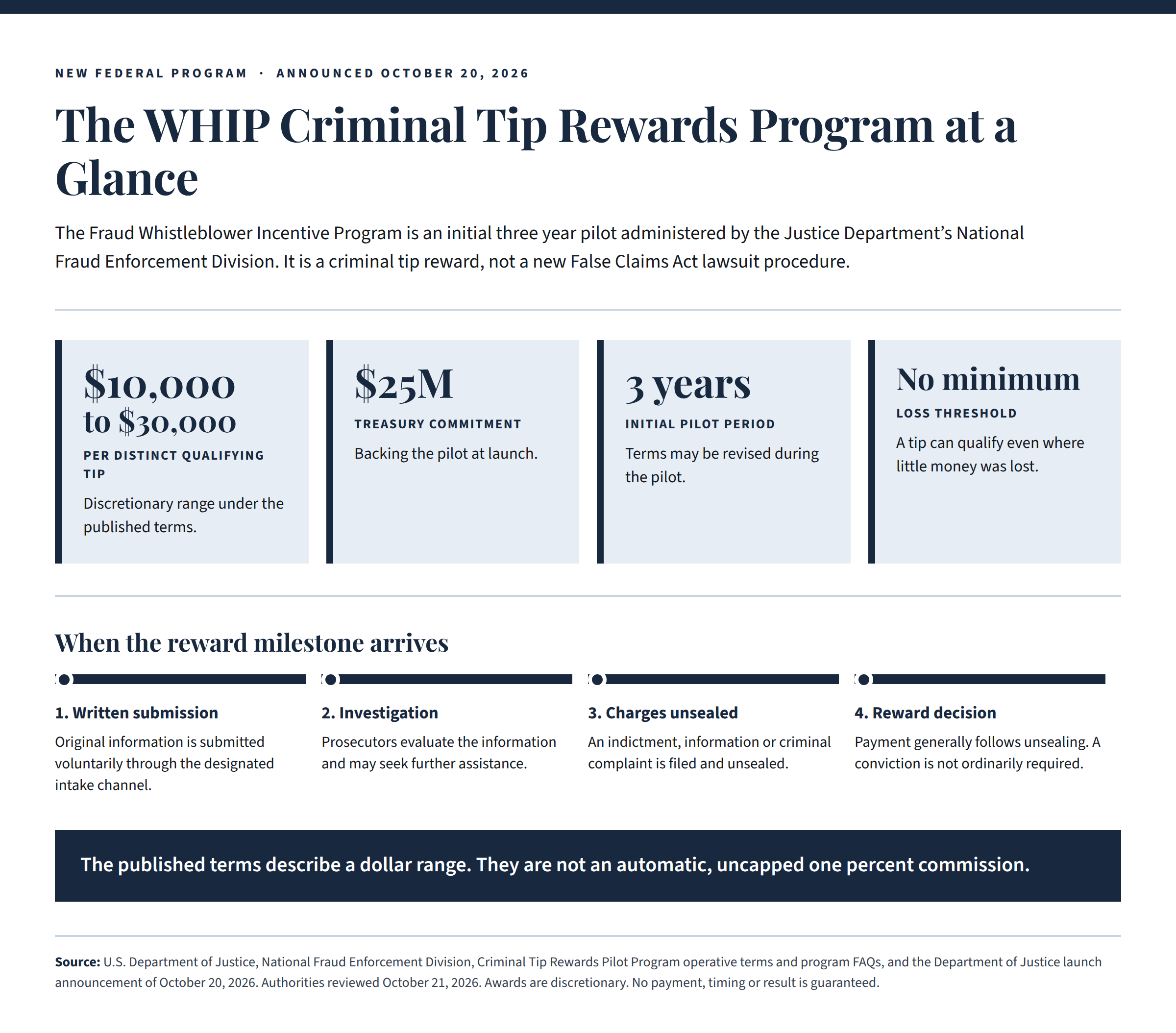
On October 20, 2026, President Donald Trump and Vice President JD Vance unveiled the Fraud Whistleblower Incentive Program, known as WHIP. The Justice Department’s National Fraud Enforcement Division is administering the new criminal-tip initiative, backed by a $25 million Treasury commitment. Its purpose is to encourage people to expose certain healthcare and government-program fraud by offering a reward earlier in the prosecution. [1][2]
The written terms describe discretionary payments of $10,000 to $30,000 for each distinct qualifying tip that leads to covered criminal charges. Payment generally follows the filing and unsealing of an indictment, information, or criminal complaint. A conviction is not ordinarily required. The announcement’s reference to a one-percent commission should not be mistaken for an automatic, uncapped award under the published rules. [3][4][2]
Here is my concern: by the time you qualify for the quickie, you may already have forfeited a claim to the biggie.
Speak with the Lawyers at Brown, LLC Today!
Over $1 billion in aggregate judgments and settlements for our clients in state and federal courts. We fight for maximum damages and results.
By “quickie,” I mean WHIP’s smaller, earlier-stage reward. By “biggie,” I mean a potentially much larger award under a separate whistleblower law or program. Neither is guaranteed. “Earlier-stage” describes a legal milestone; it does not promise a quick payment.
The risk is not that every WHIP payment automatically cancels every other award. The risk is that prosecutors, regulators, and competing whistleblowers can move ahead while a source has not completed the separate steps needed to preserve a larger claim. In some situations the problem arises before an award is offered. In others, the acceptance terms or another program’s election rules require attention. [5][6][7][8][9][10]
The Quickie Starts at a Milestone That May Already Be Too Late for Something Else
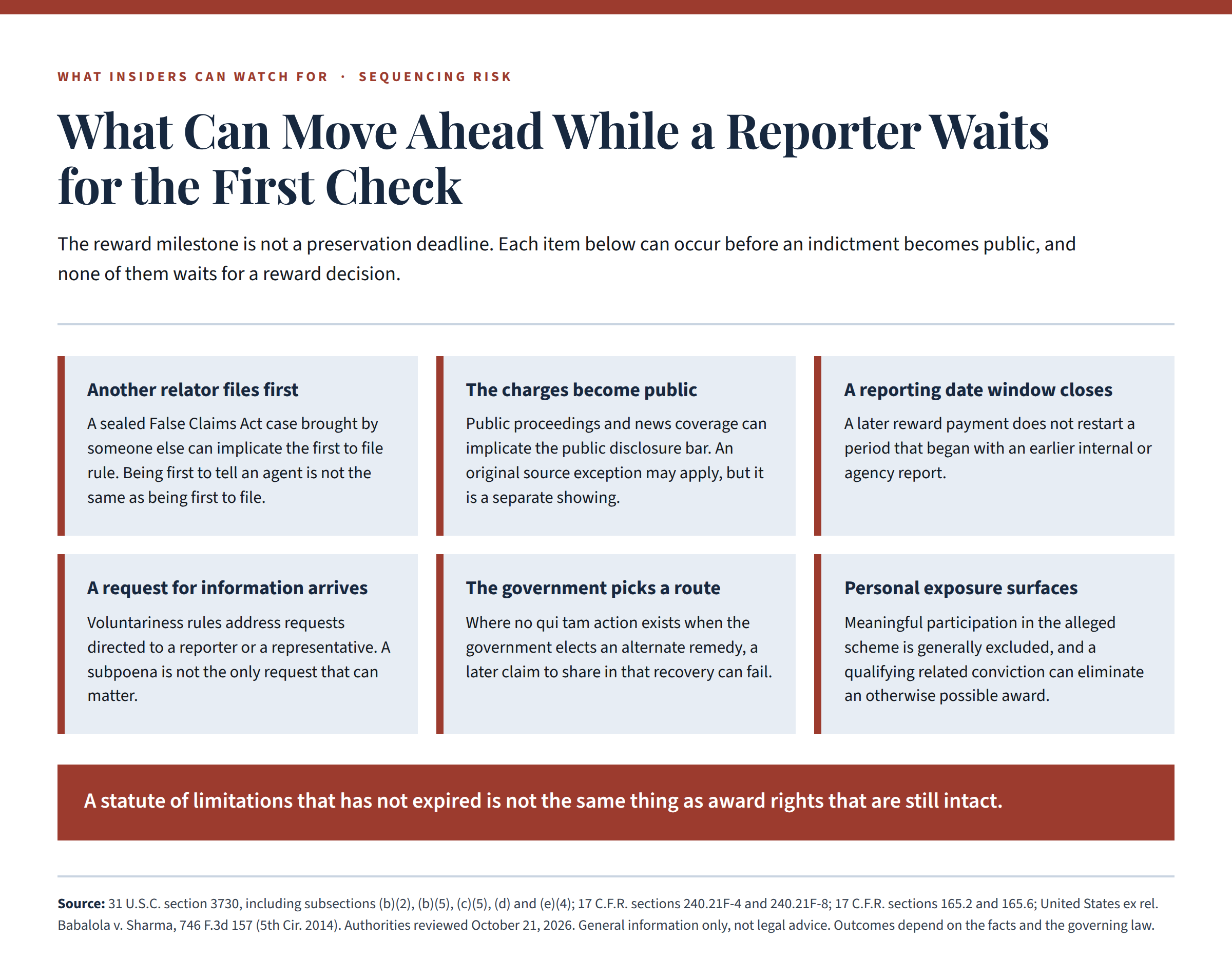
The reward milestone is not a preservation deadline. Before the indictment becomes public, the government may already have selected a recovery route. Another relator may have filed a sealed False Claims Act case. An SEC reporting-date window may have expired. A request for information may have raised a voluntariness issue. None of those events waits for the reward check. [5][6][7][9]
My concern is a sequence that sounds reasonable to a nonlawyer: report the fraud, help the agents, wait for charges, accept the quickie, and then ask about the biggie.
Related: Brown, LLC secured two of the year’s largest individual recoveries — a $950M settlement against Raytheon and $350M against Walgreens. Learn about our False Claims Act practice →
That is not a sequence I would leave to chance. And it is a sequence that can kill the bigger awards from programs like the SEC whistleblower program and possibly the False Claims Act where the bigger whistleblower payouts happen.
The FCA Case That Makes the Warning Real: Babalola
The False Claims Act ordinarily provides eligible relators with 15% to 25% of a qualifying recovery when the government proceeds, or 25% to 30% when the government declines and the relator succeeds. A relator is not merely a helpful witness. The statutory process requires a qui tam complaint filed under seal and the required government disclosure. [5]
In United States ex rel. Babalola v. Sharma, 746 F.3d 157 (5th Cir. 2014), medical assistants reported healthcare fraud to government agencies in 2007 and cooperated. Criminal charges followed in 2009, guilty pleas in 2010, and restitution orders in 2011. Their FCA complaint came later, in November 2011. [6]
They sought a share of the criminal recovery under the FCA’s alternate-remedy provision. The Fifth Circuit rejected that claim because no qui tam action existed when the government elected the alternate remedy. Reporting first did not substitute for filing. [6]
The holding has two important limits. The majority did not invalidate the later FCA lawsuit. It also assumed, without deciding, that criminal proceedings could otherwise qualify as an alternate remedy. This was not a WHIP case; WHIP did not exist. It is a warning about sequencing, not a decision that every criminal case destroys every civil whistleblower claim. [6]
You can still have a lawsuit while no longer having a right to share in the recovery you thought the lawsuit would reach. I would not confuse “the statute of limitations has not expired” with “all of your award rights are intact.” Those are different questions.
Public Charges Create Another Problem, but Original Sources Have an Important Answer
Public criminal proceedings and resulting news coverage can implicate the FCA’s public-disclosure bar when substantially the same allegations or transactions underlie a later lawsuit. But an original-source exception may apply, and the government can oppose dismissal under that provision. [5]
A genuine whistleblower’s documented, voluntary disclosure to the government before the public disclosure can be particularly important. Another statutory route concerns independent knowledge that materially adds to the public allegations and is voluntarily provided to the government before filing. [5]
That means a WHIP reporter may have a strong argument against the public-disclosure bar. It does not mean the WHIP award decides original-source status. And it does not mean original-source status retroactively creates a pending FCA case for alternate-remedy purposes. [3][5][6]
Whistleblower tip: If you’ve witnessed Medicare or Medicaid billing fraud at your employer, you may qualify as a qui tam relator with a potential share of the government’s recovery. See our Medicare & Medicaid fraud practice →
First to tell an agent is not necessarily first to file. Filing first is not a ticket to every criminal dollar. And filing under seal is not the same as going public.
Our $350 Million Walgreens Resolution: Calculate the Award on the Right Recovery
Brown, LLC represented a whistleblower in one of the actions resolved through the Walgreens settlement. The resolution totals $350 million: the original $300 million plus the additional $50 million, which our firm confirms has been paid. This is not a disclosure of our client’s award or a claim that Brown alone produced a multi-party result. [13][14]
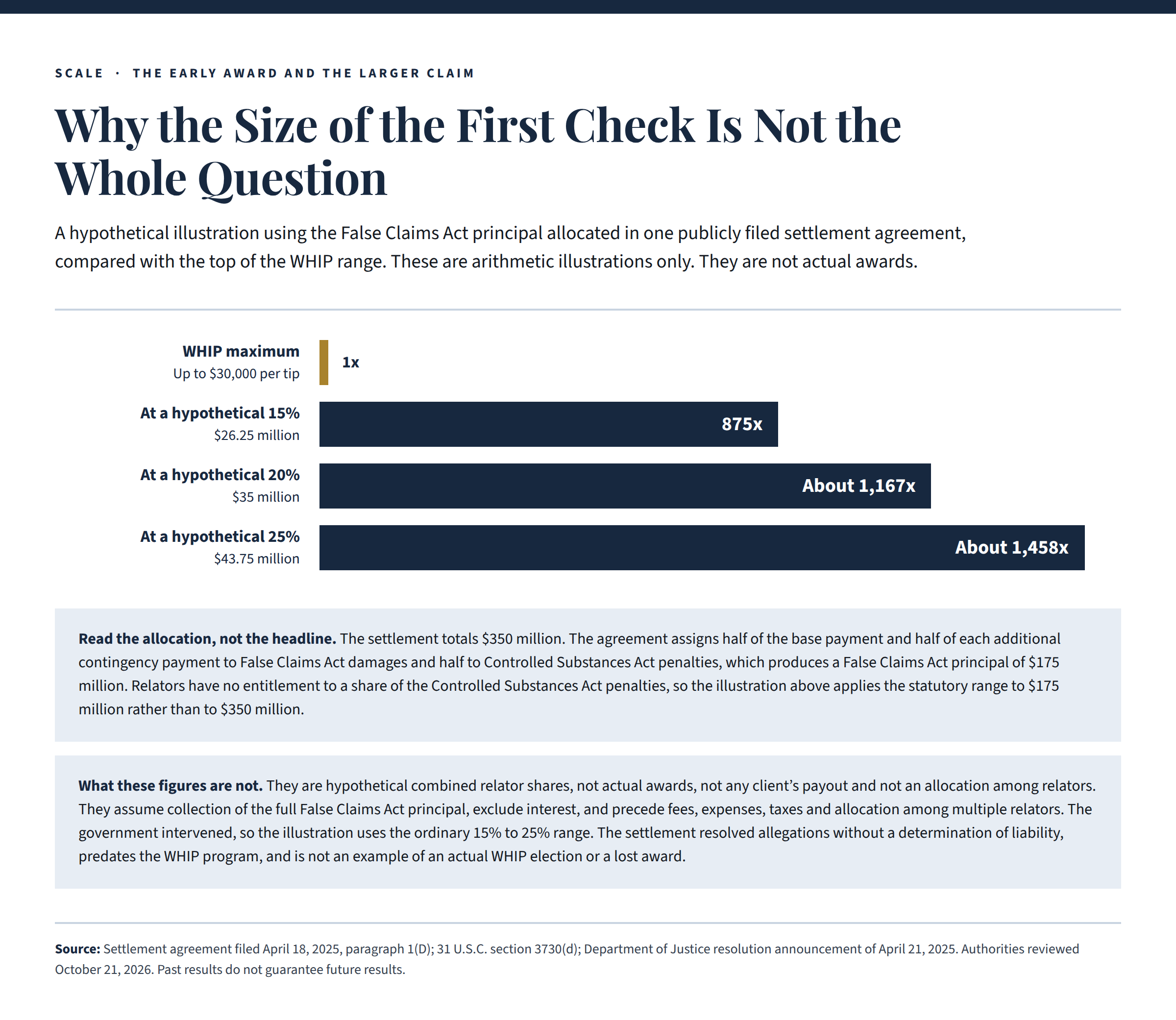
Paragraph 1(D) of the agreement assigns $150 million of the base payment to FCA damages and $150 million to Controlled Substances Act penalties. It divides additional contingency payments equally between those categories. With the $50 million additional payment, the principal allocation is therefore $175 million to the FCA and $175 million to the CSA. Relators have no entitlement to a share of the CSA penalties. [15]
Using the $175 million FCA principal allocation, the following are hypothetical, imputed combined relator shares:
| Hypothetical percentage | Illustrative combined gross share | Compared with $30,000 |
| 15% | $26.25 million | 875 times |
| 20% | $35 million | About 1,167 times |
| 25% | $43.75 million | About 1,458 times |
These are arithmetic illustrations, not actual awards, our client’s payout, or allocations among relators. They assume collection of the full $175 million FCA principal; they do not assert that every scheduled base installment has already been collected. They exclude interest and precede fees, expenses, taxes, and allocation among relators. The government intervened, so the illustration uses the ordinary 15%–25% range. The settlement resolved allegations without a determination of liability, predates WHIP, and is not an example of an actual WHIP election or a lost award. [5][15][14]
At a hypothetical 20%, the combined share would be $35 million. That is why a source with evidence of substantial fraud should understand the larger claim before waiting for the smaller reward. It is also why I will not apply an FCA percentage to the entire $350 million and call the result a whistleblower award. The agreement, not the headline, determines the eligible dollars.
SEC Whistleblower Awards: 120 Days Can Mean Three Different Things
The SEC generally pays eligible whistleblowers 10% to 30% of qualifying collections when its successful enforcement action results in more than $1 million in ordered monetary sanctions. Certain DOJ proceedings can support an additional related-action award. That does not make a WHIP submission an SEC submission. [8][16]
Nor does healthcare fraud at a public company automatically establish securities fraud. There must be a supported securities-law theory. Where that theory exists, the sequence deserves immediate attention.
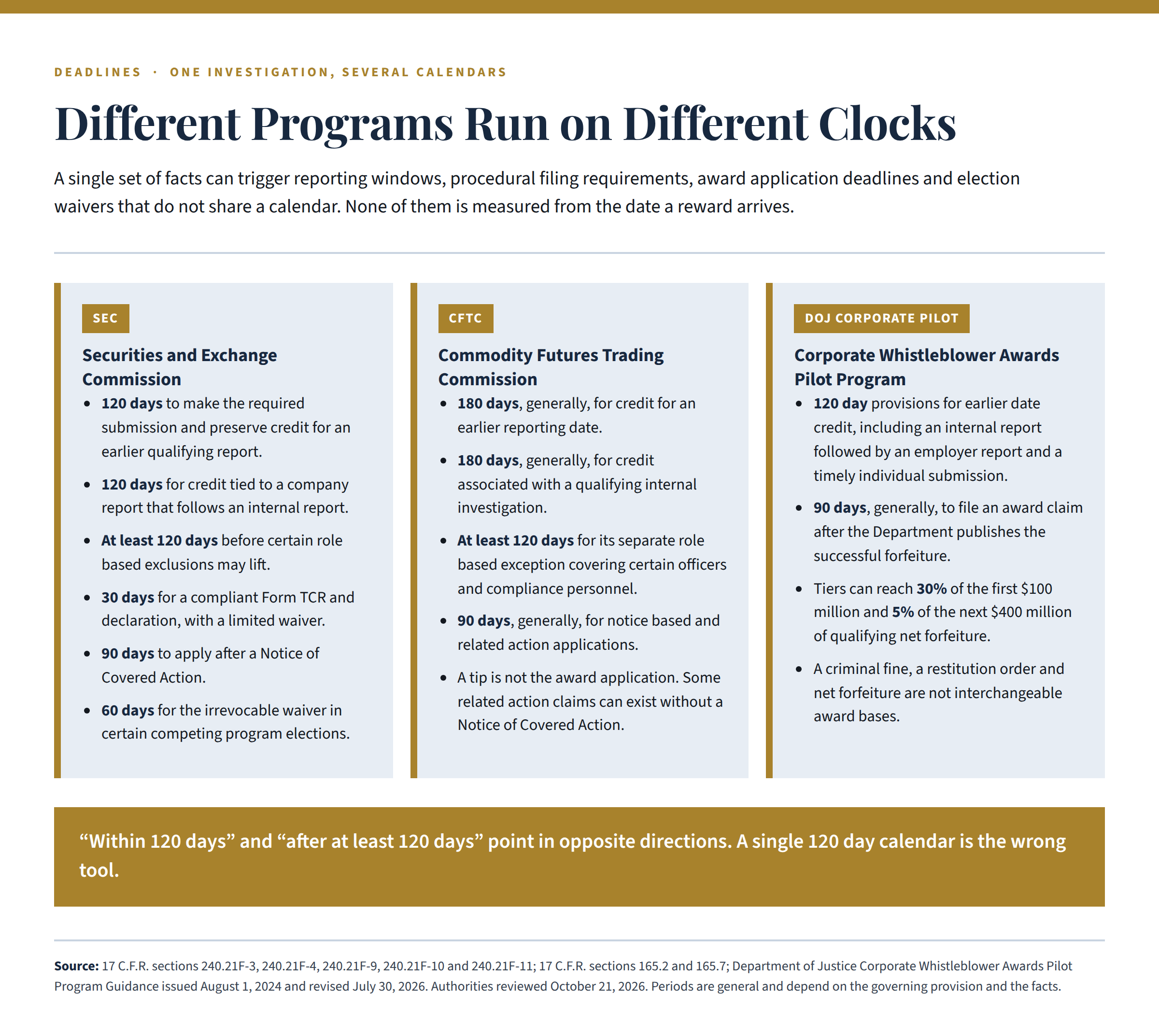
Three of the SEC’s rules use the number 120, and they point in different directions. Rule 21F-4(b)(7) gives a whistleblower 120 days after a qualifying report to another authority or an internal channel to make the SEC submission and keep the earlier reporting date. Rule 21F-4(c)(3) gives 120 days after an internal report to submit to the SEC and receive credit for what the company’s own investigation turns up. Rule 21F-4(b)(4)(v)(C) runs the other way: certain officers, compliance, audit, and investigative personnel are excluded until at least 120 days after their internal report, and even then the privilege and unlawful-acquisition restrictions remain. A later WHIP payment restarts none of these, and repeating the same information to DOJ does not reset a clock that began with an internal report. Behind them sit the 30-day Form TCR rule, the 90-day award application after a Notice of Covered Action, and 60-day competing-program elections. The CFTC uses 180 days for its date-credit rules, so a single “120-day” calendar can be wrong in a commodities case. [7][20][21][8][9]
The SEC illustrated the distinction in September 2026. It awarded more than $1.2 million to a claimant who satisfied the 120-day exception, while treating approximately seventeen months of unreasonable reporting delay as a negative award factor. The claimant’s role and percentage were redacted. Clearing an eligibility restriction did not erase the consequences of additional delay. [18]
Speak with the Lawyers at Brown, LLC Today!
Over $1 billion in aggregate judgments and settlements for our clients in state and federal courts. We fight for maximum damages and results.
A waiting-period exception is not a permission slip to keep waiting.
An SEC Denial Shows Why “The Other Agency Will Handle It” Is Not Enough
In its May 5, 2025 order, Release No. 102987, the SEC denied an award to joint claimants whose later SEC submission did not meaningfully help the enforcement action. They said they were sources of press reports and had relied on another agency to coordinate with the SEC. The other agency’s identity was redacted. [19]
The SEC distinguished original-source status from causation. Its investigation began from press reports; the claimants’ later submission was not helpful. It rejected the requested waiver and emphasized the usefulness of the submission to the SEC itself. [19]
The government knowing your information is not the same as your SEC award claim being protected.
Can the Quickie and Biggie Be Paid Together? Identify the Particular Award
For the SEC, distinguish an award on the SEC’s own enforcement action from a related-action award on a DOJ proceeding. Rule 21F-3 contains competing-program restrictions, a comparability analysis, disclosure requirements, and irrevocable-waiver provisions. Even a noncomparable program can require a waiver. [8]
WHIP’s small, discretionary award gives a substantial textual basis to analyze it as noncomparable. That is my reading of the criteria, not an SEC determination. It does not resolve how an already-paid WHIP reward for the same action will be handled. I would clarify that before acceptance, not assume a refund later repairs everything.
The question is not simply “Can I receive two checks?” It is “For which action, on which recovery, under which rules, and after which election?”
DOJ’s Corporate Program: Another Criminal Path, Another Set of Traps
DOJ’s Corporate Whistleblower Awards Pilot Program concerns qualifying corporate misconduct and successful forfeiture exceeding $1 million in net proceeds. Its discretionary tiers can reach 30% of the first $100 million and 5% of the next $400 million. A criminal fine, restitution order, and net forfeiture are not interchangeable award bases. [10]
The payment interaction requires care. WHIP expressly contemplates later corporate-program awards. Yet the corporate guidance addresses receipt of another governmental or statutory award for the same or substantially the same misconduct, while also discussing denial or reduction for overlapping compensation and potentially distinct forfeitures. Its revision distinguishes mere eligibility elsewhere from actually receiving an award. [3][10][27]
I would not conceal that tension or turn it into an automatic forfeiture claim. The published materials do not supply a universal WHIP offset formula. Seek a documented, case-specific explanation before accepting money on the assumption that the larger award is untouched.
“Potentially eligible” is not a final accounting.
IRS, FinCEN, and Antitrust: Criminal Activity Can Open Different Doors
Criminal conduct can also open the IRS, FinCEN, and antitrust reward programs. The IRS pays 15%–30% of collected proceeds, which can include criminal fines and forfeitures, but only on a signed Form 211, and the federal FCA excludes tax claims. FinCEN’s 10%–30% AML and sanctions awards exclude forfeiture and restitution from the base and await a final implementing rule. The antitrust program pays a presumptive 15%–30% on criminal recoveries of at least $1 million where there is identifiable harm to the Postal Service. Each uses a different recovery base, a different filing, and a different clock, and none is satisfied by a WHIP tip. The details are on the firm’s WHIP whistleblower program page. [28][29][31][32][33]
A new program should expand the analysis, not replace it.
Hire Whistleblower Counsel Early: One Accurate Account, Properly Prepared
A whistleblower can know exactly what happened and still present it in a way that leaves investigators unable to identify the offense, the relevant payment, or the reliable witnesses. A stack of documents is not self-explanatory. Neither is “everybody knew.” My job is to help explain who knew what, how we can prove it, and which legal requirements the evidence may satisfy.
That work should start before the first substantive submission, not after five agencies have received five inconsistent summaries. Consistency means fidelity to the facts. It does not mean repeating a mistaken answer or forcing every agency’s form to contain identical language. The underlying chronology, sources, amounts, and limits of personal knowledge should remain accurate across the WHIP tip, a sealed FCA disclosure, an SEC or CFTC submission, and an interview.
Prepare for the Interview Without Manufacturing a Script
Preparation is not permission to guess, conceal unfavorable facts, or rehearse a story that the evidence cannot support. WHIP’s terms disqualify deliberate material falsehoods and misleading concealment. Knowing and willful material false statements in covered federal proceedings can create separate exposure. An honest mistake is not automatically a crime; the practical instruction is to be accurate and correct errors promptly. [3][35]
I want investigators to spend their time following the evidence, not trying to reconcile the witness’s own accounts. Help them understand the wrongdoing. Protect the source’s rights at the same time.
Criminal Cooperation Is Not Immunity, and a Reward Is Not Retaliation Protection
Anyone involved in the misconduct needs advice about personal exposure before treating a reward application as a harmless form. WHIP generally excludes meaningful participation, subject to narrow discretion for minimal participants. Other programs have their own culpability rules. A qualifying related conviction can eliminate an otherwise possible FCA, SEC, CFTC, or IRS award. [3][5][36][37][28]
The solution is not to omit inconvenient facts. It is to assess them truthfully with counsel. Nor should someone assume that award eligibility decides a retaliation claim or supplies permanent anonymity. Those are separate questions.
Report Promptly. Retain Counsel Early. Do Not Leave the Larger Claim Unfiled
WHIP can help bring fraud to light, including schemes too small to produce a substantial percentage-based recovery. I support that purpose. I also want the person providing the evidence to understand what the program does not do for them.
Before the first submission, assess which programs fit the facts, preserve the reporting history, address any personal exposure, and coordinate the necessary filings. For a supported FCA claim, evaluate the sealed complaint promptly. Do not file an unsupported placeholder. Before an interview, prepare to distinguish knowledge from inference and explain the documents accurately. Before an award is accepted, review the actual terms and any competing-program restrictions. [5][8][10][38][39]
A possible biggie may take years, fail on the merits, or produce an uncollectible judgment. The quickie can have real value. The answer is not to assume the larger award will happen. It is to avoid losing a potentially valuable claim without ever making an informed decision.
Do not let the quickie cost you the biggie. Come forward with the truth, a prepared account, and a legal strategy that begins before the first check.
General information and commentary based on authorities reviewed October 21, 2026. Eligibility and outcomes depend on the facts, governing law, and operative program terms. No payment, timing, anonymity, or result is guaranteed. Past results do not guarantee future results.
Linked Authorities and Verification Notes
Inline reference numbers link directly to the cited authority. The source notes identify the supporting provisions and distinguish the firm’s supplied payment confirmation from public documents.
[1] DOJ: WHIP launch announcement, October 20, 2026 — Launch date; DOJ and National Fraud Enforcement Division; $25 million Treasury commitment; covered offenses; early rewards and potential additional awards.
[2] Reuters: Trump announces fraud-tip program, October 20, 2026 — Trevor Hunnicutt byline; White House launch with President Trump and Vice President Vance; public percentage description contrasted with DOJ terms. Additional reporting includes Andrew Goudsward.
[3] DOJ, Criminal Tip Rewards Pilot Program: operative terms — Introduction; eligibility/original information; voluntariness; charging milestone; anonymous submissions; designated intake; discretion. Reviewed October 21, 2026.
[4] DOJ, Criminal Tip Rewards Pilot Program FAQs — No minimum loss; submission channel; charging-stage reward; no conviction requirement.
[5] 31 U.S.C. § 3730 — Subsections (b)(2), (b)(5), (c)(5), (d), (e)(3), (e)(4), and (h): seal/disclosure, first-to-file, alternate remedies, shares, bars, and retaliation.
[6] United States ex rel. Babalola v. Sharma, 746 F.3d 157 (5th Cir. 2014) — 159–63; especially notes 4 and 7. No retroactive share of earlier criminal recovery; assumed rather than decided criminal alternate-remedy eligibility; later FCA action not invalidated.
[7] 17 C.F.R. § 240.21F-4 — SEC definitions — (a) voluntariness; (b)(4)(v) exceptions including at-least-120-day rule; (b)(5) source; (b)(7) 120-day date credit; (c)(1)–(3) causation and internal-reporting credit.
[8] 17 C.F.R. § 240.21F-3 — SEC awards and related actions — SEC action over $1 million; related-action nexus; comparability, prior-payment restriction, 60-day irrevocable waiver, and disclosure of another application. WHIP classification is analysis, not an SEC ruling.
[9] 17 C.F.R. § 165.2 — CFTC definitions — (g)(7)(iii) 120-day role exception; (i)(3) 180-day internal-report credit; (l)(2) 180-day earlier-date credit; (o) voluntariness, including employer-request attribution.
[10] DOJ Corporate Whistleblower Awards Pilot Program Guidance — Guidance issued August 1, 2024 and revised July 30, 2026. II.1(b) and n.3; II.2(d), II.4(b), II.7(b)(iii); III; V. Distinguish an internal report followed by an employer report, individual reporting, net forfeiture, other-award restrictions, and the later 90-day claim.
[11] United States v. L-3 Communications EOTech, Inc., 921 F.3d 11 (2d Cir. 2019) — Voluntary dismissal before the government’s later action did not preserve alternate-remedy share rights.
[12] United States v. Wegeler, 941 F.3d 665 (3d Cir. 2019) — No intervention in criminal prosecution to seek relator share; asserted share rights belong in FCA action. Whether criminal prosecution is an alternate remedy was not decided.
[13] Brown, LLC: Walgreens resolution announcement — Firm’s involvement in one of the resolved whistleblower actions; not sole credit for the global resolution.
[14] DOJ, Walgreens resolution announcement, April 21, 2025 — Government intervention; resolution of allegations; no determination of liability; payment framework.
[15] Walgreens settlement agreement, filed April 18, 2025 — Agreement ¶ 1(D), printed p. 6: $150 million FCA base plus half of each additional contingency payment and half of interest; the CSA component is excluded from relator sharing. Jason T. Brown separately confirmed on October 21, 2026 that the $50 million additional payment was made. The agreement establishes allocation, not independent proof of that subsequent payment.
[16] SEC, Whistleblower Program — 10%–30% awards; over-$1-million SEC action threshold; covered-action notices and award application process.
[17] SEC, Whistleblower frequently asked questions — Direct reporting, original information, internal-reporting credit, and general program procedures.
[18] SEC Release No. 106457, September 22, 2026 — More than $1.2 million award; 120-day eligibility exception satisfied; approximately 17-month unreasonable reporting delay remained a negative award factor. Role and percentage redacted.
[19] SEC Release No. 102987, May 5, 2025 — Pages 2–4 and 7–9: original source versus useful SEC submission; other-agency coordination argument; no waiver; award denied. Other agency’s identity is redacted.
[20] 17 C.F.R. § 240.21F-9 — SEC submission procedures — Compliant TCR, penalty-of-perjury declaration, anonymous attorney submission, and subsection (e)’s 30-day rule and limited waiver.
[21] 17 C.F.R. § 240.21F-10 — SEC covered-action award claims — 90-calendar-day Notice of Covered Action deadline; Form WB-APP; preliminary determination procedures.
[22] 17 C.F.R. § 240.21F-11 — SEC related-action claims — Same WB-APP when related order already entered; separate 90-day period when later; special treatment of deferred/nonprosecution agreements.
[23] CFTC Whistleblower Program overview — General 10%–30% framework; initial tip versus separate award claim; sanctions/collections distinction.
[24] 17 C.F.R. § 165.7 — CFTC award applications — 90-day notice and related-action deadlines; (b)(3)(iii) covers related actions without a connected CFTC covered action and thus without a Notice of Covered Action.
[25] 17 C.F.R. § 165.11 — CFTC related actions — Qualifying entities/nexus; prohibition after SEC award for the same related action, not a categorical bar on every other program payment.
[26] DOJ, Corporate Whistleblower Awards Pilot Program overview — Separate corporate self-disclosure opportunity versus individual whistleblower procedures; current program links.
[27] DOJ Corporate Whistleblower Awards Pilot Program FAQs — Mixed schemes, other-program eligibility, distinct forfeitures, internal reporting, and culpability. Check together with operative guidance, not as an automatic stacking promise.
[28] 26 U.S.C. § 7623 — IRS whistleblower awards — 15%–30% framework and thresholds; reductions; participation/conviction; collected proceeds including qualifying criminal fines and civil forfeitures; Tax Court review.
[29] IRS, Submit a whistleblower claim for award — Form 211, information required, signature, eligibility, and current submission route. General fraud report is not a Form 211 claim.
[30] 31 U.S.C. § 3729 — False-claims liability and subsection (d)’s Internal Revenue Code exclusion.
[31] 31 U.S.C. § 5323 — AML and sanctions whistleblowers — 10%–30% statutory framework, Treasury/Attorney General recipients, excluded forfeiture/restitution/victim payments, related-action reductions, and conviction restriction.
[32] FinCEN, Whistleblower Program — Covered laws and implementation status. Page reviewed October 21, 2026 says award processing/payment follows final implementing regulation; proposed rules not treated as final.
[33] DOJ Antitrust Division, Whistleblower Rewards Program — Presumptive discretionary 15%–30% range, qualifying $1 million recovery threshold, and submission channel.
[34] DOJ/USPS/USPS OIG Antitrust Whistleblower Rewards MOU — IV.A.5: identifiable postal harm need not be material. IV.B.10: other-government awards/related civil recoveries affect award analysis. No enforceable private right created.
[35] 18 U.S.C. § 1001: statements or entries generally — Knowing and willful material falsehoods and concealment in covered federal contexts; ordinary uncertainty or an innocent mistake is not automatically a violation.
[36] 17 C.F.R. § 240.21F-8 — SEC eligibility — Eligibility restrictions, including conviction of a criminal violation related to the relevant action.
[37] 17 C.F.R. § 165.6 — CFTC ineligibility — Related criminal conviction, false submissions, and other exclusions; award eligibility distinct from retaliation protections.
[38] Federal Rule of Civil Procedure 9 — Particularity requirement for pleading fraud; no unsupported placeholder recommendation.
[39] Federal Rule of Civil Procedure 11 — Reasonable inquiry and factual/legal support for court filings.