Skip to main content

The $549.5 Million Perfectus Aluminum Case: How Fake “Pallets” Became a Customs Fraud Whistleblower Case
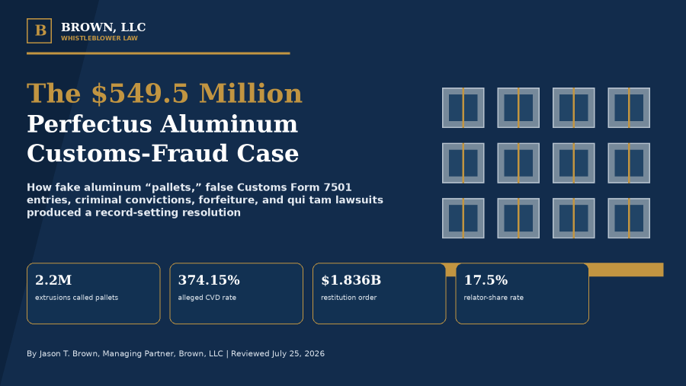
Table of Contents
The Perfectus Aluminum case is the clearest modern example of how a customs classification theory can become a massive parallel civil, criminal, forfeiture, and whistleblower matter.
In May 2026, Perfectus Aluminum Inc., Perfectus Aluminum Acquisitions LLC, and four affiliated warehouse companies agreed to a $549,594,030 False Claims Act settlement. The United States alleged that more than 2.2 million Chinese aluminum extrusions were spot-welded together and presented to U.S. Customs and Border Protection as finished “pallets” outside applicable antidumping and countervailing duty orders.
The civil settlement came after a 2021 jury conviction, a criminal restitution order exceeding $1.836 billion, forfeiture of aluminum structures, and the Ninth Circuit’s affirmance of the corporate convictions.
Whistleblower tip: If you’ve witnessed Medicare or Medicaid billing fraud at your employer, you may qualify as a qui tam relator with a potential share of the government’s recovery. See our Medicare & Medicaid fraud practice →
Why this case matters: Perfectus shows that a customs fraud case can grow from false Customs Form 7501 entries into criminal convictions, money laundering, billion-dollar restitution, asset forfeiture, a nine-figure FCA settlement, and a potentially extraordinary whistleblower share.
Key Numbers at a Glance
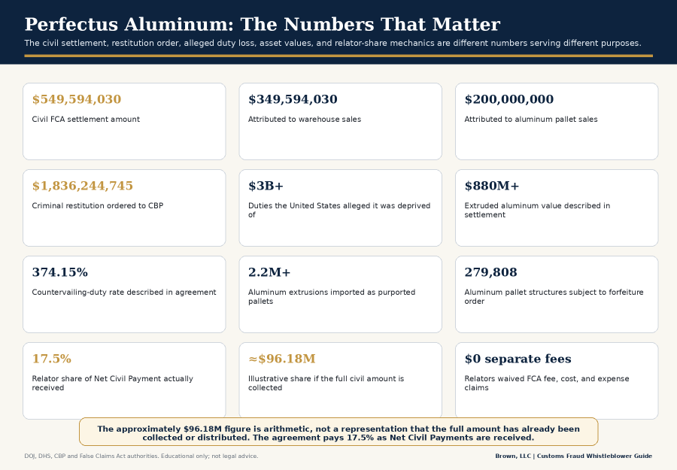
The settlement, restitution order, alleged duty loss, asset values, and relator-share base are separate figures and should not be conflated.
- $549,594,030: civil False Claims Act settlement.
- $349,594,030: attributed to sales of four warehouse properties.
- $200,000,000: attributed to sales of the aluminum pallets.
- $1,836,244,745: criminal restitution ordered to CBP.
- More than $3 billion: duties the United States alleged it was deprived of.
- More than $880 million: value of the extruded aluminum described in the settlement agreement.
- 374.15%: countervailing-duty rate described in the settlement agreement.
- More than 2.2 million: aluminum extrusions imported as purported pallets.
- 279,808: aluminum structures subject to the forfeiture order.
- 17.5%: relator share of Net Civil Payments actually received.
- Approximately $96.18 million: mathematical share if the full $549,594,030 is ultimately collected as Net Civil Payment. This should not be described as already paid.
- No separate FCA fee award: the relators waived separate expenses, attorneys’ fees, and costs.
What DOJ Said the Perfectus Scheme Did
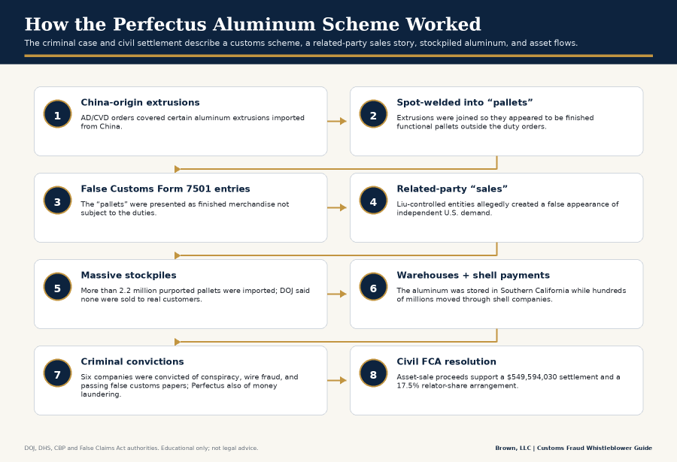
The alleged civil conduct and proven criminal conduct centered on disguising extruded aluminum as functional finished pallets.
Step 1: Antidumping and countervailing duties applied to Chinese aluminum extrusions
In 2011, certain Chinese aluminum extrusions became subject to antidumping and countervailing duty orders. The settlement agreement says the United States contended that countervailing duties of 374.15% applied to more than $880 million of extruded aluminum.
Speak with the Lawyers at Brown, LLC Today!
Over $1 billion in aggregate judgments and settlements for our clients in state and federal courts. We fight for maximum damages and results.
Those rates explain why the economics were so large. A remedial duty can exceed the value of the imported merchandise itself. Avoiding the duty can create exposure measured in billions even when the goods are worth hundreds of millions.
Step 2: The extrusions were spot-welded into the shape of pallets
According to DOJ, the aluminum was simply extruded aluminum joined together to look like functional pallets. The theory was that a finished pallet would not be subject to the same duty order as the covered extrusion. But DOJ said there was no real U.S. market for the purported pallets. More than 2.2 million were imported between 2011 and 2014, no customers bought them, and none were sold as pallets. The criminal releases said the structures were stockpiled in massive Southern California warehouses and were intended eventually to be melted or reconfigured into commercially useful aluminum products.
Step 3: Customs Form 7501 entries allegedly presented the pallets as finished merchandise
The civil settlement resolved allegations that the defendants knowingly made or caused false statements on Customs Form 7501 Entry Summaries that were material to duties owed to CBP. This is the bridge to the reverse False Claims Act: an existing duty obligation, false records material to that obligation, knowledge, and an alleged improper reduction of money owed to the United States.
Step 4: Related companies created a false appearance of legitimate sales and demand
The criminal case described purported sales to Liu-controlled U.S. entities and annual reports suggesting robust demand from independent customers. In reality, the aluminum was stockpiled in more than two million square feet of warehouse space, and the defendants planned to melt or reconfigure it into a commercially useful form.
A key lesson is that the government did not look only at the customs form. It examined the economic substance of the transaction. Were there genuine customers? Was the finished product functional? Did related companies create circular or sham sales? What happened to the product after entry?
Step 5: Hundreds of millions moved through shell companies
DOJ said hundreds of millions of dollars moved through shell companies to the U.S. aluminum entities and then back to China Zhongwang and related companies as purported payments for the aluminum. The Perfectus entities were convicted of international promotional money laundering in addition to conspiracy, wire fraud, and passing false papers through a customhouse. [3][4] That parallel criminal theory matters because customs fraud can create exposure far beyond the unpaid duty. Money laundering, forfeiture, wire fraud, obstruction, and false customs-document charges may follow the money trail.
The Civil and Criminal Cases Developed on Parallel Tracks
The case did not begin with a single audit and end in a short settlement. It unfolded across qui tam litigation, a criminal indictment, a jury trial, restitution, forfeiture, appellate proceedings, asset sales, and a later civil FCA resolution.
- 2011: relevant AD/CVD orders imposed on certain Chinese aluminum extrusions.
- 2011–2014: more than 2.2 million extrusions imported as purported pallets.
- April 2015: Mike Rapport filed the first qui tam action.
- July 2017: Eric Shen filed a second qui tam action; the government pursued warehouse forfeiture.
- September 2018: the Aluminum Extruders Council filed a third qui tam action; the government targeted aluminum structures.
- 2019: federal prosecutors obtained the criminal indictment.
- August 2021: a jury convicted six companies.
- April 2022: the court ordered approximately $1.836 billion in restitution and finalized aluminum forfeiture.
- July 2024: the Ninth Circuit affirmed the corporate convictions and remanded for further proceedings.
- December 2025: the three civil FCA actions were consolidated.
- 2026: the $549,594,030 civil settlement became effective.
The chronology is important for whistleblowers. Qui tam information can contribute to a civil FCA case even when the government pursues criminal charges, restitution, forfeiture, or other parallel remedies.
How the Reverse False Claims Act Theory Worked
The False Claims Act makes a person liable for knowingly using a false record material to an obligation to pay the government or knowingly concealing or improperly avoiding that obligation.
| FCA element | Perfectus theory |
| Obligation | AD/CVD owed on covered Chinese aluminum extrusions |
| False record or statement | Customs Form 7501 entries allegedly characterized the products as finished pallets outside the duty orders |
| Knowledge | The government alleged the companies knew what the merchandise was and structured the transactions and storage around the scheme |
| Materiality | Product identity determined whether the high remedial duties applied |
| Improper avoidance | The entries allegedly caused CBP not to collect the duties |
| Government loss | The settlement agreement says the United States alleged more than $3 billion in lost duties |
| Conspiracy and causation | Related aluminum and warehouse entities allegedly worked together; the criminal jury convicted the companies of conspiracy |
The case also demonstrates why customs cases can be larger than the value of the imported goods. A remedial duty rate can be several times the entered value, and the FCA can add treble damages. The settlement agreement’s 374.15% rate on more than $880 million produces an alleged duty figure above $3 billion before considering FCA multipliers.
Why the “finished product” theory allegedly failed
Customs law can legitimately treat a finished article differently from its components. But the government alleged that these pallets were not commercially genuine finished goods. The facts DOJ emphasized included:
- no actual independent customers;
- no real sales of the pallets;
- massive warehousing;
- related-party entities;
- plans to melt or reconfigure the aluminum;
- false appearance of demand;
- entry documents that allegedly concealed the true merchandise.
The lesson is not that assembly can never change duty treatment. The lesson is that sham assembly does not create a lawful exemption when the product’s supposed function and market are fictional.
Related: Brown, LLC secured two of the year’s largest individual recoveries — a $950M settlement against Raytheon and $350M against Walgreens. Learn about our False Claims Act practice →
How the $549.5 Million Settlement Is Structured
The settlement agreement fixes the civil amount at $549,594,030:
- $349,594,030 is attributed to sales of four warehouse properties;
- $200,000,000 is attributed to sales of the aluminum pallets;
- the defendants are jointly and severally liable for the full amount;
- the consent judgment is non-dischargeable in bankruptcy;
- net proceeds received from warehouse and aluminum sales are credited as the “Net Civil Payment.”
This is not the same as saying a check for $549.5 million was delivered on the announcement date. The agreement uses assets and sale proceeds to satisfy the civil amount and credits payments as the United States receives them.
The criminal restitution order remains separate. The settlement expressly reserves criminal obligations, tax liability, suspension and debarment rights, claims concerning other conduct, and individual liability.
The 17.5% Whistleblower Share—and the $96 Million Caveat
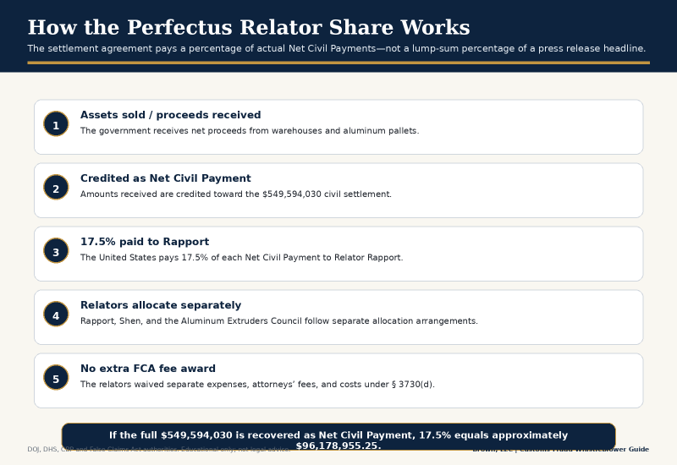
The settlement pays the relator share as Net Civil Payments are collected.
DOJ’s press release says the relator share will be 17.5% of settlement proceeds returned to CBP. The settlement agreement is more precise: as the United States receives any Net Civil Payment, it pays 17.5% to Relator Rapport. The three relators then follow their separate agreements concerning allocation.
If the full $549,594,030 is ultimately collected as Net Civil Payment, 17.5% equals approximately $96,178,955.25. That is useful arithmetic, but it should not be written as though the full amount has already been paid to the relators.
The agreement also states that no other relator-share payments will be made by the United States for the covered matters and that the relators waived separate claims for FCA expenses, attorneys’ fees, and costs.
Why a Trade Association Could Be a Relator
The Aluminum Extruders Council’s participation is a major lesson for U.S. manufacturers and competitors.
The FCA does not limit relators to employees. A domestic producer, competitor, association, customer, broker, vendor, or consultant may have standing if it possesses original or materially additive information and clears the first-to-file and public-disclosure rules. Industry participants can sometimes identify customs fraud from pricing, trade data, product specifications, physical inventory, supplier relationships, or evidence that imports are economically impossible unless duties are being avoided.
But a low market price alone is not enough. A viable case needs a specific false entry mechanism and proof connecting the defendant to the information submitted to CBP.
What Evidence Made This Type of Case Provable?
The evidence in a Perfectus-style case may include:
- Customs Form 7501 entries describing the goods;
- product specifications showing the merchandise remained covered aluminum extrusions;
- photographs and physical evidence of the spot-welded structures;
- documents showing there were no independent customers and no actual pallet sales;
- warehouse ownership, storage records, and stockpile data;
- related-party contracts and invoices;
- wire transfers and shell-company flows;
- annual reports and investor statements describing supposed demand;
- internal communications about product design, duty orders, melting facilities, and entry treatment;
- witnesses who understood the manufacturing, import, sales, and storage arrangements.
Whistleblowers do not need to possess every record. They do need to explain how the scheme worked, where the evidence is, who controlled it, and why the customs declarations were false.
Five Legal Lessons From the Perfectus Case
- Sham engineering does not create a lawful exclusion. Product engineering cannot lawfully convert covered merchandise into an excluded finished good when the “finished product” is a sham with no genuine commercial function.
- Civil and criminal theories can proceed together. Customs fraud can trigger an FCA case, wire-fraud charges, customs-document offenses, money laundering, restitution, and forfeiture.
- Warehouses and related entities can matter. Storage companies are not necessarily passive when they knowingly facilitate stockpiling, asset concealment, related-party transactions, or the customs scheme.
- Collectability and assets matter. The civil settlement depends on warehouse and aluminum sales, not simply a theoretical damages number.
- Competitors and trade associations can be powerful relators. They can identify economically impossible pricing, sham finished products, and market harm that insiders within the importer may not report.
What Perfectus Means for Current Customs Whistleblowers
The case is especially relevant to insiders who see merchandise modified, packaged, labeled, or routed to create an artificial duty exclusion. High-risk patterns include:
- a product is lightly assembled only to claim it is a finished good outside an AD/CVD order;
- there is no real market for the purported finished product;
- affiliated entities create circular sales or fake customers;
- inventory is stockpiled indefinitely and later melted, disassembled, or converted;
- the broker is given a sanitized product description while engineers or sales teams know the real identity;
- executives compare duty savings to storage or conversion costs;
- warehouses, shell importers, and related entities are used to isolate liability;
- a company cancels or reroutes shipments when inspections or scope questions arise.
Why Brown, LLC for a Perfectus-Style Customs Fraud Case?
A Perfectus-style case requires more than an allegation that tariffs were avoided. Counsel must understand the customs obligation, the merchandise, the duty order, the entry statements, the corporate relationships, the money flows, the criminal risk, the asset picture, and the qui tam filing rules.
Brown, LLC approaches customs fraud matters as full enforcement cases. Led by former FBI Special Agent and Legal Advisor Jason T. Brown and supported by former DOJ Civil Fraud experience, the firm can evaluate the reverse-FCA theory, build a damages and collectability model, coordinate with technical customs professionals, preserve first-to-file status, and present the case to DOJ and CBP.
Speak with the Lawyers at Brown, LLC Today!
Over $1 billion in aggregate judgments and settlements for our clients in state and federal courts. We fight for maximum damages and results.
The firm also evaluates whether a direct CBP report, EAPA allegation, DOJ Corporate Whistleblower submission, or parallel strategy is appropriate—but will not substitute an agency tip for the sealed qui tam filing when the FCA reward path should be preserved.
Frequently Asked Questions
What did Perfectus Aluminum agree to pay?
The settlement agreement fixes the civil FCA amount at $549,594,030, attributed to warehouse sales and aluminum-pallet sales.
Was Perfectus criminally convicted?
Yes. Six related companies were convicted in 2021 of conspiracy, wire fraud, and passing false papers through a customhouse. The Perfectus entities were also convicted of international promotional money laundering.
What was the $1.836 billion figure?
That was the criminal restitution ordered to CBP, separate from the later civil FCA settlement.
How much did the whistleblowers receive?
The agreement provides a 17.5% share of Net Civil Payments actually received, paid by the United States to Relator Rapport and allocated among relators under separate arrangements. Full-collection arithmetic is about $96.18 million, but collection and distribution should not be assumed complete.
Who filed the Perfectus qui tam cases?
Mike Rapport, Eric Shen, and the Aluminum Extruders Council filed separate FCA actions that were later consolidated.
Why were the aluminum pallets allegedly false finished goods?
DOJ said the structures were merely extrusions spot-welded to look like pallets, had no real customers, and were never sold as pallets.
Can a trade association file a qui tam case?
Potentially. The FCA does not limit relators to employees, but first-to-file, public disclosure, originality, and representation requirements apply.
What is the reverse False Claims Act theory?
It alleges that false records or concealment were used to avoid duties owed to the United States rather than to obtain a government payment.
Can customs fraud lead to criminal charges?
Yes. Perfectus involved conspiracy, wire fraud, false customs papers, money laundering, forfeiture, and restitution in addition to the civil FCA case.
Should a competitor report directly to CBP?
Not before obtaining legal advice if it wants to preserve a qui tam reward. EAPA or CBP reporting may be useful, but they are not substitutes for filing an FCA complaint under seal.
Bottom Line
Perfectus Aluminum is not simply a large tariff settlement. It is a case study in how product design, false customs entries, related-party transactions, warehouses, money laundering, criminal prosecution, forfeiture, and whistleblower litigation can converge.
Its central lesson is straightforward: changing the shape or label of merchandise does not lawfully change its duty treatment when the “finished product” is a sham and the government receives false information. For an insider, competitor, customs broker, trade association, warehouse employee, or supplier who sees a similar pattern, the first legal decision is how to preserve the evidence and file in the correct reward lane before another source or relator reaches the government first.
Why customs and tariff fraud is quickly becoming one of the most active whistleblower lanes under the False Claims Act. Read here.
Related Brown, LLC Resources
[R1] Customs and Tariff Fraud Is Now a False Claims Act Frontier: https://ifightforyourrights.com/blog/customs-and-tariff-fraud-is-becoming-a-major-whistleblower-lane-under-the-false-claims-act/
[R2] Customs Fraud Whistleblower Lawyer: https://ifightforyourrights.com/whistleblower-lawyer/customs-fraud-whistleblower/
[R3] Everything You Need to Know About the False Claims Act: https://ifightforyourrights.com/whistleblower-lawyer/everything-you-need-to-know-about-false-claims-act/
[R4] What Is a Qui Tam Lawsuit?: https://ifightforyourrights.com/blog/what-is-a-qui-tam-lawsuit/
Sources
[1] DOJ, Perfectus Aluminum $549.5M FCA Settlement: https://www.justice.gov/opa/pr/perfectus-aluminum-inc-and-related-companies-agree-pay-5495m-settle-false-claims-act
[2] DOJ, Perfectus Settlement Agreement: https://www.justice.gov/opa/media/1440366/dl
[3] U.S. Attorney’s Office, Six Companies Ordered to Pay $1.83B Restitution: https://www.justice.gov/usao-cdca/pr/six-southern-california-companies-ordered-pay-183-billion-restitution-scheming-avoid
[4] U.S. Attorney’s Office, Six Companies Convicted in Aluminum Duty Scheme: https://www.justice.gov/usao-cdca/pr/six-southern-california-companies-convicted-scheming-avoid-payment-18-billion-duties
[5] U.S. Attorney’s Office, 2019 Perfectus / China Zhongwang Indictment: https://www.justice.gov/usao-cdca/pr/federal-indictment-alleges-scheme-avoid-payment-18-billion-anti-dumping-duties-chinese
[6] DOJ and DHS, A Resource Guide to Trade Fraud Enforcement: https://www.justice.gov/fraud/media/1452331/dl?inline=
[7] 31 U.S.C. § 3729: https://uscode.house.gov/view.xhtml?edition=prelim&num=0&req=granuleid%3AUSC-prelim-title31-section3729
[8] 31 U.S.C. § 3730: https://uscode.house.gov/view.xhtml?edition=prelim&num=0&req=granuleid%3AUSC-prelim-title31-section3730
[9] Brown, LLC, Customs Fraud Whistleblower Practice: https://ifightforyourrights.com/whistleblower-lawyer/customs-fraud-whistleblower/
Attorney advertising. General information only; not legal advice. Prior results do not guarantee a similar outcome.