Skip to main content

NJ CEPA Explained: New Jersey Whistleblower Rights, Retaliation Claims, Deadlines, and Remedies

Table of Contents
Quick Answer
New Jersey’s Conscientious Employee Protection Act, usually called NJ CEPA or CEPA, is the state’s core whistleblower retaliation statute. It protects employees who disclose unlawful conduct, provide information to a public body, or object to and refuse to participate in illegal, fraudulent, or unsafe practices. It also reaches deception and misrepresentation directed at shareholders, investors, clients, patients, customers, employees, retirees, pensioners, and government entities, and it includes special protection for licensed or certified health care professionals who reasonably believe patient care is improper. [N.J.S.A. 34:19-3]
A strong CEPA case is usually not about whether an employee used the word “whistleblower.” It is about whether the employee can tie the complaint or refusal to a specific legal rule, professional standard, or clear mandate of public policy, show a real adverse employment action, and prove a causal link between the two as well as damages. New Jersey courts treat CEPA as a remedial statute and construe it liberally, but they also require precision in hitting the proofs, so it’s critical how you frame the complaint.
That combination is why NJ CEPA generates so much confusion online. Many pages explain the statute at a surface level. Far fewer explain the written-notice rule, the one-year deadline, the waiver trap, the protection for watchdog employees, the patient-care framework, and the difference between a specific protected complaint and generalized workplace unhappiness. This guide comprehensively covers those points in one place.
There’s a saying in court that he who represents himself has a fool for a client. While this guide is meant to be serve as informative in educating people about their New Jersey whistleblower rights, you may not rely on it and in order to evaluate your case and advance it, it’s strongly recommended to retain one of the best New Jersey CEPA law firms to work you through the process. Most whistleblower law firms, like Brown, LLC will typically take NJCEPA matters on a contingency basis and offer free, confidential consultations.
What NJ CEPA Protects
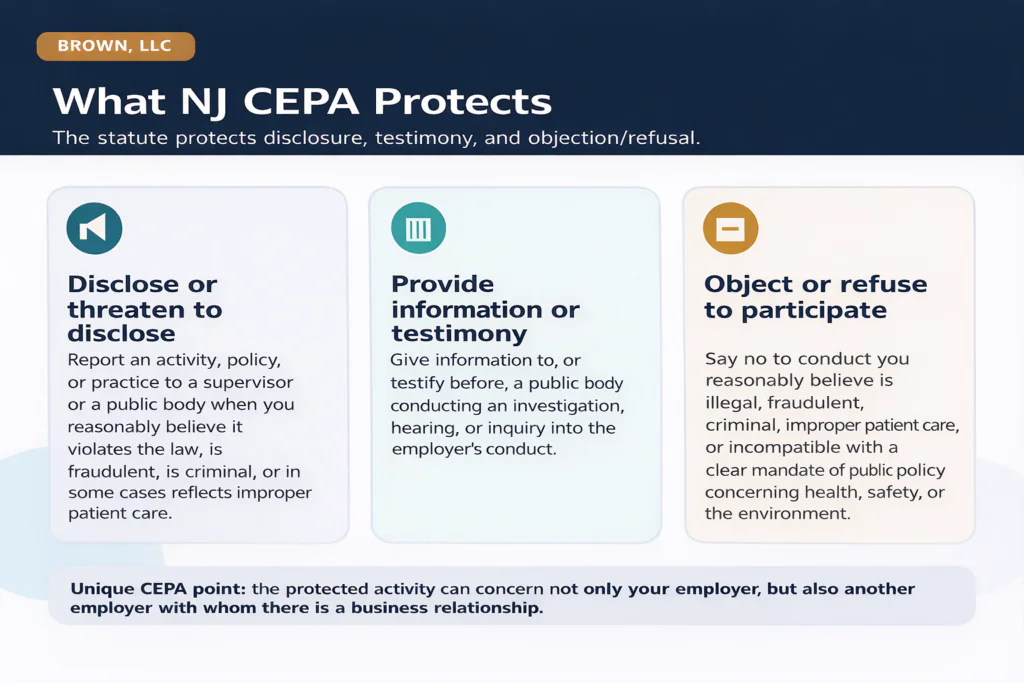
CEPA protects three broad categories of whistleblowing activity. First, an employee can disclose, or threaten to disclose, an activity, policy, or practice to a supervisor or a public body. Second, an employee can provide information to, or testify before, a public body that is investigating or hearing about the employer’s conduct. Third, an employee can object to, or refuse to participate in, conduct the employee reasonably believes is illegal, fraudulent, criminal, improper patient care, or incompatible with a clear mandate of public policy concerning public health, safety, welfare, or environmental protection. [N.J.S.A. 34:19-3]
Speak with the Lawyers at Brown, LLC Today!
Over 100 million in judgments and settlements trials in state and federal courts. We fight for maximum damage and results.
CEPA is broader than many people realize. It applies not only to wrongdoing by the employee’s direct employer, but also to conduct by another employer with whom there is a business relationship. It also does not require the employee to report only to government agencies. Internal complaints to a supervisor can qualify, and refusals to join in the conduct can qualify as well. [N.J.S.A. 34:19-3]
Any type of disclosure is an important to step. The company has lawyers protecting its rights – you should retain counsel early to understand how to properly disclose in a manner that protects your rights. If you fail to do so properly then may waive protection and you certainly want to avoid an unforced error that’s avoidable.
Who Is Covered, and What Counts as Retaliation
CEPA’s definition of employer is broad. It includes private employers, the State, counties, municipalities, school districts, authorities, commissions, boards, and other public instrumentalities. [N.J.S.A. 34:19-2]
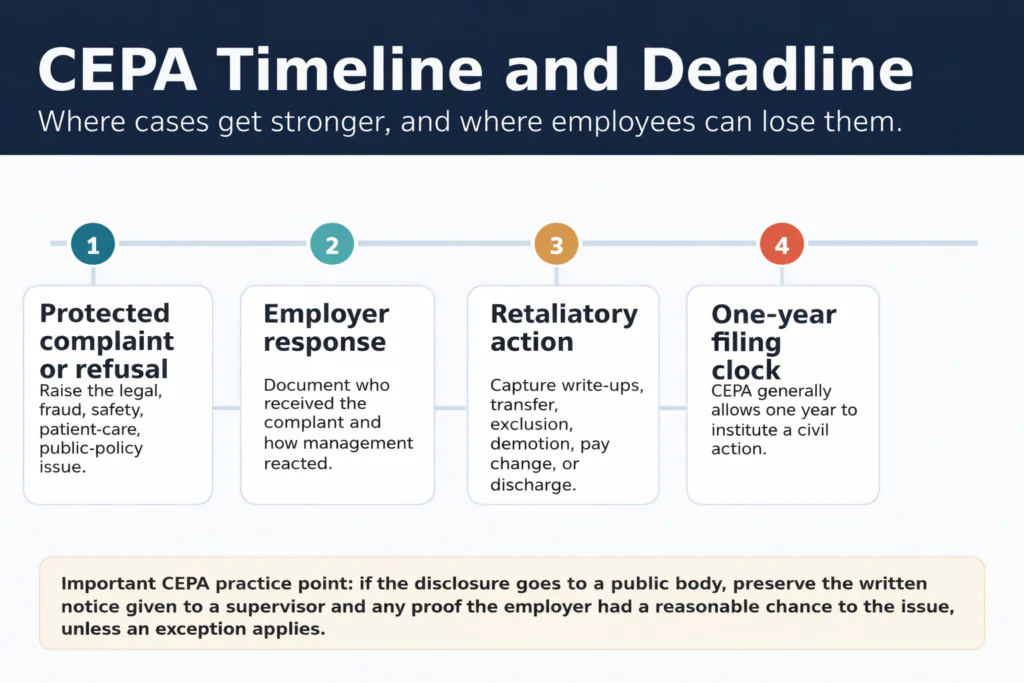
Retaliation is not limited to firing. New Jersey’s labor agency explains that retaliation can include a poor performance review, a salary change, increased oversight, changed job responsibilities, denial of a raise, exclusion from meetings, transfer, and similar acts that would deter a reasonable worker from asserting rights. That fits CEPA’s definition of retaliatory action, which reaches discharge, suspension, demotion, and other adverse employment action in the terms and conditions of employment. [N.J.S.A. 34:19-2; NJDOL Retaliation Protections]
That matters because many viable CEPA cases begin before a termination. A worker who is frozen out, stripped of responsibilities, buried under write-ups, or reassigned after raising legal or safety issues may already be in retaliation territory and have invokable rights.
The 4 Elements of a CEPA Claim
New Jersey courts generally analyze CEPA claims through a four-part framework. The employee must show: (1) a reasonable belief that the employer’s conduct violated a law, rule, regulation, or clear mandate of public policy; (2) protected whistleblowing activity; (3) an adverse employment action; and (4) a causal connection between the protected activity and the adverse action.
The first element often decides the case. Courts do not require proof that the employer actually broke the law. But the employee must still identify some authority that is closely related to the challenged conduct. A CEPA claim becomes stronger when the complaint references a statute, regulation, policy requirement, patient-care standard, ethical rule governing the employer’s conduct, or a clear public-policy source that can be measured.
It warrants repeating that the standard is the employee must show just a reasonable belief that there was a violation. So even if the employee was mistaken, but the employee had a good faith articulable basis for the reporting they may enjoy protections under NJCEPA.
The fourth element also deserves attention. Direct evidence of retaliatory motive is rare. Causation can be inferred from timing, the employer’s response to the complaint, a sudden change in treatment, an unusual investigation, or a paper trail that shows the complaint came first and discipline followed. [Roach]
You do not need to prove an actual violation, but you do need a real legal or public-policy hook
One of the most important CEPA rules is this: the employee does not have to prove the employer actually violated the law. The employee must instead show an objectively reasonable belief that the conduct violated a law, rule, regulation, or clear mandate of public policy. [Dzwonar; Hitesman]
That is a powerful rule for employees. It means a case does not fail merely because later discovery shows the employer found a loophole or because a regulator never issued a formal violation. At the same time, the rule is not limitless. The court acts as a gatekeeper and will require a substantial nexus between the complaint and some identifiable legal or policy standard. [Dzwonar]
This is why the best CEPA complaints are specific. They identify the statute, regulation, code provision, compliance requirement, or public-policy source that made the employee speak up. Vague objections about fairness, tone, management style, or office politics are usually not enough. [Battaglia; Hitesman]
Internal complaints, reports to public bodies, and the written-notice rule
Internal complaints matter under CEPA. A worker can engage in protected conduct by raising the issue to a supervisor. But when the employee discloses misconduct to a public body, CEPA adds an important procedural rule. The employee generally must first give written notice to a supervisor and a reasonable opportunity to correct the practice. [N.J.S.A. 34:19-4]
There are two important exceptions. Written notice is not required if the employee is reasonably certain the activity is already known to one or more supervisors, or if the employee reasonably fears physical harm and the situation is emergency in nature. [N.J.S.A. 34:19-4]
From a practical standpoint, this rule makes documentation critical. Preserve the email, letter, text message, incident report, or compliance submission that raised the issue. If the complaint was oral, send a confirming message. A CEPA case becomes harder when the employee remembers a complaint but cannot prove when, how, and to whom it was made.
Watchdog employees, compliance staff, safety personnel, and health care workers
Many employers argue that a worker was “just doing the job” or the reporting was in the performance of their duties and therefore was not engaged in protected whistleblowing. The New Jersey Supreme Court rejected that narrow view in Lippman v. Ethicon. CEPA protection extends to watchdog employees performing their regular duties. In other words, compliance, quality, audit, safety, and similar professionals do not lose protection just because speaking up is part of the role. [Lippman]
Health care cases have their own nuance. A licensed or certified health care professional can be protected when the employee reasonably believes the employer’s conduct constitutes improper quality of patient care. But the claim still must be tied to a governing law, rule, regulation, declaratory ruling, or professional code of ethics that actually supplies a meaningful standard for acceptable versus unacceptable patient care. [N.J.S.A. 34:19-3; Hitesman]
That means health care CEPA cases get stronger when the complaint points to a licensing rule, patient-safety regulation, hospital standard tied to law, or governing professional code that actually addresses the conduct in question.
What strong CEPA cases usually have in common
Successful CEPA cases tend to share the same structural features. The employee identifies a real law or public-policy source. The complaint or refusal is clear. The timing is documented. The retaliation is concrete. And the employer’s reaction helps explain motive.
Strong cases often include emails, reports, calendar invites, corrected records, witness accounts, performance history, and the exact documents showing what changed after the complaint. CEPA cases are won through specifics.
| Stronger CEPA fact pattern | Weaker CEPA fact pattern |
| Complaint identifies a statute, regulation, ethical rule, patient-care standard, or public-policy source tied to the conduct. [Dzwonar; Hitesman] | Complaint is vague, conclusory, or sounds like generalized workplace unhappiness. [Battaglia] |
| Employee disclosed, testified, objected, or refused in a way the employer can trace. [N.J.S.A. 34:19-3] | Employee never clearly complained, or cannot show who received the complaint and when. |
| Employer responded with demotion, transfer, exclusion, discipline, pay consequences, or discharge. [N.J.S.A. 34:19-2; NJDOL Retaliation Protections] | No material adverse action followed, or the record does not show a real change in the terms and conditions of employment. |
| Timeline and surrounding circumstances support causation. [Roach] | The action is too remote in time, too attenuated, or supported by unrebutted evidence of a separate legitimate reason. |
| Claim is analyzed early for overlap and waiver issues. [N.J.S.A. 34:19-8; Young] | The case is filed late or without evaluating how CEPA affects parallel state/common-law claims. |
Common Reasons CEPA Claims Fail
New Jersey courts have repeatedly warned that CEPA is not a catch-all civility code. Complaints about trivial matters, minor issues, vague unfairness, or generalized dissatisfaction do not fit the statute. [Battaglia]
A claim can also fail when the employee cannot identify the legal or policy standard behind the complaint. For clear-mandate and patient-care theories in particular, the court expects an authority that actually governs the employer’s conduct. [Hitesman]
And lawful business disagreement is not enough. In Young v. Schering, the Court made clear that CEPA does not provide a remedy every time an employee disagrees with lawful research or business judgments. [Young]
The lesson is straightforward. Precision beats outrage. A carefully documented complaint tied to a real legal or public-policy standard is far more valuable than a broad accusation that the employer acted badly.
NJ CEPA Statute of Limitations and Remedies
CEPA has a short filing deadline. An aggrieved employee or former employee may file a civil action within one year of the violation. The statute also expressly provides for a jury trial if any party requests one. [N.J.S.A. 34:19-5]
The remedies are significant. CEPA allows injunctions, reinstatement, restoration of fringe benefits and seniority, compensation for lost wages and other remuneration, costs, attorney’s fees, punitive damages, and civil fines. [N.J.S.A. 34:19-5]
The damages question can extend beyond a simple termination case. In Donelson v. DuPont Chambers Works, the New Jersey Supreme Court held that constructive discharge is only one path to lost wages under CEPA. If unlawful retaliation proximately causes the employee’s damages, the employer can be responsible for those losses. [Donelson]
The one-year deadline is one of the biggest traps in CEPA practice. It is short. It is often litigated. And waiting for an internal investigation to finish does not automatically protect the claim.
The CEPA Waiver Trap: Think About Claim Selection Early
CEPA’s waiver provision is one of the statute’s most important strategy points. The statute says that filing a CEPA action is deemed a waiver of rights and remedies available under other contracts, collective bargaining agreements, state law, rules, regulations, or the common law. [N.J.S.A. 34:19-8]
That does not mean every related claim disappears. In Young v. Schering, the New Jersey Supreme Court held that sufficiently distinct common-law tort and contract claims can survive when they are truly independent from the CEPA retaliation theory. [Young]
Still, waiver issues should be analyzed before a complaint is filed. A rushed CEPA filing without a deliberate claim map can create avoidable problems.
Key New Jersey CEPA Cases That Shape Successful Claims
The best way to understand CEPA is to understand the cases that define it. These are the decisions that repeatedly matter in motion practice, briefing, and settlement analysis.
| Case | Why it matters |
| Dzwonar v. McDevitt (N.J. 2003) | Set out the core four-element framework and explained that the employee need not prove an actual legal violation, but must show an objectively reasonable belief tied to an identifiable legal or policy source. |
| Estate of Roach v. TRW (N.J. 2000) | Confirmed that causal connection may be inferred from the surrounding circumstances rather than direct admissions. |
| Battaglia v. UPS (N.J. 2013) | Warned that vague, conclusory, trivial, or generalized complaints are not what CEPA protects. |
| Lippman v. Ethicon (N.J. 2015) | Held that watchdog employees remain protected even when speaking up is part of their regular duties. |
| Hitesman v. Bridgeway (N.J. 2014) | Required a meaningful governing standard for patient-care and clear-mandate claims, and reinforced that CEPA is remedial and construed liberally. |
| Young v. Schering (N.J. 1995) | Explained that CEPA’s waiver provision does not automatically bar claims that are sufficiently distinct from the retaliation theory. |
| Donelson v. DuPont Chambers Works (N.J. 2011) | Held that constructive discharge is not the only route to lost-wage recovery under CEPA. |
What to Do After Whistleblower Retaliation in New Jersey
If you think you have an NJ CEPA claim, move in a disciplined way.
- Preserve the complaint. Save the email, report, text, policy note, or message that raised the issue.
- Build a timeline. Mark the complaint date, every follow-up, every performance change, and every retaliatory act.
- Identify the legal hook. Ask what statute, regulation, rule, ethics code, patient-care standard, or public-policy source made the conduct improper.
- Preserve written notice if the disclosure went to a public body. CEPA’s notice rule can matter. [N.J.S.A. 34:19-4]
- Collect comparator facts. What changed after you complained? Who was treated differently?
- Act before the one-year deadline expires. [N.J.S.A. 34:19-5]
- Evaluate waiver before filing. CEPA can affect parallel state and common-law claims. [N.J.S.A. 34:19-8; Young]
Perhaps, the most important step is to retain experienced New Jersey whistleblower counsel to take you through the process step by step and protect your rights.
Frequently Asked Questions About NJ CEPA
What is NJ CEPA?
NJ CEPA is the New Jersey Conscientious Employee Protection Act. It is New Jersey’s main whistleblower retaliation statute. It protects employees who disclose unlawful conduct, provide information to a public body, or object to and refuse to participate in conduct they reasonably believe is illegal, fraudulent, criminal, improper patient care, or contrary to a clear mandate of public policy. [N.J.S.A. 34:19-3]
What counts as retaliation under New Jersey whistleblower law?
Retaliation can include termination, demotion, suspension, transfer, poor performance reviews, changes in pay, increased scrutiny, changed responsibilities, exclusion from meetings, and other adverse changes in the terms and conditions of employment. It is broader than firing alone. [N.J.S.A. 34:19-2; NJDOL Retaliation Protections]
Do I have to be fired to bring a CEPA claim?
No. CEPA is not limited to discharge cases. The statute and state guidance both recognize a broader range of adverse actions, including demotion, transfer, discipline, and other adverse employment changes. [N.J.S.A. 34:19-2; NJDOL Retaliation Protections]
Do I have to prove my employer actually broke the law?
No. Under Dzwonar and later cases, a CEPA plaintiff does not have to prove an actual legal violation. The plaintiff must show an objectively reasonable belief tied to an identifiable law, rule, regulation, or clear mandate of public policy. [Dzwonar; Hitesman]
Is an internal complaint enough under NJ CEPA?
Often, yes. CEPA protects disclosures to supervisors as well as disclosures to public bodies, and it protects objections and refusals too. But if the employee discloses to a public body, the written-notice rule in N.J.S.A. 34:19-4 may apply unless an exception is present. [N.J.S.A. 34:19-3; N.J.S.A. 34:19-4]
Do compliance, quality, audit, safety, and watchdog employees qualify for CEPA protection?
Yes. In Lippman, the New Jersey Supreme Court held that CEPA’s protections extend to the performance of regular job duties by watchdog employees. Compliance and safety professionals do not lose protection simply because reporting issues is part of the job. [Lippman]
How long do I have to file an NJ CEPA lawsuit?
The statute gives an aggrieved employee or former employee one year to institute a civil action. That is a short limitations period, so timing should be analyzed early. [N.J.S.A. 34:19-5]
What damages can I recover in a CEPA case?
Potential remedies include injunctive relief, reinstatement, restored benefits and seniority, lost wages and other remuneration, costs, attorney’s fees, punitive damages, and civil fines. [N.J.S.A. 34:19-5]
Can filing a CEPA claim affect my other claims?
Yes. CEPA has a waiver provision. Filing a CEPA action can waive overlapping rights and remedies under other state-law or common-law theories, although distinct claims may survive if they are sufficiently independent. [N.J.S.A. 34:19-8; Young]
Can a CEPA case succeed if retaliation forced me onto leave or made me unable to keep working?
Potentially, yes. In Donelson, the New Jersey Supreme Court held that constructive discharge is not the only route to lost-wage recovery under CEPA. If retaliation proximately caused the loss, the damages analysis can go beyond a simple resignation theory. [Donelson]
Do New Jersey employers have to post CEPA notices?
Yes. CEPA requires employers to conspicuously display, and annually distribute to employees, notice of employee protections, rights, obligations, and procedures under the statute. The state’s poster materials also state that employers with 10 or more employees must distribute the notice once each year. [N.J.S.A. 34:19-7; CEPA Notice Poster]
Bottom line
NJ CEPA is one of the strongest employee whistleblower statutes in the country, but it rewards precision. The best cases identify the governing rule, document the protected complaint or refusal, capture the retaliation as it unfolds, and move before the one-year deadline runs out. [N.J.S.A. 34:19-3 to 34:19-5; Dzwonar; Battaglia]
Need to evaluate a New Jersey whistleblower retaliation claim? The decisive documents are usually the complaint, the legal or public-policy hook, the timeline, and the employer’s response.
Authorities cited in this guide
- [N.J.S.A. 34:19-2] N.J.S.A. 34:19-2 (definitions, including employer and retaliatory action).
- [N.J.S.A. 34:19-3] N.J.S.A. 34:19-3 (protected whistleblowing activity and prohibited retaliation).
- [N.J.S.A. 34:19-4] N.J.S.A. 34:19-4 (written notice rule for disclosures to a public body, with exceptions).
- [N.J.S.A. 34:19-5] N.J.S.A. 34:19-5 (one-year filing period, jury trial, and remedies).
- [N.J.S.A. 34:19-8] N.J.S.A. 34:19-8 (waiver provision).
- [N.J.S.A. 34:19-7] N.J.S.A. 34:19-7 (posting and annual distribution of CEPA notices).
- [CEPA Notice Poster] Official New Jersey CEPA notice/poster materials describing required posting and annual notice distribution.
- [NJDOL Retaliation Protections] New Jersey Department of Labor, My Work Rights | Retaliation Protections.
- [Dzwonar] Dzwonar v. McDevitt (N.J. 2003).
- [Roach] Estate of Roach v. TRW (N.J. 2000).
- [Battaglia] Battaglia v. United Parcel Service, Inc. (N.J. 2013).
- [Lippman] Lippman v. Ethicon, Inc. (N.J. 2015).
- [Hitesman] Hitesman v. Bridgeway Inc. (N.J. 2014).
- [Young] Young v. Schering Corporation (N.J. 1995).
- [Donelson] Donelson v. DuPont Chambers Works (N.J. 2011).