
New FDA-SEC Agreement Puts Pharma and Biotech Securities Fraud in the Spotlight
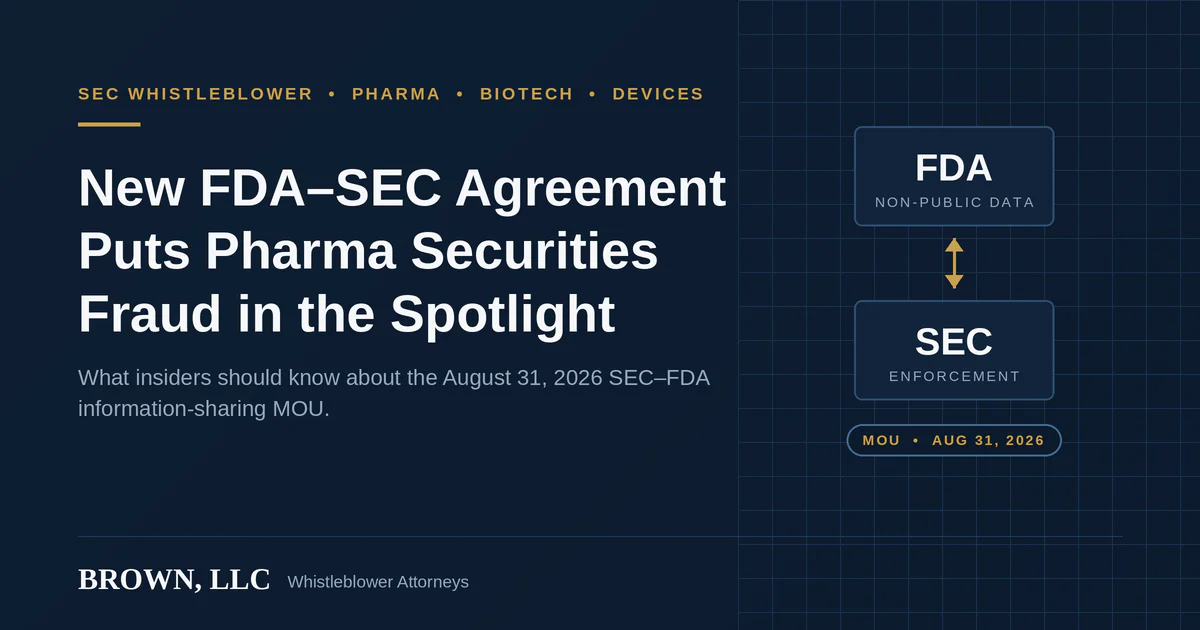
Table of Contents
Key Takeaways
- On August 31, 2026, the SEC and FDA signed a three-year Memorandum of Understanding (MOU) creating a formal channel for sharing non-public information about FDA-regulated companies—including clinical trial results and FDA review status.
- The SEC may now use non-public FDA information to review public-company filings and in enforcement investigations, making it far easier to compare what a company told the FDA with what it told Wall Street.
- The MOU does not create a new “FDA whistleblower reward.” Awards still flow through the existing SEC Whistleblower Program: 10% to 30% of monetary sanctions when sanctions exceed $1 million, with anonymity available through counsel.
- The strongest FDA-SEC whistleblower cases come from insiders—scientists, regulatory affairs, clinical operations, biostatistics, quality, pharmacovigilance, and finance professionals—who can prove management knew X while telling investors Y.
- The same facts can sometimes support a False Claims Act qui tam case when the misconduct caused Medicare, Medicaid, or another government payor to pay for the drug or device.
When a Drug Company Tells Investors One Story—and the FDA Knows Another
A biotech company tells investors its pivotal clinical trial was a success. Internally, the biostatisticians know the primary endpoint failed.
A pharmaceutical company says FDA approval remains on track. Internally, regulatory affairs has already received a Complete Response Letter, a clinical hold, or FDA meeting minutes identifying a significant obstacle. A medical device company promotes the safety and effectiveness of its product while employees are reviewing adverse event reports, Form 483 observations, or a Warning Letter that paints a materially different picture.
Those situations raise more than FDA compliance issues. When a publicly traded company makes materially false or misleading statements to investors, they may present securities fraud issues—and potential SEC whistleblower cases.
Related: Brown, LLC secured two of the year’s largest individual recoveries — a $950M settlement against Raytheon and $350M against Walgreens. Learn about our False Claims Act practice →
On August 31, 2026, the U.S. Securities and Exchange Commission and the U.S. Food and Drug Administration signed a Memorandum of Understanding establishing a formal framework for sharing information about FDA-regulated companies, products, and activities. The MOU specifically identifies false or misleading statements to the investing community about the status of FDA review, product approvals, clinical trial results, and other issues within the FDA’s authority as the kind of information the agencies intend to exchange. In announcing the agreement, SEC Chairman Paul S. Atkins said that FDA-related disclosures by public companies “have a significant impact on our markets.”
What the SEC–FDA Memorandum of Understanding Actually Says
The MOU runs six pages, and the enforcement pieces are spelled out. Section II states that the SEC reviews public-company disclosures, including situations where a company engaged in FDA-regulated activities may have disseminated false or misleading statements about FDA review status, product approvals, or clinical trial results. Section III lays out how the two agencies will actually work together:
- Information sharing on request. Each agency intends to share appropriate information about FDA-regulated products, activities, and the firms that manufacture, distribute, and sell them, and each will maintain a mechanism (such as a dedicated mailbox and secure file transfer) for requests and non-public transfers.
- FDA referrals to the SEC. The FDA Office of the Chief Counsel is designated as the FDA lead for referrals of potential violations to the SEC, and as the FDA lead when an SEC case is in civil or judicial adjudication.
- Named points of contact. The SEC will maintain at least one point of contact in its Division of Enforcement and one in its Division of Corporation Finance; the FDA will maintain a point of contact in its Office of the Chief Counsel. The initial SEC contacts include an Associate Director in the Corporation Finance Disclosure Review Program and an Assistant Chief Counsel in the Division of Enforcement.
- SEC use of non-public FDA information. Under 21 C.F.R. § 20.85, the SEC may use non-public FDA records to inform any public-company filing review and in connection with any enforcement investigation, proceeding, or civil action within its jurisdiction.
- Confidentiality safeguards. The SEC may not re-disclose non-public FDA information to anyone outside the SEC without the FDA’s written permission, and the FDA will not share trade secrets or confidential commercial information that federal law prohibits it from disclosing.
| What the MOU does | What the MOU does not do |
| Creates a standing, documented channel for the FDA to share non-public regulatory information with the SEC, and vice versa | Create any new liability, disclosure rule, private cause of action, or FDA whistleblower award program |
| Designates the FDA Office of the Chief Counsel as the lead for referring potential violations to the SEC | Impose binding, enforceable obligations on either agency (Section V.2) |
| Lets the SEC use FDA records in filing reviews and enforcement investigations, proceedings, and civil actions | Cover requests made before August 31, 2026, public information, testimony requests, or subpoena responses |
| Runs for three years and may be extended or modified by mutual written consent | Permit the FDA to share protected trade secrets or confidential commercial information |
What Changes for Pharmaceutical, Biotech, and Medical Device Whistleblowers
For decades the FDA and the SEC occupied different regulatory worlds. The FDA knew what happened in clinical trials, submissions, inspections, and meeting rooms. The SEC knew what public companies said in 10-Ks, 8-Ks, press releases, and earnings calls. Unless a case became a criminal referral, the two records were rarely laid side by side.
The MOU changes that. When an SEC attorney reviewing a biotech’s disclosures wants to know what the FDA actually told the company, there is now a named contact, a request template, and a secure transfer process to get the answer.
Speak with the Lawyers at Brown, LLC Today!
Over $1 billion in aggregate judgments and settlements for our clients in state and federal courts. We fight for maximum damages and results.
The SEC still cannot read every FDA file, and it will not go looking without a reason. The agency received roughly 27,000 whistleblower tips in fiscal year 2025, and only about 11% concerned corporate disclosures and financials. Someone has to tell the SEC where to look. A whistleblower who can point to which FDA communication, which data set, and which executive presentation contradicts the public story has handed the SEC a ready-made request to send to the FDA.
FDA Red Flags That Can Become Securities Fraud Issues
Most FDA setbacks are just that: setbacks. The problem arises when a public company’s statements to investors do not square with what the company knows. Below are FDA-regulated events that pharmaceutical, biotech, and device insiders see regularly, paired with the kind of investor-facing statement that can turn each one into an SEC whistleblower case.
| FDA-regulated event | Potential investor-facing mismatch |
| Complete Response Letter (CRL) or refuse-to-file letter | Company describes the letter as “minor” or “addressable” when it requires new clinical trials, or says the application is “under review” when it was not accepted for filing |
| Clinical hold | Hold is not disclosed, or is disclosed without its safety rationale, while the company touts the trial’s progress |
| Failed primary endpoint; post hoc or subgroup reanalysis | Trial publicly characterized as “positive” or “meeting objectives” when the prespecified primary endpoint was missed |
| Form 483 observations, Warning Letter, or Official Action Indicated (OAI) classification | Described as “routine” while the company knows it threatens approval timing, supply, or a major customer |
| FDA meeting minutes (Type A/B/C, pre-NDA, pre-BLA) or advisory committee feedback | Publicly characterized as “constructive” or “aligned” when the minutes reflect that the FDA rejected the proposed pathway or required additional studies |
| Data-integrity findings at a clinical site, CRO, or laboratory | Not disclosed, while the company relies on the affected data in investor presentations |
| cGMP or Quality System failures, import alerts, recalls (including Class I device recalls) | Revenue guidance or supply assurances that ignore a manufacturing problem management knows is unresolved |
| Safety signals: DSMB actions, serious adverse events, boxed-warning or REMS discussions, medical device reports (MDRs) | Safety profile described as “clean” or “consistent with prior studies” when internal pharmacovigilance data show otherwise |
| 510(k), De Novo, or PMA status for a medical device | Clearance or approval described as imminent or received when the submission is deficient, withdrawn, or has drawn an additional-information request |
None of these fact patterns automatically establishes securities fraud. The legal analysis turns on the actual statements, materiality, knowledge (scienter), timing, and evidence. What the table does show is where to start looking for proof.
What Brown, LLC Is Looking for in an FDA-SEC Whistleblower Case
Brown, LLC is not looking for every FDA regulatory violation or workplace complaint. We are interested in significant cases involving a current or former insider with firsthand knowledge that an FDA-regulated public company may have materially misled investors.
1. You are an insider with real visibility
You may work—or previously have worked—in clinical development, clinical operations, regulatory affairs, biostatistics, medical affairs, medical writing, pharmacovigilance or drug safety, quality assurance or quality control, manufacturing or CMC, research and development, compliance, finance, investor relations, or senior management. You may also have been at a contract research organization (CRO) or contract manufacturer that did the work for the public company. We want to know how close you were to the information and how you know what happened.
2. You know what management knew
A strong case is not simply: “The company had an FDA problem.” It is far more significant if you can establish that senior management knew about the problem before making contrary or misleading statements to investors.
3. There is a meaningful public statement to compare against the internal facts
The relevant statement may appear in an SEC filing (10-K, 10-Q, 8-K, S-1, or proxy), an earnings call, a press release, an investor or J.P. Morgan-style conference presentation, a topline clinical trial announcement, a statement about an NDA, BLA, 510(k), or PMA submission, or a representation about anticipated FDA approval, safety, or efficacy.
4. There are documents or other strong evidence
We are particularly interested when an insider lawfully possesses, has access to, or can identify contemporaneous evidence such as FDA correspondence, meeting minutes, clinical study reports, statistical analysis plans and outputs, internal emails, executive or board presentations, safety databases, quality and deviation records, regulatory strategy documents, or communications showing what executives knew and when.
5. The issue is material
A minor disagreement with an FDA inspector is ordinarily not what we are looking for. We are interested in information involving a lead drug candidate, a pivotal or registrational trial, a material FDA submission, a significant approval milestone, a serious safety problem, a substantial manufacturing issue, or another development that could meaningfully affect the company’s stock price or investors’ decisions.
Clinical Trial Fraud and False Statements About Trial Results
Clinical trial fraud whistleblower cases deserve a closer look. The MOU specifically identifies clinical trial results as an example of FDA-regulated information about which false or misleading representations may affect investors. Fact patterns worth examining include:
- misrepresenting whether a prespecified clinical endpoint was achieved;
- concealing materially unfavorable trial data or unblinding results;
- misrepresenting safety or efficacy data, or omitting serious adverse events;
- concealing significant data-integrity concerns at a trial site, CRO, or laboratory;
- publicly characterizing trial results differently from how they were understood internally; or
- making statements about regulatory submissions or approval prospects that materially conflict with known facts.
None of those circumstances automatically establishes securities fraud. The legal analysis depends on the actual statements, materiality, knowledge or scienter, timing, and evidence.
The CytoDyn prosecution shows what insider evidence can do. In December 2024, a federal jury in Maryland convicted the former CEO of CytoDyn Inc., a publicly traded biotechnology company, of securities fraud, wire fraud, and insider trading. According to the Department of Justice, between 2018 and 2021 he intentionally misled investors about an investigational HIV and COVID-19 drug’s prospects for FDA approval—including the status of the company’s FDA submissions—to inflate the stock price and attract new investors, then sold 4.8 million of his own shares for roughly $4.4 million. In January 2026 he was sentenced to 30 months in federal prison and ordered to pay more than $5.3 million in restitution. The case was investigated by the FBI, the FDA’s Office of Criminal Investigations, and the U.S. Postal Inspection Service—the same FDA–securities overlap the MOU now puts on paper.
False Statements About FDA Approval Can Become Securities Fraud
Few events move a biotech company’s valuation as dramatically as FDA approval—or the failure to obtain it. That is why the SEC pays close attention to statements about the FDA regulatory process, PDUFA dates, and approval timelines.
The SEC has been bringing these cases for more than twenty years. In SEC v. Biopure Corporation, the SEC alleged that the company and three senior executives made materially misleading statements about efforts to obtain FDA approval of a synthetic blood product while the company was raising money from investors. According to the SEC’s complaint, the FDA placed a clinical hold on the company’s trauma trials in April 2003 because of safety concerns, and the company concealed the hold for eight months while publicly discussing its plans for trauma approval. Then, in July 2003, the FDA informed the company that it had not approved the product for orthopedic surgery and raised serious concerns about the reliability of the submission—yet the company publicly described the FDA’s communication as good news, and its stock rose more than 20%. The former CEO ultimately consented to a permanent injunction and a civil penalty.
Whistleblower tip: If you’ve witnessed Medicare or Medicaid billing fraud at your employer, you may qualify as a qui tam relator with a potential share of the government’s recovery. See our Medicare & Medicaid fraud practice →
When a company recharacterizes an FDA communication, the regulatory affairs and clinical professionals who read the actual letter are often the only people outside the executive suite who know the truth.
What About Manufacturing, Quality-Control, Data-Integrity, and Safety Problems?
The employee who discovers a major securities issue may never have worked in securities. A quality-control specialist may uncover the underlying problem. A scientist may identify compromised data. A manufacturing employee may know that a critical process repeatedly fails or that a facility received an OAI classification. A regulatory-affairs professional may receive significant FDA correspondence. A pharmacovigilance employee may observe a serious safety signal that never reaches the company’s public risk disclosures.
Those facts may begin as FDA, cGMP, or compliance issues. But when the company is publicly traded, another question should be asked: What is the company telling investors about the same issue? A supply-chain assurance, a revenue forecast for a product the company knows it cannot manufacture to specification, or a “no material adverse developments” statement can each become the misstatement that anchors an SEC case.
The Most Important Evidence: Internal Reality Versus External Representation
Step One: What happened?
Identify the actual clinical, FDA, manufacturing, safety, efficacy, approval, or regulatory problem, described the way the underlying documents describe it rather than the way the press release did.
Step Two: Who knew?
Identify the executives, regulatory personnel, scientists, board members, lawyers, disclosure-committee members, or others who received the information.
Step Three: When did they know?
Timing is everything here. The chronology must show what decisionmakers knew before the relevant investor-facing statement, financing, or insider stock sale.
Step Four: What did the company say afterward?
Identify the SEC filing, earnings call, press release, investor presentation, conference statement, or other public representation—and the date it was made.
Step Five: What proves the discrepancy?
Contemporaneous documents and firsthand testimony are what turn suspicion into a whistleblower submission the SEC can act on. Under the MOU, even a precise pointer to the FDA record (“the FDA’s July meeting minutes say the opposite”) carries weight, because the SEC can now request that record directly.
SEC Whistleblower Awards for Pharmaceutical and Biotech Securities Fraud
Can an SEC whistleblower receive an award for pharmaceutical, biotech, or medical device securities fraud? Potentially. The SEC Whistleblower Program provides monetary awards to eligible individuals who voluntarily provide original information about possible violations of the federal securities laws that leads to a successful enforcement action with monetary sanctions exceeding $1 million. Eligible whistleblowers may receive 10% to 30% of the monetary sanctions collected in the SEC action and in certain related actions, including parallel criminal cases brought by the Department of Justice.
The money is real. According to the SEC’s annual reports to Congress, the SEC had awarded more than $2.2 billion to whistleblowers through fiscal year 2024, and it awarded more than $60 million to 48 individual whistleblowers in fiscal year 2025. The largest individual awards in the program’s history have exceeded $100 million.
Is there an FDA whistleblower reward program? No. The August 2026 FDA-SEC agreement does not create a separate FDA whistleblower reward, and the FDA has no bounty program of its own. What it does is give FDA-regulated facts a formal path into SEC enforcement, where the SEC Whistleblower Program’s awards already apply. Award eligibility is fact-specific and should be evaluated by an experienced SEC whistleblower attorney before you submit anything.
Can You Report Anonymously—and Are You Protected From Retaliation?
Anonymity. A whistleblower who is represented by counsel may submit information to the SEC anonymously. The attorney files the Form TCR, verifies the whistleblower’s identity, and serves as the point of contact. In a small biotech where only a handful of people saw the FDA letter, anonymity is often the single most important protection a whistleblower has.
Anti-retaliation. The Dodd-Frank Act prohibits employers from firing, demoting, suspending, threatening, harassing, or otherwise discriminating against an employee for reporting possible securities violations to the SEC, and it gives whistleblowers a private right of action in federal court for reinstatement, double back pay with interest, and attorneys’ fees. One caution: under the Supreme Court’s decision in Digital Realty Trust, Inc. v. Somers (2018), Dodd-Frank’s retaliation protection applies to individuals who actually report to the SEC—not to those who report only internally. Employees of public companies who report internally may have separate protection under the Sarbanes-Oxley Act, which has its own short deadlines. How and when you report can decide which protections you keep, which is one reason to speak with a whistleblower retaliation attorney before you raise the issue.
Confidentiality agreements. SEC Rule 21F-17 prohibits any person from taking action to impede an individual from communicating directly with the SEC about a possible securities law violation, including through confidentiality or severance agreements. A non-disclosure agreement does not bar you from reporting to the SEC. It can, however, affect what documents you may lawfully retain, so do not remove trade-secret or patient-level data before getting legal advice.
Timing. The SEC’s rules generally treat information as “original” based on when the whistleblower first provides it. An employee who first reports internally and then reports to the SEC within 120 days can be credited with the earlier date. The SEC also publishes Notices of Covered Action, after which award claimants have 90 days to apply. Waiting can cost you eligibility, or a share of the award.
SEC Whistleblower Program vs. False Claims Act: Which Applies to Pharmaceutical Fraud?
Pharmaceutical and medical device insiders often hold facts that implicate two different whistleblower regimes. The SEC Whistleblower Program addresses lies to investors. The federal False Claims Act (FCA) addresses fraud that causes Medicare, Medicaid, TRICARE, the VA, or another government payor to pay for a drug or device it should not have paid for—for example, off-label promotion, kickbacks to prescribers, adulterated or non-conforming product, or clinical data fraud that supports government reimbursement.
| SEC Whistleblower Program | False Claims Act (qui tam) | |
| Who was defrauded | Investors and the securities markets | Federal (and state) government health programs |
| Typical pharma/biotech theory | Misleading statements about FDA status, trial results, safety, manufacturing, or revenue | Kickbacks, off-label marketing, adulterated drugs, price reporting, 340B, clinical data fraud tied to reimbursement |
| Company must be | Public (or otherwise subject to the securities laws) | Any company—public or private |
| How it is filed | Form TCR submitted to the SEC (anonymously through counsel) | Sealed complaint filed in federal court by the relator’s counsel |
| Award range | 10%–30% of sanctions over $1 million | 15%–30% of the government’s recovery |
| Retaliation remedy | Dodd-Frank: reinstatement, 2x back pay, fees | FCA § 3730(h): reinstatement, 2x back pay, fees |
The two can run side by side. A drug that repeatedly fails quality or dissolution testing can support an FCA case if government programs paid for non-conforming product, and an SEC case if the public manufacturer told investors its quality systems were sound. Brown, LLC is a national plaintiff-side False Claims Act firm and represented the relator in Texas ex rel. Ahmed v. Pfizer/Tris Pharma, a $41.5 million Medicaid settlement involving alleged dissolution-testing fraud on a pediatric ADHD medication. That experience comes into play when a life-sciences insider’s facts point in both directions. Learn more about our pharmaceutical fraud whistleblower practice and False Claims Act representation. Past results do not guarantee future outcomes.
You Don’t Need to Work in Finance to Be an FDA-SEC Whistleblower
Some of the most valuable pharmaceutical securities fraud whistleblowers are far removed from the CFO’s office. Scientists know the science. Clinical personnel know the trial. Regulatory employees know what the FDA said. Quality personnel know the manufacturing problem. Management knows what was ultimately disclosed to investors. A securities fraud issue emerges when those information streams do not match. Insiders who frequently hold the critical evidence include:
- Regulatory affairs professionals who receive and interpret FDA correspondence, meeting minutes, CRLs, and 483s;
- Biostatisticians and data managers who know whether the prespecified analysis succeeded and whether the public topline matches the statistical analysis plan;
- Clinical operations, clinical research associates (CRAs), and medical monitors who see site data-integrity problems and protocol deviations firsthand;
- Medical writers and medical affairs staff who draft the clinical study report and see how it differs from the press release;
- Pharmacovigilance and drug safety personnel who see the adverse event signal before it appears—or fails to appear—in a risk-factor disclosure;
- Quality assurance, quality control, and manufacturing/CMC employees who know about failed batches, out-of-specification results, and unresolved deviations;
- CRO and contract manufacturer employees who performed the work and reported problems to the sponsor;
- Finance, investor relations, legal, and disclosure-committee members who saw the internal information and the draft public statements side by side.
What Brown, LLC Generally Does Not Want From These Cases
The new agreement should not cause every FDA complaint to be treated as an SEC whistleblower case. Brown, LLC is generally not looking for a submission based solely on:
- an employee’s belief that the company is unethical;
- an isolated FDA technical violation with no meaningful investor impact;
- speculation about what management might have known;
- a disagreement over scientific or clinical judgment;
- information already widely known to the market;
- an outsider attempting to infer fraud solely from public documents, stock charts, or message boards without meaningful additional evidence; or
- allegations that cannot be connected to a materially false or misleading investor statement.
A Practical Example
Assume a senior employee at a publicly traded biotechnology company participates in meetings concerning its principal drug candidate. The employee knows that:
- the company’s pivotal trial failed an important endpoint;
- senior executives received that information;
- the FDA subsequently raised substantial concerns in writing;
- management nevertheless issued statements portraying the trial and regulatory path in materially more favorable terms—and completed a financing on the strength of those statements; and
- the employee possesses or can identify contemporaneous records establishing the chronology.
That hypothetical is much closer to what Brown, LLC would want to evaluate than a generic allegation that “the company violated FDA rules.” We are looking for provable securities fraud with an FDA nexus, not simply regulatory noncompliance.
How to Report Pharmaceutical or Biotech Securities Fraud to the SEC
If you believe you have this kind of information, do things in the right order:
- Do not tip your hand. Do not post on investor message boards, social media, or anonymous review sites, and do not confront executives. Public disclosure can destroy the “original information” value of what you know.
- Preserve what you lawfully have. Do not delete relevant emails or files you are entitled to keep, and do not remove trade-secret or patient-identifiable data you are not entitled to take. Get advice on the line between the two before you act.
- Build the chronology. Date each internal fact and each public statement. The strongest submissions read like a timeline: what the FDA said, when management learned it, and what investors were told.
- Consult an SEC whistleblower attorney. Counsel can evaluate whether the facts support a securities theory, an FCA theory, or both; protect your anonymity; and coordinate any internal report with an SEC submission so you do not forfeit retaliation protection.
- File the Form TCR. Your attorney submits the tip, complaint, or referral to the SEC, typically with a detailed narrative and supporting exhibits, and manages follow-up requests from SEC staff.
- Cooperate and monitor. SEC investigations can take years. When a Notice of Covered Action is posted, an award application must be filed within 90 days.
Talk to a Pharmaceutical or Biotech SEC Whistleblower Attorney
Brown, LLC evaluates significant SEC whistleblower cases nationwide. The firm is led by former FBI Special Agent Jason T. Brown, its whistleblower team includes Department of Justice alumni, and the firm has recovered more than $1 billion in aggregate settlements and judgments as counsel or co-counsel. We want to hear from current and former pharmaceutical, biotechnology, and medical device insiders with firsthand evidence that a public company materially misled investors about:
- clinical trial results, endpoints, or data integrity;
- FDA approval prospects or the status of an NDA, BLA, 510(k), or PMA submission;
- communications received from the FDA, including CRLs, clinical holds, meeting minutes, 483s, and Warning Letters;
- drug or device safety or efficacy;
- manufacturing, cGMP, or quality-system problems; or
- another material FDA-regulated issue.
If you were inside the company and can explain what management knew, what investors were told, and how you can prove the difference, Brown, LLC wants to hear from you. Consultations are free and confidential, and SEC submissions can be made anonymously through counsel.
Call (877) 561-0000 or contact us online to speak with an SEC whistleblower lawyer. The SEC whistleblower process is highly fact-specific, and timing can affect eligibility. Potential whistleblowers should obtain legal advice before submitting information to any agency or taking company documents.
Frequently Asked Questions
What is the FDA-SEC Memorandum of Understanding?
It is a three-year agreement signed on August 31, 2026 by SEC Chairman Paul S. Atkins and the FDA that creates a formal framework for the two agencies to share information—including non-public information—about FDA-regulated companies, products, and activities. It designates points of contact in the SEC’s Divisions of Enforcement and Corporation Finance and the FDA’s Office of the Chief Counsel, and it makes the FDA Office of the Chief Counsel the lead for referring potential violations to the SEC.
Does the new FDA-SEC agreement create a new whistleblower reward?
No. The MOU does not create a separate FDA whistleblower reward program, and the FDA does not pay whistleblower bounties. Eligible individuals may seek awards under the existing SEC Whistleblower Program—10% to 30% of monetary sanctions over $1 million—if all statutory and regulatory requirements are satisfied.
Can I become an SEC whistleblower for pharmaceutical fraud?
Potentially. The relevant question is whether your information concerns a possible violation of the federal securities laws. A pharmaceutical regulatory violation alone is not necessarily an SEC case. A public pharmaceutical company materially misleading investors about FDA approval, clinical trials, safety, efficacy, manufacturing, or another material issue may present a securities-law issue.
Is misleading investors about FDA approval securities fraud?
It can be, when the statements are materially false or misleading and made with the required state of mind. The SEC has brought enforcement actions over misleading public statements about FDA approval efforts, and the Department of Justice has obtained criminal convictions of biotech executives for misleading investors about FDA submissions and approval prospects.
Can false clinical trial statements support an SEC whistleblower case?
Potentially. The FDA-SEC MOU expressly identifies clinical trial results as an area where false or misleading representations may affect investors. The strength of any case depends on the actual statements, the underlying data, materiality, knowledge, timing, and evidence.
Can I report a biotech or pharmaceutical company to the SEC anonymously?
Yes. Whistleblowers represented by an attorney may submit a Form TCR to the SEC anonymously. Your attorney verifies your identity to the SEC and serves as the intermediary. Your identity is not disclosed to the company.
What is the SEC whistleblower reward for biotech or pharmaceutical securities fraud?
Awards range from 10% to 30% of the monetary sanctions collected in a successful SEC enforcement action and certain related actions, provided total sanctions exceed $1 million. The SEC has awarded more than $2.2 billion to whistleblowers since the program began, and individual awards have exceeded $100 million.
Can a scientist, CRA, biostatistician, or regulatory affairs professional be an SEC whistleblower?
Yes. An SEC whistleblower does not have to work in finance. Employees with scientific, clinical, regulatory, quality, or safety knowledge often possess the critical evidence needed to show that statements made to investors did not reflect the company’s internal information.
Will I be protected from retaliation if I report my pharmaceutical employer to the SEC?
The Dodd-Frank Act prohibits retaliation against employees who report possible securities violations to the SEC and provides for reinstatement, double back pay with interest, and attorneys’ fees. Under Digital Realty Trust v. Somers, that protection applies to those who report to the SEC, not those who report only internally, so how and when you report can decide whether you are protected. Public-company employees may have additional protection under Sarbanes-Oxley.
What if the company is private, or the fraud is against Medicare rather than investors?
The SEC Whistleblower Program generally requires a securities-law violation, which usually means a public company or a securities offering. If the misconduct instead caused Medicare, Medicaid, or another government program to pay for a drug or device—through kickbacks, off-label promotion, adulterated product, or false data—the False Claims Act may apply, with relator awards of 15% to 30%. Some fact patterns support both.
Does the MOU let the SEC see everything a company sends the FDA?
No. The FDA will not share trade secrets or confidential commercial information that federal law prohibits it from disclosing, and the SEC cannot re-disclose non-public FDA information without the FDA’s written permission. The MOU also does not cover public information, testimony, or subpoena responses. What it does do is give the SEC a documented way to obtain the FDA’s side of a story that a company has told investors.
What evidence does Brown, LLC look for in a biotech or pharma whistleblower case?
Firsthand insider knowledge, contemporaneous documents, evidence showing what decisionmakers knew and when, identifiable investor-facing statements, and a clear explanation of why those statements materially conflicted with the company’s actual FDA, clinical, safety, efficacy, manufacturing, or regulatory information.
Sources and Authorities
Primary sources for the August 31, 2026 development:
- SEC Press Release 2026-80, “SEC and FDA Announce MOU to Bolster Cooperation and Ensure Market Integrity” (Aug. 31, 2026)
- Memorandum of Understanding Between the U.S. Securities and Exchange Commission and the U.S. Food and Drug Administration (signed Aug. 31, 2026), Sections I–VII
- 21 C.F.R. § 20.85 (FDA disclosure to other federal agencies); 17 C.F.R. § 240.24c-1 (SEC sharing of non-public information)
Additional official sources for legal and enforcement context:
- SEC Office of the Whistleblower — Program Overview and Annual Reports to Congress
- SEC Whistleblower Frequently Asked Questions
- DOJ Press Release, “Two Biotech CEOs Convicted in Securities Fraud Scheme” (Dec. 10, 2024)
- DOJ Press Release, “Biotech CEO Sentenced in Securities Fraud Scheme” (Jan. 26, 2026)
- SEC Litigation Release No. 19376, SEC v. Biopure Corporation, et al. (Sept. 14, 2005) and Litigation Release No. 20010 (Feb. 21, 2007)
- Digital Realty Trust, Inc. v. Somers, 138 S. Ct. 767 (2018); 15 U.S.C. § 78u-6 (Dodd-Frank § 21F); 17 C.F.R. §§ 240.21F-1 et seq. (SEC whistleblower rules, including Rules 21F-7 and 21F-17)
- 31 U.S.C. §§ 3729–3733 (False Claims Act)
Editorial note: This article distinguishes the MOU itself from existing securities-law and False Claims Act remedies. The MOU is an information-sharing framework; it does not create a new private cause of action, disclosure rule, or FDA whistleblower award program. Past results do not guarantee future outcomes. This article is attorney advertising and is not legal advice.