 Skip to main content

Eleventh Circuit Vacates Zafirov: False Claims Act Whistleblowers Are Not “Officers of the United States”

Table of Contents
Defendants accused of defrauding the government will sometimes attack more than the allegations against them. They attack falsity. They attack scienter, materiality, causation, damages, the whistleblower, and the evidence. And increasingly, some defendants attack the False Claims Act itself.
There is a difference between arguing that a particular False Claims Act case should fail and arguing that the statutory mechanism Congress created to uncover fraud should not exist in its present form. The first asks whether the defendant is liable. The second asks whether a private citizen should be permitted to expose and litigate fraud against the United States at all.
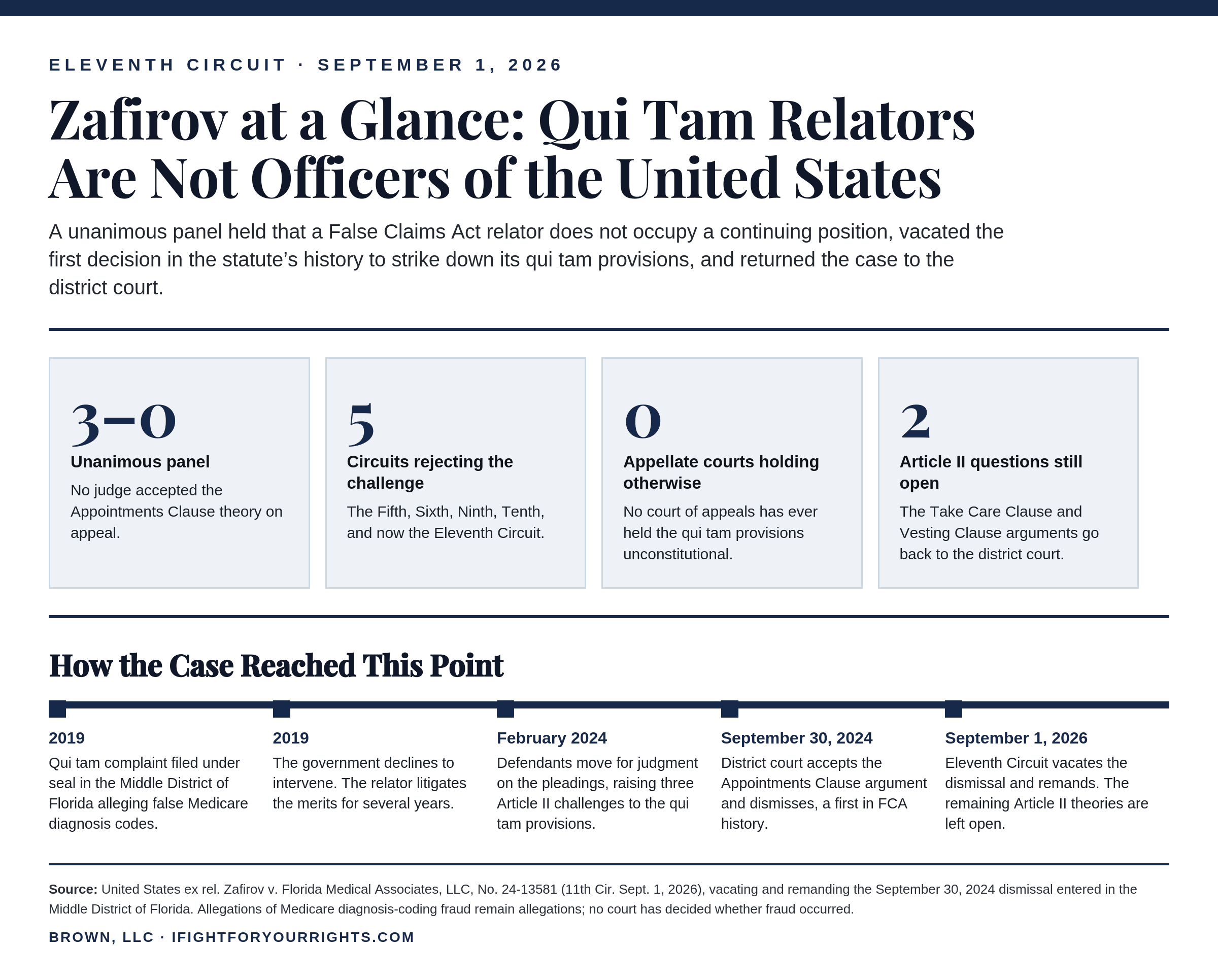
On September 1, 2026, the United States Court of Appeals for the Eleventh Circuit rejected the most consequential version of that second argument to date. In United States ex rel. Zafirov v. Florida Medical Associates, LLC, No. 24-13581, a unanimous panel held that False Claims Act relators are not “Officers of the United States” under the Constitution’s Appointments Clause, vacated the district court’s dismissal, and sent the case back for further proceedings.
Related: Brown, LLC secured two of the year’s largest individual recoveries — a $950M settlement against Raytheon and $350M against Walgreens. Learn about our False Claims Act practice →
The opinion, written by Judge Elizabeth Branch and joined by Judge Robert Luck and Senior District Judge Federico Moreno, sitting by designation, decides one question and expressly leaves two others open. It resolves the Appointments Clause challenge. It does not decide the defendants’ separate Take Care Clause and Vesting Clause arguments, which the district court never reached and which now return to that court in the first instance.
Even so, this is the first federal appellate ruling to review the first decision in the history of the False Claims Act to strike down its qui tam provisions, and it took that decision apart. That matters throughout Florida, Georgia, and Alabama, and it will be cited far beyond them.
How Zafirov Became the Test Case
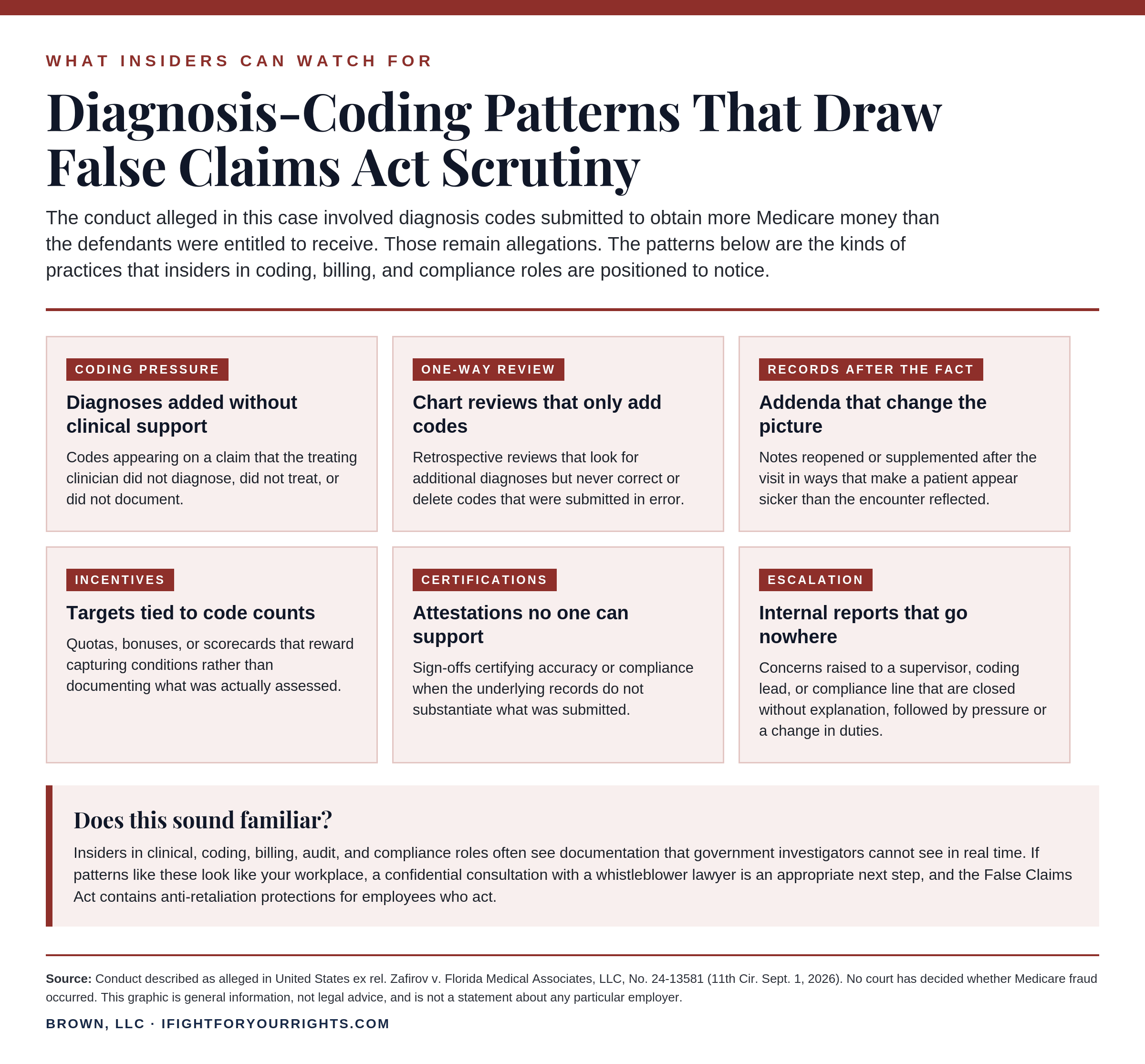
Dr. Clarissa Zafirov filed her qui tam action in 2019 in the Middle District of Florida against her employer, Florida Medical Associates (doing business as VipCare), and related entities including Physician Partners, Anion Technologies, Freedom Health, and Optimum Healthcare. As the Eleventh Circuit described the allegations, Zafirov claimed the defendants knowingly submitted false diagnosis codes to obtain more Medicare money than they were entitled to receive.
Those are allegations. No court has decided whether Medicare fraud occurred. The government declined to intervene, and the parties litigated on the merits for several years.
Speak with the Lawyers at Brown, LLC Today!
Over $1 billion in aggregate judgments and settlements for our clients in state and federal courts. We fight for maximum damages and results.
Then, in February 2024, the defendants changed the subject. They moved for judgment on the pleadings, arguing that the qui tam provisions violate Article II of the Constitution in three ways: the Appointments Clause, because relators supposedly exercise significant federal authority in a continuing position without presidential appointment; the Take Care Clause, because the President lacks sufficient supervision and control over relators; and the Vesting Clause, because relators exercise executive power the Constitution vests in the President alone. The Department of Justice, which had declined to intervene in the case, intervened for the limited purpose of defending the constitutionality of the statute.
The theory did not come from nowhere. Justice Thomas floated it in his 2023 dissent in United States ex rel. Polansky v. Executive Health Resources, and two other Justices signaled openness to it in a separate concurrence. Defendants around the country took the hint.
On September 30, 2024, Judge Kathryn Kimball Mizelle accepted the Appointments Clause argument and dismissed the case, the first time any federal court had held the qui tam provisions unconstitutional. Because Zafirov was, in the district court’s words, “the only litigant on her side of the enforcement action,” the dismissal ended the case. The court did not reach the Take Care Clause or Vesting Clause arguments. Both Zafirov and the United States appealed.
Jason T. Brown, founding partner of Brown, LLC and a former FBI Special Agent and Legal Advisor, viewed the stakes as far larger than one Medicare case:
“Defense counsel are paid to test serious arguments, and I do not criticize lawyers for doing their jobs. But there is a certain irony when a defendant accused of improperly taking federal money argues that the constitutional defect is not the alleged false claim, but the existence of the citizen Congress authorized to expose it. If that theory had prevailed, it would not have won one case. It would have dismantled an enforcement structure built to uncover fraud the government may never otherwise see. It would have rewarded the exploiter and suffocated the exposer.”
What the Eleventh Circuit Actually Decided
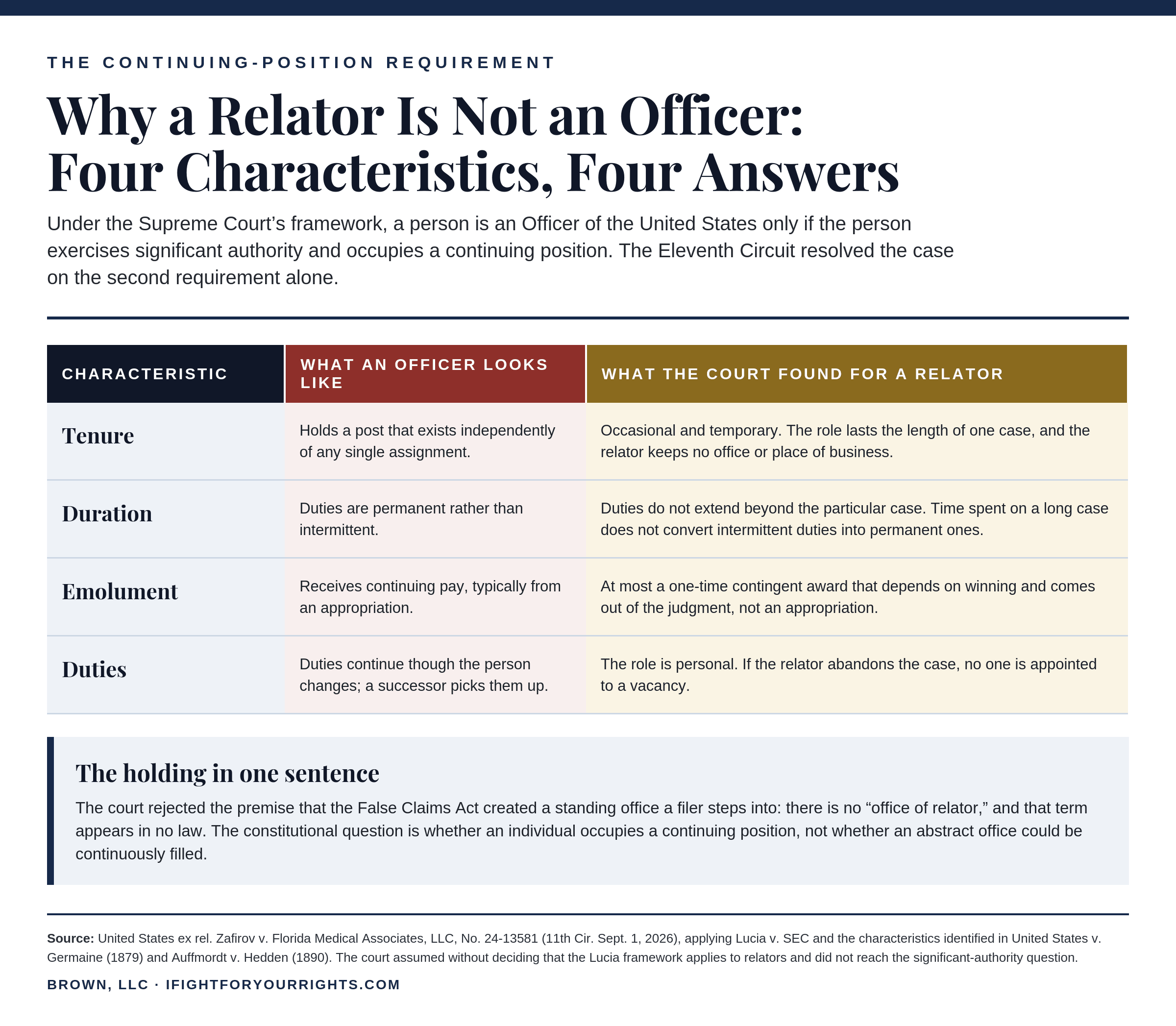
Under the Supreme Court’s framework in Lucia v. SEC, a person is an “Officer of the United States” only if he or she both exercises significant authority pursuant to the laws of the United States and occupies a continuing position established by law. The district court found both. The Eleventh Circuit needed to disagree on only one.
The panel chose the second requirement and held that relators do not occupy a continuing position. That alone was sufficient. The court expressly did not decide whether relators exercise “significant authority,” and it assumed without deciding that the Lucia framework even applies to relators, who are not government employees at all.
To decide what a “continuing” position means, the court went back to the Supreme Court’s own nineteenth-century cases, United States v. Germaine (1879) and Auffmordt v. Hedden (1890), and to Chief Justice Marshall’s 1823 circuit opinion in United States v. Maurice. It declined to adopt the Second Circuit’s three-part test from United States v. Donziger, which the district court had used, and relied instead on the characteristics the Supreme Court has actually identified: tenure, duration, emolument, and duties. On each, the relator came up short:
- Tenure. A relator’s role is occasional and temporary. It lasts the length of one case; a relator may bring several cases in a year or none; and a relator keeps no office or place of business. When the case settles or is dismissed, the relator has no remaining duties, just like the pension-examining surgeon in Germaine, who might perform fifty examinations in a year or none.
- Duration. Some qui tam cases last years. The court held that does not matter. The Supreme Court has never measured duration by how long a person happens to spend on a task, but by whether the duties are permanent or intermittent. A relator’s duties, like the customs appraiser’s in Auffmordt, do not extend beyond the particular case in which the relator acts.
- Emolument. Officers receive a continuing emolument. A relator receives, at most, a one-time contingent award that depends on winning, comes out of the judgment rather than any appropriation, and carries no penalty for walking away except losing the fee. The court found that indistinguishable from the fee-per-examination surgeon in Germaine.
- Duties. An office exists where the duties continue though the person changes. A relator’s role is personal. If a relator abandons a case, no one steps into the role except the Attorney General, through intervention. The defendants argued that a new relator can replace one who dies or goes bankrupt; the court called that a mischaracterization. In those situations, the relator’s estate or bankruptcy trustee carries the relator’s own claim forward. No one is appointed to a vacancy.
The court also rejected the defendants’ reliance on Morrison v. Olson. The independent counsel in Morrison was an officer despite serving a temporary, single-mission role, but only because that counsel drew a salary from a permanent appropriation and had duties a successor picked up mid-investigation. Neither is true of a relator. And the court rejected the defendants’ reading of Kellogg Brown & Root v. Carter: nothing in Carter lets one relator “step into the role” of another; it simply holds that a procedurally dismissed case does not bar a later, separate one.
On that reasoning, the Eleventh Circuit joined the Fifth Circuit (sitting en banc in Riley v. St. Luke’s Episcopal Hospital), the Sixth Circuit, the Ninth Circuit, and the Tenth Circuit in holding that the qui tam provisions do not violate the Appointments Clause. No court of appeals has ever held otherwise.
The Opinion’s Most Important Sentence Is One of Its Shortest
The defendants’ theory, and the district court’s, depended on the idea that the False Claims Act created a standing “office of relator” that is “continuous even if it is not continually filled,” and that anyone who files a qui tam complaint steps into that office. The Eleventh Circuit rejected the premise in a single sentence: “there is no ‘office of relator’; that term is not in the FCA or any other law.”
The court then explained why the framing was wrong even on its own terms. The constitutional question is whether an individual occupies a continuing position, not whether some abstract office could be continuously filled. The Supreme Court in Germaine and Auffmordt did not analyze a fictional office of the civil surgeon or office of the customs appraiser. It looked at what the actual person actually did. No precedent has ever held that because a position could be filled, whoever fills it holds a continuing office, and the Eleventh Circuit declined to become the first.
That is more than semantic housekeeping. It goes to the architecture of the False Claims Act. A whistleblower does not apply for a federal job. The President does not select the whistleblower. The Department of Justice does not hire the whistleblower. The relator does not draw a government salary, acquire a portfolio of federal responsibilities, or keep exercising governmental authority after the case ends. The relator is a private person with information about an alleged fraud whom Congress has authorized, under a detailed statutory scheme and subject to substantial statutory controls and government rights, to bring an action in the name of the United States.
Brown put it this way:
“There is no office of relator. There is no badge, no salary, no desk at Main Justice. There is a person who saw something wrong, gathered the proof, and had the nerve to put their name on a sealed complaint knowing it might cost them their career. I carried a badge for years. I know the difference between an officer of the United States and a citizen with the courage to report their employer. So does the Eleventh Circuit.”
Declination Is Not Deputization, and It Is Not Exoneration
The constitutional attack also spotlights one of the most misunderstood features of False Claims Act practice: what happens when the Department of Justice declines to intervene.
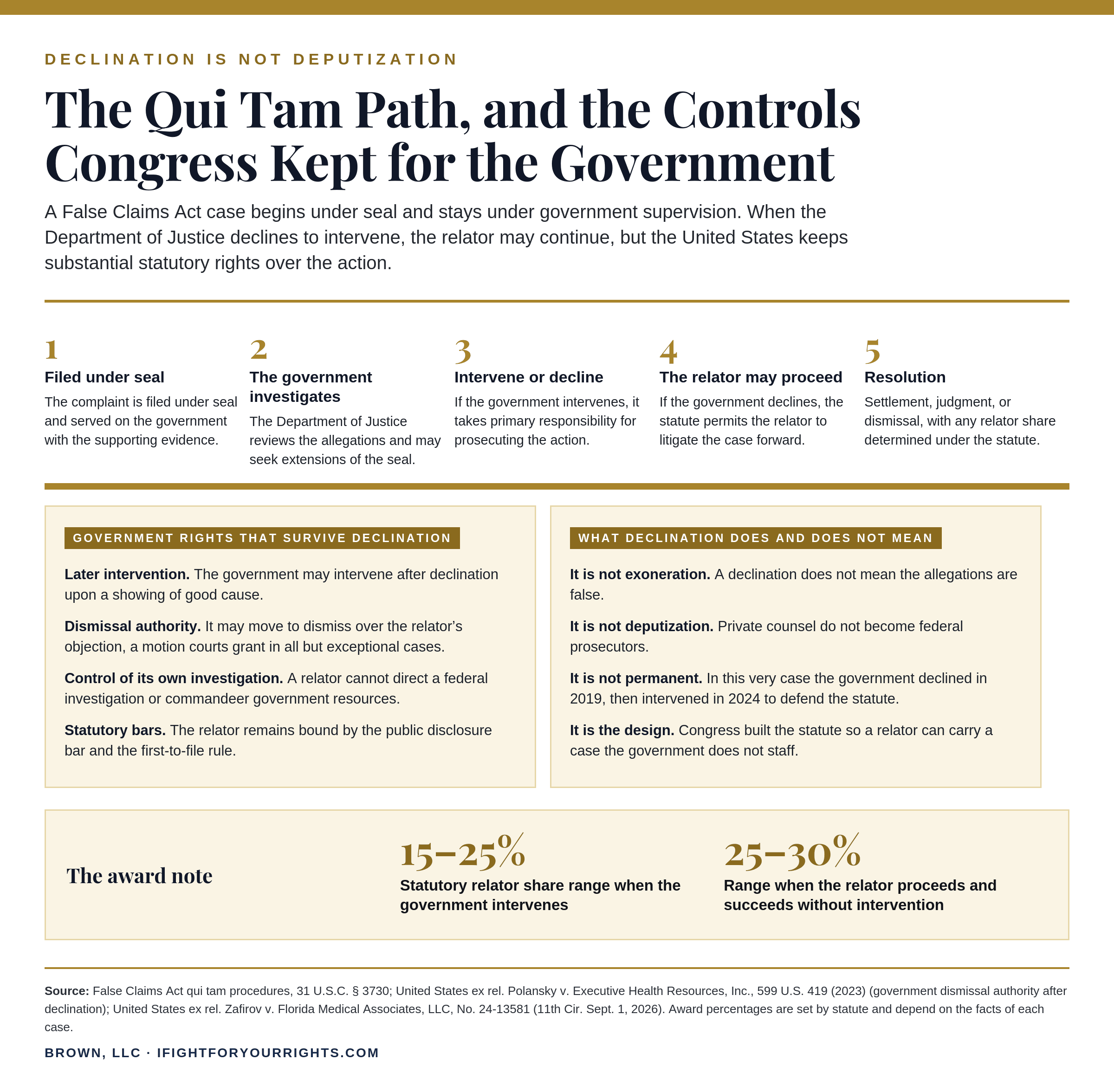
A qui tam complaint is filed under seal. The government investigates and decides whether to intervene. If it intervenes, it assumes primary responsibility for prosecuting the action. If it declines, the statute permits the relator to continue. Even then, the government retains substantial rights: it can intervene later upon a showing of good cause, and it can move to dismiss over the relator’s objection, a motion courts must grant, under Polansky, in all but the most exceptional cases.
A declination therefore does not convert private counsel into federal prosecutors. Nor does declination mean the allegations are false. It means the government has elected not to take primary responsibility for that litigation at that time. Zafirov itself proves the point: the government declined to intervene in 2019, then intervened in 2024 to defend the statute. The United States can and does step back in when it has reason to.
Whistleblower tip: If you’ve witnessed Medicare or Medicaid billing fraud at your employer, you may qualify as a qui tam relator with a potential share of the government’s recovery. See our Medicare & Medicaid fraud practice →
That distinction matters to Brown, LLC because the firm handles both intervened and non-intervened False Claims Act matters. Brown, LLC is led by Jason T. Brown, a former FBI Special Agent and Legal Advisor, and its whistleblower team includes former Department of Justice experience. The firm has been involved in major FCA matters including the $428 million False Claims Act component of the Raytheon resolution, part of an aggregate resolution exceeding $950 million; representation connected to the Walgreens False Claims Act resolution of up to $350 million; and a $140 million False Claims Act judgment. Lex Machina has ranked Brown, LLC the second most prolific False Claims Act firm in the country over a five-year benchmark. Past results do not guarantee future outcomes.
Brown explained the practical problem:
“No enforcement agency has unlimited lawyers, investigators, experts, time, or trial capacity. I lived that reality inside the Bureau. Congress understood it long before any of us entered this field, which is exactly why the False Claims Act is built so a relator can carry the case when the government cannot. Declination is not a constitutional flaw in qui tam litigation. It is the statutory design working as intended.”
Why Attacks on Qui Tam Enforcement Embolden Fraud
There is a legitimate place for aggressive defense work in False Claims Act litigation. A defendant should challenge a weak case. If the claim was not false, say so. If there was no knowledge, contest scienter. If the alleged violation was immaterial to payment, litigate materiality. If damages are overstated, attack the model. If a statutory bar applies, invoke it. Those arguments test whether liability exists under the law Congress enacted.
A structural attack on qui tam enforcement is different. If it succeeds, it can prevent even a potentially meritorious qui tam case from being adjudicated on the merits, without answering whether the claim was false, whether the defendant knew it, or how much the government lost. That is exactly what happened in Zafirov for nearly two years.
“The deterrence point is not rhetorical,” Brown said. “If you remove private enforcement, you reduce the number of people capable of turning concealed misconduct into an actual litigated case. A sophisticated wrongdoer does not need immunity. It only needs the odds of detection and enforcement to fall low enough that cheating looks like a business calculus instead of a legal catastrophe.”
Fraud against the government happens inside organizations, in billing systems, contract files, coding decisions, pricing data, compliance certifications, internal emails, and conversations that government investigators cannot see in real time. Insiders can. If insiders learn that they may report fraud but cannot carry a viable case forward unless the government personally takes over, many significant cases will never reach discovery, summary judgment, trial, or settlement. The predictable result is not merely fewer qui tam cases. It is a lower expected cost for concealed fraud.
That is how disabling private enforcement emboldens fraud even if no defense lawyer subjectively intends that result.
A Respectful Word to the Defense Bar
Creative constitutional advocacy is part of the adversarial system. Important doctrines often develop because lawyers press arguments that initially seem unconventional, and the defense bar is entitled to do that here. But the practical consequence of the argument deserves equal scrutiny.
There is something backwards about a system in which an FCA defendant could avoid adjudication not because the claim was truthful, not because the defendant lacked scienter, and not because the conduct was immaterial, but because Congress supposedly lacked the constitutional authority to let a private citizen pursue the fraud after the Executive Branch elected not to take over the case.
A defendant should prevail because the facts and the law defeat liability. Constitutional doctrine should not become immunity by attrition, a rule under which fraud becomes progressively harder to prosecute simply because the government cannot personally staff every viable matter. The Eleventh Circuit’s own framing is instructive: a court should invalidate an act of Congress only for the most compelling constitutional reasons. A statute that has enlisted private citizens against fraud since 1863 does not clear that bar on a theory about an office that does not exist.
Brown put it more simply:
“Technical defenses have their place. Constitutional defenses have their place. But the False Claims Act is not a typographical error that somehow survived since Lincoln. Congress made a deliberate choice to enlist private citizens in protecting public money. If a defendant wants to beat a whistleblower case, beat the evidence and beat the law. Do not pretend the whistleblower should never have been allowed onto the field.”
The Government Still Holds the Controls
The caricature of the qui tam relator as an unaccountable private Attorney General also ignores the controls Congress wrote into the statute, controls the Eleventh Circuit walked through before it reached the constitutional question.
The complaint begins under seal. The government receives the allegations and the relator’s supporting evidence. It investigates. It can intervene. It can seek extensions of the seal. It can intervene later on a showing of good cause. It can dismiss over the relator’s objection, subject to a court approval that Polansky requires be given substantial deference. And when the government intervenes, it takes primary responsibility for prosecuting the action. The relator, meanwhile, is bound by the public disclosure bar and the first-to-file rule and has no power to direct a federal investigation, commandeer government resources, or dictate what the government does with what it learns.
That structure is a poor fit for the image of a private prosecutor exercising a permanent slice of Executive Branch power. The Eleventh Circuit did not need to weigh those controls to decide the Appointments Clause question, because it resolved the case at the threshold: the relator holds no continuing position and therefore is not an officer. But those controls are where the remaining fight will be fought.
The Constitutional Fight Is Not Over
Zafirov is a major victory for qui tam enforcement. It is not the last word.
The Eleventh Circuit expressly left the Take Care Clause and Vesting Clause arguments for the district court to consider on remand, the same district court that accepted the Appointments Clause theory in the first place. Those arguments ask a different question: not whether the relator is an officer, but whether the President retains enough supervision and control over a private relator to satisfy Article II. Whatever the district court decides will likely return to the Eleventh Circuit and could well be headed to the Supreme Court. The defendants may also seek rehearing en banc or certiorari on the Appointments Clause holding itself. And FCA defendants in other circuits are pressing the same theories right now.
That caveat matters. Lawyers and prospective whistleblowers should not describe Zafirov as holding that every constitutional challenge to the False Claims Act has been extinguished. It has not.
What the decision does hold is important enough: an FCA relator is not an Officer of the United States merely because Congress permits the relator to pursue a qui tam action, there is no “office of relator,” and the Appointments Clause does not invalidate the qui tam provisions on that theory.
“Anyone who tells you Zafirov ended the constitutional fight has not read past the first page,” Brown said. “It ended one argument, decisively, and it took the district court’s best theory off the table. The Take Care and Vesting Clause arguments are still live, and we are going to be litigating them for a while. But whistleblowers should not wait for the Supreme Court to bless the statute before they come forward. Fraud does not pause for appellate review, and neither do the statutes of limitations.”
What Zafirov Means for False Claims Act Whistleblowers
For whistleblowers in Florida, Georgia, and Alabama, the immediate message is that the Appointments Clause theory that produced the district court dismissal did not survive appellate review. To the extent non-intervened cases in the Eleventh Circuit were stayed or slowed specifically because of the Appointments Clause issue in Zafirov, the principal appellate basis for that delay has now been removed, subject to case-specific orders and further review, although defendants may continue to press the remaining Article II theories.
Nationally, the decision adds a fifth court of appeals to the body of authority sustaining qui tam enforcement against the Appointments Clause attack, and it does so with a detailed continuing-position analysis that district courts confronting the same argument can now follow. District courts confronting the same motions now have a published, unanimous roadmap.
Speak with the Lawyers at Brown, LLC Today!
Over $1 billion in aggregate judgments and settlements for our clients in state and federal courts. We fight for maximum damages and results.
Whistleblower cases may involve Medicare diagnosis-coding fraud like the conduct alleged in Zafirov, Medicaid fraud, defense contractor and procurement fraud, pharmaceutical fraud, kickbacks, cybersecurity misrepresentations in government contracting, false certifications, inflated invoices, medically unnecessary services, grant fraud, customs-duty evasion and reverse false claims, and other schemes involving knowingly false claims for, or obligations to pay, government money.
In every one of those cases, the central questions should remain the ones the False Claims Act was designed to answer: Was there a false or fraudulent claim? Was it made knowingly? Was the falsity material to the government’s payment decision? What did the government lose? And what evidence proves it?
Those are hard questions. They should be hard. Whether an informed private citizen is constitutionally permitted to ask them on behalf of the United States should not become an escape hatch from answering them.
Whistleblowers Remain the Front Line of Fraud Enforcement
The most important fact about whistleblowers is not that they are private prosecutors. They are not. It is that they often possess information the government does not have.
They may be doctors who see coding decisions from inside a practice, as Dr. Zafirov was. Pharmacists who know what was actually dispensed. Engineers who know whether a contractor met a certification. Accountants who understand pricing data. Compliance professionals who know what management was told. Employees who know the difference between what happened and what was represented to the government.
The False Claims Act turns that information into a structured enforcement process rather than leaving it buried inside the organization that possesses it.
“If you make the whistleblower disappear, you do not make the fraud disappear,” Brown said. “You make the fraud harder to find. That is why attacks on the qui tam mechanism matter far beyond the courtroom. The statute is not simply a reward program. It is an information system, an enforcement system, and a deterrence system all at once, and today the Eleventh Circuit kept all three switched on.”
The Eleventh Circuit has now rejected one significant effort to disable that system. The remaining constitutional arguments will continue to be litigated. So will the underlying fraud cases.
And they should be decided on the facts and the law, not on the fiction that a whistleblower becomes a federal officer simply by having the courage and the information to bring a case Congress expressly authorized.
Related Reading From Brown, LLC
- Everything You Need to Know About the False Claims Act
- Reporting Medicare and Medicaid Fraud
- Upcoding in Healthcare
- Government and Defense Contractor Fraud
- Whistleblower Retaliation
- Florida False Claims Act and State Whistleblower Laws
- Georgia False Claims Act and State Whistleblower Laws
- Whistleblower FAQs
- Request a Free, Confidential Consultation