
DOJ Declined My Qui Tam Case: What Now? | Non-Intervened FCA Lawyer
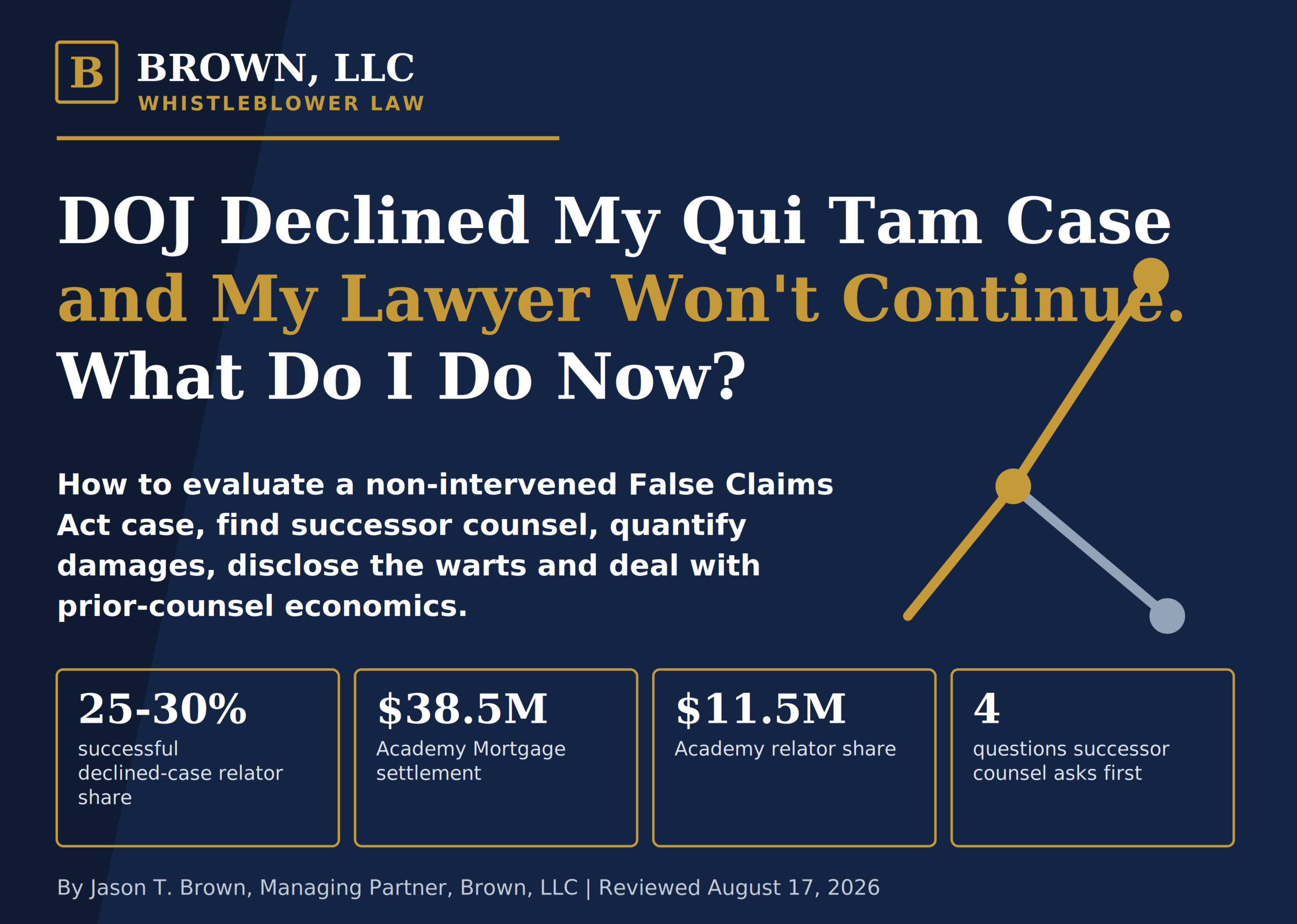
Table of Contents
Start with the law. If the United States declines to proceed with a False Claims Act case, the relator has the right to conduct the action under the law as it exists as of this writing and if the government doesn’t object to you proceeding.
The practical problem is harder. If the lawyers who filed the case, investigated it, presented it to DOJ, lived through the seal period and know the government’s concerns do not want to staff and finance the litigation after declination, a new whistleblower law firm is going to take that fact seriously. I would.
Related: Brown, LLC secured two of the year’s largest individual recoveries — a $950M settlement against Raytheon and $350M against Walgreens. Learn about our False Claims Act practice →
Successor counsel is being asked to make a new investment decision after DOJ and often the original firm have already made theirs. A non-intervened FCA case can require years of discovery, ESI review, experts, depositions, Rule 9(b) fights, summary judgment, trial preparation and appeal work. It can be quite costly in terms of time and expense. The new firm needs a concrete reason to believe the case is worth that risk.
A DOJ Declination Does Not End the Qui Tam Case
A declination is the government’s election not to take primary responsibility for prosecuting the action at that time. It is not a court judgment that the relator loses. DOJ’s fiscal year 2025 False Claims Act report expressly states that qui tam cases may be pursued by the government or by the whistleblower and that significant recoveries were obtained by both. DOJ reported more than $5.3 billion in settlements and judgments in qui tam suits filed in fiscal year 2025 and earlier, while a record 1,297 new qui tam cases were filed.
That does not make a declination harmless. DOJ lawyers normally consult the affected agency and assess falsity, materiality and other FCA issues before deciding how to handle the matter. The Justice Manual states that agency views are solicited during the investigative, litigation and settlement phases. So the correct question is not whether declined cases can succeed. They can. The question is what happened in your case.
A successor firm needs clarity on prior-counsel economics, the DOJ record, concrete damages and every material weakness before accepting a declined case.
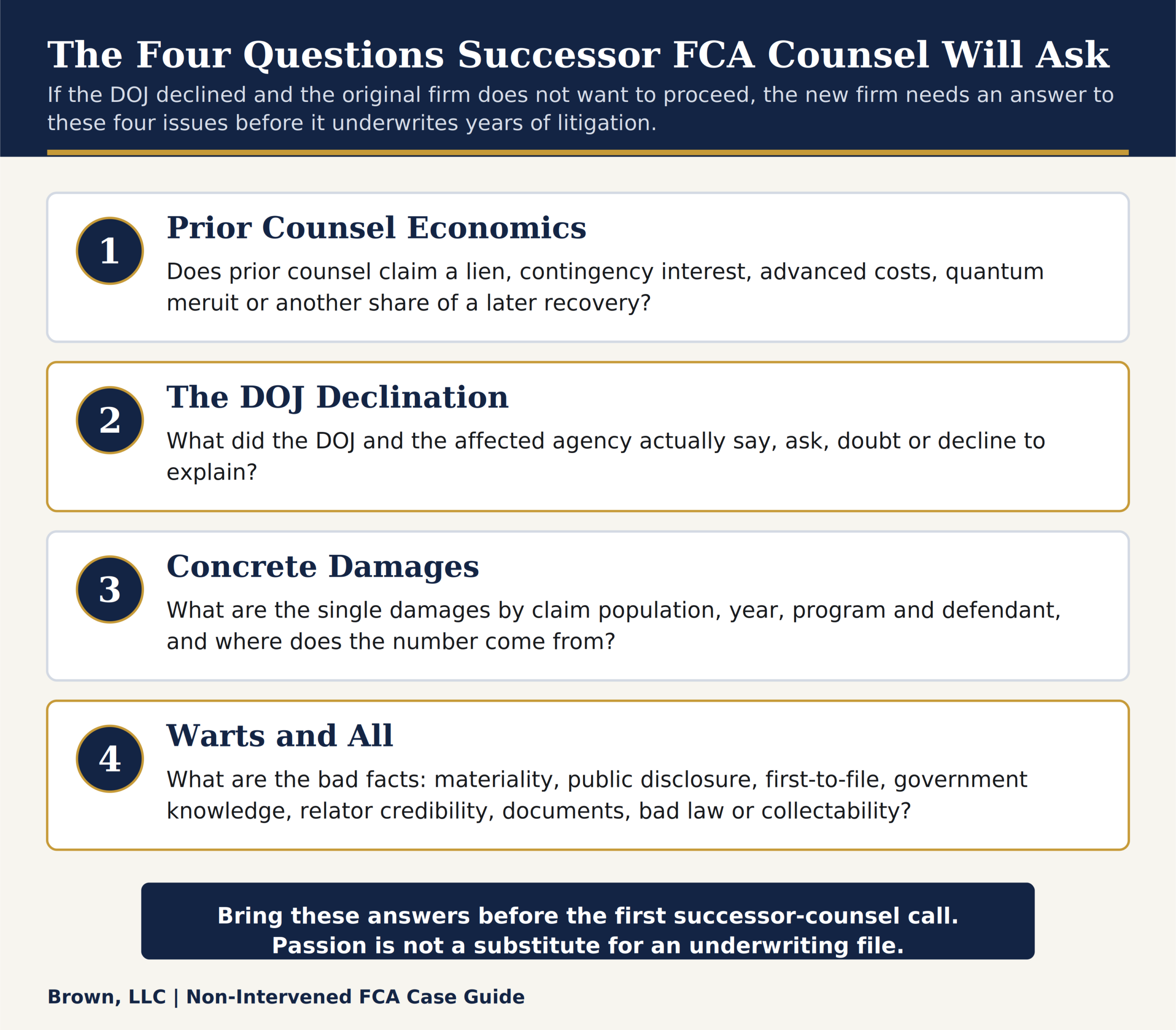
The Four Questions Every Quality Successor Whistleblower FCA Firm Will Ask
1. What does prior FCA counsel claim?
Before a new firm invests hundreds or thousands of hours, it needs to know whether former counsel claims an economic interest in the recovery.
Depending on the engagement agreement and governing law, prior counsel may assert a contractual fee interest, an attorney lien, reimbursement of advanced expenses, quantum meruit, or another right arising from the work already performed. Do not assume the answer. Get the position in writing.
- Does prior counsel claim a percentage of any later recovery?
- Does the firm seek repayment of litigation costs or expert expenses?
- Does the engagement agreement address withdrawal or successor counsel?
- Is prior counsel willing to negotiate a division of fees?
- Will prior counsel transfer the complete case file and cooperate in the transition?
A new firm does not want to discover six months into the case that the economics it modeled are materially different because former counsel claims a substantial piece of the fee or recovery. A former firm who bails on you should relinquish their fee and make it easier for a new firm to come aboard. If you voluntarily leave your counsel they may be entitled to a lien for their time spent and a pro rata share of your recovery which may make it harder for a new firm to take over the case.
Speak with the Lawyers at Brown, LLC Today!
Over $1 billion in aggregate judgments and settlements for our clients in state and federal courts. We fight for maximum damages and results.
2. What happened with DOJ?
Do not summarize the seal investigation by saying, “DOJ did not understand the case,” or they didn’t dedicate enough resources. Tell successor counsel what actually happened.
- How long was the case under seal?
- Which DOJ component and U.S. Attorney’s Office handled it?
- Which agency was involved?
- Did DOJ issue Civil Investigative Demands?
- Were the relator and other witnesses interviewed?
- How many government presentations occurred?
- Did DOJ ask repeatedly about claims data, damages, materiality or scienter?
- Did the agency disagree with the legal theory or factual premise?
- Did DOJ raise first-to-file, public-disclosure, original-source or pleading issues?
- Did DOJ provide a reason for declining—or simply decline without substantive explanation?
If DOJ gave no reason, say exactly that. If the government said something damaging, disclose it. A successor firm would rather hear the government’s worst comment from the relator than discover it later from the docket, the agency, or prior counsel.
3. What are the damages—concretely?
A large government program is not a damages model. A $500 million contract is not automatically $500 million in FCA damages. Total Medicare revenue is not automatically government loss. Gross billings are not automatically single damages. Start with single damages and show the work.
The FCA can impose treble damages and civil penalties, but multiplying a weak number by three does not improve the underlying proof. A $15 million case with actual claims data and clean causation can be more attractive than a supposed $500 million case built on assumptions that may collapse at summary judgment.
4. What are the warts?
Bring the defense case with you. Successor counsel needs to hear about the facts you wish did not exist:
- The agency knew part of the conduct and continued paying.
- There is an earlier related whistleblower case.
- There was public reporting before your filing.
- A key witness changed their account.
- Your complaint overstated something.
- A government lawyer questioned materiality or damages.
- You participated in part of the conduct.
- Some documents may create privilege, access or counterclaim issues.
- An important damages assumption cannot currently be proven.
- The defendant is financially distressed or difficult to collect from.
- There is adverse circuit or Supreme Court precedent.
- A key allegation came from someone else and cannot presently be corroborated.
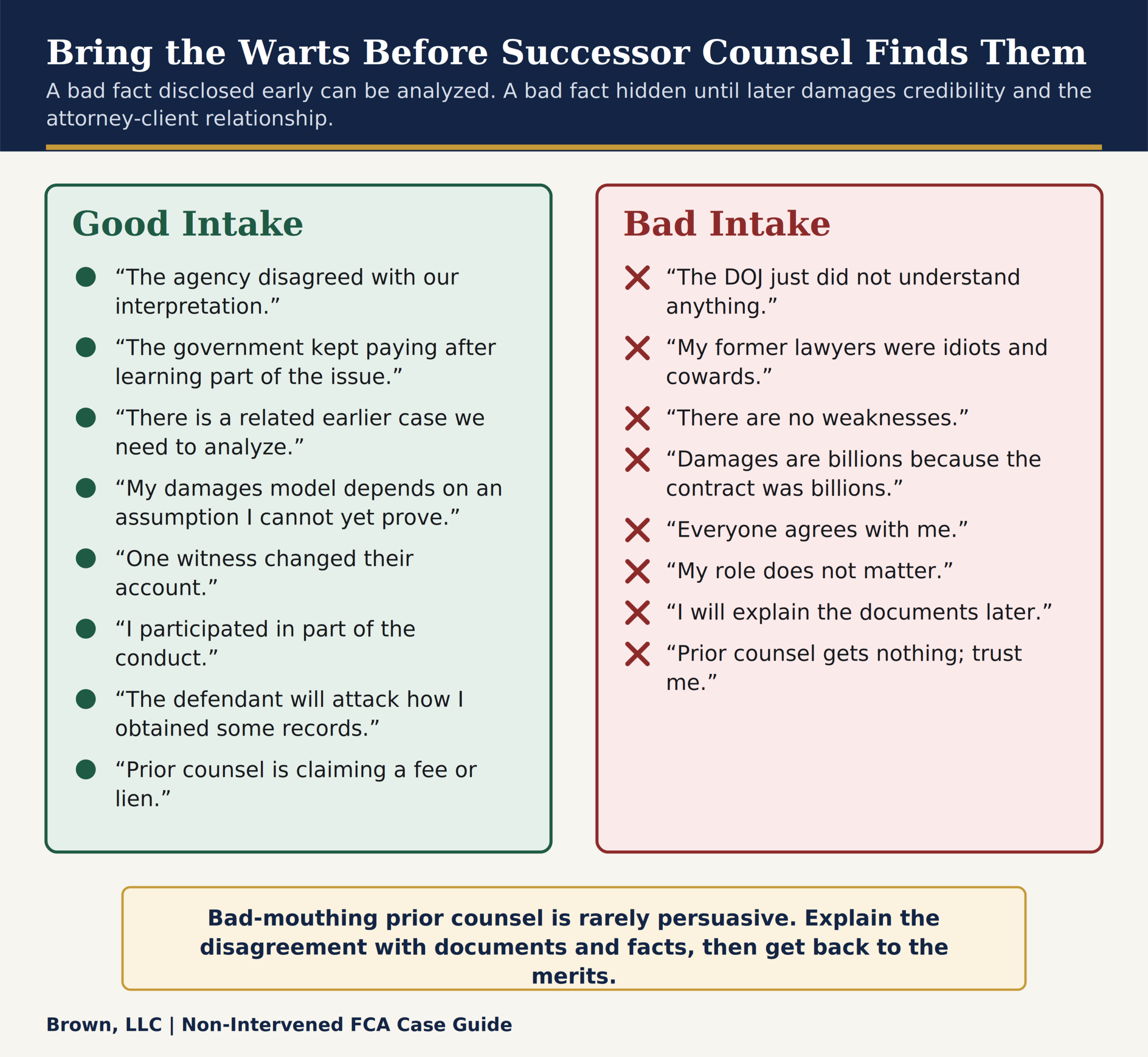
A bad fact disclosed early can be analyzed. A bad fact hidden until after a new firm commits time damages your credibility and makes the lawyers wonder what the next surprise will be.
Do Not Spend the Consultation Bad-Mouthing Prior Counsel
Maybe prior counsel made mistakes. Maybe the relationship broke down. Maybe you have a legitimate complaint. Give successor counsel the facts.
A useful explanation sounds like this: After DOJ declined, my current firm advised that it would not fund the experts and discovery needed to proceed. I disagree with that assessment because we have since identified new claims data and a former executive who will testify. I can provide the correspondence and the firm’s written position on fees and costs.
Speak with the Lawyers at Brown, LLC Today!
Over $1 billion in aggregate judgments and settlements for our clients in state and federal courts. We fight for maximum damages and results.
An unhelpful explanation is a twenty-minute speech about how your old lawyers were lazy, stupid, greedy, cowardly or disloyal. A prospective law firm is evaluating the lawsuit and the future attorney-client relationship. If every former professional is described as incompetent or malicious, the new lawyers will consider whether they may receive the same treatment someday. You do not have to praise former counsel. Explain the disagreement professionally and get back to the merits.
A Real Declined Case That Succeeded: Academy Mortgage
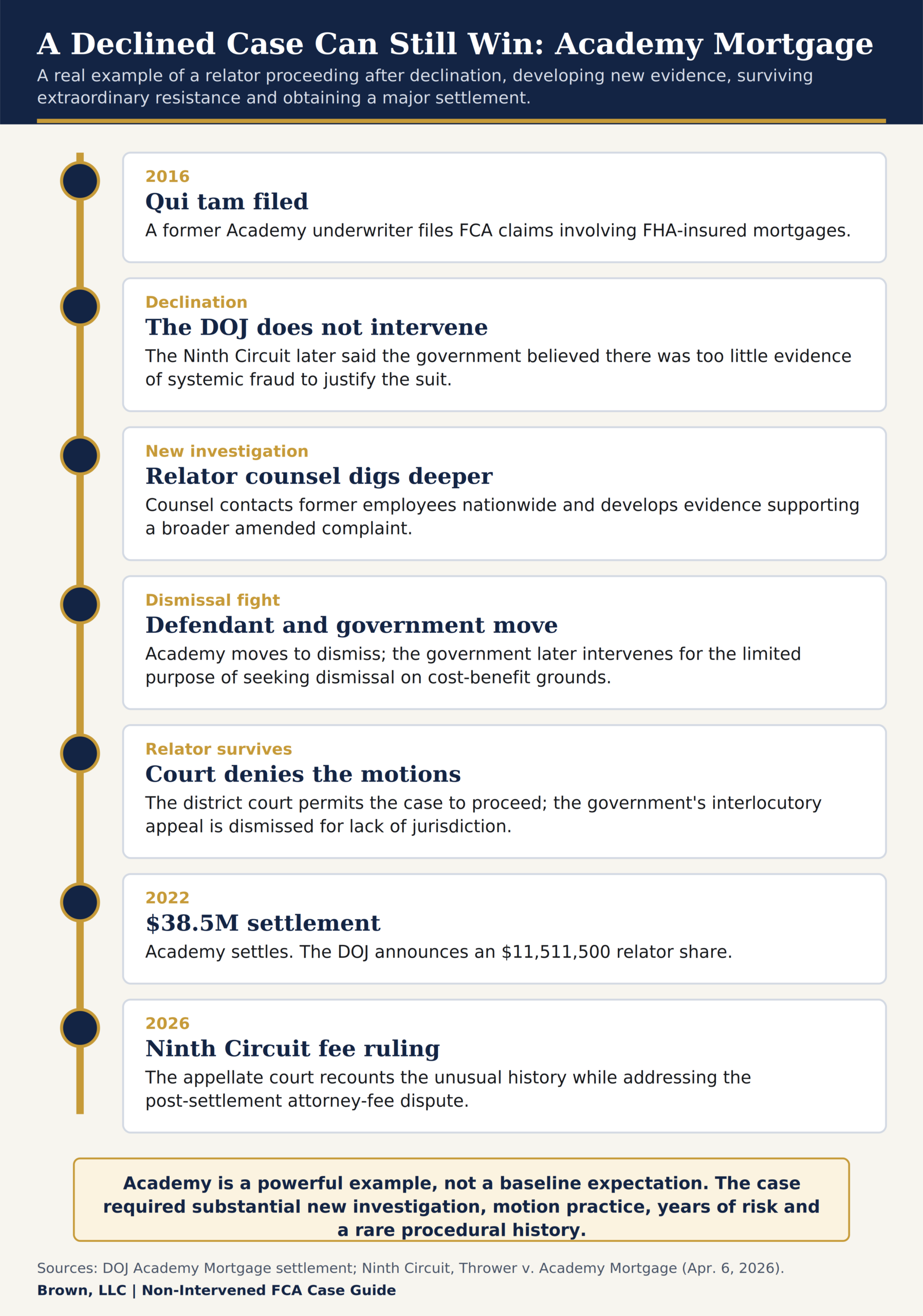
Academy Mortgage is proof that a declined case can succeed, but its procedural history was unusually difficult and should not be treated as a normal expectation.
The Academy Mortgage case is useful because it shows both sides of the declined-case problem. A former Academy underwriter filed an FCA action in 2016 involving FHA-insured mortgages. In a 2026 opinion, the Ninth Circuit recounted that the government declined intervention after concluding there was too little evidence of systemic fraud to justify the suit. Thrower’s counsel proceeded anyway, conducted a substantial nationwide investigation of former employees, developed new evidence and filed an amended complaint.
The case then became even more difficult. Academy moved to dismiss. The government later intervened for the limited purpose of seeking dismissal based on its cost-benefit analysis. The district court denied the motions, and the government’s interlocutory appeal was dismissed for lack of jurisdiction.
In 2022, Academy agreed to pay $38.5 million. DOJ announced that Thrower would receive $11,511,500 as her relator share whistleblower reward.
Academy is a powerful example because counsel changed the evidentiary picture after declination. It is also an unusual example. It required extensive investigation, years of litigation, a rare fight with the government and major financial risk. The lesson is not that every declined case will become Academy Mortgage. The lesson is that a declined case needs a credible post-declination theory for how it becomes stronger.
What Is Better Now?
This may be the most important question in the entire successor-counsel process. DOJ declined. Existing counsel does not want to proceed. What changed?
- New claims data now quantifies the fraud.
- A former executive or decision-maker is now willing to testify.
- A new document directly proves knowledge.
- Discovery from another matter revealed admissions.
- A new appellate decision strengthened the legal theory.
- A damages expert can now model government loss.
- The fraud expanded into another program or a much larger claim population.
- The government misunderstood a factual premise that can now be demonstrated.
- Prior counsel is leaving for a business reason unrelated to the merits.
If nothing changed, say that too. Maybe prior counsel has limited resources, changed practice areas or simply does not litigate declined cases. The successor firm still needs to independently underwrite the merits.
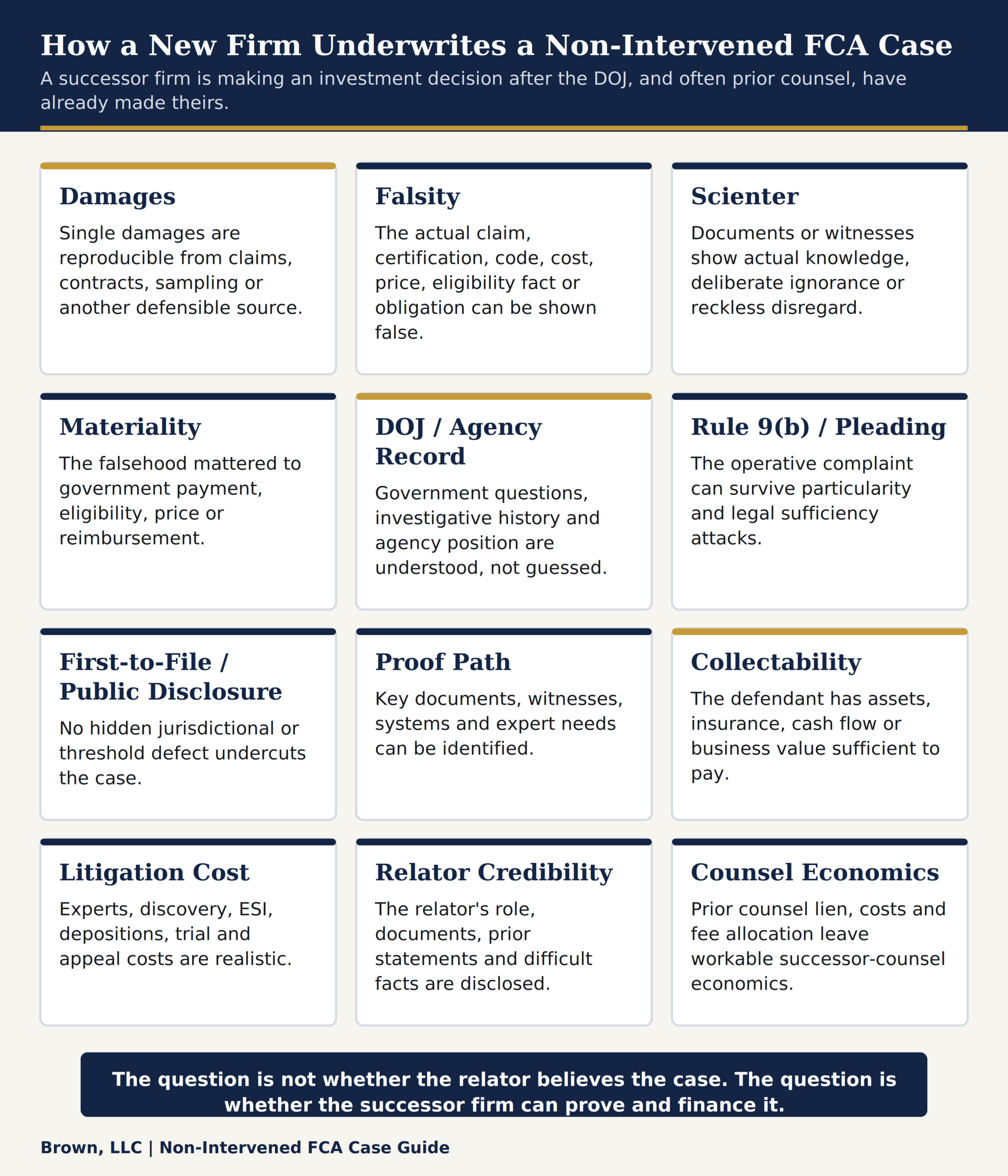
A new FCA firm evaluates damages, falsity, scienter, materiality, DOJ history, pleading risk, threshold bars, proof, collectability, costs, relator credibility and prior-counsel economics.
How a New Firm Underwrites a Non-Intervened FCA Case
Once DOJ declines, the economics change. Government intervention brings federal lawyers, investigative resources, agency expertise and extraordinary settlement leverage. A non-intervened case puts substantially more of the burden on relator’s counsel. The FCA gives the successful non-intervened relator a larger statutory percentage, generally 25% to 30%, because the relator and counsel carry that added risk. Successor counsel will therefore look at the case like an investment:
- What are the provable single damages?
- What is the realistic settlement or judgment range?
- Can the complaint survive Rule 9(b) and Rule 12?
- Can materiality survive government-knowledge evidence?
- Can scienter be proven after discovery?
- How many experts are needed?
- What volume of ESI must be reviewed?
- How many defendants and jurisdictions are involved?
- How long until trial?
- What is the probability of summary judgment?
- What is the defendant’s ability to pay?
- What fee or lien does prior counsel claim?
The new firm does not need certainty. It needs an expected value that justifies the capital and attorney time at risk.
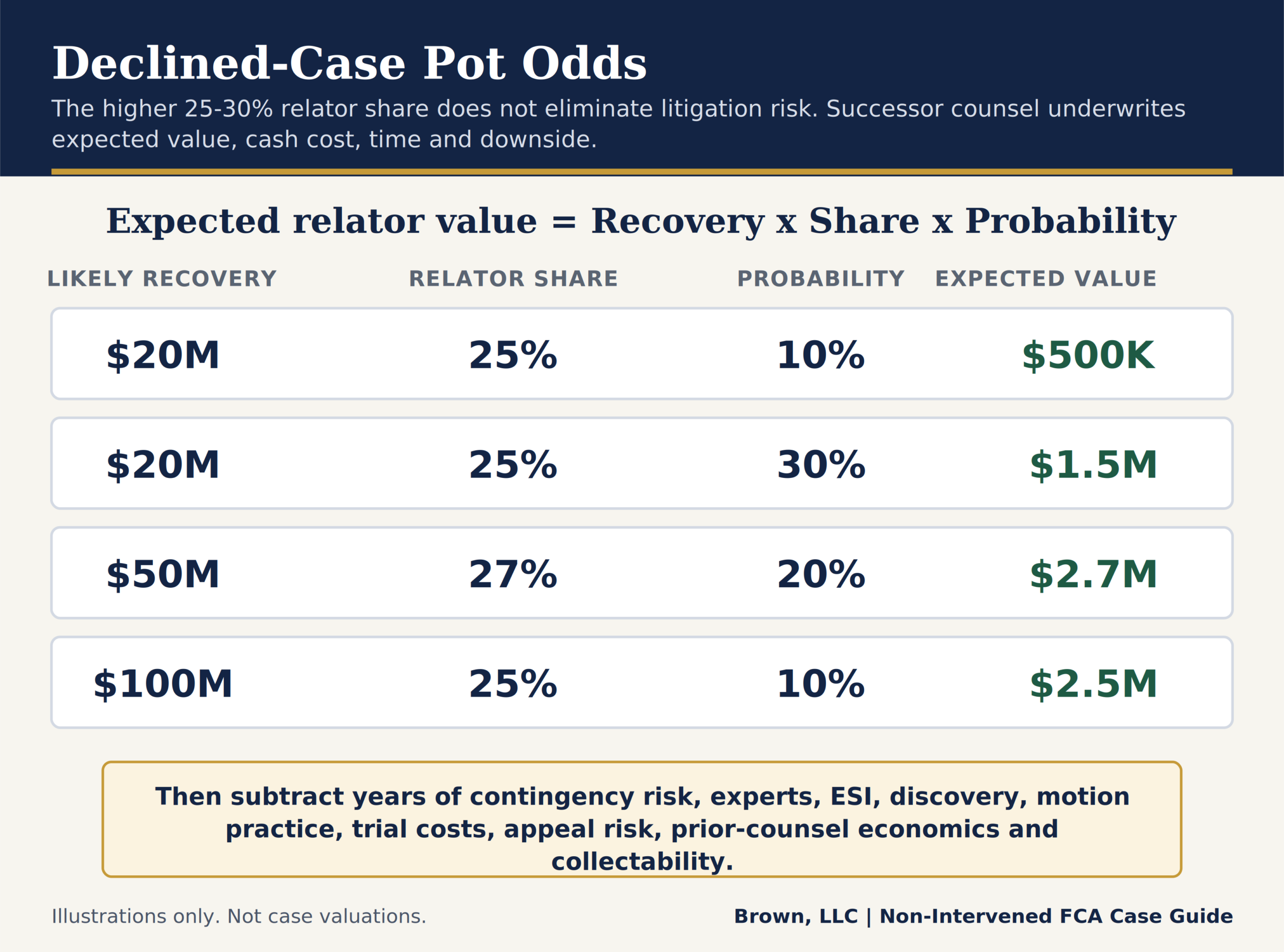
Declined-Case Pot Odds
A simple expected-value model is useful.
A $20 million recovery at a 25% relator share equals $5 million if successful. At a 10% probability of success, the risk-adjusted relator value is $500,000 before considering fees, costs, taxes, time and prior-counsel claims.
A $50 million recovery at a 27% share equals $13.5 million if successful. At a 20% probability, the risk-adjusted amount is $2.7 million.
Those numbers are illustrations, not case valuations. The useful point is that a successor firm must discount the headline damages by litigation probability and collection risk.
Build a Successor-Counsel Package Before You Shop the Case
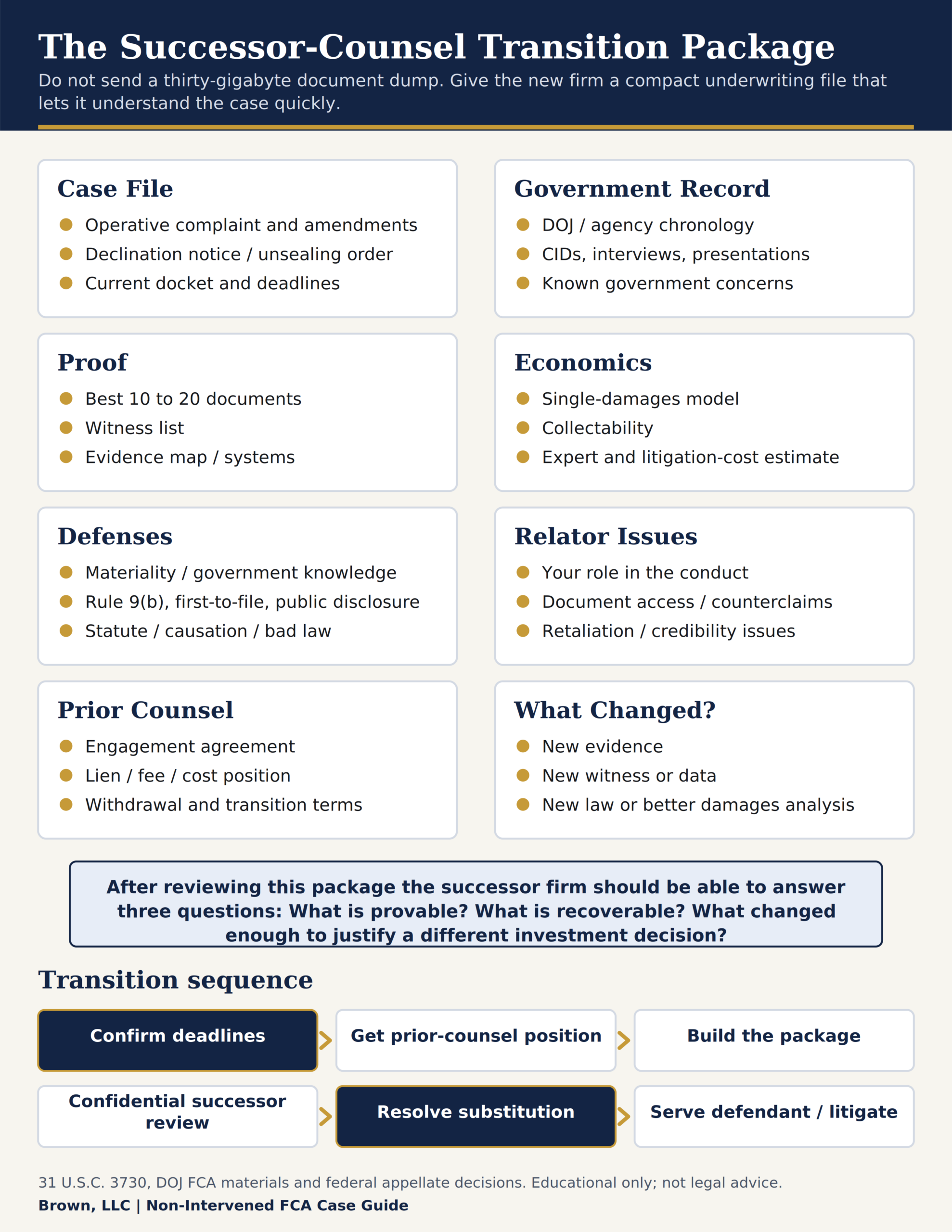
Do not send twenty gigabytes of files to ten law firms and ask them to figure it out. Build a compact package:
- The operative complaint and every amendment;
- The DOJ declination notice and unsealing or intervention orders;
- A one- or two-page chronology of the government investigation;
- A list of CIDs, interviews, presentations and agency contacts;
- A summary of DOJ or agency concerns, if known;
- The best ten to twenty documents;
- A witness list explaining what each witness proves;
- A single-damages model with assumptions and sources;
- The defendant’s strongest legal and factual arguments;
- Any Rule 9(b), first-to-file, public-disclosure, original-source, statute-of-limitations or materiality problem;
- The relator’s own role and any credibility issue;
- Any document-access, privilege, confidentiality, retaliation or counterclaim problem;
- The defendant’s financial condition and collectability;
- All current deadlines and anticipated motion practice;
- Prior counsel’s written position on liens, fees, costs and transition;
- A short section called ‘What Changed Since Declination?’
Do not indiscriminately circulate sealed, privileged, confidential or government-sensitive material. A prospective firm can arrange a controlled review.
Do Not Let the Representation Gap Drift
A non-lawyer relator generally cannot simply take over the government’s FCA claim and litigate it pro se.
In 2025, the D.C. Circuit joined the other federal appellate courts to address the issue and held that an FCA relator cannot prosecute the government’s claims without licensed counsel because the relator is pursuing the United States’ claim, not merely a personal claim.
Whistleblower tip: If you’ve witnessed Medicare or Medicaid billing fraud at your employer, you may qualify as a qui tam relator with a potential share of the government’s recovery. See our Medicare & Medicaid fraud practice →
If current counsel plans to withdraw, successor-counsel efforts should begin early. Court deadlines do not stop because the relator is searching for another firm. Withdrawal and substitution procedures vary by court, local rules and the posture of the case. Coordinate the transition rather than allowing current counsel to disappear before the next firm is ready.
DOJ Can Still Return
Section 3730(c)(3) permits the government to seek intervention later upon a showing of good cause. Do not build the case around the hope that DOJ will come back.
Build a case that can survive if DOJ never returns. At the same time, post-declination discovery can materially change the government’s view. Internal admissions, claims data, expert analysis or testimony that did not exist during the seal investigation may justify keeping DOJ informed where appropriate.
The goal is not to beg the government to reverse itself. The goal is to develop evidence strong enough that later intervention would make sense if the government chooses it.
A DOJ Declination Is the Right Time to Re-Underwrite the Entire Case
Do not simply re-pitch the complaint that DOJ already declined. Start over intellectually.
- What did we believe when the complaint was filed?
- What did DOJ investigate?
- What did the agency say?
- Which allegations became weaker?
- Which allegations became stronger?
- What will the defendant put in the first motion to dismiss?
- What claims can we actually prove?
- What are the single damages?
- What discovery will be needed?
- How much will the experts cost?
- Can the defendant pay?
- What is the best defense fact?
- Would I take this case today if I had never seen it before?
That last question strips away sunk cost and emotion. Successor counsel will ask it whether the relator does or not.
Frequently Asked Questions
Can I continue my qui tam case after DOJ declines?
Yes. Under 31 U.S.C. § 3730(c)(3), the relator has the right to conduct the action when the government elects not to proceed. DOJ may later seek intervention upon a showing of good cause.
What percentage can a relator receive in a non-intervened FCA case?
If the government does not proceed and the relator successfully conducts the action, the statutory share generally ranges from 25% to 30% of the proceeds.
Does DOJ declination mean my case is bad?
Declination establishes that DOJ elected not to take over the action at that time. The practical meaning depends on the investigation and any feedback from DOJ or the affected agency.
Can I find a new lawyer after DOJ declines?
Potentially. Successor counsel will usually conduct a fresh merits, damages, procedural, collectability and economics review before taking the case.
Why does a new firm care whether my old lawyers want to continue?
Because prior counsel knows the record and the government history. A decision not to fund the declined litigation is relevant information, even though it may reflect business reasons rather than the merits.
Can prior counsel claim a lien or part of the future fee?
Potentially, depending on the engagement agreement, governing law and circumstances. Obtain prior counsel’s written position before asking a new firm to underwrite the case.
What damages information should I prepare?
Prepare single damages by claim population, year, program and defendant, with the source data and assumptions identified. Do not rely only on total contract value, total revenue or treble-damages multiplication.
Should I criticize my former FCA lawyers when meeting successor counsel?
Explain the facts, the disagreement and prior counsel’s written position. Personal attacks tend to reduce rather than increase confidence in a future attorney-client relationship.
Can I represent myself if my FCA lawyer withdraws?
A non-lawyer relator generally cannot prosecute the United States’ FCA claims pro se. The D.C. Circuit joined the other circuits on this issue in 2025.
Can DOJ intervene later after initially declining?
Yes. The FCA permits later government intervention upon a showing of good cause.
What is the Academy Mortgage example?
The government initially declined, the relator developed additional evidence and proceeded, the government later sought dismissal, and the matter ultimately settled for $38.5 million with an $11.5115 million relator share. It is an unusually successful declined-case example, not an expected result.
What should I send a prospective successor firm?
A compact transition package: complaint, declination, government chronology, best evidence, witnesses, single-damages model, defenses, relator issues, deadlines, collectability, prior-counsel economics and what has changed since declination.
Sources
[1] 31 U.S.C. § 3730, Qui Tam Procedure, Rights After Declination, Relator Shares, First-to-File and Retaliation: https://uscode.house.gov/view.xhtml?edition=prelim&num=0&req=granuleid%3AUSC-prelim-title31-section3730
[2] DOJ, False Claims Act Settlements and Judgments Exceed $6.8B in FY2025: https://www.justice.gov/opa/pr/false-claims-act-settlements-and-judgments-exceed-68b-fiscal-year-2025
[3] Ninth Circuit, United States ex rel. Thrower v. Academy Mortgage Corp., No. 24-4103 (Apr. 6, 2026): https://cdn.ca9.uscourts.gov/datastore/opinions/2026/04/06/24-4103.pdf
[4] DOJ, Academy Mortgage Agrees to Pay $38.5M; Relator Receives $11.5115M: https://www.justice.gov/archives/opa/pr/academy-mortgage-corporation-agrees-pay-385-million-settle-false-claims-act-allegations
[5] D.C. Circuit, United States ex rel. Brooks v. Lockheed Martin Corp., No. 24-7134 (Feb. 4, 2025): https://media.cadc.uscourts.gov/opinions/docs/2025/02/24-7134-2098535.pdf
[6] DOJ Justice Manual § 4-4.000, False Claims Act / Agency Consultation: https://www.justice.gov/jm/jm-4-4000-commercial-litigation
[7] Ninth Circuit, United States v. United States ex rel. Thrower, 968 F.3d 996 (2020): https://cdn.ca9.uscourts.gov/datastore/opinions/2020/08/04/18-16408.pdf
Attorney advertising. This article is for informational purposes only and does not create an attorney-client relationship. Prior results do not guarantee a similar outcome.