 Skip to main content

Reporting Auto Safety Defects, FMVSS Violations, and Compliance Failures
If you work in the automotive industry and have inside knowledge of a vehicle safety defect, FMVSS violation, or failure to report safety-critical information to regulators, federal law may protect you from retaliation for coming forward, and, in limited circumstances, may provide a monetary award if civil penalties are collected.
The NHTSA whistleblower program exists to ensure that credible safety concerns reach regulators before they result in preventable injuries or fatalities. Engineers, supplier employees, quality-control professionals, testing personnel, and compliance staff are often the first to identify risks that are not visible to the public or fully reflected in regulatory filings.
Speak With NHTSA Whistleblower Counsel (Confidential)
If you want a free, confidential consultation about your rights under the NHTSA whistleblower program, contact Brown, LLC at (877) 561-0000.
We are highly selective. We represent individuals with original, detailed, inside information concerning significant safety or compliance issues. There are no upfront fees. We are paid only if there is a recovery.
Quick Overview
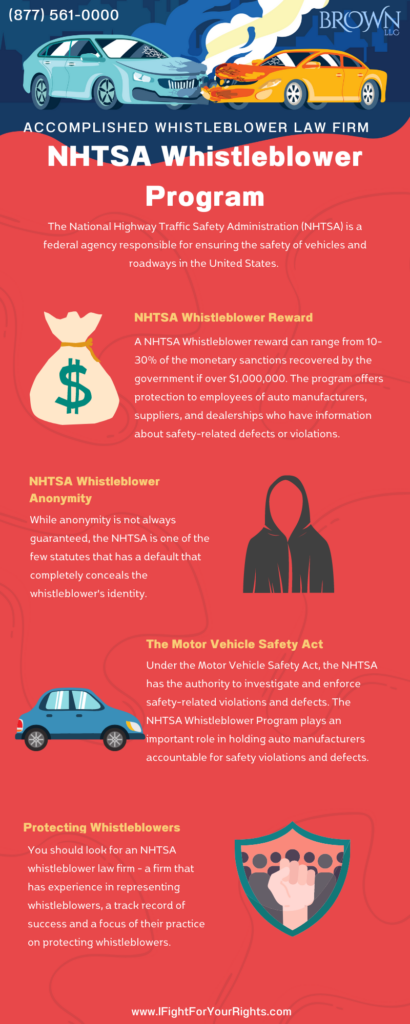
The NHTSA whistleblower program allows individuals with original, non-public information about motor vehicle safety defects or reporting failures to submit that information to the National Highway Traffic Safety Administration. If the information leads to a successful enforcement action and more than $1 million in civil penalties are collected, an eligible whistleblower may receive 10%–30% of the collected penalties.
Individuals who may be eligible include:
- Automotive engineers, designers, and test engineers
- Quality assurance and compliance professionals
- Employees of vehicle manufacturers (OEMs)
- Employees of parts suppliers and sub-suppliers
- Contractors and independent consultants
- Dealership or service-network employees
- Foreign-based employees whose information relates to vehicles sold in the United States
Speak with the Lawyers at Brown, LLC Today!
Over 100 million in judgments and settlements trials in state and federal courts. We fight for maximum damage and results.
Key eligibility principles:
- Information must be based on direct knowledge or independent technical analysis
- Public complaints alone are not sufficient
- No minimum employment duration is required
- Reports may be submitted anonymously through counsel
- NHTSA, not the whistleblower, decides whether a defect exists
What Conduct Does the NHTSA Whistleblower Program Cover?
The program was created under the Motor Vehicle Safety Whistleblower Act, part of the 2015 FAST Act (49 U.S.C. Chapter 301).
Covered violations include:
- Safety-related defects in vehicles or equipment
- FMVSS noncompliance (e.g., braking performance, occupant protection, visibility standards)
- Failures to report defects, deaths, injuries, warranty claims, or recalls
- Misleading or incomplete submissions to NHTSA, including recall-scope determinations
Early Warning Reporting (EWR) and Recall-Scope Failures
NHTSA places particular emphasis on Early Warning Reporting (EWR) compliance. Incomplete, delayed, or misleading EWR submissions are a frequent basis for enforcement actions. In late 2024, NHTSA finalized regulations (49 C.F.R. Part 513) clarifying eligibility, confidentiality, procedures, and award criteria.
Guidance for Engineers, Quality, and Compliance Professionals
Engineers and quality professionals often hesitate to report concerns because they are unsure whether an issue legally qualifies as a “defect” or fear that professional judgment may later be second-guessed. You are not required to prove a violation. NHTSA evaluates whether the information provided is credible, specific, and materially useful.
Examples of reportable concerns include:
- Materials or adhesives failing outside validated storage or handling conditions
- Manufacturing deviations undermining approved specifications
- Repeated field complaints inconsistent with internal root-cause conclusions
Good-faith reporting—even where management disagrees—is protected.
Frequently Asked Questions (NHTSA Whistleblower Program)
Do I need to be certain that a defect exists before reporting?
No. You are not required to prove that a defect exists or that a violation has occurred. NHTSA determines whether conduct violates federal safety laws. Whistleblowers are expected to provide credible, specific, and materially useful information, not legal conclusions.
Can I report anonymously?
Yes. Reports may be submitted anonymously through counsel. Your identity is protected to the fullest extent permitted by law, and disclosure is not required simply to submit information.
Do supplier or sub-supplier employees qualify?
Yes. Employees of parts suppliers and sub-suppliers may qualify if their information relates to vehicles or equipment sold in the United States and concerns safety defects, FMVSS noncompliance, or reporting failures.
Does my information need to be new or never reported internally?
Your information must be original, meaning it is not already known to NHTSA in a materially complete form. Internal reporting may strengthen a claim in some circumstances, but it is not always required and may carry retaliation risk. This is fact-specific.
What types of issues are commonly reportable?
Examples include safety-related defects, FMVSS noncompliance, delayed or incomplete recalls, inaccurate Early Warning Reporting (EWR), or internal data or analyses that were not provided—or were mischaracterized—to NHTSA.
How long do NHTSA investigations take?
Investigations vary widely and often take months or years, depending on complexity, scope, and whether enforcement action is pursued.
Can I be retaliated against for reporting?
Federal law prohibits retaliation for lawful whistleblower activity. Remedies may include reinstatement, back pay, and other relief. OSHA enforces these protections and strict deadlines may apply.
Why should I speak with counsel before submitting information?
You typically have one meaningful opportunity to submit whistleblower information in a way that preserves eligibility. Counsel can help assess risk, structure submissions, protect anonymity, and avoid missteps that could undermine protections or eligibility.
Does every report result in an award?
No. Awards are available only if NHTSA brings a qualifying enforcement action and collects civil penalties exceeding $1 million. The program is enforcement-driven and selective.
Speak With Counsel Before Submitting Information to NHTSA
You typically have one meaningful opportunity to submit whistleblower information correctly in a way that preserves eligibility. If you have credible, original information about an auto safety defect, FMVSS violation, or reporting failure, speaking with experienced NHTSA whistleblower counsel before submission can help protect your rights and maximize your options.
Contact Brown, LLC for a free, confidential consultation at (877) 561-0000
We assist with anonymous submissions, evidence strategy, retaliation protection, and award positioning.
This page is for informational purposes only and does not constitute legal advice. Every matter is fact-specific.