Skip to main content

What Is My Whistleblower Retaliation Case Worth?
Table of Contents
Every whistleblower who has been fired, demoted, sidelined, threatened, isolated, or blackballed believes the retaliation case is strong. Sometimes it is. Many times it is weaker than it feels. That is not because the whistleblower is lying. It is because retaliation cases are hard to prove, hard to value, and often worth less than the client expects.
The employer will almost always say the same thing: “We did not fire them because they reported fraud. We fired them because of performance, restructuring, attitude, confidentiality violations, poor judgment, policy breaches, lack of teamwork, or business reasons.” A good retaliation valuation starts by separating outrage from proof.
Short Answer: Retaliation Cases Are Usually Worth Wage Loss Plus Leverage, Not Fantasy Numbers
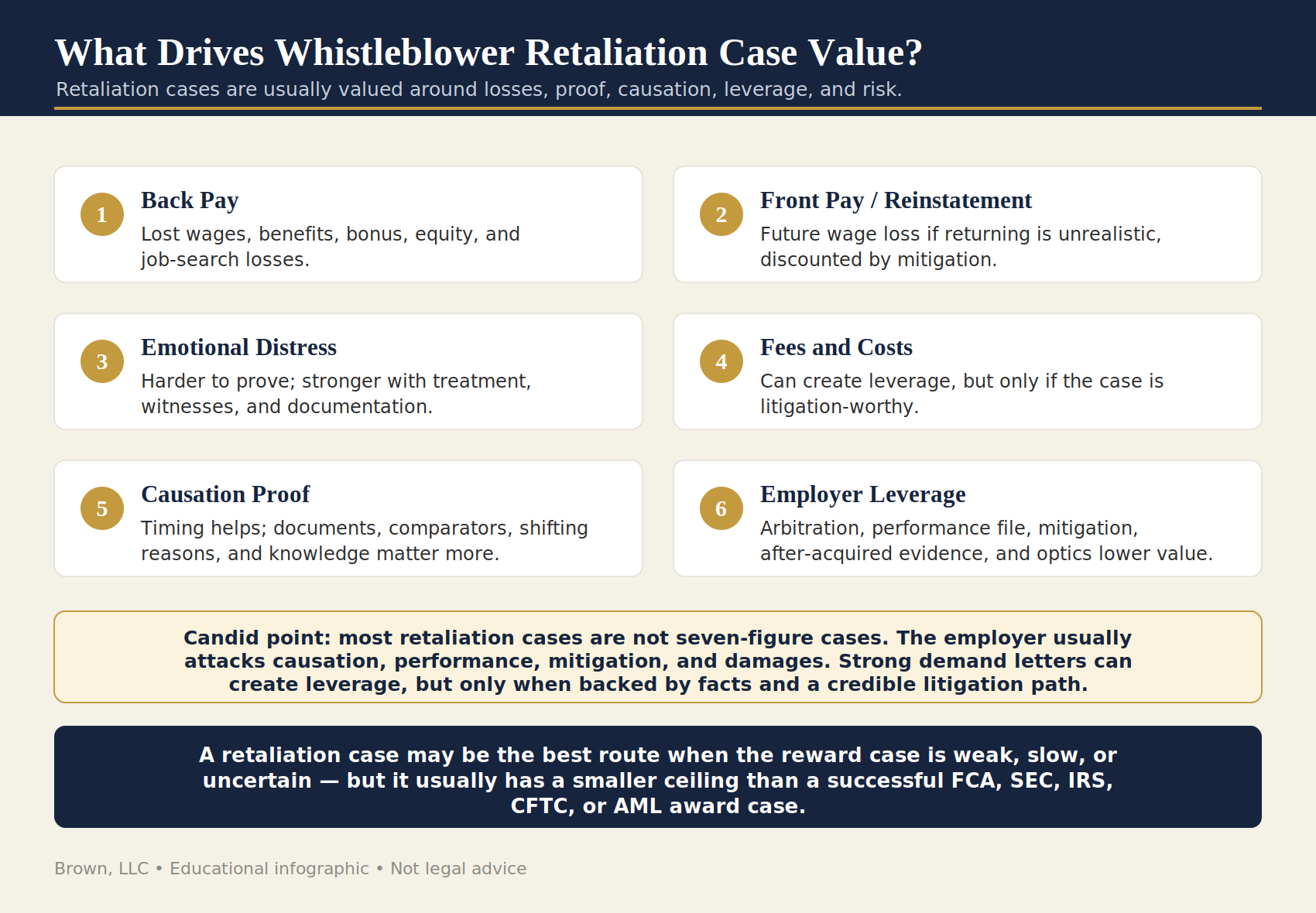
A whistleblower retaliation case is usually valued around these components:
- Back pay: lost wages, benefits, bonus, equity, and other compensation.
- Front pay or reinstatement: future loss if returning is impractical.
- Emotional distress or special damages: stronger with treatment, documentation, and credible witnesses.
- Statutory multipliers: some statutes provide double back pay or other enhanced remedies.
- Attorneys’ fees and costs: leverage if the claim is litigation-worthy.
- Employer risk: optics, discovery, executive depositions, agency scrutiny, and reputational concerns.
The False Claims Act retaliation provision provides relief necessary to make the employee, contractor, or agent whole, including reinstatement, two times back pay, interest, special damages, litigation costs, and reasonable attorneys’ fees. SEC/Dodd-Frank retaliation similarly provides reinstatement, two times back pay with interest, and litigation costs, expert fees, and reasonable attorneys’ fees for prevailing employees.
Speak with the Lawyers at Brown, LLC Today!
Over $1 billion in aggregate judgments and settlements for our clients in state and federal courts. We fight for maximum damages and results.
Those remedies sound powerful. But settlement value is not the maximum statutory remedy. It is the discounted value of what you can prove, what the employer risks, what a judge or jury may do, and what both sides want to avoid.
Related: Brown, LLC secured two of the year’s largest individual recoveries — a $950M settlement against Raytheon and $350M against Walgreens. Learn about our False Claims Act practice →
Candid Settlement Ranges: Practical Bands, Not Promises
Because most private retaliation settlements are confidential, there is no reliable public “average whistleblower retaliation settlement.” Public verdict lists are biased upward because large wins are publicized and quiet losses are not. Agency statistics show outcomes, but not a clean private-case average. As a practical settlement framework, many retaliation cases fall into these rough bands. These are not guarantees. They are case-evaluation ranges:
| Case type | Common practical range | Why |
| Low-leverage / early-exit matter | $10,000-$50,000 | Short wage gap, unclear protected activity, weak causation, limited damages, employer mainly buying peace. |
| Modest but documented retaliation | $50,000-$150,000 | Some wage loss, suspicious timing, credible protected activity, but defenses or mitigation limit value. |
| Strong terminated employee case | $150,000-$500,000 | Clear protected activity, decision-maker knowledge, meaningful wage loss, pretext evidence, no major credibility problems. |
| High-earner / executive / professional case | $500,000-$2M+ | Large compensation, career damage, strong proof, damaging documents, serious employer exposure. |
| Exceptional case | Above $2M | Rare. Requires major wage loss, strong liability, egregious conduct, public-company optics, punitive/exemplary exposure where available, or major fee/risk pressure. |
The point is not that $2 million cases never happen. They do. The point is that most retaliation cases do not live there.
Public Data Reality Check: Retaliation Claims Are Common, and Many Do Not Survive
The EEOC states that retaliation is the most frequently alleged basis of discrimination in all sectors, and its guidance notes that the percentage of charges alleging retaliation essentially doubled after 1998. That matters because judges, mediators, defense counsel, insurers, and employers see retaliation allegations constantly. They are not shocked by the label. They need proof.
The OSHA whistleblower statistics also show why expectations need to be grounded. In FY2023, OSHA reported 3,649 total whistleblower complaint determinations across covered statutes. Of those, 23 were merit findings, 509 were settled, 359 were settled-other, 2,154 were dismissed, and 562 were withdrawn. That means roughly 24.4% had a positive outcome for the complainant by that broad count, while roughly 59% were dismissed.
That does not mean a good case has only a 24.4% chance. It means the pool is full of weak, late, poorly documented, wrong-statute, low-damages, and hard-to-prove complaints. Strong cases do better. Weak cases usually do not become valuable just because the employee feels wronged.
Why Retaliation Cases Fall Apart
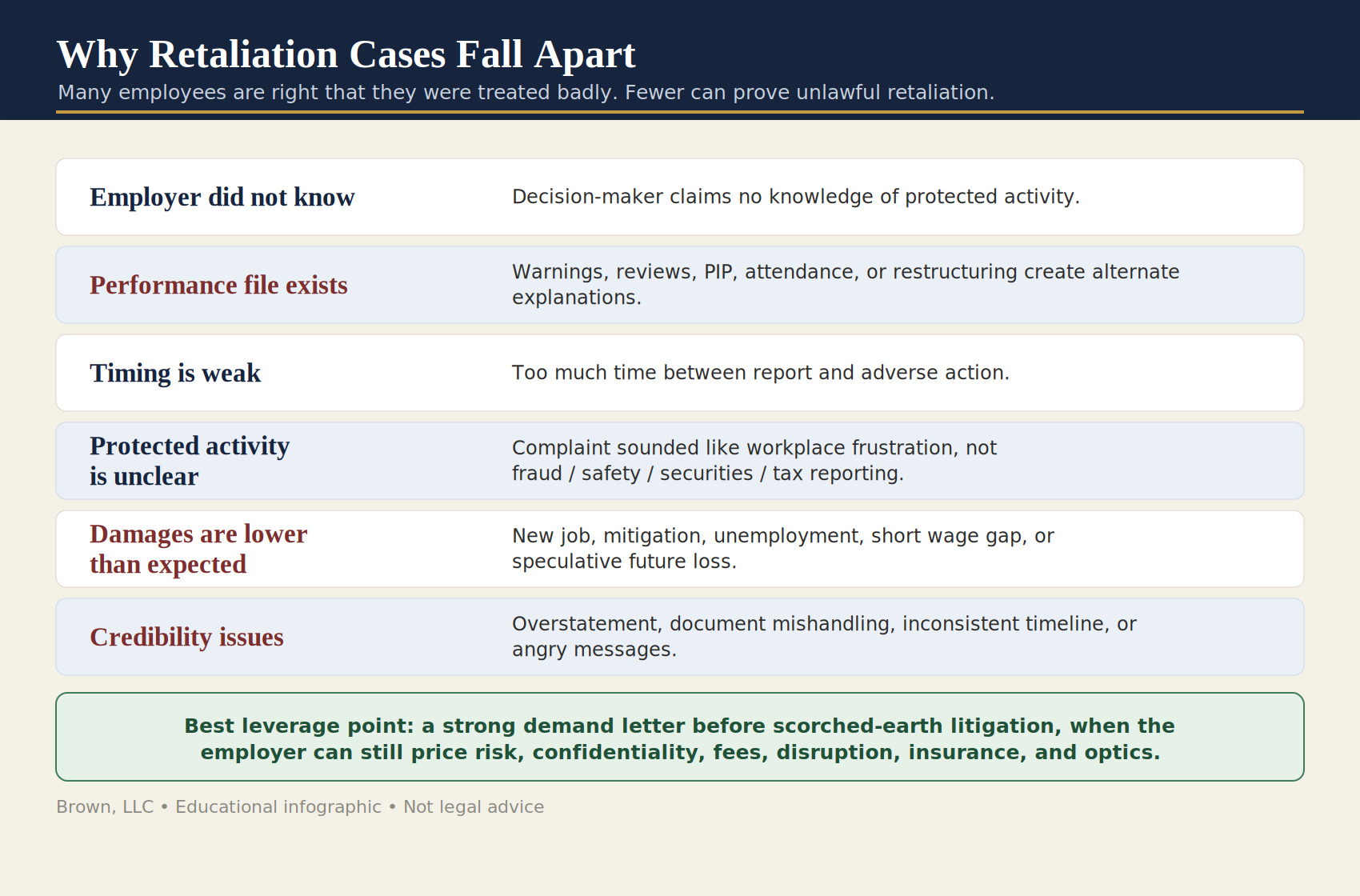
The employer did not know about the protected activity
A decision-maker generally cannot retaliate for something they did not know. If the employee reported fraud to one person, but the firing decision was made by someone else with plausible lack of knowledge, the case gets harder.
The protected activity is unclear
Not every complaint is protected whistleblowing. “My boss is unfair” is different from “the company is submitting false claims to Medicare” or “the public filings omit material revenue-recognition problems.” Vague workplace complaints may not put the employer on notice that the employee is trying to stop legal violations.
The performance file is bad
Employers often build performance files before termination. Sometimes the file is pretext. Sometimes it is real. Either way, it affects value. Written warnings, PIPs, attendance issues, policy violations, angry emails, confidentiality concerns, and interpersonal issues all reduce leverage.
Timing helps, but it rarely wins alone
Close timing between reporting and termination can help prove causation. But timing alone is vulnerable. The longer the gap, the more the employer will argue that intervening events caused the decision.
Mitigation reduces damages
If the whistleblower finds comparable work quickly, back pay shrinks. If they do not search seriously, the employer will argue failure to mitigate. If they earn more later, damages may be reduced substantially.
Speak with the Lawyers at Brown, LLC Today!
Over $1 billion in aggregate judgments and settlements for our clients in state and federal courts. We fight for maximum damages and results.
Judges and mediators are desensitized to retaliation labels
Retaliation is common in employment litigation. A judge may believe the workplace was rough and still find the legal proof insufficient. A mediator may understand the employee’s anger and still tell both sides the case is not worth seven figures.
The Demand-Letter Route May Be the Best Route — but Only if Done Right
In many retaliation matters, the highest risk-adjusted value may come from a strong pre-suit demand letter or structured pre-litigation negotiation, not from years of litigation.
That is because the employer may want to avoid discovery, executive depositions, litigation expense, agency attention, insurance complications, public filings, and reputational risk. A demand letter can price those risks before both sides become entrenched.
But a demand letter is not magic. A weak demand letter that reads like anger without evidence will usually fail. The best demand letter does four things:
- It identifies the protected activity clearly.
- It ties the adverse action to decision-maker knowledge and timing.
- It explains damages realistically.
- It shows the employer that litigation would be credible, expensive, and uncomfortable.
The demand-letter route is often best when the goal is a clean exit, compensation, confidentiality, neutral reference language, non-disparagement, preservation of award-case rights, and avoiding a litigation war.
Why the Case May Be Worth Less Than the Whistleblower Thinks
There are several hard truths. First, the law usually compensates provable loss, not moral injury. Being betrayed, isolated, or humiliated matters, but it must be translated into legally recoverable damages.
Second, emotional distress is harder than clients expect. Treatment records, medication, testimony from family, physical symptoms, and credible chronology help. General stress, anger, or insomnia without proof may not move value much.
Third, front pay is uncertain. Courts do not usually award indefinite future earnings because the employee fears they will never work again. Front pay must be reasonable and supported.
Fourth, settlement value is affected by tax consequences, attorney economics, delay, arbitration, appeal risk, confidentiality demands, and the employer’s insurance position.
Fifth, retaliation litigation can become a trial about the employee. The employer may seek emails, texts, performance reviews, job-search records, medical records, mitigation records, and after-acquired evidence. That discovery risk affects value.
The Headwinds Are Real Even in Famous Cases
The UBS whistleblower litigation shows how long retaliation cases can take. Reuters reported that UBS agreed in principle to settle with the whistleblower in 2026, ending a lawsuit filed after a 2012 termination that had gone to the U.S. Supreme Court. Reuters also reported that the Supreme Court had reinstated a more than $2.6 million award in 2024, but the award was later set aside by an appeals court due to jury-instruction issues before the eventual settlement.
That is the point. Even a case with a major Supreme Court win can take more than a decade and still face reversal, retrial risk, and settlement uncertainty.
How to Calculate Retaliation Case Value
A practical formula is:
Retaliation settlement value = provable economic loss + plausible emotional/special damages + statutory multiplier/fee leverage + employer risk − causation/proof/mitigation/credibility discounts.
Example: A whistleblower earning $150,000 is fired and remains unemployed for 10 months before finding comparable work. Gross wage loss is about $125,000, plus benefits. If the statute allows double back pay and fees, the theoretical number rises. But if causation is disputed, the employee had prior performance issues, and emotional damages are lightly documented, settlement value may be far below the theoretical maximum.
By contrast, a $150,000 employee with clean reviews, written fraud reports, firing two weeks later, executives forwarding “we need to get rid of him” emails, and 18 months of unemployment has a materially different case.
What Increases Retaliation Value
- Clear written protected activity.
- Decision-maker knowledge.
- Close timing plus evidence of pretext.
- Clean performance history.
- Meaningful wage loss and benefits loss.
- Strong mitigation efforts.
- Comparable employees treated better.
- Documents showing anger about the report.
- A statute with double back pay, fees, or strong remedies.
- Employer sensitivity to reputational, government-contract, public-company, or regulatory risk.
What Lowers Retaliation Value
- Ambiguous complaint.
- No decision-maker knowledge.
- Long gap between report and adverse action.
- Existing performance problems.
- Policy violations or document-taking issues.
- Quick new job or limited wage loss.
- Weak mitigation.
- Speculative emotional distress.
- Arbitration or forum problems.
- Overheated demand disconnected from damages.
Retaliation Value vs. Award-Case Value
A retaliation case may be the best way to get faster leverage and personal relief. But it is often smaller than a successful underlying reward case. For how reward-case value is calculated across the FCA, SEC, IRS, CFTC, and AML programs, see our companion article on what a whistleblower case is worth.
A strong FCA case can produce a relator share tied to government recovery. A strong SEC case can produce an award tied to collected sanctions. A strong IRS case can produce an award tied to collected tax proceeds. Retaliation usually compensates the harm to the individual. That harm can be substantial, but it is generally bounded by wages, benefits, emotional distress, statutory enhancements, and fees.
This is why strategy matters. Sometimes the retaliation case should be used to protect the whistleblower while preserving the underlying award case. Sometimes the retaliation case is the main path because the reward case is too speculative. Sometimes a demand letter is better than filing. Sometimes filing is necessary.
What a Strong Retaliation Demand Letter Should Include
- A clear timeline.
- The protected report or conduct.
- Who knew about it.
- The adverse action.
- Evidence of causation or pretext.
- Back pay and benefit calculations.
- Mitigation status.
- Emotional/special damages support.
- Relevant statute and remedies.
- Settlement demand tied to real exposure, not fantasy.
The goal is not to yell. The goal is to make the employer and its counsel price risk.
Why Brown, LLC Takes a Pragmatic View
Brown, LLC evaluates retaliation cases with the same discipline it applies to whistleblower award cases. The firm looks at statute fit, protected activity, causation, damages, mitigation, timing, documents, forum, likely defenses, settlement leverage, and whether the retaliation case helps or hurts the underlying whistleblower case.
That is important because retaliation and reward strategy can collide. A reckless public retaliation demand can reveal the fraud theory, damage a sealed FCA case, trigger document disputes, or give the employer time to blame the whistleblower. The employment strategy must be aligned with the whistleblower strategy.
Bottom Line
A whistleblower retaliation case may be valuable. It may also be harder, slower, and less valuable than the client expects. The strongest cases have clear protected activity, decision-maker knowledge, close timing, pretext evidence, clean performance history, real wage loss, and credible damages. The weakest cases rely mostly on the employee’s belief that the employer acted unfairly.
Whistleblower tip: If you’ve witnessed Medicare or Medicaid billing fraud at your employer, you may qualify as a qui tam relator with a potential share of the government’s recovery. See our Medicare & Medicaid fraud practice →
If you were retaliated against after reporting fraud, do not assume the case is worthless. Do not assume it is seven figures either. Build the timeline, preserve lawful evidence, calculate the wage loss, and speak with a whistleblower lawyer before sending a demand letter or filing suit.
FAQ
What is the average whistleblower retaliation settlement?
There is no reliable public average because most settlements are confidential and statutes differ. Practical values often range from low five figures for weak or low-damages cases to six figures for strong documented termination cases, with seven-figure outcomes reserved for high earners, severe facts, major wage loss, or strong employer-risk cases.
What damages can I recover in a whistleblower retaliation case?
Potential remedies may include back pay, front pay or reinstatement, interest, special damages, emotional distress, attorneys’ fees, litigation costs, and statutory multipliers depending on the law. FCA retaliation provides reinstatement, two times back pay, interest, special damages, litigation costs, and reasonable attorneys’ fees.
Is a demand letter better than filing a lawsuit?
Often, yes. A strong demand letter can create leverage before both sides spend years in litigation. But it must be precise, credible, and strategically aligned with any underlying FCA, SEC, IRS, CFTC, AML, or other whistleblower matter.
Why do retaliation cases get dismissed?
Common reasons include unclear protected activity, lack of employer knowledge, weak causation, strong performance defenses, mitigation problems, poor damages proof, document-handling issues, or wrong forum/statute.
Can I bring a retaliation case and a whistleblower reward case?
Sometimes. But the strategies must be coordinated. A retaliation filing or demand can affect the underlying whistleblower case, especially if an FCA case is under seal or if document handling and privilege issues exist.
Source and Accuracy Confirmation
This article is based directly on the statutes, agency guidance, and public reports listed in the Sources section below, and its factual statements have been checked against those sources. The statutory remedies for FCA and Dodd-Frank retaliation, the EEOC and OSHA data, and the reported procedural history of the cited litigation reflect those materials as published. The settlement bands, formulas, and examples are illustrative case-evaluation tools, not predictions, and individual results vary with statute, proof, forum, and risk. Because most private retaliation settlements are confidential, the article states plainly that no reliable public average exists and limits its claims to what the cited sources support.
Sources
DOJ FCA FY2025 press release: https://www.justice.gov/opa/pr/false-claims-act-settlements-and-judgments-exceed-68b-fiscal-year-2025
DOJ FCA FY2025 fraud statistics PDF: https://www.justice.gov/opa/media/1424121/dl
False Claims Act, 31 U.S.C. § 3730: https://www.law.cornell.edu/uscode/text/31/3730
SEC FY2025 Office of the Whistleblower annual report: https://www.sec.gov/files/fy25-annual-whistleblower-report.pdf
SEC whistleblower statute, 15 U.S.C. § 78u-6: https://www.law.cornell.edu/uscode/text/15/78u-6
IRS Whistleblower Office FY2024 annual report: https://www.irs.gov/pub/irs-pdf/p5241.pdf
IRS Whistleblower Office: https://www.irs.gov/compliance/whistleblower-office
CFTC FY2025 Whistleblower report: https://www.whistleblower.gov/sites/whistleblower/files/2026-02/FY%202025%20Whistleblower%20%26%20Customer%20Education%20Report.pdf
CFTC whistleblower award amount rule, 17 CFR § 165.8: https://www.law.cornell.edu/cfr/text/17/165.8
CFTC award criteria, 17 CFR § 165.9: https://www.law.cornell.edu/cfr/text/17/165.9
FinCEN proposed whistleblower rule: https://www.federalregister.gov/documents/2026/04/01/2026-06271/whistleblower-incentives-and-protections
FinCEN whistleblower program: https://www.fincen.gov/whistleblower-program
DOJ Corporate Whistleblower Awards Pilot Program: https://www.justice.gov/criminal/criminal-division-corporate-whistleblower-awards-pilot-program
OSHA whistleblower statistics FY2018-FY2023: https://www.whistleblowers.gov/factsheets_page/statistics/FY2023
EEOC FY2024 Annual Performance Report: https://www.eeoc.gov/2024-annual-performance-report
EEOC retaliation guidance: https://www.eeoc.gov/laws/guidance/enforcement-guidance-retaliation-and-related-issues
Reuters, UBS whistleblower settlement after 13 years: https://www.reuters.com/business/ubs-settle-lawsuit-with-whistleblower-court-filings-show-2026-03-12/