Skip to main content

What Happens If the DOJ Declines Your False Claims Act Case?
Table of Contents
Why Declination Matters
A government declination is one of the most misunderstood moments in False Claims Act practice. Some relators hear “declined” and assume the case is over. Others hear “declined” and treat it like a green light to push forward no matter what. Both reactions are dangerous.
The truth is harder and more useful. Under the False Claims Act, if the government declines to intervene, the relator may still conduct the action. The potential relator share is also higher in a successful declined case than in an intervened case. But a declined case becomes a different animal.
The relator’s lawyers now carry more of the litigation burden. The case economics matter more. The motion-to-dismiss risk matters more. And if the relator has separate employment, confidentiality, licensing, or criminal exposure, separate counsel may sometimes be needed to analyze that personal risk while the qui tam team analyzes the case itself.
What the Statute Says
Under 31 U.S.C. § 3730(c)(3), if the government elects not to proceed with the action, the relator has the right to conduct the action. Under § 3730(d)(2), if the government does not intervene and the action succeeds, the relator generally receives between 25% and 30% of the proceeds.
Speak with the Lawyers at Brown, LLC Today!
Over 100 million in judgments and settlements trials in state and federal courts. We fight for maximum damage and results.
Those numbers are why sophisticated relators do not stop thinking when the DOJ declines. But the higher percentage does not make a declined case easy money. It means the relator is being compensated for carrying more risk.
2026 Reality Check
Declination is not the same as failure. The DOJ reported record False Claims Act activity for fiscal year 2025. Whistleblowers filed 1,297 qui tam suits, and non-intervened, or declined, qui tam matters still generated roughly $2.288 billion in recoveries in FY 2025.
That means the old shorthand, that a declination means the case is dead, is not just incomplete. It is wrong.
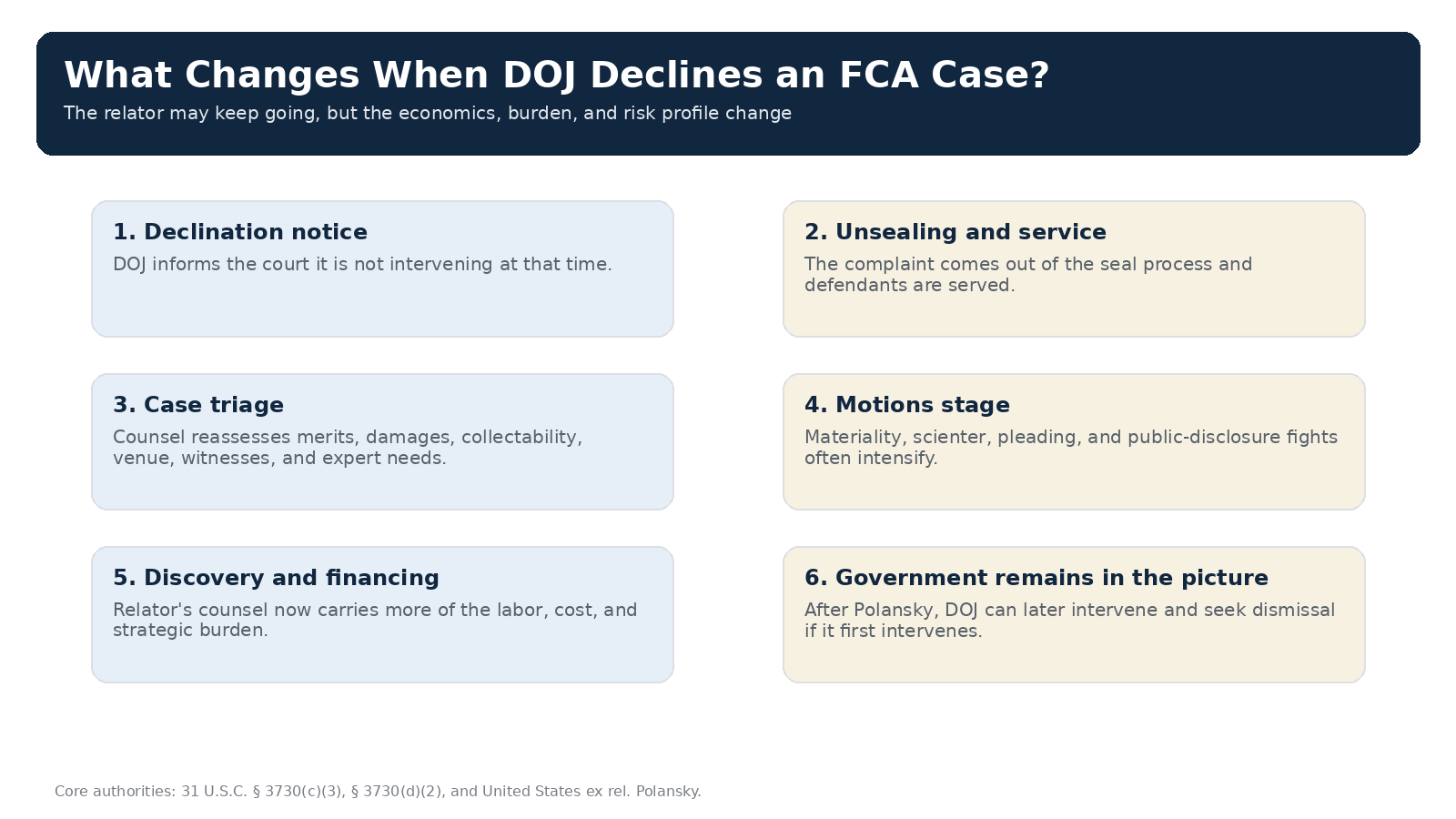
What Changes the Day the DOJ Declines
-
The economics change
A declined case has to justify itself not just morally, but financially and procedurally. Is the defendant solvent? Are the damages large enough to support years of litigation? Will experts be required? Are there meaningful state-law claims riding with the federal case? Those questions become central very quickly.
-
The burden shifts
When the DOJ intervenes, the government takes primary responsibility for prosecution. When the DOJ declines, your lawyers are doing much more of the work. Pleading fights, discovery, experts, motions practice, trial preparation, and settlement leverage all become more dependent on relator-side counsel.
-
Counsel quality matters even more
Not every firm that can file a sealed complaint is built to prosecute a declined action. The right question is not merely, “Have you filed FCA cases?” It is, “What do you do after declination? Have you actually pushed cases without the DOJ?”
-
The relator’s own risk profile may change
A relator may have separate issues that are not solved by having a strong qui tam lawyer. If the relator took documents, signed restrictive agreements, has employment retaliation exposure, faces licensing issues, or was involved in the underlying conduct, separate counsel may sometimes be needed to give independent advice on that personal exposure.
Can the DOJ Come Back Later?
Yes. After the Supreme Court’s decision in United States ex rel. Polansky v. Executive Health Resources, the government may move to dismiss a False Claims Act suit whenever it has intervened, whether during the seal period or later. So even in a declined case, the DOJ is not necessarily gone forever.
In some matters that helps the relator. In others it creates a second layer of strategic uncertainty. Either way, it reinforces the point that a declined case is still a government case in a meaningful sense.
Proceed or Pause? A Working Checklist
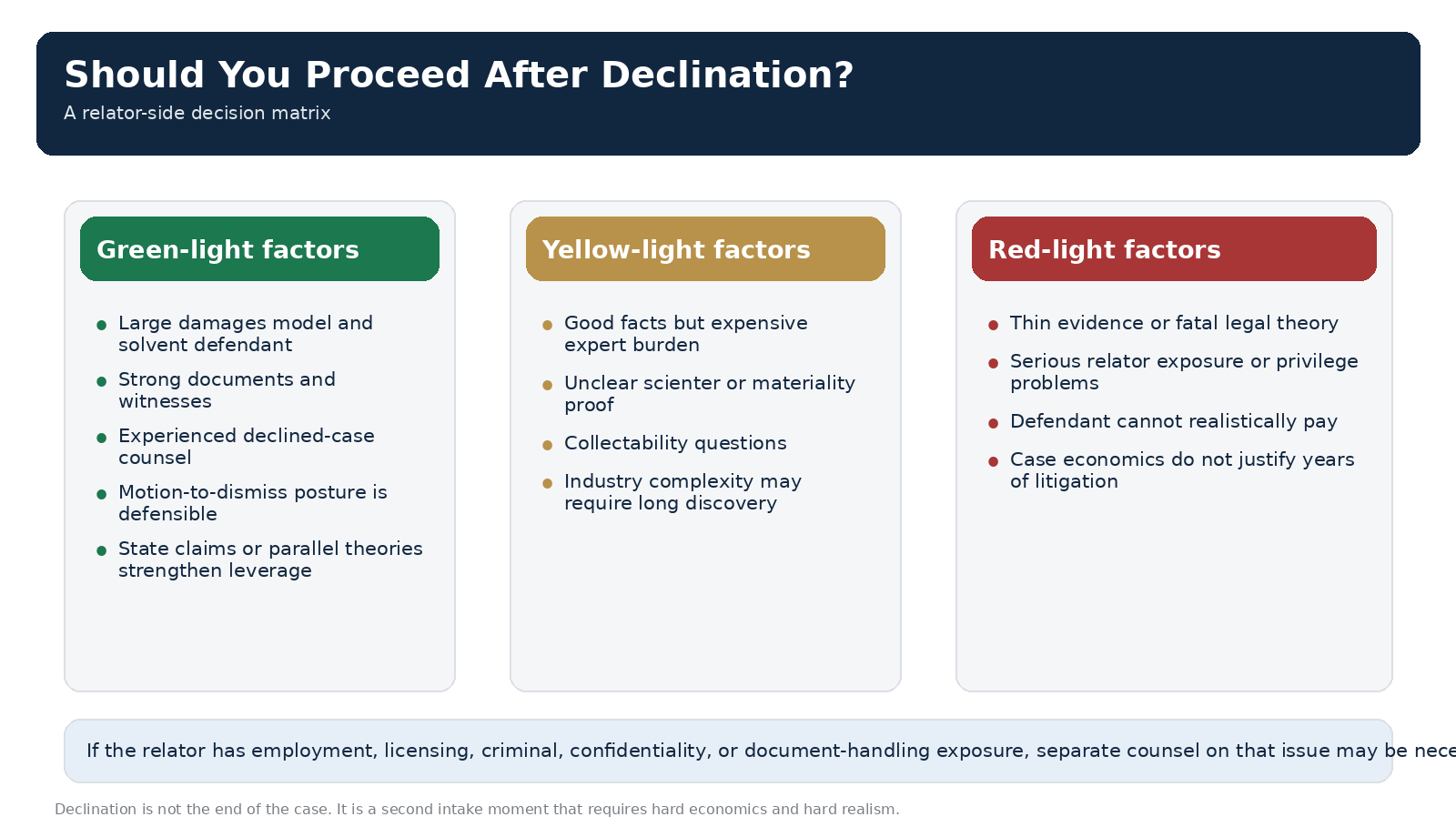
| Proceed factors | Needs hard review | Pause factors |
| Large damages model and solvent defendant | High expert burden or messy proof | Thin evidence or fatal legal theory |
| Strong documents and witnesses | Unclear scienter or materiality proof | Defendant cannot realistically pay |
| Experienced declined-case counsel | Cost may outrun realistic recovery | Serious relator exposure unresolved |
| Good venue and defendable pleading posture | State claims may or may not add value | Case economics do not justify years of litigation |
When Separate Counsel May Be Necessary
This issue deserves its own section because it is where sophisticated counseling distinguishes itself from sales copy. Separate counsel may be appropriate if the relator has potential criminal exposure, licensing or professional-discipline issues, confidentiality or trade-secret problems, employment or severance negotiations, indemnification questions, or conflicts with current counsel about what risks matter most personally.
A qui tam lawyer’s core job is to evaluate and prosecute the False Claims Act case. Sometimes that same lawyer can also handle the relator’s related issues. Sometimes that would be a mistake. In the right case, separate counsel protects the relator and improves the FCA strategy because each problem is being handled by the lawyer best equipped for it.
What to Do Immediately After Declination
- Reassess the case, not just the feeling. A decline is emotional, but the next step should be analytical.
- Ask why the government likely passed. Resource limits, proof complexity, and economics all matter.
- Stress-test the motion-to-dismiss posture, including scienter, materiality, first-to-file, and public-disclosure issues.
- Re-run the economics. A good fraud theory can still be a bad declined case if it will take years to litigate against an uncollectible defendant.
- Evaluate your own exposure honestly. If you have document-handling, employment, licensing, confidentiality, or criminal concerns, raise them early.
The best relator-side lawyers do not treat declination as a talking point. They treat it as a second intake moment.
Bottom Line
If the DOJ declines your False Claims Act case, you may still proceed. The statute allows it. The potential relator share is higher if you succeed. And the public FY 2025 data proves declined cases can still generate serious recoveries.
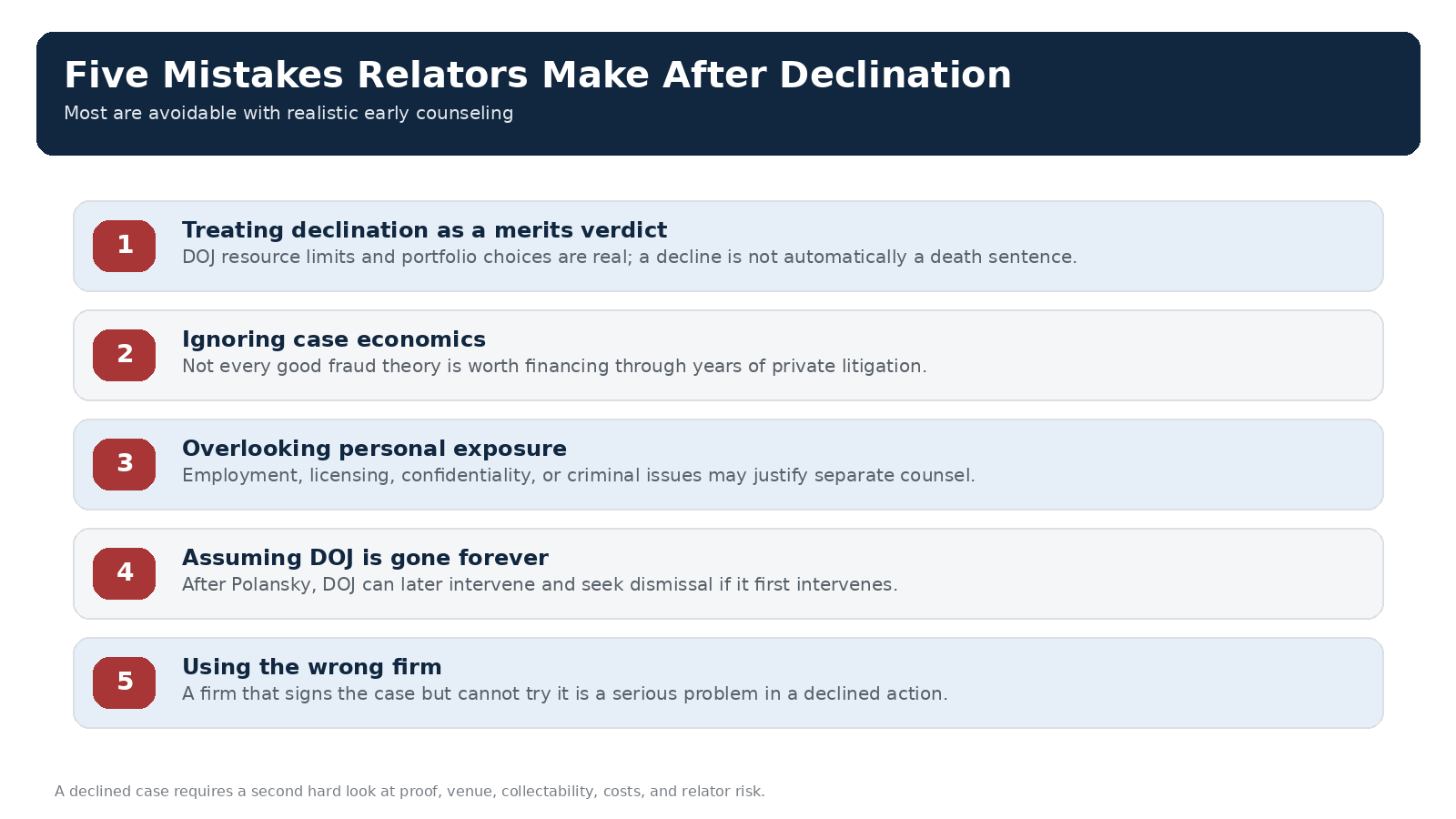
But that does not mean every declined case should be pursued. The smart move is to reassess the merits, the economics, the collectability, the motion posture, and your own exposure. In some matters, that analysis will show the case should move forward aggressively. In others, it will show the case is not worth years of private litigation.
And in some cases, the right answer will include retaining separate counsel to analyze your personal exposure while your qui tam team focuses on the FCA claim. That is what sophisticated FCA advice looks like after a declination.
If the DOJ Declines, Is My FCA Case Over?
No. The False Claims Act allows the relator to continue the action if the government declines to proceed.
Do I Get a Bigger Percentage if I Win a Declined Case?
Usually yes. The statute generally provides a 25% to 30% share in a successful non-intervened case.
Does Declination Mean the DOJ Thinks the Case Is Weak?
Not necessarily. Declination can reflect resources, priorities, proof complexity, economics, or strategy.
Could I Need Separate Counsel?
Yes. If you have personal exposure involving employment, documents, confidentiality, licensing, or possible criminal issues, separate counsel may sometimes be appropriate.
Three Questions to Ask Counsel After Declination
- What do you think the DOJ saw as the biggest weakness or economic obstacle in this case?
- If we proceed, who will actually finance and litigate discovery, experts, and trial work?
- Do I need separate personal counsel for documents, employment, licensing, or criminal-risk questions?
Strong relator-side counsel will answer these questions candidly and without overselling the case.
This page provides general information for marketing and educational purposes and is not legal advice.