 Skip to main content

The 2026 National Health Care Fraud Takedown: What 455 Charges and $6.5 Billion in Alleged Fraud Mean for Whistleblowers

Table of Contents
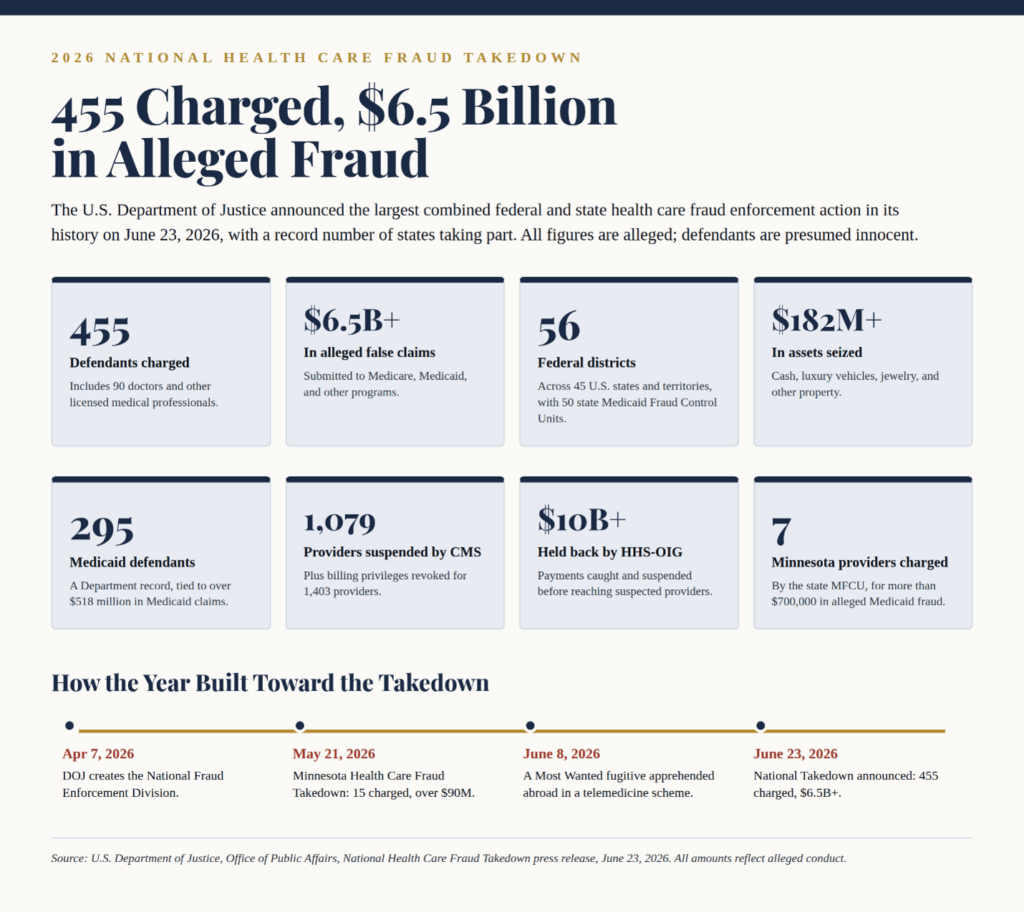
On June 23, 2026, the U.S. Department of Justice announced what it called the 2026 National Health Care Fraud Takedown: charges against 455 defendants, including 90 doctors and other licensed medical professionals, tied to health care fraud and opioid schemes involving more than $6.5 billion in alleged false claims and, in some cases, patient harm, including death.
The cases span 56 federal districts and 45 U.S. states and territories, with 50 state Medicaid Fraud Control Units (MFCUs) taking part, the most in the DOJ’s history. Seven of those defendants were charged in Minnesota by the state Attorney General’s MFCU, accused of billing the state Medicaid program for more than $700,000 in services that were never provided or were provided by unlicensed personnel.
This post brings the national announcement and the Minnesota filings together so that health care insiders can see how these schemes work from the inside, how investigators uncover them, and the outsized role ordinary employees and whistleblowers play in bringing them to light.
What the DOJ Announced in the 2026 Takedown
The takedown was framed as a whole-of-government effort coordinated by the DOJ’s Health Care Fraud Unit alongside U.S. Attorneys’ Offices, the FBI, the Department of Health and Human Services Office of Inspector General (HHS-OIG), the Drug Enforcement Administration (DEA), and state MFCUs. According to the DOJ, the operation included the seizure of more than $182 million in cash, luxury vehicles, jewelry, and other assets, and it relied heavily on data analytics to flag suspicious billing.
Several numbers stand out. The DOJ reported a record for Medicaid enforcement specifically: 295 defendants and more than $518 million in false claims submitted to Medicaid, described as the largest number of Medicaid fraud defendants and the largest Medicaid loss charged in the Department’s history.
Speak with the Lawyers at Brown, LLC Today!
Over $1 billion in aggregate judgments and settlements for our clients in state and federal courts. We fight for maximum damages and results.
On the civil side, the announcement listed 48 civil monetary settlements totaling more than $73 million, civil charges against 13 defendants tied to $14.8 million in schemes, and civil settlements with 31 defendants totaling $23 million. The Centers for Medicare and Medicaid Services (CMS) reported suspending 1,079 providers and revoking billing privileges for 1,403 providers, while HHS-OIG described actions seeking more than $10 billion in payments held back before they reached suspected fraudulent providers.
The Federal Fraud Cases That Show the Scale
The largest single category highlighted involved fraudulent wound care, specifically amniotic wound allografts. The DOJ charged 11 defendants across six districts in connection with billions of dollars in claims.
In one matter, prosecutors alleged that providers billed Medicare more than $4 billion over roughly two and a half years for one company’s allografts, generating over $2 billion in payments, driven by a kickback scheme rather than medical need. The complaint describes a company that did not manufacture the grafts but relabeled tissue at a markup of around 2,000%, charging up to $1,450 per square centimeter, and paying kickbacks of roughly 40%.
The DOJ alleged the grafts were applied to hospice patients, to superficial wounds that did not need them, and to areas far larger than the wound itself. In a separate case, a nurse practitioner was charged in a $906 million scheme that allegedly billed Medicare more than $1 million per patient on average. CMS separately cut Medicare’s allograft payment to $127 per square centimeter starting January 1, 2026.
Related: Brown, LLC secured two of the year’s largest individual recoveries — a $950M settlement against Raytheon and $350M against Walgreens. Learn about our False Claims Act practice →
Other federal cases included a $67 million scheme to bill Illinois Medicaid for behavioral health services, in which the defendant allegedly submitted claims for 500 or more hours of counseling per day, more than the staff could possibly deliver. In the Central District of California, a hospice owner was charged in a $27.7 million scheme that allegedly involved buying the identities of recently deceased people from a funeral home employee in order to bill for hospice care never given and to manipulate the data metrics fraud detectors watch.
In the Southern District of Florida, the medical director of a cardiovascular practice was charged in an $89 million scheme to run unnecessary heart tests on student athletes; according to the charges, one student athlete whose abnormal results were signed off as normal later died during a basketball practice.
The takedown also included 36 defendants tied to illegal opioid diversion, among them a refill arrangement that allegedly kept dispensing Schedule II drugs even after patients overdosed and died.
The Seven Minnesota Medicaid Fraud Cases
Minnesota’s MFCU brought seven separate complaints, each charging theft by false representation, the charge typically used in state-level fraud cases. The conduct alleged is strikingly consistent and, for anyone who has worked in home care or behavioral health, is likely familiar.
One defendant, charged in Ramsey County, allegedly billed for more than 6,000 hours of personal care assistant, companion, and homemaker services he could not have provided, including during a nearly two-year stretch when he was working as a college basketball coach in another state. Another, charged in Clay County, allegedly billed more than $150,000 for psychotherapy and substance use counseling without any license, using the credentials and identities of three licensed professionals who did not know their names were being used, across more than 160 clients.
A defendant charged in Hennepin County allegedly billed nearly $70,000 for personal care services to a child for almost 25 months after the child had moved to California.
Two defendants charged in Anoka County allegedly billed for services while either they or the recipient were out of the country. One faced more than 1,655 fraudulent claim submissions totaling over $182,000; the other allegedly billed for hundreds of hours while abroad, thousands of hours while the recipient was abroad, and roughly 98 hours after the recipient had died.
A defendant charged in Ramsey County allegedly billed more than $60,000 for over 3,500 hours of personal care that could not have happened because he was working another job or serving a different client elsewhere at the same time. A seventh defendant, charged in Polk County, allegedly billed more than $29,000 for adult rehabilitative mental health and case management services she did not provide.
How These Fraud Cases Came to Light
For potential whistleblowers, the most useful detail in the Minnesota announcement is where the cases came from. The state Attorney General’s office said the Minnesota Department of Human Services flagged two of the seven, the health insurer UCare referred two, the Crystal Police Department forwarded two, and a private citizen contacted the MFCU about one.
Put simply: ordinary people and front-line organizations, not just data systems, put these cases in motion. The state also noted that since January 1, 2025, it stopped payment to 695 providers based on credible fraud allegations and made more than 655 referrals to law enforcement.
Speak with the Lawyers at Brown, LLC Today!
Over $1 billion in aggregate judgments and settlements for our clients in state and federal courts. We fight for maximum damages and results.
This matters because the federal programs at the center of the takedown, Medicare and Medicaid, are covered by the federal False Claims Act, which lets private individuals with inside knowledge file what are known as qui tam cases on behalf of the government. Many states, including Minnesota, have parallel false claims laws. People who report fraud through these channels may be eligible for a share of what the government recovers and the law contains anti-retaliation protections for employees who report in good faith.

Health Care Fraud Red Flags Insiders Can Watch For
The charging documents describe patterns that tend to repeat across home care, behavioral health, hospice, and wound care settings. Based on the alleged and admitted conduct in these cases, insiders have reported noticing red flags such as:
- Billing for services on dates when the patient was hospitalized, out of the country, moved away, or deceased.
- Time records that add up to impossible totals, such as a single provider billing hundreds of hours in a period when they held another full-time job.
- Use of a licensed professional’s name, signature, or credentials on notes for services that person never performed or supervised.
- Pressure to sign off on charts, test results, or therapy notes quickly and without real review.
- Kickbacks framed as marketing fees, bonuses, hotel stays, or referral payments tied to enrolling specific patients.
- Treatments applied to patients who do not appear to need them, especially vulnerable groups such as hospice patients, people with disabilities, children, or those struggling with addiction.
Does This Sound Familiar?
If you work in a clinic, agency, hospice, pharmacy, or care company, some of this may resemble things you have already seen. Have you been asked to chart visits that did not happen, or to log hours for a client who was not actually there? Have you noticed claims going out under a clinician’s name for work that clinician never did? Have you raised a concern internally about billing or staffing only to watch it go nowhere? Have you felt uneasy about how patients were recruited, or about being told not to ask questions?
The DOJ is taking these matters very seriously both criminally and civilly and the customs fraud whistleblowers we present to the government draw a large audience and a high level of interest

Recognizing the pattern does not mean you have to have all the answers or proof gathered. The people who help surface these cases are often employees, former employees, billing staff, or family members who simply knew that what they were seeing did not add up.

Talking With a Whistleblower Lawyer About Health Care Fraud
If the conduct described here reflects something you have experienced or witnessed, you do not have to sort out on your own whether it rises to the level of fraud. A confidential conversation with a whistleblower lawyer or with a whistleblower law firm can help you understand your options, the protections that may apply to you, and how the reporting process works. Reaching out early, before taking any steps on your own, is often the most careful path.
Sources and Accuracy Confirmation
This post is based directly on the listed sources, primarily the DOJ Office of Public Affairs press release announcing the 2026 National Health Care Fraud Takedown, the Minnesota Attorney General’s office press release describing the seven state charges, and the related DOJ release on the earlier 2026 Minnesota Health Care Fraud Takedown. The factual statements above, including the charge counts, dollar figures, referral sources, and descriptions of alleged conduct, have been checked against those sources. All charges described are allegations, and every defendant is presumed innocent unless and until proven guilty. Some details reported in secondary news coverage, such as exact claim counts in individual Minnesota cases, track the Attorney General’s office statement; where available sources did not provide further detail, no additional claims have been added.
Sources and Further Reading
- DOJ Office of Public Affairs, National Health Care Fraud Takedown Results in 455 Defendants Charged: https://www.justice.gov/opa/pr/national-health-care-fraud-takedown-results-455-defendants-charged-connection-over-65
- Minnesota Attorney General’s Office, Medicaid fraud charges against seven: https://www.ag.state.mn.us/Office/Communications/2026/06/23_Medicaid-Fraud.asp
- DOJ Office of Public Affairs, Minnesota Health Care Fraud Takedown (15 defendants, over $90M): https://www.justice.gov/opa/pr/minnesota-health-care-fraud-takedown-results-charges-against-15-defendants-over-90m-fraud
- DOJ Health Care Fraud Unit, 2026 National Health Care Fraud Takedown case summaries and court documents: https://justice.gov/criminal/criminal-fraud/health-care-fraud-unit/2026-national-hcf-case-summaries
- KSTP coverage of the Minnesota charges: https://kstp.com/kstp-news/top-news/7-minnesota-providers-among-455-charged-in-nationwide-6-5b-health-care-fraud-takedown/