Skip to main content

Redi-Bag USA and CEO Agree to Pay $7.3 Million: How False Country-of-Origin Declarations Can Become a Customs Fraud False Claims Act Case

Table of Contents
A country-of-origin declaration can look like a line on a customs form. In the Redi-Bag USA settlement, the government alleged that the line concealed a much larger economic fact: polyethylene retail carrier bags made in China were allegedly routed through Hong Kong and declared as Hong Kong-origin goods, allowing the importer to avoid antidumping duties that could reach 77.57% of the value of the merchandise when the applicable order and product specifications were met.
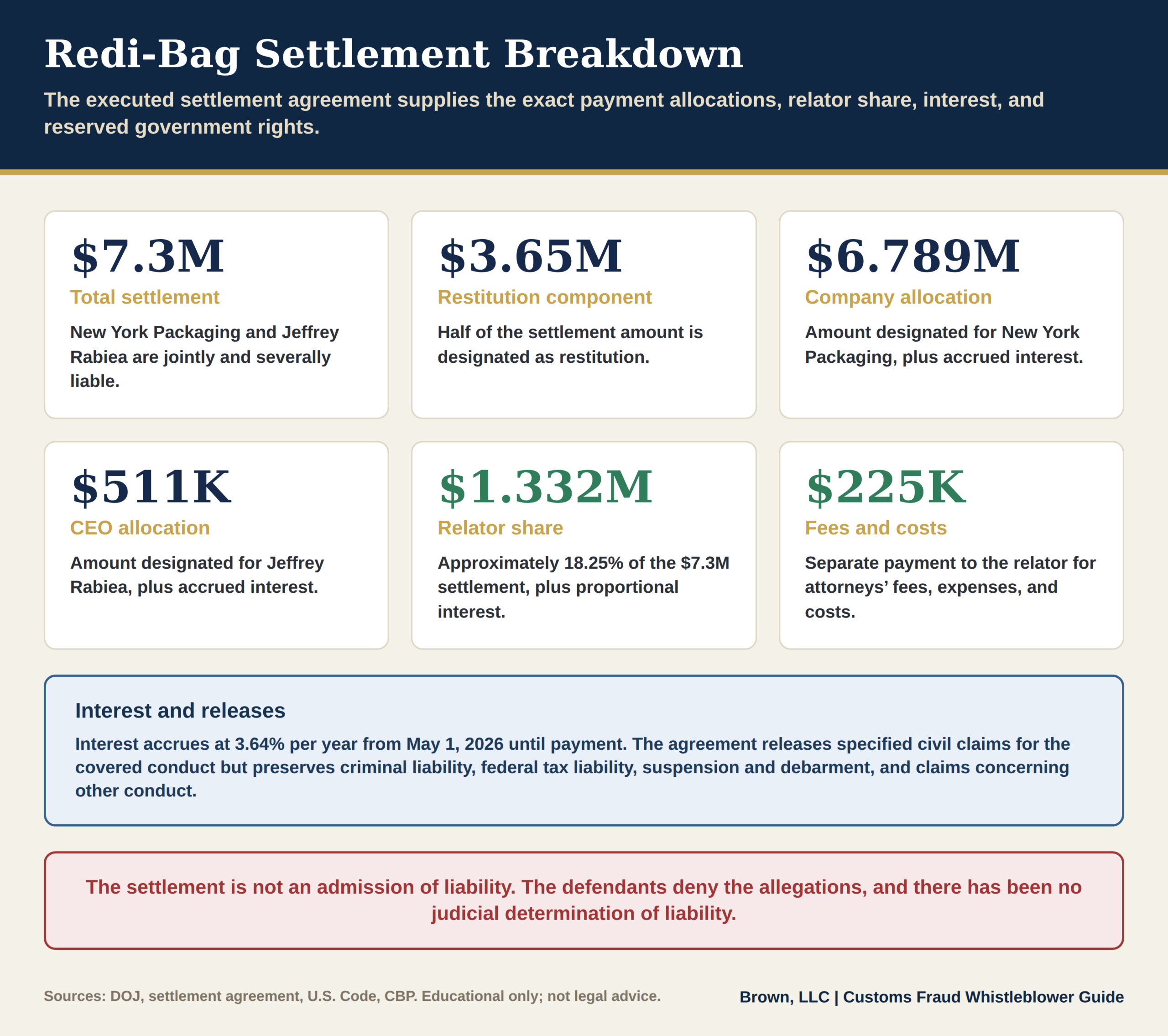
New York Packaging II LLC, doing business as Redi-Bag USA, and its chief executive, Jeffrey Rabiea, agreed to pay $7.3 million to resolve the allegations. The whistleblower, a former contracted sales representative, will receive $1,332,250, plus a proportional share of interest. The defendants will separately pay $225,000 toward the relator’s attorneys’ fees, expenses, and costs.
At a time of heightened federal trade enforcement, a false country-of-origin declaration is not a minor paperwork problem. When an importer knowingly uses routing, labels, customs entries, or concealed manufacturing facts to avoid duties owed to the United States, the conduct can become a reverse False Claims Act case. A knowledgeable insider may be the person who makes the money path and the knowledge evidence provable.

Key Facts From the Redi-Bag Customs Fraud Settlement
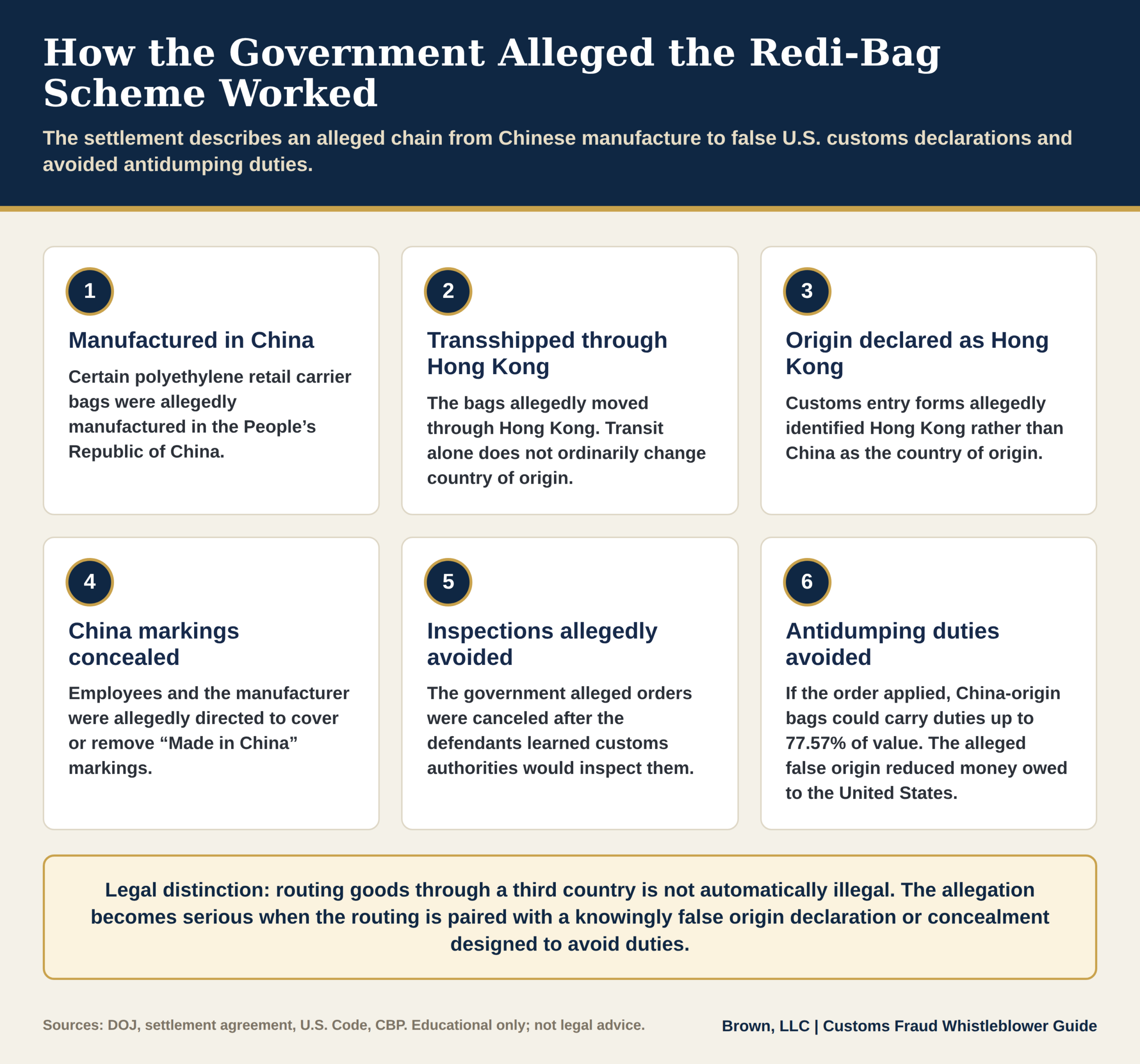
The government alleged more than a routing choice: it alleged a coordinated effort to make China-origin goods appear to originate in Hong Kong.
What the Government Alleged Happened
Redi-Bag USA is a New York-based supplier of custom bags, liners, and packaging to grocery, restaurant, deli, medical, retail, and industrial customers. According to the settlement agreement, the United States contended that Redi-Bag USA and Rabiea knew certain bags were manufactured in China and transshipped through Hong Kong, but nevertheless caused customs entry forms to identify Hong Kong as the country of origin.
The alleged concealment went beyond the entry forms. The government contended that the defendants hid the manufacturing facts from the company’s customs broker and, by extension, CBP; directed employees to cover “Made in China” markings; directed the manufacturer to remove those markings; and canceled orders after learning customs authorities would inspect them.
Speak with the Lawyers at Brown, LLC Today!
Over $1 billion in aggregate judgments and settlements for our clients in state and federal courts. We fight for maximum damages and results.
Those alleged facts mattered because the applicable antidumping order targeted specified China-origin polyethylene retail carrier bags. When the order applied, the duty could reach 77.57% of the entered value. A false origin declaration therefore could directly change how much money the importer owed the United States.
Country of Origin Is Not Necessarily the Country of Shipment
One of the most important customs-law points is simple: shipping goods through a country does not automatically make that country the goods’ origin. For goods made wholly in one country, origin generally follows the place of manufacture or production. When production occurs in more than one country, customs law may apply a substantial-transformation or other product-specific origin test.
Transshipment itself is not automatically illegal. Global supply chains routinely move goods through intermediate ports. The legal problem arises when an importer knowingly treats a transit country as the origin even though the governing origin rules point elsewhere, or when it alters labels, invoices, certificates, or entry data to support the false origin.
In Redi-Bag, the government did not merely allege that bags passed through Hong Kong. It alleged the defendants knew the bags were manufactured in China and took affirmative steps to conceal that fact.
How Customs Duty Evasion Becomes a Reverse False Claims Act Violation
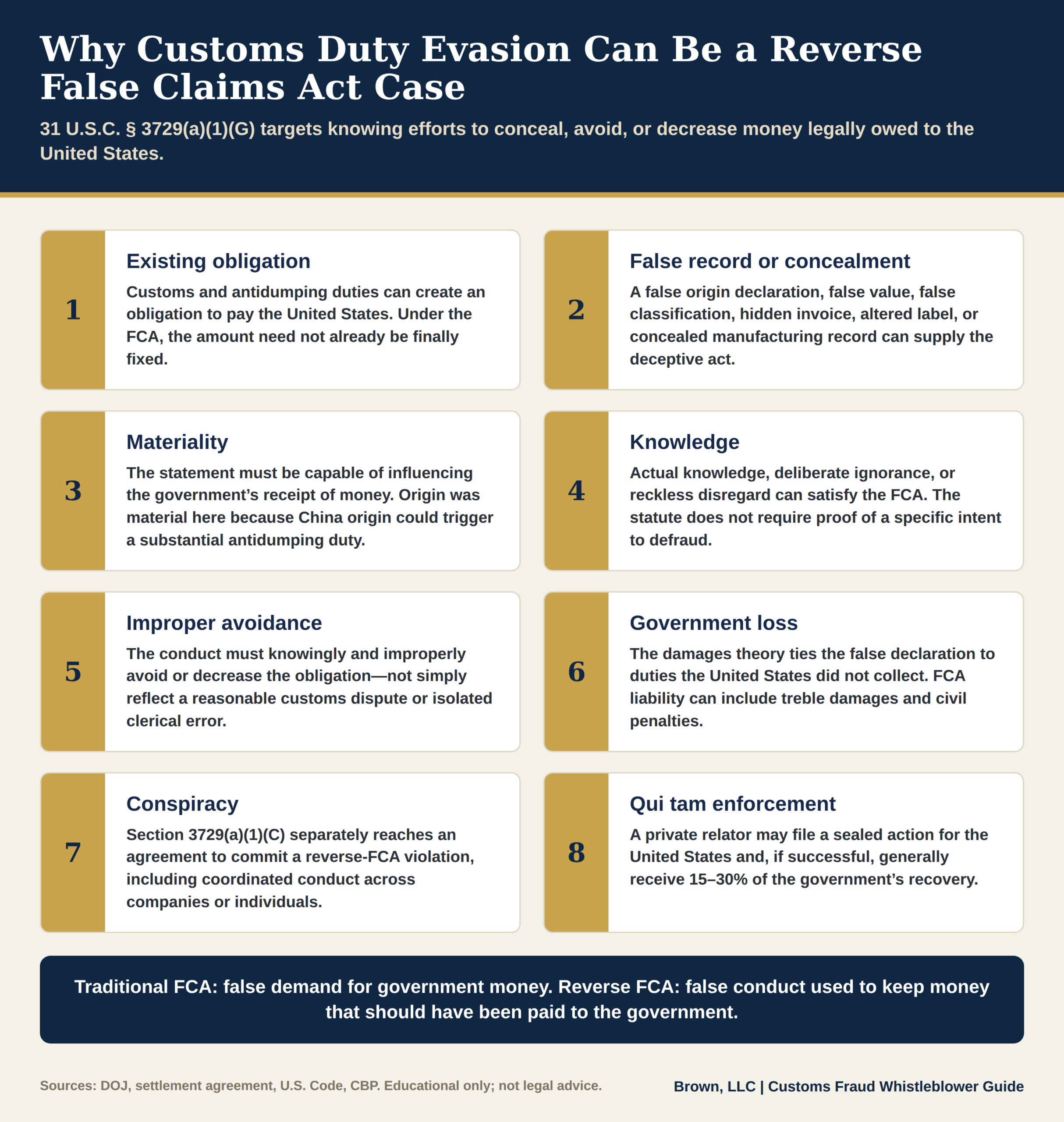
Most people associate the False Claims Act with a company asking the government to pay a false invoice. Customs duty evasion works in the opposite direction. The importer is not necessarily demanding money from the Treasury; it is allegedly using false information to keep money that should have been paid to the Treasury. That is why these cases are commonly called reverse False Claims Act cases.
Section 3729(a)(1)(G) reaches both false records material to an obligation and knowing concealment or improper avoidance of the obligation.
1. There must be an obligation to pay the United States
Section 3729(a)(1)(G) applies to an “obligation” to pay or transmit money or property to the government. The FCA defines obligation broadly to include an established duty arising from statute, regulation, contract, grant, license, fee-based relationship, or the retention of an overpayment. The amount does not have to be finally fixed before the obligation can exist.
For customs cases, the obligation may arise from the import transaction, the tariff schedule, an antidumping or countervailing duty order, or another trade law requiring payment. The Redi-Bag settlement expressly alleged an obligation to pay antidumping duties when the order applied.
2. There must be a false record, concealment, or improper avoidance
The reverse-FCA provision has two related paths. Liability may arise when a person knowingly makes or uses a false record or statement material to an obligation, or when a person knowingly conceals or knowingly and improperly avoids or decreases the obligation.
In a country-of-origin case, the alleged false record may be the customs entry, an origin declaration, a commercial invoice, a certificate of origin, or records supplied to a customs broker. Concealment may involve removing country markings, hiding factory information, using side invoices, or structuring a shipment to make the true manufacturing origin harder to see.
3. The falsehood must be material
Under the FCA, material means having a natural tendency to influence, or being capable of influencing, the payment or receipt of money.
Country of origin was allegedly material in Redi-Bag because origin determined whether a specific antidumping order applied. If China origin triggered a duty and Hong Kong origin did not, the declaration was capable of influencing the amount CBP collected.
4. The defendant must act knowingly
The FCA does not require proof that the defendant acted with a specific intent to defraud. “Knowingly” includes actual knowledge, deliberate ignorance, and reckless disregard.
That distinction is important. An honest clerical error or reasonable customs classification dispute is not automatically an FCA case. A case becomes stronger when internal communications, labeling instructions, broker communications, inspection avoidance, repeated entries, or executive decisions show awareness that the government-facing information did not match reality.
The Redi-Bag allegations included several facts the government viewed as knowledge evidence: concealing information from the broker, covering or removing “Made in China” markings, and canceling orders when inspection was expected. Those are allegations only, but they illustrate the difference between a mistake and an alleged scheme.
5. The conduct must improperly avoid or decrease the payment obligation
The FCA is not a substitute for every customs disagreement. The government must connect the knowing falsehood or concealment to an improper reduction or avoidance of duties. A legitimate dispute over substantial transformation, tariff classification, valuation methodology, or scope of an antidumping order may be defensible. A knowingly false origin statement designed to obtain a lower duty is different.
6. The government must prove loss or another recoverable FCA measure
The core damages theory is ordinarily the duties the United States should have collected but did not. The FCA authorizes treble damages and civil penalties, although settlements often reflect litigation risk, ability to pay, cooperation, restitution, and other negotiated considerations rather than a mechanical maximum calculation.
7. Conspiracy can create separate exposure
Section 3729(a)(1)(C) reaches conspiracies to commit a reverse-FCA violation. In a trade-fraud case, the potential participants could include importers, executives, manufacturers, brokers, intermediaries, or other parties who knowingly agree to use false information to reduce duties. The Redi-Bag settlement resolved the government’s conspiracy allegation along with the reverse-FCA allegation.
Related: Brown, LLC secured two of the year’s largest individual recoveries — a $950M settlement against Raytheon and $350M against Walgreens. Learn about our False Claims Act practice →
The Whistleblower’s Role and the $1.33 Million Relator Share
The Redi-Bag case began with a qui tam complaint filed under seal on November 22, 2021. The relator, John Maierhoffer, had worked as a contracted sales representative. The United States later partially intervened for settlement purposes.
Under the FCA, a private person may file an action for the United States. The complaint remains under seal while DOJ investigates. If the government proceeds with the action, the relator generally receives 15–25% of the recovery, depending on the person’s contribution and the circumstances. If the government declines and the relator successfully pursues the case, the statutory range generally rises to 25–30%. Reasonable attorneys’ fees and costs are separately recoverable from the defendant in a successful case.
Here, the $1,332,250 share equals approximately 18.25% of the $7.3 million settlement, before the proportional interest payment. The separate $225,000 fee-and-cost payment did not reduce the relator share.
The case also shows why outsiders should not assume only customs personnel can become trade-fraud whistleblowers. A sales representative may see where products are made, what customers are told, which labels are changed, how orders are routed, or what management says when inspections arise.
The settlement agreement—not the headline alone—shows how the money, interest, relator share, and releases actually work.
Why the CEO’s Individual Settlement Matters
The agreement allocated $6.789 million to New York Packaging and $511,000 to Rabiea, but made both jointly and severally liable for the entire settlement amount. That means the government did not resolve the matter solely with the corporate entity.
Speak with the Lawyers at Brown, LLC Today!
Over $1 billion in aggregate judgments and settlements for our clients in state and federal courts. We fight for maximum damages and results.
The FCA applies to “any person,” which can include an individual executive who personally participates in or causes the false conduct. Corporate status does not automatically shield a CEO from personal FCA exposure when the evidence supports direct knowledge and involvement.
What the Settlement Did—and Did Not—Resolve
The agreement released specified civil and administrative monetary claims for the covered conduct under the FCA, the Tariff Act, the Program Fraud Civil Remedies Act, and common-law theories after payment. It did not release criminal liability, federal tax liability, suspension and debarment rights, liability for other conduct, or certain product and delivery claims.
The reservation language is significant. A civil FCA settlement does not necessarily end every form of exposure. Trade-fraud investigations can involve parallel civil, criminal, administrative, tax, and import-enforcement consequences.
Customs Fraud Red Flags and Evidence That Can Make a Case Provable
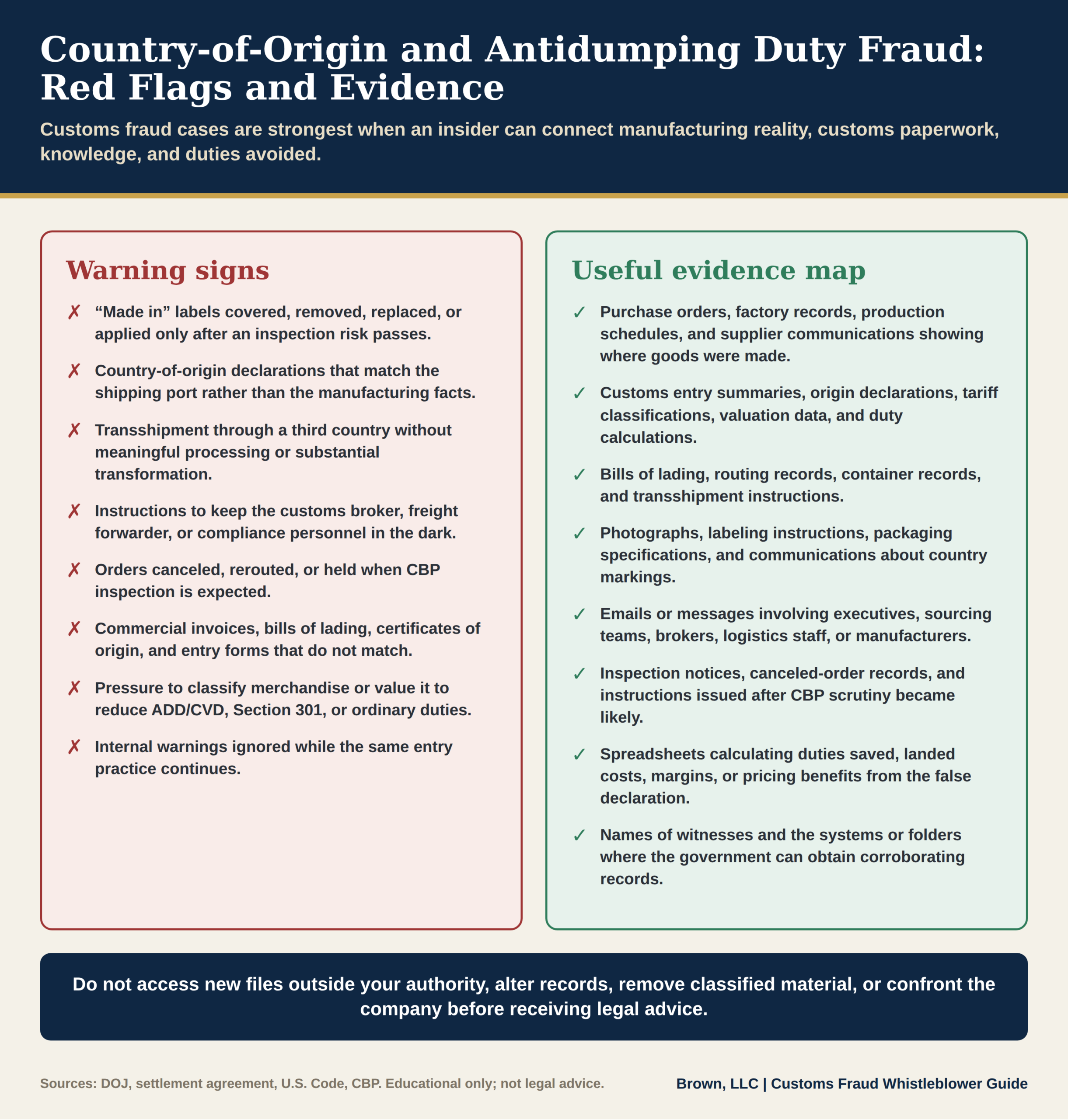
The strongest customs whistleblower cases connect the internal manufacturing facts to the customs declaration, knowledge evidence, and the duties avoided.
A potential whistleblower does not need to possess every document. Knowing how the scheme works, where the records are kept, who approved the entries, and how the duty savings were calculated can be extraordinarily valuable. The government can obtain records through subpoenas and civil investigative demands.
The strongest evidence often fits four buckets: the true manufacturing facts, the government-facing entry records, evidence of knowledge, and the duty calculation. A case with only one bucket may be incomplete. A case connecting all four is much harder to dismiss as a paperwork mistake.
Who May Have a Customs Fraud or Tariff Evasion Whistleblower Case?
- Import managers and customs compliance personnel who see false country-of-origin, classification, valuation, or duty declarations;
- Customs brokers or freight forwarders who learn that the importer withheld or falsified material information;
- Sourcing, procurement, factory, and quality personnel who know where merchandise was actually manufactured;
- Sales representatives who receive product, customer, labeling, or routing instructions that contradict customs entries;
- Logistics and warehouse employees who observe relabeling, transshipment, inspection avoidance, or split documentation;
- Finance and pricing employees who calculate margins or landed cost based on duties knowingly avoided;
- Competitors and domestic manufacturers with non-public evidence of a specific evasion mechanism;
- Former employees or contractors with original knowledge of the scheme and the proof path.
The case must be evaluated under the FCA’s first-to-file, public-disclosure, original-source, statute-of-limitations, materiality, and pleading rules. That is why early counsel matters even when the insider does not yet have a complete damages calculation.
Federal Trade Fraud Enforcement Is Expanding
The Redi-Bag settlement was announced one day after DOJ stated that the DOJ/DHS Trade Fraud Task Force had surpassed $1 billion in civil and criminal recoveries, penalties, forfeitures, and publicly charged losses in less than a year. DOJ described a strategic shift toward civil False Claims Act cases and criminal accountability across the global supply chain.
DOJ and DHS launched the cross-agency task force in August 2025 to pursue tariff and duty evasion, smuggling, and prohibited imports. In July 2026, the task force also issued a detailed Resource Guide to Trade Fraud Enforcement.
Whistleblower tip: If you’ve witnessed Medicare or Medicaid billing fraud at your employer, you may qualify as a qui tam relator with a potential share of the government’s recovery. See our Medicare & Medicaid fraud practice →
The milestone is not simply a cash-recovery statistic; it combines different enforcement measures. But the policy signal is unmistakable. Country-of-origin fraud, transshipment schemes, undervaluation, tariff misclassification, and antidumping or countervailing duty evasion are now central federal fraud priorities.
How to Report Customs Fraud Without Losing the Best Legal Route
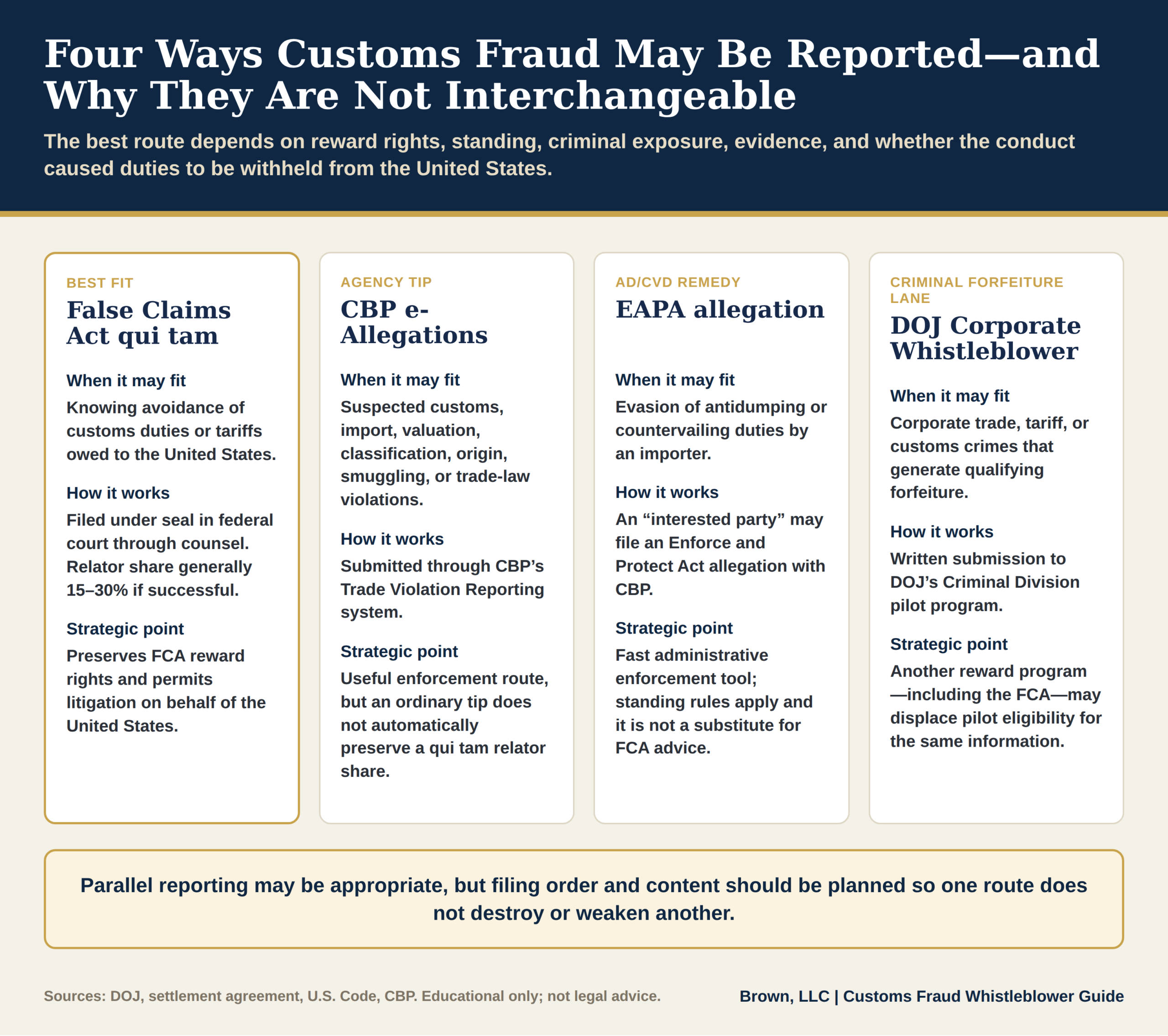
Reporting options overlap, but they do not create the same rights, rewards, standing, or litigation posture.
False Claims Act qui tam complaint
A reverse-FCA qui tam case is ordinarily the strongest reward path when the evidence shows a knowing effort to avoid customs duties owed to the United States. The action is filed under seal, the government receives a written disclosure of substantially all material evidence, and the first-to-file rule makes timing important.
CBP e-Allegations
CBP’s e-Allegations system allows members of the public and trade community to report suspected trade violations. It can be an effective agency-enforcement route. But an ordinary agency tip does not automatically create the statutory relator share available through a timely FCA case.
Enforce and Protect Act allegation
EAPA provides a specialized CBP process for an “interested party” to allege evasion of antidumping or countervailing duties. It can produce rapid administrative measures and duty collection, but standing and procedural requirements apply. It should not be treated as a substitute for an FCA analysis.
What a Potential Customs Fraud Whistleblower Should Do Now
- Write a factual timeline identifying shipments, dates, suppliers, countries, decision-makers, inspections, and customs entries;
- Separate what you personally know from what you suspect or heard from others;
- Identify where purchase orders, factory records, entry files, invoices, broker communications, and duty calculations are stored;
- Preserve records already lawfully in your possession without altering them;
- Do not access new systems, take privileged records, remove classified or controlled material, or violate a protective order;
- Do not confront management or alert potential participants before receiving legal advice;
- Do not submit an agency tip before understanding whether it could affect first-to-file or reward rights;
- Speak with a customs fraud whistleblower lawyer experienced in both the False Claims Act and trade-enforcement routing.
Why Brown, LLC for a Customs Fraud False Claims Act Case
Customs fraud cases sit at the intersection of trade law, government revenue, federal fraud litigation, and whistleblower strategy. A useful case must do more than allege a mislabeled shipment. It must connect the origin or entry falsehood to a duty obligation, identify the knowledge evidence, quantify the money path, and preserve the correct enforcement and reward route.
Brown, LLC evaluates customs and tariff whistleblower matters through that full lens. The firm’s role can include:
- Analyzing whether the facts support a reverse False Claims Act claim under 31 U.S.C. § 3729(a)(1)(G);
- Determining whether country of origin, substantial transformation, tariff classification, valuation, ADD/CVD scope, or another trade rule controls;
- Building a shipment-level evidence map that ties internal records to government-facing customs entries;
- Evaluating first-to-file, public-disclosure, original-source, limitations, materiality, scienter, and damages issues;
- Coordinating FCA, CBP, EAPA, criminal, and DOJ Corporate Whistleblower submissions when parallel routes may apply;
- Protecting confidentiality, evidence integrity, retaliation rights, and the whistleblower’s own legal position;
- Presenting the case to DOJ and investigating agencies in a form designed to be usable from the first meeting.
A strong law firm should also say when the facts describe a correctable customs compliance error rather than fraud. Selectivity increases credibility with the government and prevents whistleblowers from taking personal and professional risks on a theory that cannot meet the FCA’s elements.
Frequently Asked Questions About Customs Fraud Whistleblower Cases
What is customs fraud under the False Claims Act?
Customs fraud can violate the reverse False Claims Act when a person knowingly uses false records or statements, conceals facts, or improperly avoids an obligation to pay tariffs, customs duties, antidumping duties, or countervailing duties to the United States.
Can false country-of-origin declarations create a qui tam case?
Yes, potentially. A viable case requires more than an incorrect form. The evidence should show a duty obligation, a materially false origin statement or concealment, FCA-level knowledge, and duties improperly avoided or decreased.
Is transshipping goods through another country illegal?
Not by itself. Transshipment becomes problematic when it is used with false documents, false origin declarations, relabeling, sham processing, or concealment to evade duties or import restrictions.
How much can a customs fraud whistleblower receive?
Under the FCA, a successful relator generally receives 15–25% when the government proceeds with the action and 25–30% when the government declines and the relator successfully pursues it. Fees and costs are generally paid separately by the defendant.
How much did the Redi-Bag whistleblower receive?
The settlement agreement provides a $1,332,250 relator share plus proportional interest—approximately 18.25% of the $7.3 million settlement—along with a separate $225,000 payment for attorneys’ fees, expenses, and costs.
Can a CEO be personally liable for customs fraud?
Potentially. The FCA applies to any person who knowingly causes or participates in the violation. In Redi-Bag, the CEO agreed to a designated $511,000 payment and joint and several liability for the full settlement, without admitting liability.
Should I report customs fraud through CBP e-Allegations or file a qui tam case?
That depends on the evidence, standing, timing, desired remedy, and available reward rights. Filing an ordinary CBP tip may not preserve the same FCA relator rights. Counsel should evaluate the route before submission.
What is EAPA?
The Enforce and Protect Act gives CBP a process to investigate allegations that an importer is evading antidumping or countervailing duties. An allegation generally must be filed by an interested party and is different from a False Claims Act lawsuit.
Do I need documents to contact a customs fraud lawyer?
No. Direct knowledge of the scheme, the shipment flow, the entry process, the witnesses, and where records are stored may be enough for an initial legal evaluation. Do not take records outside your authorized access.
Can I be protected from retaliation?
The FCA prohibits retaliation against employees, contractors, and agents for lawful acts in furtherance of an FCA action or efforts to stop violations. Remedies can include reinstatement, double back pay, interest, fees, and other relief.
Bottom Line
The Redi-Bag settlement shows why country-of-origin fraud is not merely a customs paperwork issue. When the government alleges that an importer knew where goods were made, concealed that fact, declared a different origin, and reduced antidumping duties owed to the United States, the case fits the structure of a reverse False Claims Act claim.
The $7.3 million resolution, the CEO’s individual payment allocation, and the approximately $1.33 million relator share also demonstrate the practical value of insider information. The whistleblower did not need to be a customs officer. He needed original knowledge that could help the government prove the scheme.
If you have credible information about false country of origin, transshipment, tariff misclassification, undervaluation, antidumping or countervailing duty evasion, or other customs fraud, speak with an experienced law firm before reporting, moving documents, or confronting the company. The first filing decision can shape both the enforcement case and the whistleblower’s reward rights.
Sources and Accuracy Confirmation
This article is based on the DOJ press release, the executed settlement agreement, the False Claims Act, CBP guidance, and official Trade Fraud Task Force materials. Exact payment figures and releases come from the settlement agreement. All descriptions of the defendants’ conduct are allegations that were resolved without an admission or determination of liability.
[1] DOJ, Redi-Bag USA and CEO Agree to Pay $7.3M to Settle False Claims Act Allegations Relating to Evaded Customs Duties (July 15, 2026): https://www.justice.gov/opa/pr/redi-bag-usa-and-ceo-agree-pay-73m-settle-false-claims-act-allegations-relating-evaded
[2] DOJ, Settlement Agreement, United States ex rel. Maierhoffer v. New York Packaging II LLC, Civil No. 21-20170 (D.N.J.): https://www.justice.gov/opa/media/1452586/dl
[3] 31 U.S.C. § 3729, False Claims Act liability, definitions, damages, and penalties: https://uscode.house.gov/view.xhtml?edition=prelim&num=0&req=granuleid%3AUSC-prelim-title31-section3729
[4] 31 U.S.C. § 3730, qui tam filing process, relator share, fees, and retaliation: https://www.govinfo.gov/link/uscode/31/3730
[5] CBP, Marking of Country of Origin on U.S. Imports: https://www.cbp.gov/trade/rulings/informed-compliance-publications/marking-country-origin-us-imports
[6] DOJ, Trade Fraud Task Force Surpasses $1 Billion in Recoveries and Charged Losses (July 14, 2026): https://www.justice.gov/opa/pr/trade-fraud-task-force-surpasses-1-billion-recoveries-and-charged-losses-less-one-year
[7] DOJ/DHS, Cross-Agency Trade Fraud Task Force launch (Aug. 29, 2025): https://www.justice.gov/opa/pr/departments-justice-and-homeland-security-partnering-cross-agency-trade-fraud-task-force
[8] DOJ/DHS, A Resource Guide to Trade Fraud Enforcement (July 2026): https://www.justice.gov/fraud/media/1452331/dl?inline=
[9] CBP, e-Allegations Program: https://www.cbp.gov/trade/programs-administration/e-allegations
[10] CBP, Enforce and Protect Act (EAPA): https://www.cbp.gov/trade/eapa
[11] DOJ, Corporate Whistleblower Awards Pilot Program: https://www.justice.gov/criminal/criminal-division-corporate-whistleblower-awards-pilot-program
Attorney advertising. This article is for informational purposes only and does not create an attorney-client relationship. Prior results do not guarantee a similar outcome.