
Perfectus Aluminum’s $549.5 Million Settlement Shows How Customs Duty Evasion Can Become a Whistleblower Case under the False Claims Act
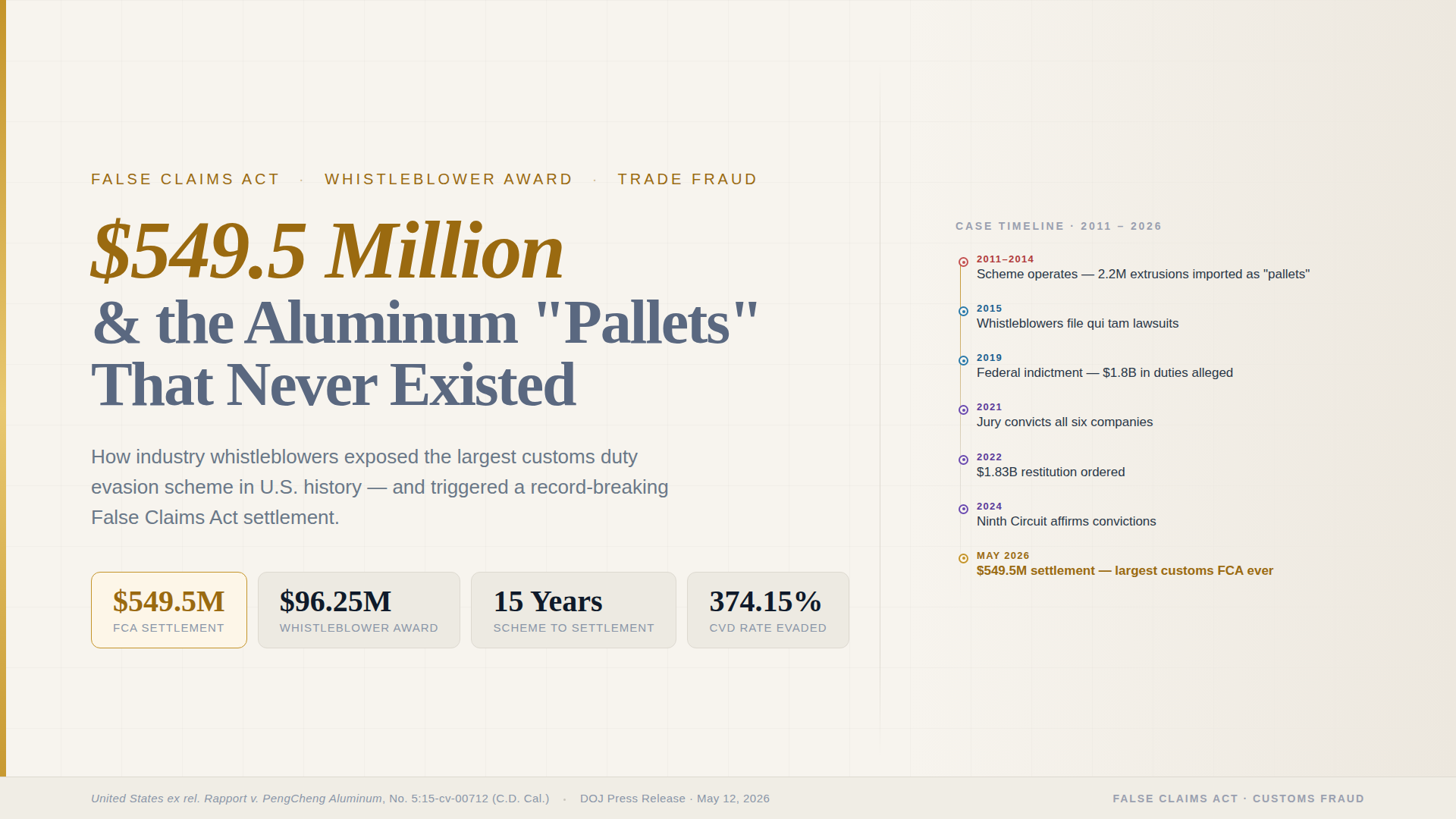
Table of Contents
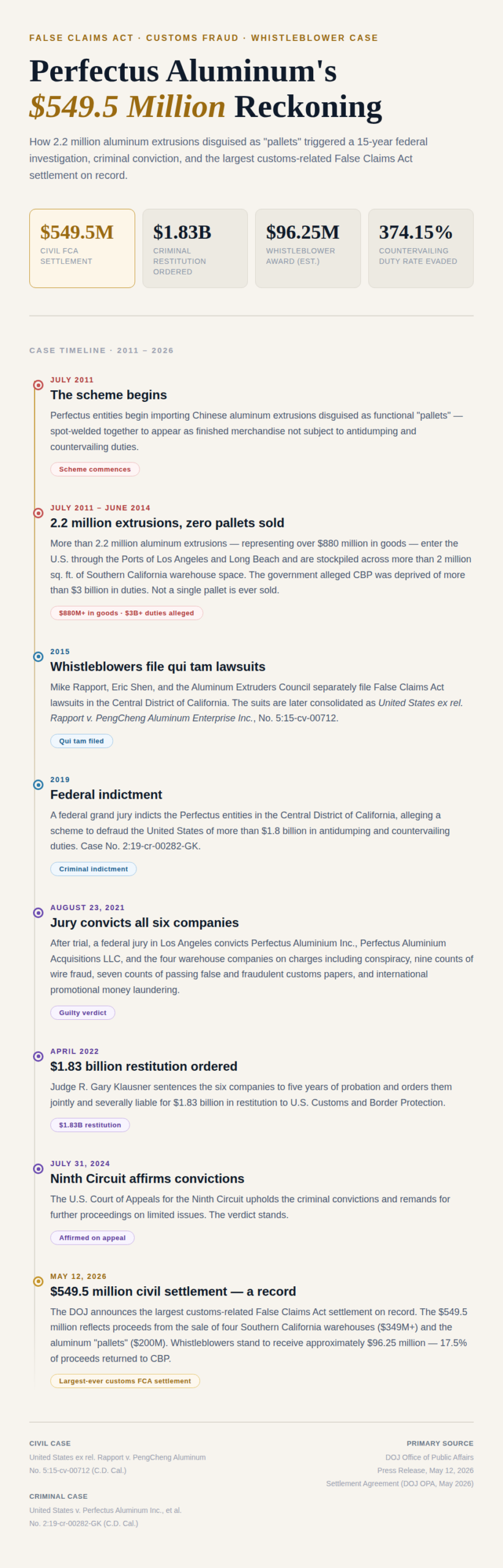
Perfectus Aluminum Inc., Perfectus Aluminum Acquisitions LLC, and four related warehouse companies agreed to pay $549.5 million to resolve False Claims Act allegations that they knowingly evaded antidumping and countervailing duties on aluminum extrusions imported from China. The May 2026 settlement followed earlier criminal convictions in the Central District of California, a $1.836 billion restitution order, forfeiture proceedings involving warehouses and aluminum “pallets.” Part of the case is attributable to qui tam lawsuits brought under the False Claims Act filed by whistleblowers including the Aluminum Extruders Council. The DOJ stated the whistleblowers will receive 17.5% of the settlement proceeds that are returned to U.S. Customs and Border Protection, so they stand to receive up to approximately $96.25 million as a whistleblower reward.
This settlement is the largest customs-related False Claims Act recovery on record, reported by legal commentators as more than ten times the size of the previous record for a customs duty evasion case under the FCA. The DOJ coordinated enforcement through its Trade Fraud Task Force, a cross-agency effort designed to pursue tariff evasion and smuggling using the full range of the department’s legal tools.
The Core Allegation: Aluminum Extrusions Disguised as “Pallets”
According to the DOJ, the case centered on aluminum extrusions imported from the People’s Republic of China between July 2011 and June 2014. During that period, Chinese aluminum extrusions were subject to antidumping and countervailing duties. Importers entering goods into the United States had to declare, among other things, the goods’ country of origin, value, duty status, and duties owed.
Speak with the Lawyers at Brown, LLC Today!
Over $1 billion in aggregate judgments and settlements for our clients in state and federal courts. We fight for maximum damages and results.
The government alleged that the Perfectus defendants and affiliated warehouse companies caused false statements to be made on Customs Form 7501 Entry Summaries. Those statements allegedly misrepresented more than 2.2 million aluminum extrusions as finished merchandise in the form of “pallets,” rather than dutiable aluminum extrusions to avoid paying the duties.
The United States alleged that the defendants avoided duties on more than $880 million of extruded aluminum and that the relevant countervailing-duty rate was 374.15%. The DOJ further alleged that CBP was deprived of more than $3 billion in duties owed to the United States.
The government’s theory was straightforward but fact-intensive: the “pallets” were not ordinary commercial pallets with real customer demand. The DOJ said they were aluminum extrusions spot-welded together to appear functional. The government also said there were no customers for the pallets imported between 2011 and 2014, and no pallets were ever sold.
Why Insider Information from the Warehouse Made the Case
This was not just an entry-form case. The warehouse facts were central to how the alleged scheme worked.
The settlement identified four warehouse defendants:
- Scuderia Development LLC, associated with a warehouse at 14600 Innovation Drive in Riverside, California.
- 1001 Doubleday LLC, associated with a warehouse at 1001 Doubleday Avenue in Ontario, California.
- Von Karman-Main Street LLC, associated with a warehouse at 2323 Main Street in Irvine, California.
- 10681 Production Avenue LLC, associated with a warehouse at 10681 Production Avenue in Fontana, California.
Earlier the DOJ materials said the vast majority of the pallets entered through the Ports of Los Angeles and Long Beach and were then stockpiled at large Southern California warehouses. The DOJ also said the aluminum was stored in more than 2 million square feet of warehouse space owned by the warehouse defendants, as well as at a New Jersey facility.
Speak with the Lawyers at Brown, LLC Today!
Over $1 billion in aggregate judgments and settlements for our clients in state and federal courts. We fight for maximum damages and results.
Customs fraud cases often leave traces outside the customs department. Warehouse employees, logistics personnel, finance staff, sales teams, and executives may each see a different part of the picture: products that do not move, inventory with no real customers, import paperwork that does not match commercial reality, or related-party transactions that seem designed to support a narrative rather than a genuine business purpose.
The Criminal Case Came First
The civil settlement did not arise in isolation. In August 2021, a federal jury convicted six corporate entities: Perfectus Aluminium Inc., Perfectus Aluminium Acquisitions LLC, Scuderia Development LLC, 1001 Doubleday LLC, Von Karman-Main Street LLC, and 10681 Production Avenue LLC.
The DOJ said the jury found the companies guilty of conspiracy, nine counts of wire fraud, and seven counts of passing false and fraudulent papers through a customhouse. The two Perfectus companies were also convicted of seven counts of international promotional money laundering.
In April 2022, U.S. District Judge R. Gary Klausner sentenced the six companies to five years of probation and ordered them to pay $1.83 billion in restitution. The settlement agreement later stated that restitution orders filed in April 2022 required over $1.8 billion to be paid to CBP, with the defendants jointly and severally liable.
The settlement agreement also noted that the Ninth Circuit affirmed the convictions on July 31, 2024, and remanded the matter for further proceedings.
What the $549.5 Million Settlement Covers
The settlement amount is over $549 million. According to the settlement agreement, over $349 million is attributable to the sale of the warehouses, and $200 million is attributable to the sale of the aluminum pallets. The United States will receive net proceeds from the sale of the warehouses and aluminum pallets, and those amounts will be credited toward the settlement amount.
The agreement also states that the defendants’ liabilities under the consent judgment are not dischargeable in bankruptcy. The United States reserved several categories of claims and rights, including criminal liability, restitution and forfeiture obligations, tax liability, suspension and debarment rights, liability for conduct outside the covered conduct, and liability of individuals.
That reservation language matters because a civil False Claims Act settlement often resolves only defined civil claims against specific parties for specific conduct. It does not necessarily end every possible government remedy connected to the same facts.
The Whistleblower Role in the Case
The settlement resolved qui tam lawsuits filed under the False Claims Act individuals and the Aluminum Extruders Council. The actions were filed separately and later consolidated in the Central District of California under United States ex rel. Rapport v. PengCheng Aluminum Enterprise Inc., et al., No. 5:15-cv-00712.
The DOJ stated that the relator share will be 17.5% of settlement proceeds returned to CBP, which could be a whistleblower award of over $96 million. The settlement agreement specifies that the United States will pay 17.5% of the Net Civil Payment to Relator Rapport, with no other relator-share payments made by the United States under the agreement for the covered matters. The agreement also notes that the relators may have separate allocation agreements among themselves.
Speak with the Lawyers at Brown, LLC Today!
Over $1 billion in aggregate judgments and settlements for our clients in state and federal courts. We fight for maximum damages and results.
According to publicly available accounts, the relators included the CEO and president of a U.S.-based competitor of Perfectus Aluminum and representatives of the Aluminum Extruders Council, a domestic industry association. This is consistent with the pattern in trade-fraud qui tam cases, where people closest to the affected industry are often best positioned to recognize anomalies in import volumes, pricing, duty treatment, or product classification that may signal evasion.
For potential whistleblowers, the key lesson is that customs-related misconduct can create False Claims Act exposure when a company allegedly avoids an obligation to pay money to the government. In trade-fraud matters, the “claim” may not look like a traditional invoice to a federal agency. The issue may be a false declaration, false classification, false country-of-origin statement, undervaluation, misuse of an exclusion, or concealment of a duty obligation.
What Insiders Can Watch For
The Perfectus matter points to several practical red flags that insiders may recognize:
- Imported goods described in one way on customs forms but treated differently in business records or operations.
- Products labeled as finished merchandise even though they appear to be raw or semi-finished inputs.
- Large inventory accumulations with little or no genuine customer demand.
- Related-party “sales” that do not resemble arm’s-length commercial transactions.
- Pressure to use a particular classification, origin, value, or product description despite internal doubts.
- Shipping, warehousing, or finance records that contradict representations made to CBP.
- Repeated instructions to avoid asking questions about why goods are being imported, stored, reconfigured, or resold in an unusual way.
- Internal reports or objections about customs duties, AD/CVD exposure, or import documentation that are ignored.
These warning signs do not prove fraud by themselves. They are the kinds of facts that may justify confidentially asking a whistleblower law firm whether the conduct raises False Claims Act or customs-enforcement concerns.
Does This Sound Familiar?
- Have you seen products imported under a description that did not match what people inside the company knew the goods really were?
- Have you seen merchandise characterized as “finished” even though it had no real customer use, no market demand, or was expected to be melted, reworked, or converted later?
- Have you seen customs forms, invoices, bills of lading, warehouse records, inventory systems, or sales records tell inconsistent stories about the same goods?
- Have employees raised concerns about antidumping duties, countervailing duties, country of origin, valuation, or customs classification, only to be told to stop questioning the process?
- Have you seen related companies create paperwork that made transactions appear independent, even though insiders knew the entities were controlled by the same people?
Those are fact-specific questions. A whistleblower lawyer can help evaluate whether the documents, timeline, and internal knowledge support a potential report to the government.
Confidential Legal Guidance May Be Appropriate
Customs fraud and False Claims Act cases are document-heavy. The most important evidence may be entry summaries, emails, warehouse records, product descriptions, invoices, ownership records, internal reports, or communications with customs brokers. Insiders who have seen similar patterns should avoid drawing conclusions alone or taking company documents without advice. A confidential consultation with a whistleblower lawyer or whistleblower law firm can help assess whether the facts may support a lawful report.
“The Perfectus case is a watershed moment for False Claims Act enforcement in the trade space,” said Jason T. Brown, founder of Brown, LLC, a customs fraud whistleblower law firm. “For years, insiders in import-dependent industries have watched duty evasion happen and assumed it was someone else’s problem to fix. This case proves that the government takes these violations seriously, that the evidence needed to support a case often already exists inside the company, and that whistleblowers who come forward can receive life-changing awards for doing the right thing.”
Source and Accuracy Confirmation
This post is based directly on the official DOJ materials and settlement agreement listed below. The factual statements have been checked against those sources. The allegations described as civil allegations are treated as allegations resolved by settlement, while the criminal convictions, restitution order, forfeiture references, and Ninth Circuit affirmance are described according to the cited government materials and settlement agreement. This post does not provide legal advice.
Links:
- https://www.justice.gov/opa/pr/perfectus-aluminum-inc-and-related-companies-agree-pay-5495m-settle-false-claims-act
- https://www.justice.gov/opa/media/1440366/dl
- https://www.justice.gov/usao-cdca/pr/six-southern-california-companies-convicted-scheming-avoid-payment-18-billion-duties
- https://www.justice.gov/usao-cdca/pr/six-southern-california-companies-ordered-pay-183-billion-restitution-scheming-avoid
- https://www.justice.gov/usao-cdca/pr/federal-indictment-alleges-scheme-avoid-payment-18-billion-anti-dumping-duties-chinese