Skip to main content

Oglethorpe Inc. And Top Executives Agree to Pay $32 Million To Resolve Allegations of Retention of Medicare Overpayment under the False Claims Act

Table of Contents
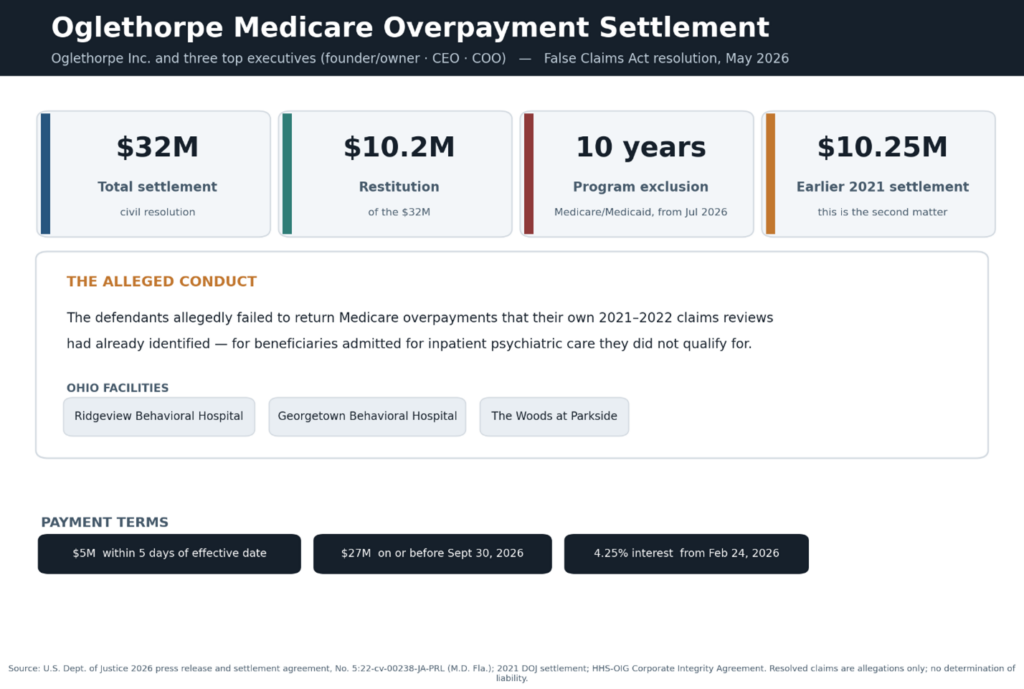
Oglethorpe Inc., a Tampa-based operator of psychiatric and substance abuse treatment facilities, along with three top executives, has agreed to pay $32 million to resolve False Claims Act allegations involving Medicare overpayments tied to three Ohio facilities: Ridgeview Behavioral Hospital, Georgetown Behavioral Hospital, and The Woods at Parkside.
The Justice Department alleges that the defendants knowingly failed to return Medicare overpayments their own claims reviews had identified, on admissions of beneficiaries who did not qualify for inpatient psychiatric care. The resolution follows a 2021 Corporate Integrity Agreement with HHS-OIG and includes a 10-year exclusion from Medicare, Medicaid, and all federal health care programs beginning in July 2026. The DOJ announced the settlement on May 27, 2026.
What the Settlement Documents Show
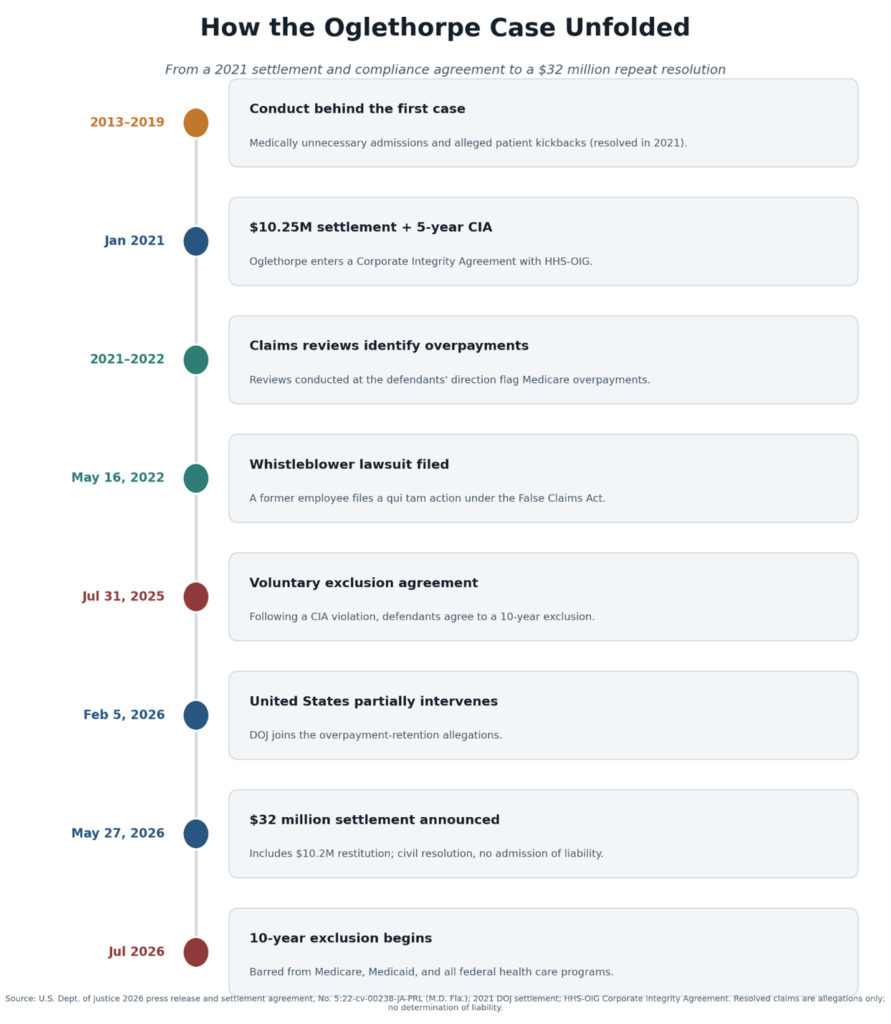
The matter arose from a qui tam lawsuit filed in the Middle District of Florida by four former Oglethorpe employees, a registered nurse, a former chief fiscal officer, a former regional director of operations, and a former director of financial operations. It was filed under the whistleblower provisions of the False Claims Act as Case No. 5:22-cv-00238-JA-PRL (M.D. Fla.).
According to the settlement agreement, the original qui tam action was filed on May 16, 2022, and an amended complaint followed on August 27, 2025. On February 5, 2026, the United States partially intervened, taking up allegations that the defendants violated Medicare law and the False Claims Act by failing to return Medicare overpayments identified through claims reviews conducted at the defendants’ direction. The government intervened as to Oglethorpe, Inc. and the three executives.
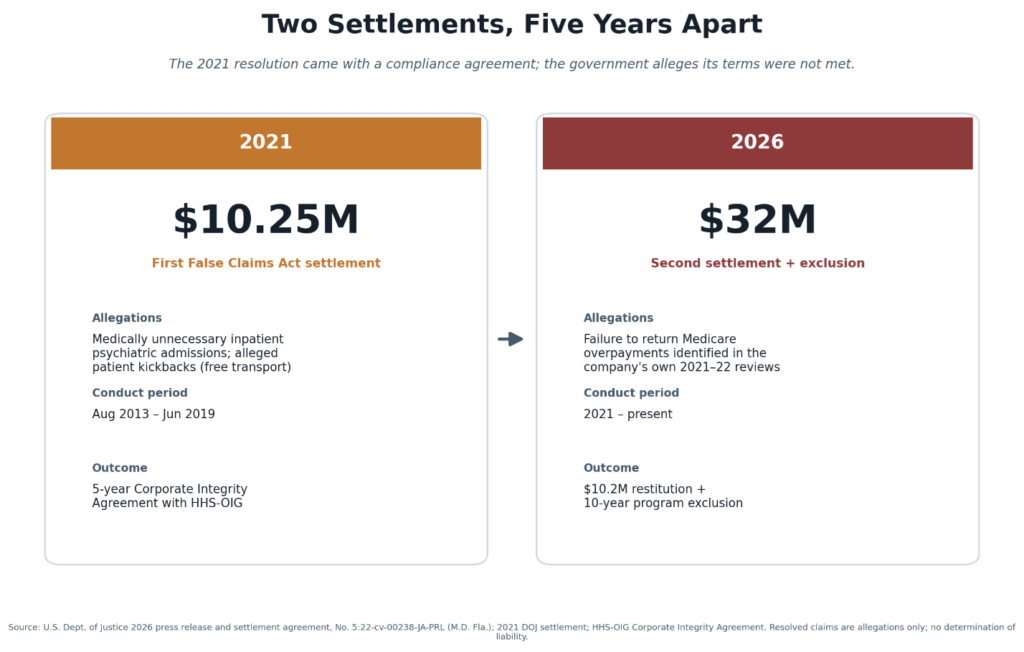
The alleged conduct was not framed as a simple billing mistake. The United States contends that the defendants failed to return amounts identified as Medicare overpayments in claims reviews completed in 2021 and 2022 at Oglethorpe’s Ohio facilities, and that they refrained from returning those amounts from 2021 through the present. The overpayments related to inpatient psychiatric facility services furnished to Medicare beneficiaries admitted to those facilities.
Speak with the Lawyers at Brown, LLC Today!
Over 100 million in judgments and settlements trials in state and federal courts. We fight for maximum damage and results.
The $32 million settlement includes over $10 million in restitution. The agreement requires $5 million within five days of the effective date, with the remaining $27 million due on or before September 30, 2026, plus interest at 4.25% per year running from February 24, 2026 through the dates of payment.
The settlement resolves civil allegations only. The agreement states that it is not an admission of liability by the defendants, and the DOJ’s announcement notes that the resolved claims are allegations only, with no determination of liability.
What Are Overpayment Violations Under the False Claims Act?
Most False Claims Act cases involve affirmative misconduct, meaning someone knowingly submitted a false or fraudulent claim to get money out of a federal program. Overpayment cases run in the opposite direction. The theory is built on the FCA’s “reverse false claims” provision, 31 U.S.C. § 3729(a)(1)(G), which imposes liability on anyone who knowingly conceals or knowingly and improperly avoids or decreases an obligation to pay or transmit money to the government. In plain terms, keeping money the government overpaid you, once you know you have it, can be just as actionable as falsely billing for it in the first place.
Two statutory developments made retained overpayments a core FCA enforcement theory. First, the Fraud Enforcement and Recovery Act of 2009 (FERA) amended the FCA to define “obligation” in 31 U.S.C. § 3729(b)(3) to include the “retention of any overpayment,” and removed any requirement that the defendant use a false record or statement to avoid repayment. Second, the Affordable Care Act added what is commonly called the 60-day rule, codified at 42 U.S.C. § 1320a-7k(d). Under that rule, a person who has received a Medicare or Medicaid overpayment must report and return it within 60 days after the date the overpayment was identified (or the date any corresponding cost report is due, if applicable). An overpayment retained beyond that deadline is, by statute, an “obligation” under the False Claims Act.
Whistleblower tip:If you’ve witnessed Medicare or Medicaid billing fraud at your employer, you may qualify as a qui tam relator with a potential share of the government’s recovery. See our Medicare & Medicaid fraud practice →
The combined effect is significant for health care providers. A claim that was honestly mistaken when submitted, an admission that a clinician believed in good faith was appropriate, or a coding error no one intended can still ripen into False Claims Act liability through inaction. The violation is not the original billing; it is the knowing failure to return the money after the overpayment is identified. The FCA’s knowledge standard reaches actual knowledge, deliberate ignorance, and reckless disregard, and it requires no specific intent to defraud. A provider that receives credible information of a potential overpayment cannot simply look away; ignoring audit findings, slow-walking quantification, or deferring repayment decisions can itself supply the “knowing” element.
The stakes mirror those of any other FCA violation: treble damages plus civil penalties for each violation, with penalty amounts adjusted annually for inflation and currently running from more than $14,000 to more than $28,000 per violation. On top of that sit administrative consequences, including repayment with interest, Corporate Integrity Agreement obligations, and, as this case shows, potential exclusion from federal health care programs.
The Oglethorpe settlement is a textbook application of this reverse false claims theory. The government did not need to establish that the underlying admissions claims were knowingly false when submitted. Its intervened theory was that once claims reviews conducted at the defendants’ own direction identified Medicare overpayments in 2021 and 2022, the defendants had a legal obligation to return that money within 60 days, and that knowingly retaining it from 2021 onward violated the False Claims Act. For insiders, that distinction matters: even where the original billing looked routine, the decision not to refund identified overpayments can be the violation.
The Earlier Oglethorpe Settlement and Corporate Integrity Agreement
This case did not arise in isolation. In 2021, Oglethorpe and several Ohio facilities agreed to pay $10.25 million to resolve earlier False Claims Act allegations involving medically unnecessary inpatient psychiatric hospitalizations and alleged kickbacks in the form of free long-distance transportation to patients. That earlier settlement covered alleged conduct from August 1, 2013, through June 20, 2019 and involved Cambridge Behavioral Hospital, Ridgeview Behavioral Hospital, and Parkside/The Woods.
As part of that resolution, Oglethorpe entered a five-year Corporate Integrity Agreement (CIA) with HHS-OIG, effective January 28, 2021. HHS-OIG’s public CIA entry lists the agreement as involving claims review, with an estimated completion date of January 2026 and a settlement amount of $10.25 million.
The CIA required an Independent Review Organization to examine whether inpatient admissions and lengths of stay were medically necessary and appropriate, whether services were properly documented, and whether claims were correctly coded, submitted, and reimbursed. It defined an “overpayment” as funds received or retained under a federal health care program to which Oglethorpe was not entitled, and it set repayment obligations for overpayments identified through that review.
Speak with the Lawyers at Brown, LLC Today!
Over 100 million in judgments and settlements trials in state and federal courts. We fight for maximum damage and results.
That context matters because the 2026 settlement centers on what allegedly happened after claims reviews identified overpayments. The government’s position is that the obligation to return identified overpayments went unmet despite the compliance framework already in place.
The 10-Year Exclusion from Federal Health Care Programs
The settlement agreement states that, as a result of violating the Corporate Integrity Agreement, the defendants entered a voluntary exclusion agreement on July 31, 2025, and agreed to be excluded from Medicare, Medicaid, and all federal health care programs for 10 years. The DOJ states that the exclusion period begins in July 2026.
This is one of the clearest signals in the documents. The matter was not resolved with a payment alone. HHS-OIG’s enforcement of the CIA produced a lengthy exclusion, showing how allegations that identified overpayments were retained can carry consequences well beyond repayment when the government believes compliance obligations were broken.
What Will the Whistleblowers Receive as a False Claims Act Whistleblower Reward?
The DOJ’s announcement states that the relators’ share of this resolution has not yet been determined. The whistleblower award can still be estimated. Because the United States intervened in the qui tam action, the False Claims Act, 31 U.S.C. § 3730(d)(1), entitles the whistleblowers to between 15% and 25% of the proceeds of the settlement. Applied to the $32 million recovery, the four former Oglethorpe employees who filed the case are collectively entitled to a whistleblower award of up to $8 million, and no less than approximately $4.8 million, with the precise percentage within that range depending on the extent to which they substantially contributed to the prosecution of the action.
The statute also entitles relators in an intervened case to recover their reasonable attorneys’ fees, expenses, and costs from the defendants, separate from and in addition to the relators’ share. The result here illustrates why insiders with firsthand knowledge of retained overpayments file under the False Claims Act: four employees who saw the same problem from different vantage points, clinical, fiscal, and operational, stand to share a multimillion-dollar award for bringing the conduct to the government’s attention.
What Insiders Can Watch For
This settlement points to several fact patterns that employees inside health care organizations may recognize.
One is a claims review, audit, or consultant report that identifies potential overpayments, followed by delay, disagreement, or inaction that prevents repayment to Medicare or another federal program. The allegations here do not merely describe claims that were wrong; they describe a failure to return overpayments the defendants’ own reviews had already identified.
Another is pressure around inpatient admission criteria. The documents repeatedly focus on whether patients qualified for inpatient psychiatric care, whether admissions and lengths of stay were medically necessary, and whether documentation supported reimbursement.
A third is the gap between formal compliance obligations and real-world decisions. Oglethorpe operated under a CIA addressing overpayment identification and repayment, yet the government alleged that overpayments identified in 2021 and 2022 were not returned.
Employees in clinical, finance, billing, audit, compliance, utilization review, or operations roles may each see a different piece of the same pattern: questionable admissions, concerns raised by reviewers, internal reports quantifying repayment exposure, or leadership decisions that appear to postpone or avoid refunds.
Has This Happened Where You Work?
Have you seen internal audits or outside claims reviews identifying Medicare overpayments that were never refunded?
Have you been asked to treat inpatient psychiatric admissions as reimbursable even when the records did not support that level of care?
Have reviewers, nurses, clinicians, finance staff, or billing personnel raised concerns about patients who did not meet admission criteria?
Have reports identifying repayment obligations been revised, buried, ignored, or delayed?
Have employees who questioned billing, medical necessity, admissions, or repayment obligations faced retaliation, demotion, termination, exclusion from meetings, or pressure to stay quiet?
These questions do not prove fraud on their own. They help frame whether the facts an insider has observed may resemble the kind of documented allegations that led to this False Claims Act settlement.
Speak Confidentially with a Whistleblower Lawyer
Health care insiders often see billing, admissions, documentation, and repayment issues before anyone outside the organization does. A confidential consultation with a whistleblower lawyer can help you understand whether the facts you have observed may fit within the False Claims Act or another whistleblower framework, and how to think through next steps rather than relying on internal assumptions alone.
Source and Accuracy Confirmation
This post is based directly on the government sources listed below, including the DOJ’s 2026 press release and settlement agreement, HHS-OIG’s Corporate Integrity Agreement materials, and the earlier 2021 DOJ settlement materials. Factual statements, including the parties, dates, amounts, payment terms, interest rate, procedural history, and the 10-year exclusion, were checked against those sources.
The publicly available documents reviewed state that the resolved claims are allegations only and that there has been no determination of liability. Where the press release and settlement agreement describe the same conduct in slightly different terms (overpayments identified by Oglethorpe’s “consultants” versus “claims reviews conducted at defendants’ direction”), this post reflects both.
https://www.justice.gov/opa/media/1442456/dl
https://oig.hhs.gov/compliance/corporate-integrity-agreements/browse-cias/oglethorpe-inc/
https://oig.hhs.gov/documents/cias/11125/Oglethorpe_Inc_01282021.pdf
https://www.justice.gov/archives/opa/press-release/file/1374146/dl