Skip to main content

No Place to Hide: The $3.7 Billion Medicare Fraud Fugitive Brought Back from Turkey

Table of Contents
Summary: In June 2026, the FBI announced the return of a fugitive accused of orchestrating one of the largest Medicare fraud schemes in U.S. history, an alleged $3.7 billion operation. The suspect fled the country in May 2025 but was tracked down in Turkey by Turkish authorities and flown back to the United States by the FBI’s Critical Incident Response Group through a foreign transfer of custody operation.
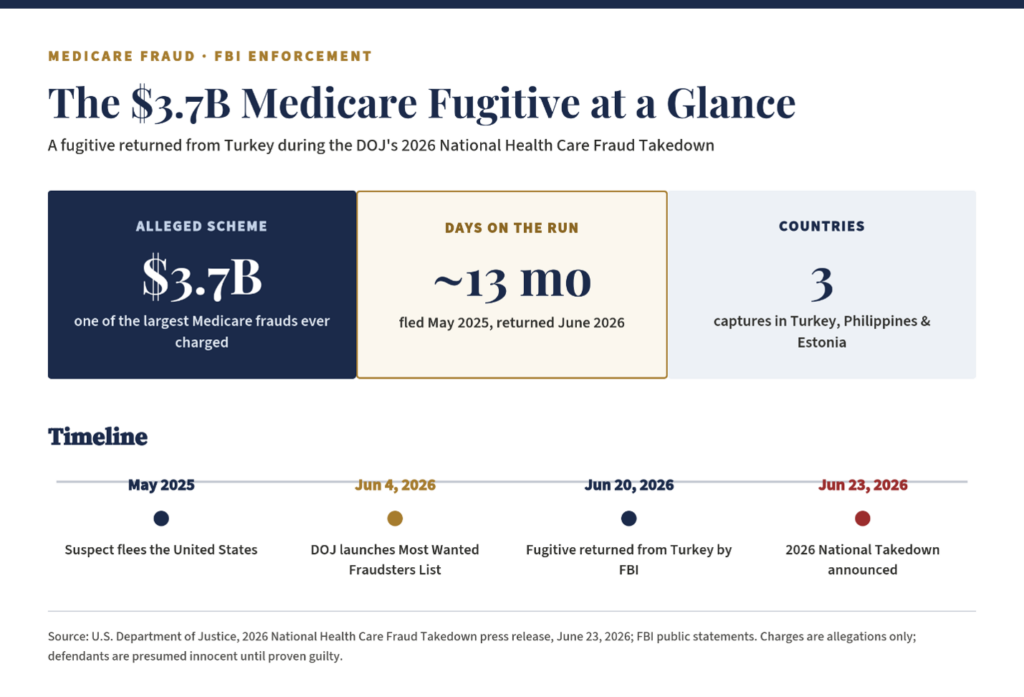
The capture came within days of a separate arrest in the Philippines of another alleged Medicare fraudster accused of a $1.2 billion scheme, bringing the combined alleged theft from taxpayer-funded healthcare programs to roughly $5 billion across the two cases. The arrests coincided with the DOJ’s 2026 National Health Care Fraud Takedown, the largest by number of defendants in U.S. history, and carry a pointed message for anyone who thinks fleeing the country makes them safe: it does not.
One of the Biggest Medicare Fraud Scams in U.S. History
According to the FBI and confirmed by the DOJ’s 2026 National Health Care Fraud Takedown press release, a fugitive connected to an alleged $3.7 billion Medicare fraud scheme (described by federal officials as among the largest of its kind ever charged) was recently apprehended abroad and returned to the United States to face prosecution. Turkish authorities detained the suspect after he reportedly fled the U.S. in May 2025. The FBI’s Critical Incident Response Group traveled to Turkey and brought him back to face charges in the U.S., working in close coordination with the DOJ and the U.S. Ambassador to Turkey.
The scope of what is alleged in this case is staggering. A $3.7 billion scheme targeting Medicare, the federal health insurance program covering approximately 67 million Americans, represents not just financial theft but a direct assault on the infrastructure that vulnerable patients and elderly Americans depend on for their healthcare.
The exact nature of the alleged billing conduct is detailed in court documents that have not yet been fully released publicly, but the scale places it squarely in the category of schemes that federal prosecutors and data analysts have been increasingly targeting, including complex, high-volume fraudulent billing that exploits Medicare’s payment systems and depends on the cooperation, whether knowing or unknowing, of multiple participants across a network.
The Arrest in Context: A Coordinated Enforcement Surge
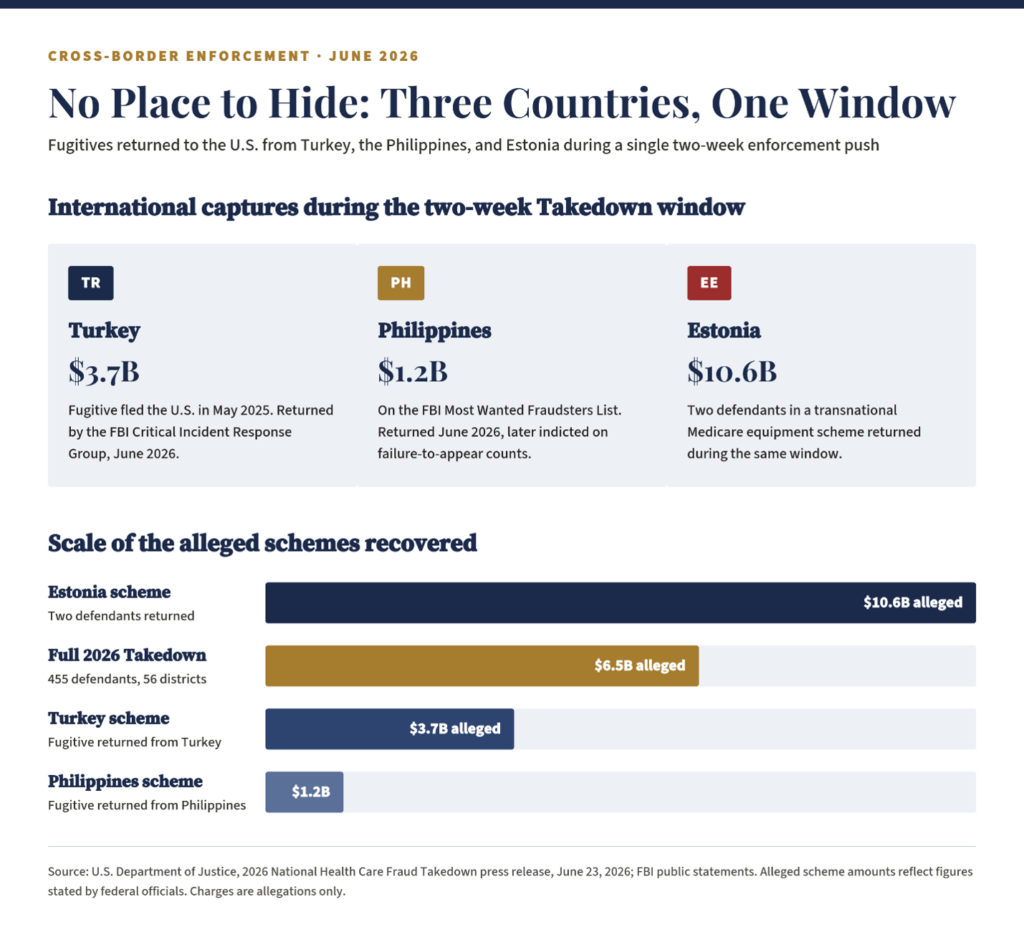
This case did not occur in a vacuum. The fugitive’s return from Turkey happened during the DOJ’s 2026 National Health Care Fraud Takedown, which the department announced on June 23, 2026. That Takedown resulted in charges against 455 defendants, including 90 doctors and other licensed medical professionals, across 56 federal districts and 45 states and territories, with 50 state Medicaid Fraud Control Units participating. The alleged false claims across all Takedown cases totaled more than $6.5 billion.
The Takedown also produced unprecedented international enforcement activity. In addition to the return from Turkey connected to the $3.7 billion scheme, two defendants were apprehended in Estonia in connection with a previously charged $10.6 billion scheme, and a separate fugitive on the FBI’s Most Wanted Fraudsters List was apprehended in the Philippines in connection with a $1.2 billion telemedicine and durable medical equipment scheme.
Speak with the Lawyers at Brown, LLC Today!
Over $1 billion in aggregate judgments and settlements for our clients in state and federal courts. We fight for maximum damages and results.
The government seized more than $182 million in cash, luxury vehicles, jewelry, and other assets in connection with the Takedown. The Centers for Medicare and Medicaid Services (CMS) simultaneously suspended 1,079 providers and revoked billing privileges for 1,403 more. HHS-OIG took 25 additional enforcement actions under the Civil Monetary Penalties Law, seeking more than $10 billion in payments to the Medicare Trust Fund for payments CMS had caught and suspended before they were paid out.
This is not incremental enforcement. It is a systematic, data-driven, multi-agency effort that has been building for years, as prior national healthcare fraud enforcement actions have demonstrated, and it is accelerating.
The Message from Federal Authorities Is Unmistakable
Senior officials made the enforcement message explicit. The DOJ’s Acting Attorney General stated that the administration had “ushered in a new era of enforcement” to safeguard taxpayer dollars. The Assistant Attorney General overseeing the National Fraud Enforcement Division put it plainly: “There is no case too big, no scheme too complex, and no hiding place too remote for our relentless fraud-fighting team.”
The FBI Director framed the Turkey capture in equally direct terms: the suspect had been on the run since May of 2025, but federal authorities tracked him down regardless. The FBI’s use of its Critical Incident Response Group, an elite unit more commonly associated with hostage recovery and crisis response, to retrieve a healthcare fraud fugitive from abroad illustrates just how seriously the government is treating these cases.
Related: Brown, LLC secured two of the year’s largest individual recoveries — a $950M settlement against Raytheon and $350M against Walgreens. Learn about our False Claims Act practice →
The creation of a formal Most Wanted Fraudsters List, a Health Care Fraud Data Fusion Center combining AI, cloud computing, and data analytics across the DOJ, FBI, HHS-OIG, and CMS, and a White House Task Force specifically targeting fraud all signal that enforcement infrastructure is being significantly upgraded. Healthcare fraud, once dismissed in some quarters as a white-collar matter unlikely to result in serious consequences, is now being treated with the urgency typically reserved for violent crime and national security threats.
The Civil Track: Whistleblowers and the False Claims Act
While the Turkey arrest is a criminal case, it is worth understanding the full enforcement picture that surrounds it. For those with inside knowledge of fraud, the civil track under the False Claims Act can be even more consequential.
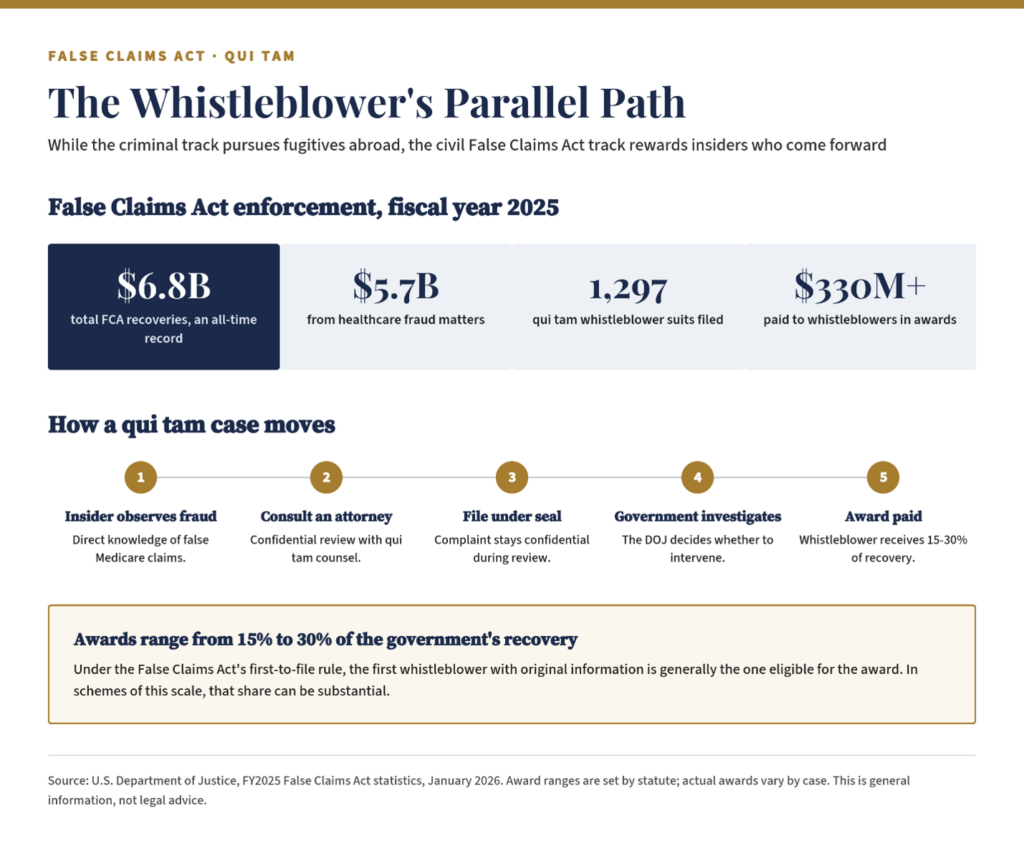
In fiscal year 2025, the DOJ recovered a record $6.8 billion through False Claims Act (FCA) settlements and judgments, the highest single-year total in the statute’s history. Healthcare fraud accounted for more than $5.7 billion of that total. A record 1,297 qui tam lawsuits were filed by whistleblowers during the same period, generating over $5.3 billion in recoveries. Whistleblowers themselves received more than $330 million in awards. Since Congress strengthened the FCA in 1986, the government has recovered more than $85 billion in total.
The FCA’s qui tam provisions allow private individuals, those with direct firsthand knowledge of fraud against a federal program, to file a sealed lawsuit on the government’s behalf and receive between 15 and 30 percent of any recovery. A billing scheme of even a fraction of the scale alleged in the Turkey case would generate an extraordinary potential Medicare whistleblower award.
The criminal arrest in Turkey and the record civil FCA numbers are two sides of the same enforcement coin. Fraudsters who flee the country face criminal extradition. Those who remain inside the system committing fraud face the growing likelihood that a colleague, coder, vendor, or manager with knowledge of the scheme will come forward, and that the government’s own data analytics will flag anomalies even before they do.
Does This Sound Familiar?
Schemes of this magnitude are not run by one person sitting alone in a room. They involve networks: billing companies, marketers, telemedicine platforms, durable medical equipment suppliers, clinical staff, and compliance personnel. People at various levels of those organizations often know, or suspect, that something is wrong.
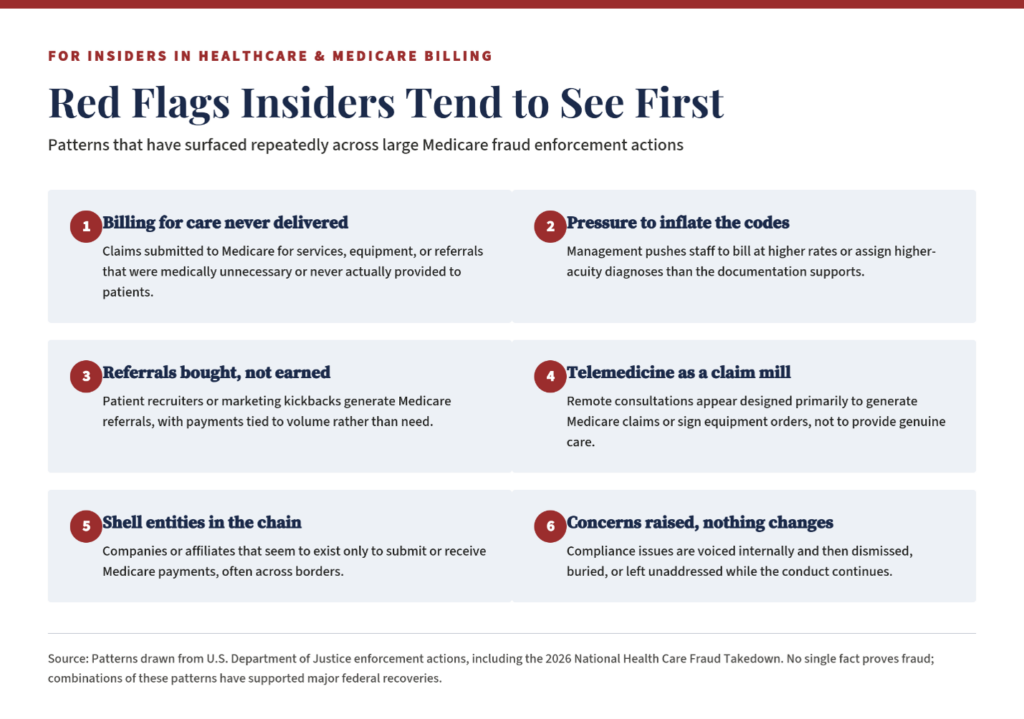
If you work in or around a Medicare-billing operation and have observed any of the following, your knowledge may be significant:
- Billing for services, equipment, or referrals that were not medically necessary or were never actually provided to patients
- Pressure from management to bill at higher rates or for higher-acuity diagnoses than the documentation supports
- Patient recruiter arrangements or marketing kickbacks designed to generate Medicare referrals
- Telemedicine consultations that appeared designed primarily to generate Medicare claims rather than to provide genuine patient care
- Durable medical equipment orders generated through call centers or foreign referral networks targeting Medicare beneficiaries
- Shell companies or affiliated entities that appeared to exist solely to submit or receive Medicare payments
- Compliance concerns that were raised internally and then dismissed or buried
- Documentation that was altered, backdated, or created after the fact to support claims already submitted
The scale of an alleged $3.7 billion scheme does not happen without many points of contact along the way. If you saw something and said nothing, or if you raised concerns that went nowhere, you may still be positioned to come forward.
Medicare Fraud Patterns Insiders Can Watch For
The 2026 Takedown and the Turkey arrest together highlight several fraud patterns that federal authorities are actively pursuing.
Government billing networks that operate across borders or involve foreign call centers, telemedicine intermediaries, or offshore payment routing deserve heightened scrutiny. The government is now sharing intelligence across international boundaries, as the Turkey and Philippines arrests demonstrate.
Unusual volume spikes in specific billing codes, including allografts and wound grafts, durable medical equipment, urinary catheters, genetic testing, and hospice enrollment, have consistently preceded major enforcement actions. CMS’s own data analytics team identified an allograft billing spike before the 2026 Takedown charges were filed.
Speak with the Lawyers at Brown, LLC Today!
Over $1 billion in aggregate judgments and settlements for our clients in state and federal courts. We fight for maximum damages and results.
Any arrangement in which patients are recruited for the purpose of generating a Medicare claim, rather than for a genuine medical need, is at the center of nearly every major enforcement action in recent memory. That pattern, billing driven by financial incentive rather than clinical judgment, is what federal data analytics is specifically designed to detect.
Fugitives who left the country believing they were safe have now been returned from Turkey, the Philippines, and Estonia within a single two-week enforcement window. Those found liable or convicted face significant penalties for Medicare fraud, including fines, imprisonment, and permanent exclusion from federal healthcare programs. The government has demonstrated that geography is no longer a meaningful barrier to prosecution.
If You Know Something, Now Is the Time
Cases of this scale and complexity are exactly the reason the False Claims Act’s qui tam provisions exist. The government cannot be everywhere, but insiders can be. If you have direct knowledge of a Medicare fraud scheme, whether or not criminal charges have already been filed, confidentially speaking with a whistleblower attorney is an important first step. A qui tam filing is sealed, meaning it remains confidential while the government investigates. The best time to come forward is before others do. Under the FCA’s first-to-file rule, the first whistleblower with original information about a scheme is generally the one who collects the reward.
The government is not waiting. Neither should you.
The DOJ is taking these matters very seriously both criminally and civilly and the customs fraud whistleblowers we present to the government draw a large audience and a high level of interest

If you have information about potential Medicare or Medicaid fraud, consider speaking with an experienced whistleblower attorney to understand your rights, evaluate your options, and determine whether a qui tam lawsuit may be appropriate. You can also review common whistleblower questions and answers before reaching out. Initial consultations are typically confidential and carry no obligation.
Sources and Accuracy Confirmation
This post is based directly on the sources listed below. Factual statements about the fugitive’s capture, the mode of return, the scale of the alleged scheme, the FBI’s Critical Incident Response Group’s role, and the 2026 National Health Care Fraud Takedown figures have been checked against the DOJ’s official press release and the Fox News report, both of which are based on FBI and DOJ statements. FCA recovery figures for fiscal year 2025 are drawn from official DOJ announcements and consistent secondary reporting from legal and medical trade publications.
The underlying criminal charges are allegations only. All defendants are presumed innocent until proven guilty beyond a reasonable doubt in a court of law. The specific conduct underlying the $3.7 billion scheme has not been fully detailed in publicly available court documents as of the date of this post; characterizations of the alleged scheme’s structure are based on general enforcement context and publicly available statements by federal officials. If additional court filings or indictment details become available, they may provide further specificity not captured here.
Sources and Further Reading
Primary Government Sources:
- U.S. Department of Justice, 2026 National Health Care Fraud Takedown Press Release: https://www.justice.gov/opa/pr/national-health-care-fraud-takedown-results-455-defendants-charged-connection-over-65
- U.S. Department of Justice, District of Puerto Rico, 2026 National Health Care Fraud Takedown: https://www.justice.gov/usao-pr/pr/2026-national-health-care-fraud-takedown
- HHS Office of Inspector General, 2026 National Health Care Fraud Takedown: https://oig.hhs.gov/newsroom/media-materials/2026-national-health-care-fraud-takedown/
- U.S. Department of Justice, 2025 National Health Care Fraud Takedown (FY2025 record): https://www.justice.gov/opa/pr/national-health-care-fraud-takedown-results-324-defendants-charged-connection-over-146
Secondary Sources:
- Fox News, FBI Brings Back Fugitive Accused in $3.7B Medicare Fraud Scheme After Capture in Turkey: https://www.foxnews.com/us/fbi-brings-back-fugitive-accused-37b-medicare-fraud-scheme-capture-turkey
- Medical Economics, False Claims Act Recoveries Hit a Record $6.8 Billion in 2025: https://www.medicaleconomics.com/view/false-claims-act-recoveries-hit-a-record-6-8-billion-in-2025
- OAN News, FBI Arrests Second Fugitive on Most Wanted Fraudsters List: https://www.oann.com/newsroom/fbi-arrests-second-fugitive-on-most-wanted-fraudsters-list-accused-of-1-2b-medicare-fraud-scheme/