Skip to main content

FinCEN’s AML Whistleblower Program Just Got Real: Why Retaining a Quality AML Whistleblower Attorney Matters

Table of Contents
Key Takeaway
Treasury has moved the FinCEN whistleblower program much closer to full implementation. The government is already taking tips, but the new proposed rule would formalize how whistleblowers submit information, apply for awards, and protect themselves. That makes the quality of your first move, and the quality of your AML whistleblower attorney, more important than ever.
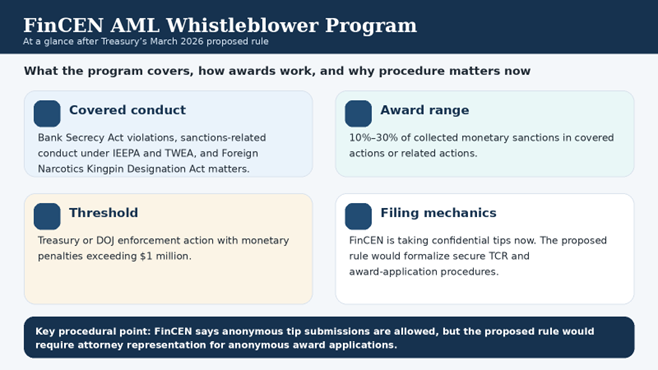
The U.S. Department of the Treasury has now taken a major step toward fully operationalizing FinCEN’s whistleblower program. On March 30, 2026, FinCEN announced a Notice of Proposed Rulemaking to fully implement the program, and the proposed rule was scheduled for publication in the Federal Register on April 1, 2026. Treasury and FinCEN say the rule would establish the full framework for whistleblower submissions, award applications, adjudication, and protections. FinCEN is also already accepting confidential tips through a dedicated whistleblower portal.
For people with inside knowledge of money laundering, sanctions evasion, Bank Secrecy Act failures, or related illicit finance activity, this is not just a bureaucratic update. It is a signal. Treasury is telling the market that it wants timely, detailed, actionable information, and that it intends to pay qualifying whistleblowers whose information leads to successful enforcement.
It is also a warning to potential whistleblowers: the process is becoming more formal. Formal programs create real opportunities, but they also create real procedural traps. A poorly framed disclosure, a missed timing issue, a misunderstanding about anonymity, or an avoidable retaliation mistake can materially affect a whistleblower’s options. That is why, now more than ever, retaining a quality AML whistleblower attorney is critical.
Treasury Just Made the FinCEN Whistleblower Program Materially More Important
The FinCEN program has existed in statute for years. It was created by the Anti-Money Laundering Act of 2020 and expanded by the Anti-Money Laundering Whistleblower Improvement Act of 2022. But the March 2026 announcement matters because Treasury is now putting the program into a more complete operational framework.
Under the proposed rule, FinCEN would formalize:
- How original information must be submitted
- How award applications must be filed
- What makes a whistleblower eligible
- How FinCEN will adjudicate claims
- What protections apply to whistleblowers
That matters because whistleblower programs do not reward vague suspicions. They reward original, actionable information that can help produce a successful enforcement result.
Speak with the Lawyers at Brown, LLC Today!
Over 100 million in judgments and settlements trials in state and federal courts. We fight for maximum damage and results.
What Is the FinSEN AML Whistleblower Program?
The FinCEN whistleblower program is, in practical terms, the federal government’s AML whistleblower program—although its scope is somewhat broader than pure anti-money laundering violations.
It covers information about violations or conspiracies involving:
- The Bank Secrecy Act (BSA)
- The International Emergency Economic Powers Act (IEEPA)
- The Trading With the Enemy Act (TWEA)
- The Foreign Narcotics Kingpin Designation Act
That means the program is designed for information involving the U.S. financial system and illicit finance, including classic AML failures and sanctions-related conduct.
In plain terms, this is the zone where many high-value insider cases live:
- Suspicious transaction monitoring failures
- Willful AML compliance breakdowns
- Sanctions screening failures
- Trade-based evasion or cross-border payment routing
- Shell-company structures used to move prohibited funds
- Internal efforts to suppress or ignore obvious red flags
How Much Can a FinCEN Whistleblower Receive?
The headline number is real. Under 31 U.S.C. § 5323, qualifying whistleblowers may receive 10% to 30% of collected monetary sanctions when their original information leads to a successful covered action or related action.
Three details matter.
1. The award is based on what is collected. The statute ties awards to what the government actually collects, not just what it alleges or announces.
2. The action must clear the $1 million threshold. FinCEN says a whistleblower may be eligible for an award if the information leads to a successful enforcement action by Treasury or DOJ that results in monetary penalties exceeding $1,000,000, assuming the other statutory requirements are met.
3. “Monetary sanctions” is a defined term. The statute says monetary sanctions include money such as penalties, disgorgement, and interest, but not forfeiture, restitution, or victim compensation payments.
That is why a serious lawyer matters early. Award value often turns on case framing, agency coordination, related actions, and whether the whistleblower’s information is positioned as the original source that drove the result.
Why Retaining a Quality AML Whistleblower Attorney Matters More Than Ever
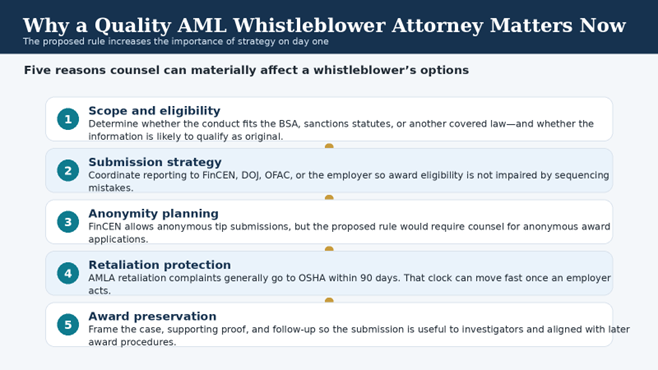
This new announcement is exactly the kind of development that increases the value of experienced counsel. Not because every whistleblower must hire a lawyer to submit a tip, but because the program is now moving from a broad statutory promise to a rules-based system with forms, timing rules, anonymity mechanics, and award procedures.
Here is why that matters.
1. Because FinCEN is moving toward a formal claims process
The proposed rule would require whistleblowers to submit original information through FinCEN’s Form TCR and award applications through Form WB-APP, generally through a secure online portal. Once a program becomes form-driven, the structure of the submission matters more.
A quality AML whistleblower attorney helps answer the questions that matter on the front end:
- Is the conduct actually within a covered statute?
- Is the information likely to qualify as original?
- What documents help prove the case?
- What facts should be emphasized first?
- How should the misconduct be described so investigators immediately understand the “who,” “what,” and “how”?
Those are not cosmetic decisions. They can shape whether the submission is actionable.
2. Because reporting to the wrong place—or only one place—can create avoidable risk
The proposed rule says that if a whistleblower gives original information to another part of Treasury, to DOJ, or to the whistleblower’s employer, the whistleblower must also provide that same information to FinCEN within a reasonable time to preserve award eligibility. That is a critical point. Many insiders first think about reporting internally, or to a line regulator, or to DOJ. But if the goal is to preserve a FinCEN whistleblower award, counsel should be evaluating forum, sequence, timing, and overlap from the beginning.
3. Because anonymity is more nuanced than many people realize
FinCEN’s whistleblower materials state that a person who wants to submit a tip anonymously may do so, including through an attorney. The proposed rule further explains that an anonymous whistleblower may submit a Form TCR on their own behalf or through counsel. But there is an important twist: if a whistleblower wants to remain anonymous at the award application stage, the proposed rule says the whistleblower must be represented by an attorney for that anonymous award application.
That is exactly the kind of procedural detail that creates problems for self-directed filings. A person may think they are protecting anonymity, only to discover later that their posture at the award stage is more complicated than expected.
4. Because retaliation rights are real, but they are time-sensitive
The AMLA anti-retaliation framework is not hypothetical. OSHA now has a rule governing retaliation complaints under AMLA. Under that framework, a person who believes they suffered retaliation generally must file with OSHA within 90 days of the alleged retaliation. If the Secretary of Labor has not issued a final decision within **180 days**, a de novo district court action may be available, assuming the delay is not due to the complainant’s bad faith.
That means a whistleblower may have two parallel tracks to think about:
- The award / reporting track, and
- The retaliation / employment track.
A quality AML whistleblower attorney, or coordinated counsel team, helps prevent one track from damaging the other.
5. Because “original information” is where strong cases separate from weak ones
The statute defines original information as information derived from the whistleblower’s independent knowledge or analysis, not already known to Treasury or DOJ from another source unless the whistleblower is the original source, and not exclusively drawn from public allegations or media reporting. That sounds simple. It is not.
Potential whistleblowers often know a great deal, but the legal question is not whether the conduct looks bad. The question is whether the information is original, properly sourced, persuasive, and connected to a viable enforcement pathway. A quality AML whistleblower attorney helps make that assessment before the whistleblower gives away leverage.
This is not just paperwork. It is part of a live enforcement push.
Treasury did not announce this rule in a vacuum. On the same day, Treasury said FinCEN issued an advisory urging financial institutions to watch for fraud schemes targeting government health care benefit programs such as Medicare and Medicaid, and Treasury separately described the whistleblower rule as a way to pay people for actionable tips related to fraud, money laundering, sanctions violations, and certain other national security laws.
That pairing matters. It suggests Treasury is presenting the whistleblower program as part of an active illicit-finance enforcement strategy—not as a dormant statutory feature.
For insiders, that should sharpen the question: if you have information now, is this the moment to protect yourself and act before someone else reports first?
FinCEN Itself Expects More Whistleblower Activity
One overlooked piece of the proposed rule is FinCEN’s own economic analysis.
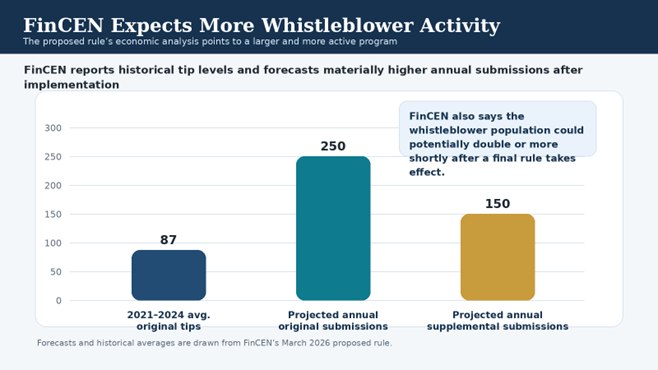
FinCEN says that, based on original tips submitted between 2021 and 2024, it has received approximately 87 original whistleblower submissions per year on average. FinCEN also says it expects the total whistleblower population to potentially double or more within a short period after a final rule takes effect. In the rule’s paperwork analysis, FinCEN estimates that annual volume could reach approximately 250 original submissions and 150 supplemental submissions within three years of the implementing regulations taking effect.
That forecast matters for two reasons.
First, it underscores that this program is likely to become more active and more competitive. Second, it highlights the value of being early, well-prepared, and strategically represented. In a more crowded field, quality and positioning matter.
Can You File a FinCEN Whistleblower Tip Anonymously?
Yes, but you should not oversimplify the answer.
FinCEN’s current whistleblower webpage says whistleblowers who want to submit a tip anonymously may do so, including through an attorney. The proposed rule similarly says a whistleblower may submit a Form TCR anonymously either on the whistleblower’s own behalf or through counsel.
But anonymity has stages. The more important question is often not just whether you can file anonymously today. It is whether you can preserve confidentiality, protect employment rights, avoid preventable disclosures, and maintain an award path as the matter evolves. That is where legal strategy becomes more important than slogans about anonymity.
What to do before reporting money laundering, BSA violations, or sanctions evasion
If you believe you have information that may belong in the FinCEN whistleblower program, do not assume that speed alone is the answer. Fast is not always smart. Smart, documented, and properly sequenced is better.
Before acting, think through:
1. What law is actually implicated? Is this BSA, sanctions, or another covered statute?
2. What makes your information original? What do you know that the government likely does not already know?
3. What documents lawfully support your account? Detailed documentation matters, but so does how evidence is handled.
4. Where should the disclosure go first? FinCEN, DOJ, another Treasury component, or the employer?
5. What is your retaliation plan? If the employer acts, the timing may move quickly.
6. How will anonymity be handled over time? Especially if an award application later becomes necessary.
A strong AML whistleblower attorney helps answer those questions before the whistleblower commits to a path that cannot easily be undone.
Do I Need an AML Whistleblower Attorney to Report Money Laundering to FinCEN?
Not in every case. FinCEN’s materials do not say counsel is required for every submission. But the proposed rule makes clear that anonymous award applications must be submitted through an attorney, and the growing complexity of award, timing, anonymity, and retaliation issues makes experienced counsel much more important.
How Much Is a FinCEN Whistleblower Reward?
If the statutory requirements are met, the award range is 10% to 30% of collected monetary sanctions in qualifying covered actions or related actions.
Does the FinCEN Whistleblower Program Cover Sanctions Violations?
Yes. FinCEN’s whistleblower program covers not only BSA violations but also conduct involving IEEPA, TWEA, and the Kingpin Act.
What if I Already Reported to DOJ, OFAC, or My Employer?
The proposed rule says that if original information was first reported to another part of Treasury, to DOJ, or to the employer, the whistleblower still must provide the same original information to FinCEN within a reasonable time to remain eligible for an award.
Can I Stay Anonymous?
Potentially, yes. FinCEN says anonymous tip submissions are allowed. But preserving anonymity through the award stage is more complicated, and the proposed rule says an anonymous award application must be submitted through an attorney.
What Is the AML Retaliation Deadline?
Under OSHA’s AMLA retaliation rule, a retaliation complaint generally must be filed within 90 days of the alleged retaliation.
Treasury’s new announcement means the FinCEN AML whistleblower program is no longer something to watch from a distance. It is becoming a structured, active, and increasingly consequential enforcement channel.
That is good news for people with legitimate, well-documented information about money laundering, sanctions evasion, BSA failures, and related illicit finance. It is also the moment when self-help becomes riskier.
Now more than ever, the right first call is often to a quality AML whistleblower attorney. Not because every whistleblower must hire counsel to press “submit,” but because the people who understand program scope, original-information issues, anonymity strategy, retaliation timing, and award mechanics are the ones best positioned to protect the whistleblower’s interests from the start.
If you are considering reporting possible money laundering, sanctions violations, or Bank Secrecy Act misconduct, speak with experienced counsel before you approach FinCEN, DOJ, OFAC, or your employer. The right strategy on day one can affect anonymity, retaliation protections, and whether you preserve the strongest possible claim.