Skip to main content

CFTC Whistleblower Awards May Get Faster: 30% Presumption for Awards of $5 Million or Less
Table of Contents
Short Answer
The Commodity Futures Trading Commission has proposed a new 30% presumption for qualifying CFTC whistleblower awards where the statutory maximum award would be $5 million or less. In plain English, if the CFTC collects up to about $16.66 million in monetary sanctions, and the whistleblower is otherwise eligible and clean on the key negative factors, the award would presumptively be set at the statutory maximum of 30%.
That is important, but the better point for insiders is broader: the CFTC whistleblower program is not just for old-school grain or oil futures traders. It can apply to crypto and digital asset fraud, spoofing, wash trading, swaps misconduct, derivatives fraud, forex scams, commodity pool fraud, false reporting, benchmark manipulation, misuse of customer funds, Bank Secrecy Act and AML failures by CFTC registrants, carbon-market manipulation, insider trading in commodity markets, and corrupt practices tied to commodities or derivatives.
Whistleblower tip: If you’ve witnessed Medicare or Medicaid billing fraud at your employer, you may qualify as a qui tam relator with a potential share of the government’s recovery. See our Medicare & Medicaid fraud practice →
If you searched for terms like CFTC whistleblower lawyer, crypto fraud whistleblower, spoofing whistleblower attorney, market manipulation whistleblower, commodity futures fraud lawyer, swaps whistleblower, derivatives fraud, CFTC Form TCR, commodity pool fraud, forex fraud whistleblower, or CFTC whistleblower award, this guide is built for you.
What the CFTC Whistleblower Program Actually Covers
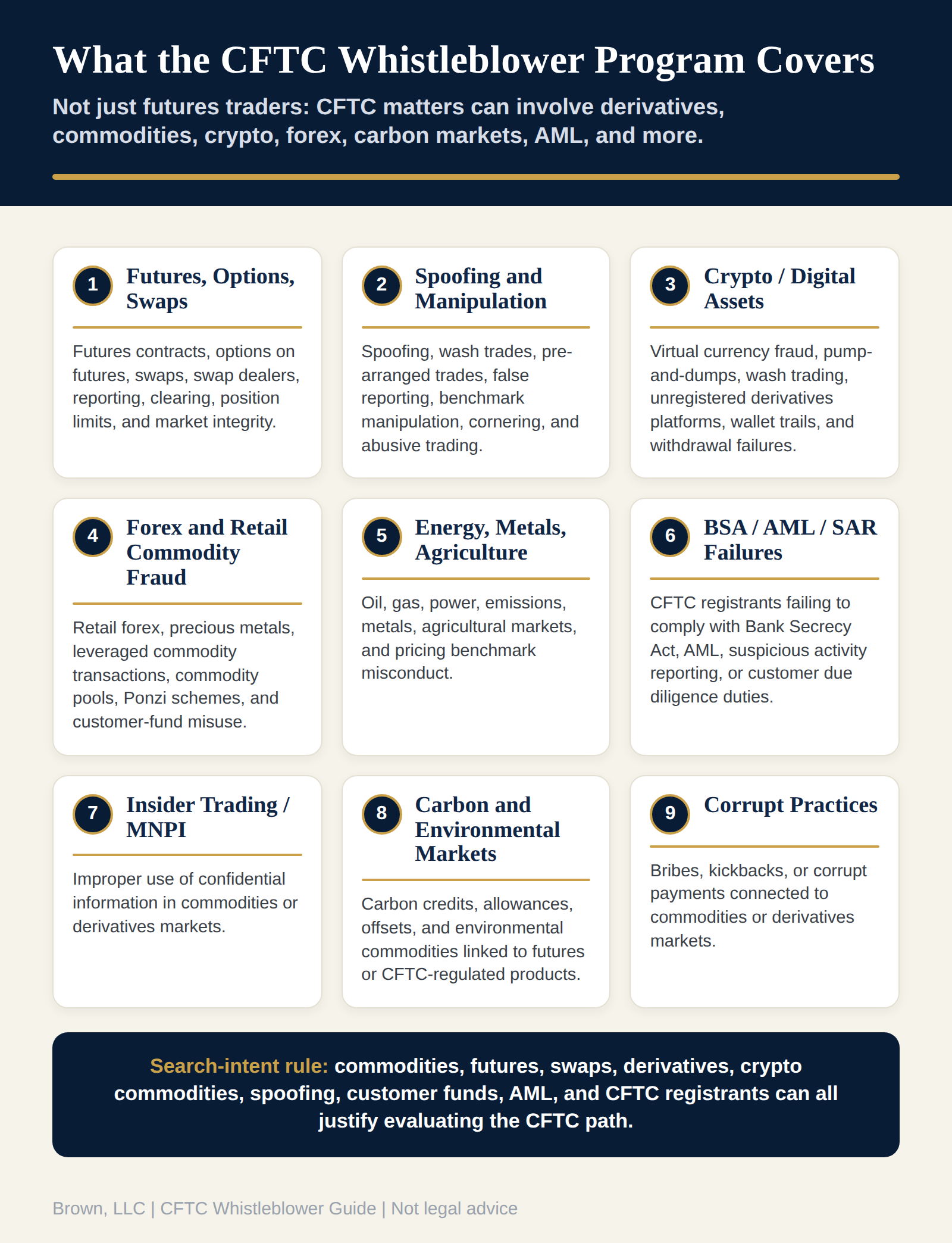
The CFTC administers a whistleblower program for individuals who voluntarily provide original information about possible violations of the Commodity Exchange Act or CFTC rules. The information must lead to a successful CFTC enforcement action with monetary sanctions over $1 million, or to a qualifying related action. The award range is generally 10% to 30% of collected monetary sanctions.
The program provides more than money. It also provides confidentiality protections, potential anonymity through counsel, and anti-retaliation protections for whistleblowers who report possible CEA violations to the Commission or assist in an investigation.
The mistake many potential whistleblowers make is assuming the CFTC only cares about traditional commodities. That is too narrow. The CFTC oversees futures, swaps, options, derivatives markets, and market participants. It also has anti-fraud and anti-manipulation authority in areas such as digital assets and other commodities when the conduct falls within the Commodity Exchange Act framework.
CFTC Whistleblower Violations: The Search Terms That Usually Signal a Real Lead
A useful CFTC whistleblower lead is usually not described internally as a “CFTC issue.” It may look like a trading desk problem, a crypto platform problem, a customer-fund problem, a pricing-benchmark problem, an AML failure, or a compliance override. The search terms below often map to real CFTC whistleblower territory:
The CFTC Whistleblower Office itself has published alerts on carbon markets, romance investment fraud involving commodities and derivatives, corrupt practices, spoofing, Bank Secrecy Act violations, insider trading, foreign corrupt practices, and digital assets/virtual currency fraud. That is a strong signal for SEO and for real intake: people with evidence in these categories should not assume they are outside the CFTC program.
What the June 2026 Proposed 30% Presumption Would Do
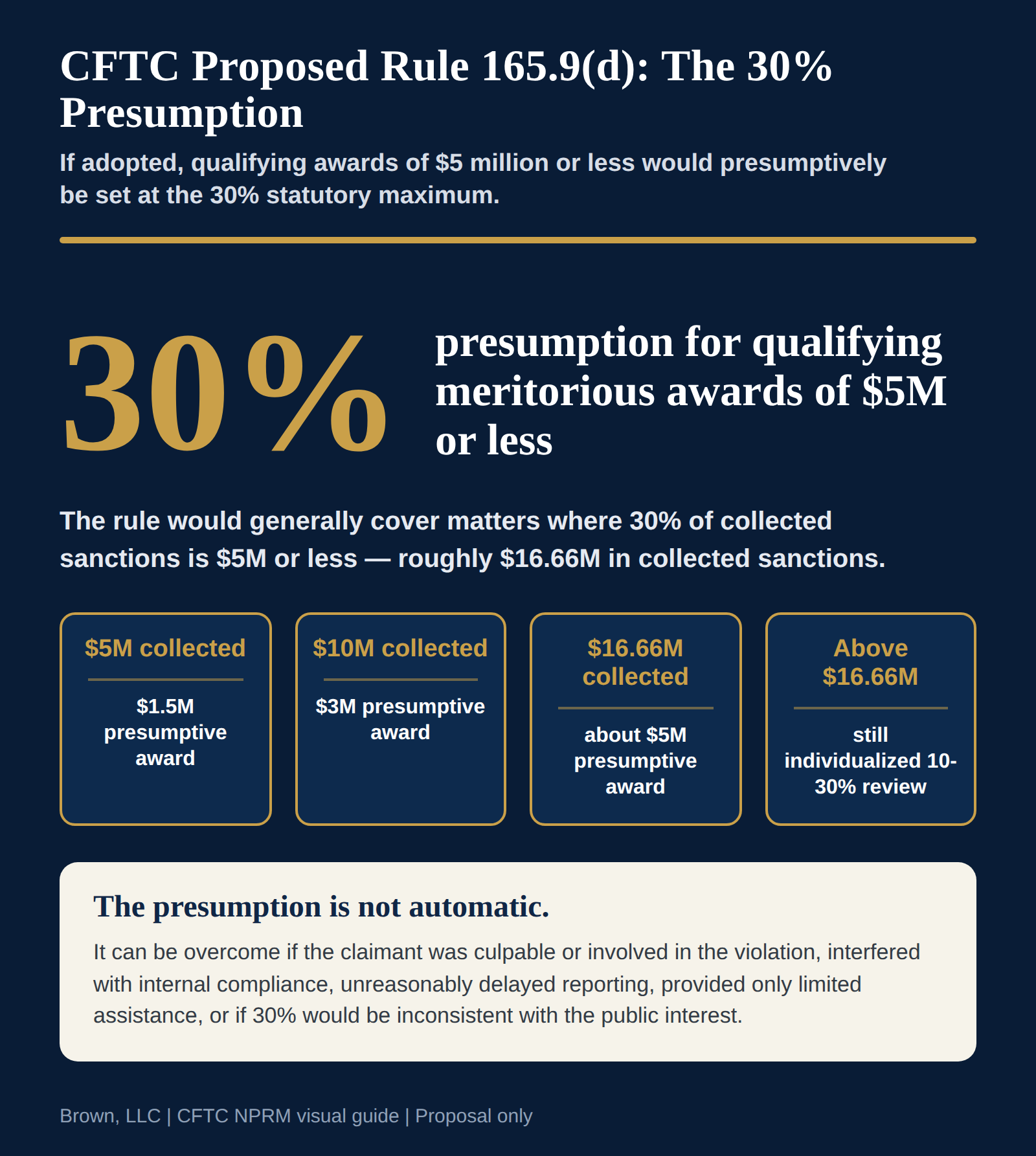
On June 11, 2026, the CFTC published a Notice of Proposed Rulemaking to amend its Part 165 whistleblower rules. The centerpiece is proposed Rule 165.9(d), a 30% presumption for certain smaller and mid-sized awards. The CFTC stated that the proposal is modeled on SEC Rule 21F-6(c) and is intended to improve efficiency, transparency, and predictability in whistleblower award processing.
The mechanics are straightforward. If the statutory maximum award of 30% would total $5 million or less across all actions tied to the whistleblower information, the award would be conditionally set at 30%. Because 30% of about $16.66 million equals about $5 million, the proposal generally covers matters where collected monetary sanctions are expected to be at or below roughly $16.66 million.
Speak with the Lawyers at Brown, LLC Today!
Over $1 billion in aggregate judgments and settlements for our clients in state and federal courts. We fight for maximum damages and results.
This does not mean every small or mid-sized CFTC award becomes automatic. The presumption would not apply, or could be overcome, if the claimant was culpable or involved in the violation, interfered with internal compliance or reporting systems, unreasonably delayed reporting, provided only limited assistance, or if a maximum award would be inconsistent with the public interest.
This is why the proposal is more than a payout headline. It is a behavioral signal. The CFTC is telling potential whistleblowers that timely, useful, clean reporting matters.
Why the CFTC Is Proposing the Change
The CFTC says its program works, but pays too slowly. In the NPRM, the Commission reported that whistleblower-provided information contributed to enforcement actions producing more than $3.3 billion in financial remedies through the end of calendar year 2025, and that about 42% of FY2024 CFTC enforcement actions involved whistleblowers. The NPRM also reported 73 awards across 56 matters, totaling more than $395 million through the end of calendar year 2025.
The problem is processing time. The NPRM states that, since 2012, the average time from the award-claim submission deadline to a final CFTC order granting an award has exceeded two and a half years. The agency is trying to reduce unnecessary percentage-by-percentage debate for matters where the maximum award is capped at $5 million or less.
The CFTC also estimated that approximately 82% of awards by count were $5 million or less in historical program data, and that approximately 30% of past matters with awards of $5 million or less would likely have resulted in higher award payments had the proposed rule been in effect.
That makes this proposal especially relevant for real-world whistleblowers. Most cases are not $200 million award cases. Many are smaller or mid-sized matters where the person reporting still took real career, legal, and personal risk. A faster and more predictable 30% path could make those cases more rational to pursue.
CFTC Whistleblower Program by the Numbers
The latest public CFTC materials show the program is substantial, but not easy. In FY2025, the CFTC received 1,697 Form TCRs and 203 Form WB-APP award applications. It issued two award orders granting three applications, paid $4.6 million in awards, and issued 120 denials. The FY2025 report also stated that roughly one third of CFTC leads originated from Form TCRs and that 30% of open investigations involved CFTC whistleblowers.
The FY2025 complaint mix is also important for targeting the right search audience. The report categorized whistleblower complaints as 73% fraud, 16% technical, and 11% non-fraud/disruptive trading. It said common allegations included crypto fraud and scams, fraudulent investment-return representations, inability to withdraw funds after investing, registration and recordkeeping violations, spoofing, and market manipulation.
A Brief History of CFTC Whistleblower Awards
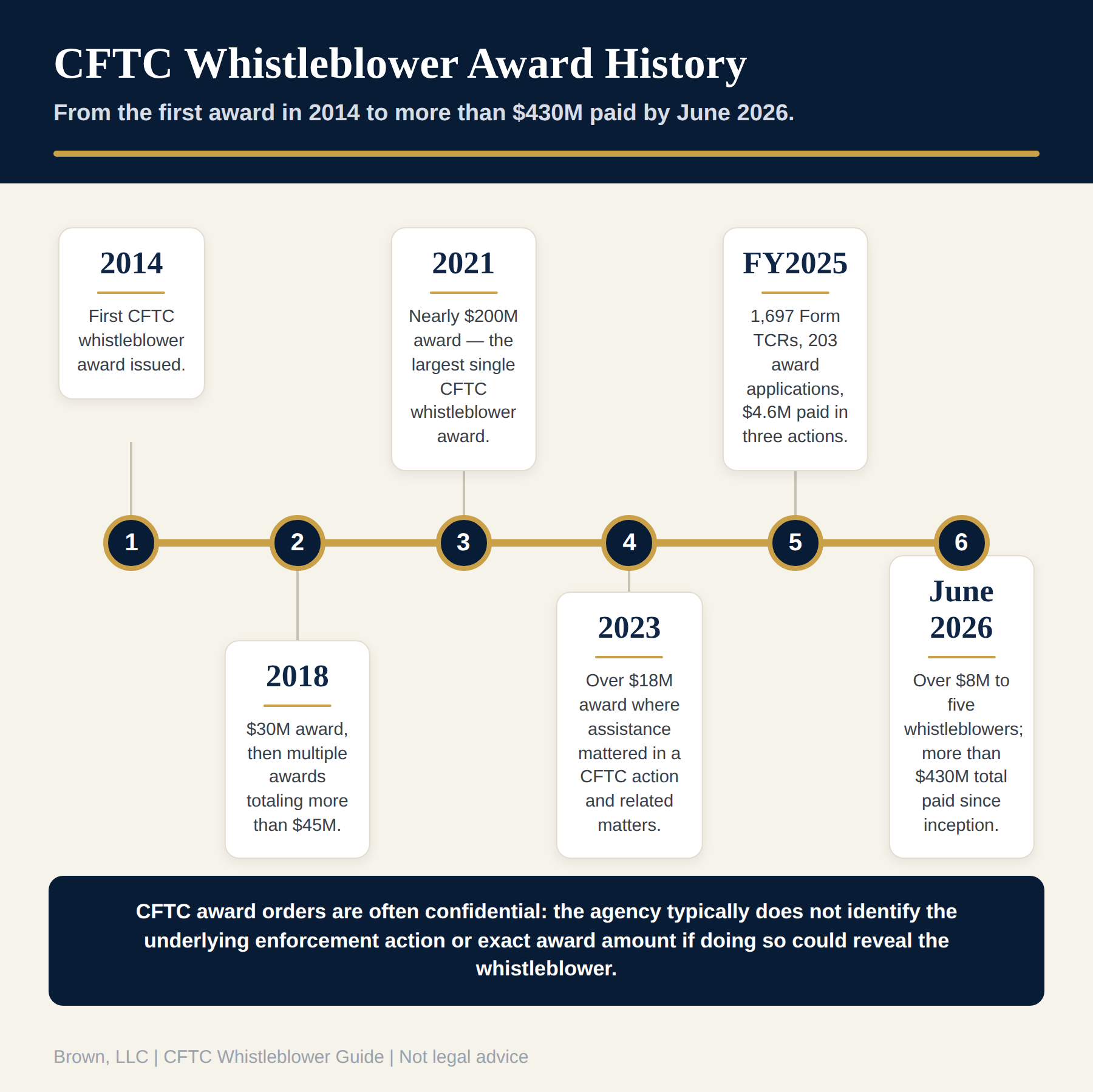
The CFTC made its first whistleblower award in 2014. Since then, the program has produced some of the most significant whistleblower awards in the federal system. In July 2018, the CFTC announced an approximately $30 million award, then its largest ever. In August 2018, it announced multiple awards totaling more than $45 million. In October 2021, it announced a nearly $200 million award to a single whistleblower, the largest CFTC whistleblower award announced to date.
Related: Brown, LLC secured two of the year’s largest individual recoveries — a $950M settlement against Raytheon and $350M against Walgreens. Learn about our False Claims Act practice →
In October 2023, the CFTC announced an award of over $18 million to a whistleblower who provided detailed information and assistance in a CFTC enforcement action and in a related action by another agency. In November 2024, the CFTC awarded nearly $4 million to two whistleblowers and emphasized that one received a higher award because of earlier reporting, among other factors. In May 2025, the CFTC awarded approximately $700,000 to a whistleblower but reduced the award because of unreasonable delay and culpability. In June 2026, the CFTC awarded more than $8 million to five whistleblowers whose tips helped resolve an enforcement action involving a fraudulent scheme.
As of the CFTC’s June 1, 2026 award announcement, the agency reported more than $430 million awarded to whistleblowers and more than $3.7 billion in monetary sanctions associated with those awards.
What Makes a Strong CFTC Whistleblower Case
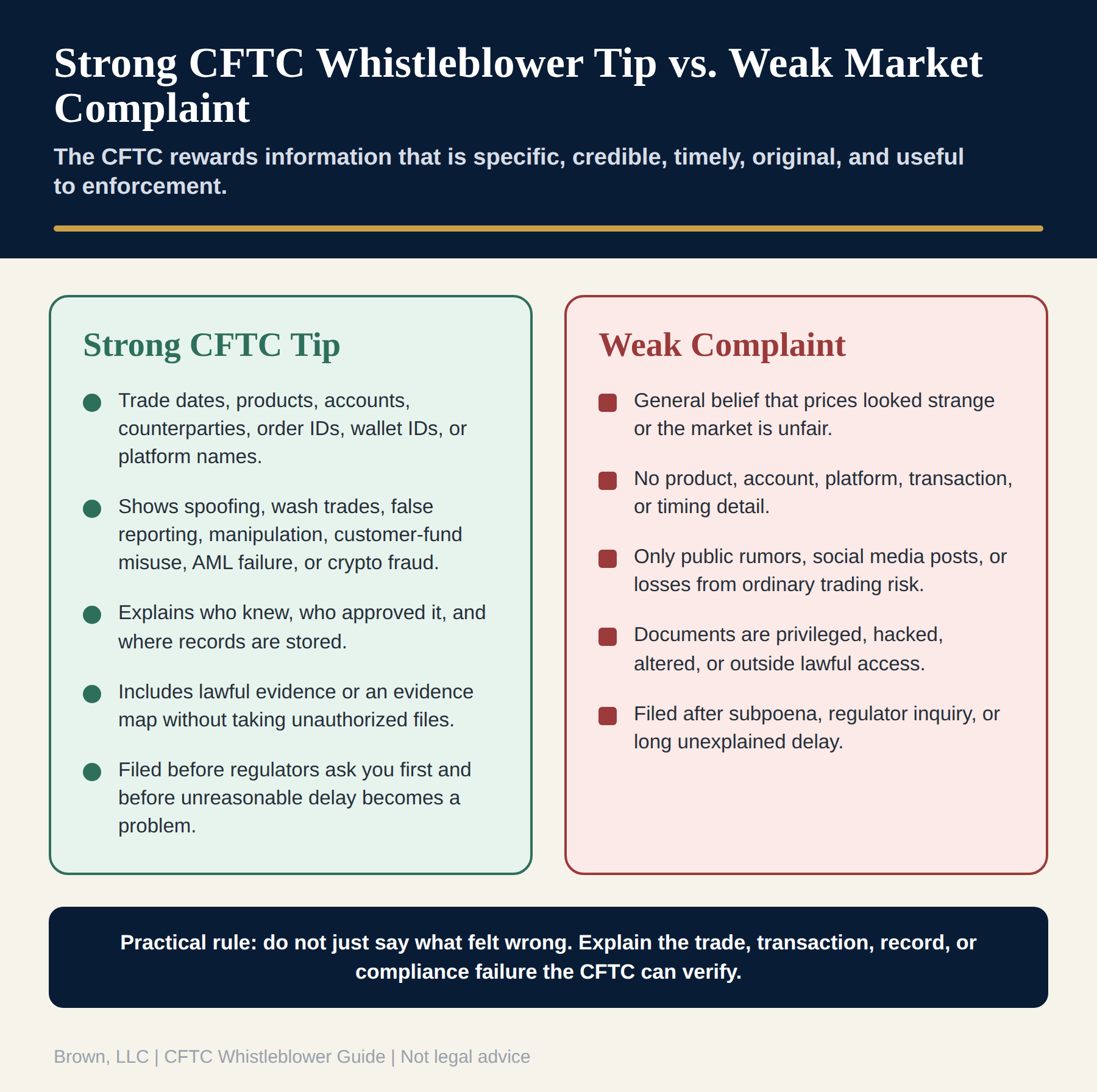
A strong CFTC whistleblower submission is not just a complaint that trading looked unfair. It gives the CFTC something it can verify. The best submissions identify products, accounts, time periods, trades, communications, customer funds, counterparties, platforms, wallets, order IDs, algorithms, compliance overrides, or records showing what happened and who knew.
The CFTC has repeatedly emphasized the value of specific, credible, and timely information. It has also reduced awards for unreasonable delay and culpability. For insiders, the message is practical: do not wait until a subpoena, internal investigation, or regulator inquiry forces your hand.
How the CFTC Process Works: Form TCR, Investigation, Notice of Covered Action, WB-APP
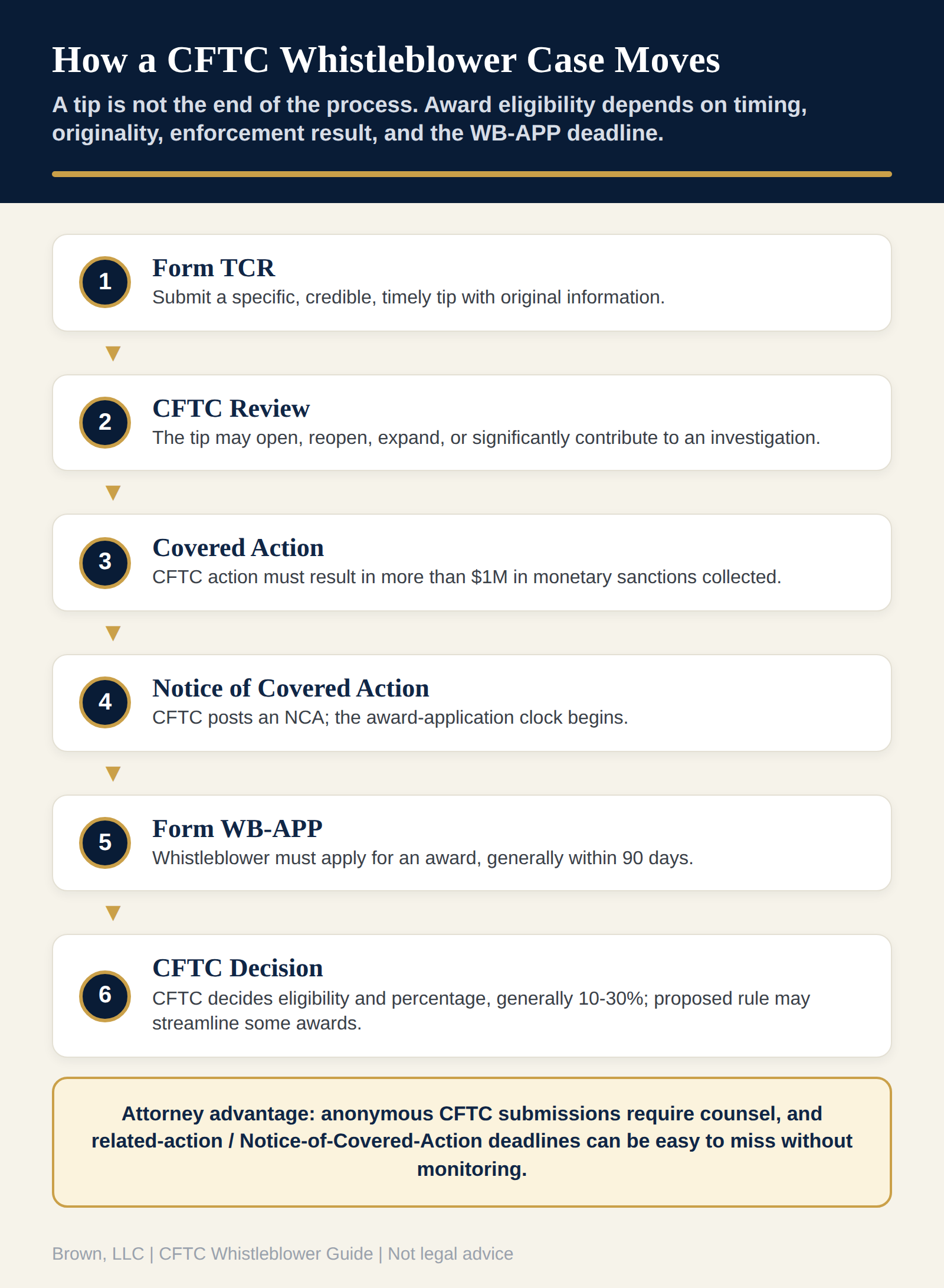
A CFTC whistleblower usually starts by submitting a Form TCR, which stands for Tip, Complaint or Referral. The information must be voluntarily provided and original. If the tip causes the CFTC to open a new investigation, reopen a closed investigation, pursue a new line of inquiry, or significantly contributes to an existing matter, and the CFTC obtains more than $1 million in monetary sanctions, the whistleblower may later be eligible to apply for an award.
The second step is often missed: a Form TCR is not the award application. After a covered CFTC action results in more than $1 million in sanctions, the CFTC posts a Notice of Covered Action. A whistleblower who submitted information related to that action generally has 90 days from the notice to submit Form WB-APP, the award application. Related actions may also be eligible, but the CFTC does not post notices for every related action, so attorney monitoring matters.
Anonymous reporting is possible, but it has procedural requirements. Under the CFTC rules, an anonymous whistleblower must follow the rules for anonymous submissions and must be represented by counsel to submit an anonymous award application.
Why a CFTC Whistleblower Lawyer Matters
A serious CFTC matter is not just a tip. It is an enforcement package. The lawyer’s job is to identify the right regulator, preserve anonymity where available, protect evidence handling, organize the trading or transaction story, preserve award eligibility, and monitor the later award-application process.
A CFTC whistleblower lawyer should help answer: Is this CFTC, SEC, DOJ, FinCEN, IRS, or some combination? Is the information voluntary and original? Could the whistleblower report anonymously? Are there related actions that could support a larger award? Did the whistleblower delay? Was the whistleblower involved in the violation? Are there employment-retaliation issues? What evidence can be used safely?
This is especially important in crypto, derivatives, swaps, commodities, carbon, forex, and AML matters because the jurisdictional line can be technical. A digital asset fact pattern may involve CFTC, SEC, DOJ, FinCEN, state regulators, or foreign authorities. A commodities fact pattern may involve both CFTC enforcement and related actions by another agency. The filing strategy should not be guessed.
Why Brown, LLC Is a Strong Fit for Serious CFTC Whistleblower Matters
Brown, LLC approaches CFTC whistleblower matters as high-stakes enforcement submissions, not generic tips. The firm can help evaluate whether the facts fit the CFTC whistleblower program, whether another regulator should also be considered, and whether the information is specific, credible, timely, original, and strong enough to justify a submission.
For a market insider, crypto employee, compliance professional, trader, operations employee, risk analyst, AML analyst, commodity pool employee, swap-dealer insider, or customer-fund witness, the value of counsel is often in the translation. Brown, LLC can help translate trading records, customer-fund flows, chat messages, wallet information, order data, AML escalations, benchmark communications, or compliance warnings into the legal framework the CFTC uses to evaluate tips and awards.
Speak with the Lawyers at Brown, LLC Today!
Over $1 billion in aggregate judgments and settlements for our clients in state and federal courts. We fight for maximum damages and results.
The firm also focuses on the risk issues that can quietly damage a CFTC whistleblower matter: retaliation, anonymity, document handling, delay, culpability, related-action deadlines, and whether the whistleblower is about to make an internal report that alerts the company before the legal strategy is set.
Practical Examples: Does This Sound Like a CFTC Case?
Example 1: Crypto platform withdrawal failures
A crypto platform advertises safe customer accounts and liquid trading, but internal employees know withdrawals are being delayed because customer assets were commingled or used elsewhere. If the assets are commodities or the conduct involves derivatives, leveraged retail commodity transactions, fraud, or manipulation within CFTC jurisdiction, the fact pattern may be worth CFTC review.
Example 2: Spoofing on a futures desk
A trader places large orders to move market perception and cancels them before execution while trading the other side of the market. The evidence may include order book data, messaging, trade blotters, supervisory reviews, or compliance alerts.
Example 3: Energy benchmark manipulation
A commodities firm holds a derivatives position that benefits from moving a physical benchmark, and internal communications show a trading strategy designed to influence that benchmark. The CFTC has brought enforcement actions involving market manipulation and benchmark misconduct, and whistleblower evidence can be highly valuable in these matters.
Example 4: AML and SAR failures by a CFTC registrant
A CFTC registrant ignores high-risk customers, fails to file suspicious activity reports, or suppresses AML alerts because the accounts are profitable. CFTC Whistleblower Office alerts specifically identify Bank Secrecy Act violations and AML/SAR failures as areas of interest.
Example 5: Commodity pool fraud
A commodity pool operator sends investors false performance reports while using new investor funds to pay earlier investors. Records may include investor statements, account records, pitch materials, emails, and bank or futures-account data.
What Not to Do
Do not submit a vague Form TCR without understanding the program. Do not wait until the CFTC, DOJ, SEC, employer, or another regulator contacts you first. Do not take privileged or unauthorized documents. Do not alter records. Do not exaggerate. Do not assume crypto automatically means SEC only. Do not assume futures, swaps, forex, commodities, carbon credits, AML, or digital assets are too technical for a whistleblower case.
Instead, build a clean timeline, identify the products and transactions, list the records that exist, preserve lawful evidence, and speak with a CFTC whistleblower lawyer before submitting.
Bottom Line
The CFTC’s proposed 30% presumption is not final. But it is still important. It shows the agency wants to make meritorious smaller and mid-sized whistleblower awards faster, more transparent, and more predictable.
For potential whistleblowers, the deeper lesson is this: CFTC cases are no longer niche. Crypto, spoofing, swaps, futures, forex, commodity pools, AML failures, carbon markets, energy trading, insider trading, and benchmark manipulation can all create CFTC whistleblower issues when the facts fit the Commodity Exchange Act.
If you have specific, credible, timely information about commodity, derivatives, digital asset, market manipulation, customer-fund, AML, or trading misconduct, do not freelance. Speak with a focused CFTC whistleblower lawyer before filing a Form TCR, reporting internally, or moving documents.
FAQ
What is a CFTC whistleblower?
A CFTC whistleblower is an individual who voluntarily provides original information to the CFTC about a possible violation of the Commodity Exchange Act or CFTC rules. If the information leads to a successful enforcement action with more than $1 million in monetary sanctions, the whistleblower may be eligible for an award.
How much can a CFTC whistleblower receive?
Eligible CFTC whistleblowers may receive between 10% and 30% of collected monetary sanctions in covered CFTC actions and qualifying related actions. The proposed 30% presumption would conditionally set certain qualifying awards of $5 million or less at the statutory maximum.
What is Form TCR?
Form TCR is the CFTC’s Tip, Complaint or Referral form. It is generally the filing vehicle used to submit whistleblower information to the CFTC.
What is Form WB-APP?
Form WB-APP is the CFTC award application. Submitting a tip is not the same as applying for an award. After a qualifying covered action, a whistleblower generally must submit Form WB-APP within the required deadline.
Can I report anonymously to the CFTC?
Yes, anonymous reporting can be available, but anonymous CFTC whistleblowers must follow specific procedures and must be represented by counsel for anonymous award applications.
Does the CFTC cover crypto fraud?
Yes, the CFTC has published a whistleblower alert on virtual currency fraud and has stated that virtual currencies are commodities under the Commodity Exchange Act. CFTC jurisdiction can arise for fraud or manipulation involving virtual currency traded in interstate commerce, and for virtual currency derivatives.
Does the CFTC cover spoofing?
Yes. The CFTC has published a whistleblower alert on spoofing in commodities and derivatives markets. Spoofing, wash trading, pre-arranged trading, and other disruptive trading practices can be CFTC issues.
Should I report internally before filing a CFTC tip?
Not without legal advice. Internal reporting can matter in some circumstances, but it can also create retaliation risk, delay issues, document destruction concerns, or company pretext. Speak with counsel before choosing the reporting sequence.
Why hire a CFTC whistleblower lawyer?
A lawyer can evaluate program fit, preserve anonymity where available, help organize the Form TCR submission, avoid document-handling errors, monitor Notices of Covered Action, file the WB-APP, and evaluate related-action award opportunities.
Sources
[1] CFTC Release No. 9250-26, CFTC Seeks Public Comment on Notice of Proposed Rulemaking Concerning Whistleblower Rules (June 11, 2026): https://www.cftc.gov/PressRoom/PressReleases/9250-26
[2] CFTC NPRM, Whistleblower Award Determination, RIN 3038-AF74 (June 11, 2026): https://www.cftc.gov/media/14196/CFTCWhistleblowerProgramNPRM061126/download
[3] CFTC FY 2025 Whistleblower & Customer Education Report: https://www.whistleblower.gov/sites/whistleblower/files/2026-02/FY%202025%20Whistleblower%20%26%20Customer%20Education%20Report.pdf
[4] CFTC Whistleblower Program overview, Whistleblower.gov: https://www.whistleblower.gov/
[5] CFTC Release No. 9245-26, CFTC Grants Five Whistleblower Awards Totaling Over $8M (June 1, 2026): https://www.cftc.gov/PressRoom/PressReleases/9245-26
[6] CFTC Release No. 8453-21, CFTC Awards Nearly $200 Million to a Whistleblower (Oct. 21, 2021): https://www.cftc.gov/PressRoom/PressReleases/8453-21
[7] CFTC Release No. 9006-24, CFTC Awards $4M to Two Whistleblowers (Nov. 12, 2024): https://www.cftc.gov/PressRoom/PressReleases/9006-24
[8] CFTC Release No. 9081-25, CFTC Awards Approximately $700,000 to Whistleblower (May 29, 2025): https://www.cftc.gov/PressRoom/PressReleases/9081-25
[9] CFTC Whistleblower Alerts, fraud categories including carbon markets, spoofing, BSA, insider trading, corrupt practices, and digital assets: https://www.whistleblower.gov/whistleblower-alerts
[10] CFTC Virtual Currency Fraud Whistleblower Alert: https://www.whistleblower.gov/whistleblower-alerts/Virtual_Currency_WBO_Alert.htm
[11] CFTC Part 165 Whistleblower Rules: https://www.cftc.gov/sites/default/files/idc/groups/public/@whistleblowernotices/documents/file/whistleblowerrules17cfr165.pdf