
AI Whistleblowers and the Truth Behind the Hype

Table of Contents
In my high school debate club, my friend Joel Stein, who went on to become a well-known columnist, argued against the Strategic Defense Initiative. As I remember it, he opened with: “SDI, SDI, we’re all going to die.”
The rhyme stuck. Fortunately, we are still here.
President Reagan’s 1983 SDI proposal called for research into intercepting ballistic missiles before they reached their targets. I think the former President may have played too many video games, since the idea had a certain 1980s quarter-gulping Asteroids machine with a Pentagon budget quality to it. [1] These days, the acronym has lost a letter and every day there’s a new video on YouTube professing: “AI, AI, we’re all going to die.”
I prefer Nick Fury’s approach in The Avengers: “Until such time as the world ends, we will act as though it intends to spin on.” [2] Fair enough. While it spins, somebody needs to check the invoices, read the safety reports, and ask why a company’s public promises look nothing like its internal emails. That is where AI whistleblowers come in.
AI can do useful things. It can also make deception faster, cheaper, and harder to spot. A person who understands what is happening behind the screen may be the person best positioned to expose it. The first questions are wonderfully low-tech: What was promised? What actually happened? Who knew? And when money changed hands, who paid?
Quick Take
- Fraud involving money has four main routes. The False Claims Act for government funds, the SEC for investors, the CFTC for commodities and trading, and the IRS for tax.
- AI washing is reportable when it misleads investors. Material misstatements about what a company’s AI can do can be an SEC enforcement issue.
- Rewards are percentages of what is collected. FCA 15% to 30%, SEC and CFTC 10% to 30%, IRS 15% to 30%, each with its own thresholds. No award is automatic.
- AI safety concerns have routes too. California’s SB 53 is in force, New York’s attorney general is taking reports now, and two federal bills are pending.
- Talk to a whistleblower attorney early. Filing bars, originality rules and retaliation deadlines can be short. Call (877) 561-0000 for a free, confidential consultation, or skip to the questions AI whistleblowers ask most.
What Is an AI Whistleblower?
An AI whistleblower reports suspected wrongdoing involving artificial intelligence: for example, false government billing, misleading investors, tax noncompliance, discriminatory systems, or concealed safety risks. The available route depends on the conduct. Existing laws may provide a financial award, protection against retaliation, both, or neither. The words “artificial intelligence” do not create a universal whistleblower program. California already has an AI-specific whistleblower statute, and Congress has two AI-related whistleblower bills pending. I cover each below. [3] [11] [15] [20] [22]
Two groups deserve attention: people exposing fraud involving money, and people exposing unsafe or unlawful conduct involving AI. Their concerns can overlap. An engineer may discover falsified safety tests that were also used to win a government contract or raise investment capital. Either kind of report is worth a conversation with a whistleblower attorney before it goes anywhere.
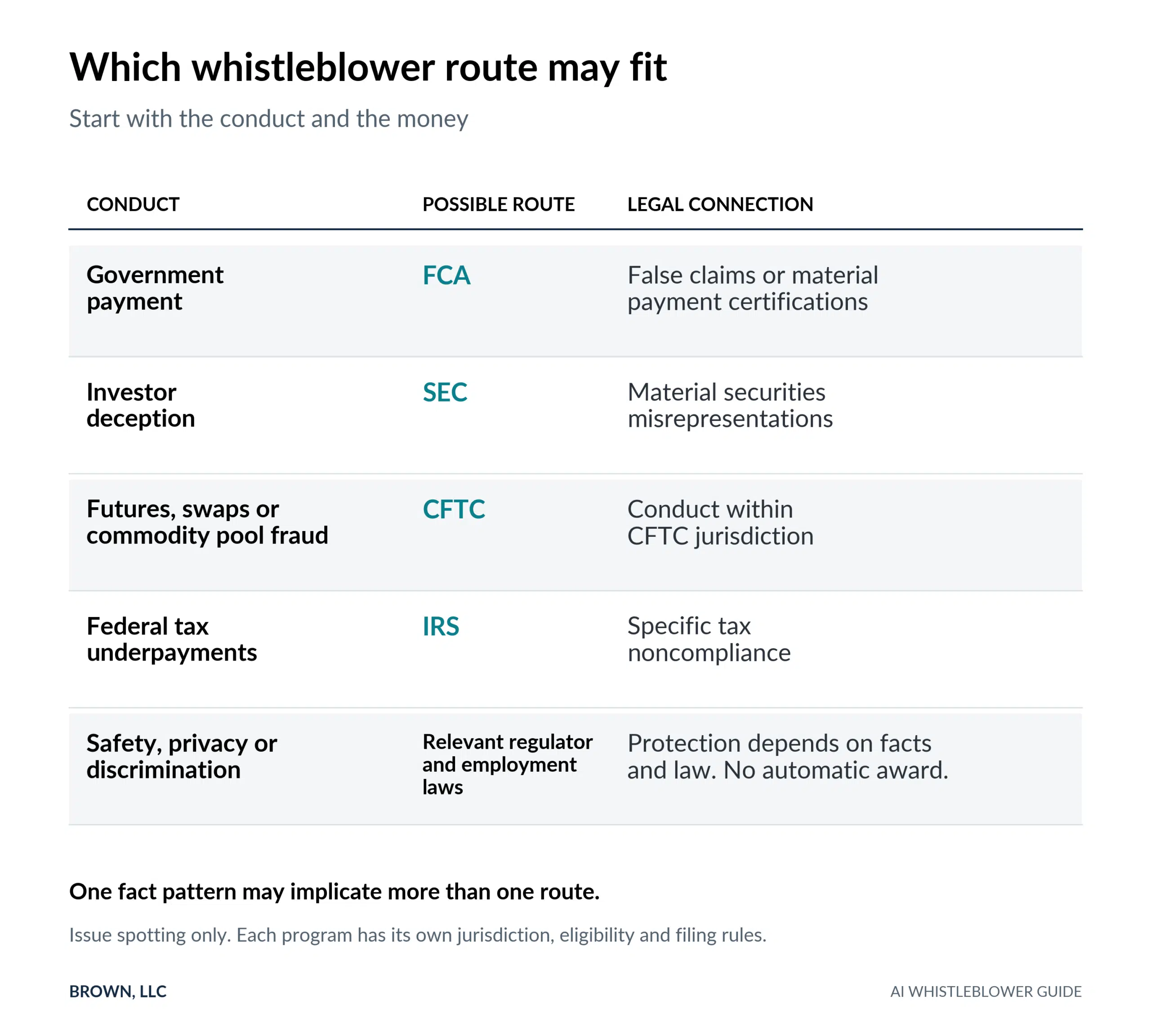
Figure 1. A starting map for identifying a possible reporting route. Jurisdiction, eligibility and the facts still control. Sources: [3], [11], [13], [15], [20] and [22].
The False Claims Act and AI Fraud Against the Government
When AI is used to obtain government money through fraud, the False Claims Act, or FCA, is often the most direct starting point. It reaches knowingly false claims and certain false records or certifications used to obtain payment. Its coverage can include qualifying claims submitted through contractors or grantees using federal funds. A whistleblower can bring that case on the government’s behalf through a qui tam lawsuit. [3] [25]
Speak with the Lawyers at Brown, LLC Today!
Over $1 billion in aggregate judgments and settlements for our clients in state and federal courts. We fight for maximum damages and results.
The analysis has several moving parts: identify the false statement or claim, its connection to government money, why it was material to payment, and what the defendant knew. Knowledge can include deliberate ignorance or reckless disregard. An honest mistake does not automatically become fraud because an AI system was involved. The Supreme Court has emphasized that materiality is a demanding requirement. [3] [4]
Here are concrete situations worth examining. These are illustrative scenarios, not allegations about any particular company.
Billing the Government for Human Work That Never Happened
Suppose a government contractor bills 100 hours of professional labor. Its own records show that a person spent 20 hours on the assignment and used AI to complete the deliverable. If the contract pays for actual labor hours, inventing the other 80 is a serious problem. The federal time-and-materials payment clause ties labor charges to hours actually performed and applicable qualifications. [5]
Now change the contract. The government agrees to pay a fixed price for a compliant deliverable, and the contractor uses AI to do the work efficiently. That efficiency does not, by itself, establish a false claim. Read what the government bought before calling the savings fraud.
The same question applies to required professional review. Was the government billed for a clinician’s service or review that never occurred? A computer-generated document does not prove that the promised human work happened. The payment rule and the actual workflow control. [4]
Inventing the Medical Record to Bill Medicare or Medicaid
Imagine AI-generated notes describing an examination that never occurred, symptoms the patient never reported, a signature the physician never supplied, or consent the patient never gave. If a company knowingly uses those records to support false Medicare or Medicaid claims, the technology may be helping manufacture the supposed basis for reimbursement. [3]
There is already a real enforcement example. In June 2025, DOJ described a charged scheme in which defendants allegedly used AI, in some instances, to fake recordings of Medicare beneficiaries consenting to products. The announcement identified about $703 million in alleged fraudulent claims and $418 million paid. Those are allegations and payment figures from a criminal case announcement, not an FCA settlement or a whistleblower award. [7]
That is a more immediate concern than a robot deciding to conquer the planet. A fabricated recording can make it appear that a real person agreed to something they never requested. It is also the kind of thing a Medicare fraud whistleblower on the inside tends to see before an auditor does.
Inflating Diagnoses and Medicare Advantage Reimbursement
Another potential scenario is the knowing use of unsupported diagnoses to increase Medicare Advantage payments, often called risk-adjustment upcoding. A whistleblower would want to connect the diagnosis, the missing clinical support, the submission, and the payment effect. “The algorithm gets things wrong” is a starting observation. Which unsupported information was knowingly used to obtain money is the next question.
Improper AI-driven coverage denials deserve separate attention. CMS has explained that algorithms may assist Medicare Advantage decisions, but plans must comply with coverage requirements and account for the individual patient’s circumstances. An unlawful denial may support a regulatory complaint or patient appeal; an FCA case still needs its own legally sufficient false-claim and payment theory. [6]
Rigging the Demonstration or Hiding Failed Tests
Consider a government procurement in which a vendor knowingly represents that its system meets a required accuracy or security standard. Internal testing shows otherwise. The sales demonstration uses handpicked results while the vendor falsely describes them as representative validation.
The useful evidence is specific: the promised standard, the actual test, the withheld results, who knew, and how the representation affected the award or payment. A disappointing model is not enough. Material deception about what the government purchased may be. [4]
Falsifying Grant Research or Computing Costs
Possible examples include fabricated experiments in a funding application, nonexistent researcher hours, duplicate charges for computing resources, or knowingly false grant-eligibility certifications. AI can change how a false record is produced. The funding requirements still apply.
In May 2025, AI and computer-vision company Vimaan Robotics agreed to pay $1.5 million to resolve FCA allegations involving an NSF grant. The alleged problem was its eligibility for the grant after it became majority-owned by venture capital companies, not a finding that its AI product was fraudulent. DOJ stated that the settlement resolved allegations without a determination of liability. [8]
Misrepresenting Cybersecurity and Data Handling
Suppose a contractor certifies that protected government information stays within an approved environment while knowingly sending it to an unauthorized AI service. Compare the contractual requirements, actual data flow, certifications, and payment significance. A security lapse can be serious without satisfying every element of an FCA case. The question is whether there was a knowing, material falsehood tied to government payment. [3] [4]
For any of these scenarios, estimate the affected transactions carefully. The entire contract value is not automatically the government’s loss. Unsupported hours, improper reimbursements, or the value of what was actually delivered may be the better measure. A large number is useful only if the evidence explains it.
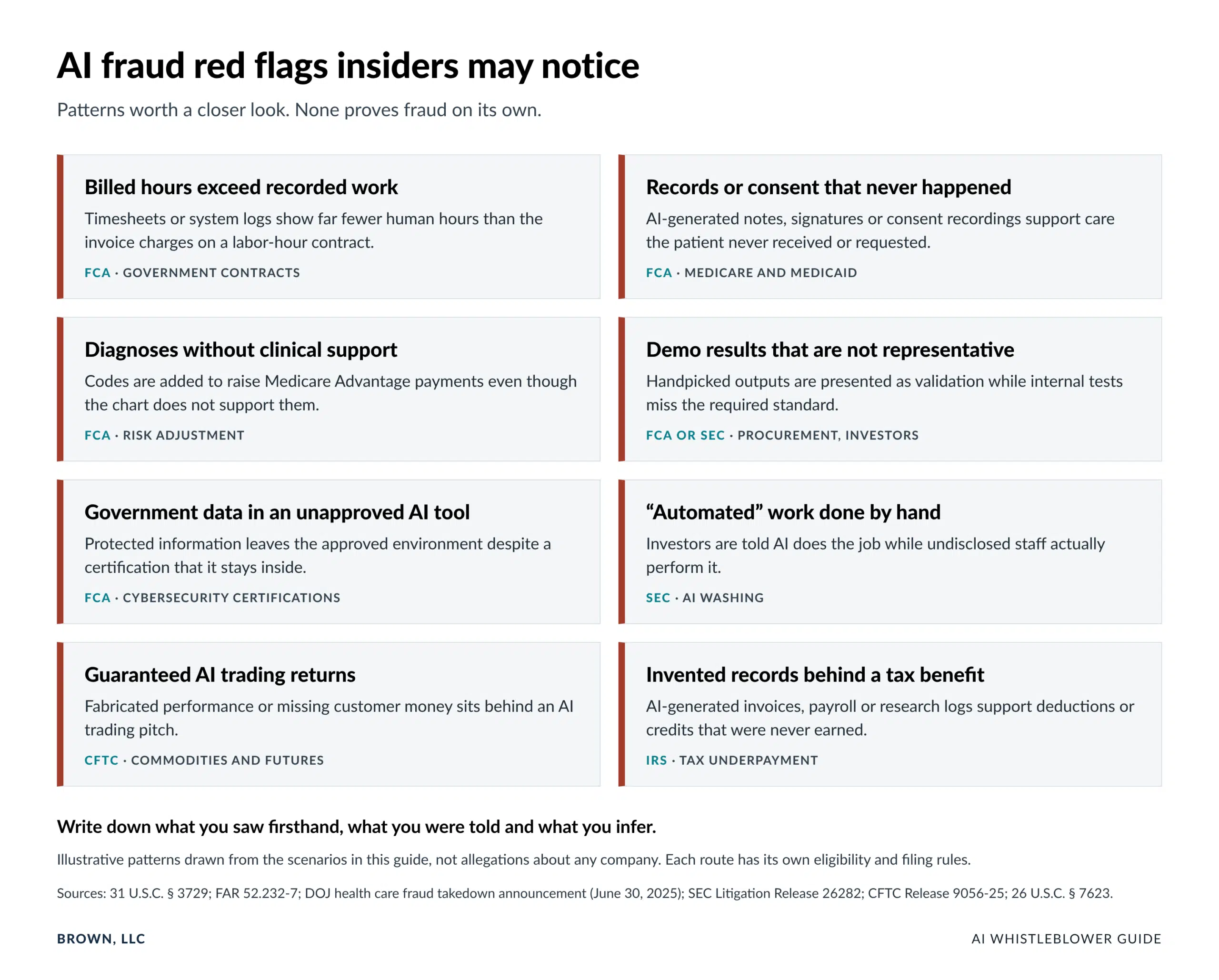
Figure 2. Illustrative red flags drawn from the scenarios above, not allegations about any company. None proves fraud on its own. Sources: [3], [5], [7], [10], [14] and [15].
What Is AI Washing, and Can an SEC Whistleblower Report It?
AI washing is the practice of dressing up a company or product with misleading claims about artificial intelligence. When material misrepresentations are made to investors or by investment advisers, the SEC may have a role. Its March 2024 cases against Delphia and Global Predictions show that claimed AI capabilities can be an enforcement issue. The firms agreed to civil penalties of $225,000 and $175,000, respectively, without admitting or denying the findings. Those penalties are not whistleblower awards. [9]
The deception can run in two directions. A contractor may bill for people when AI did the work. A company may tell investors that AI did the work when undisclosed people actually performed it.
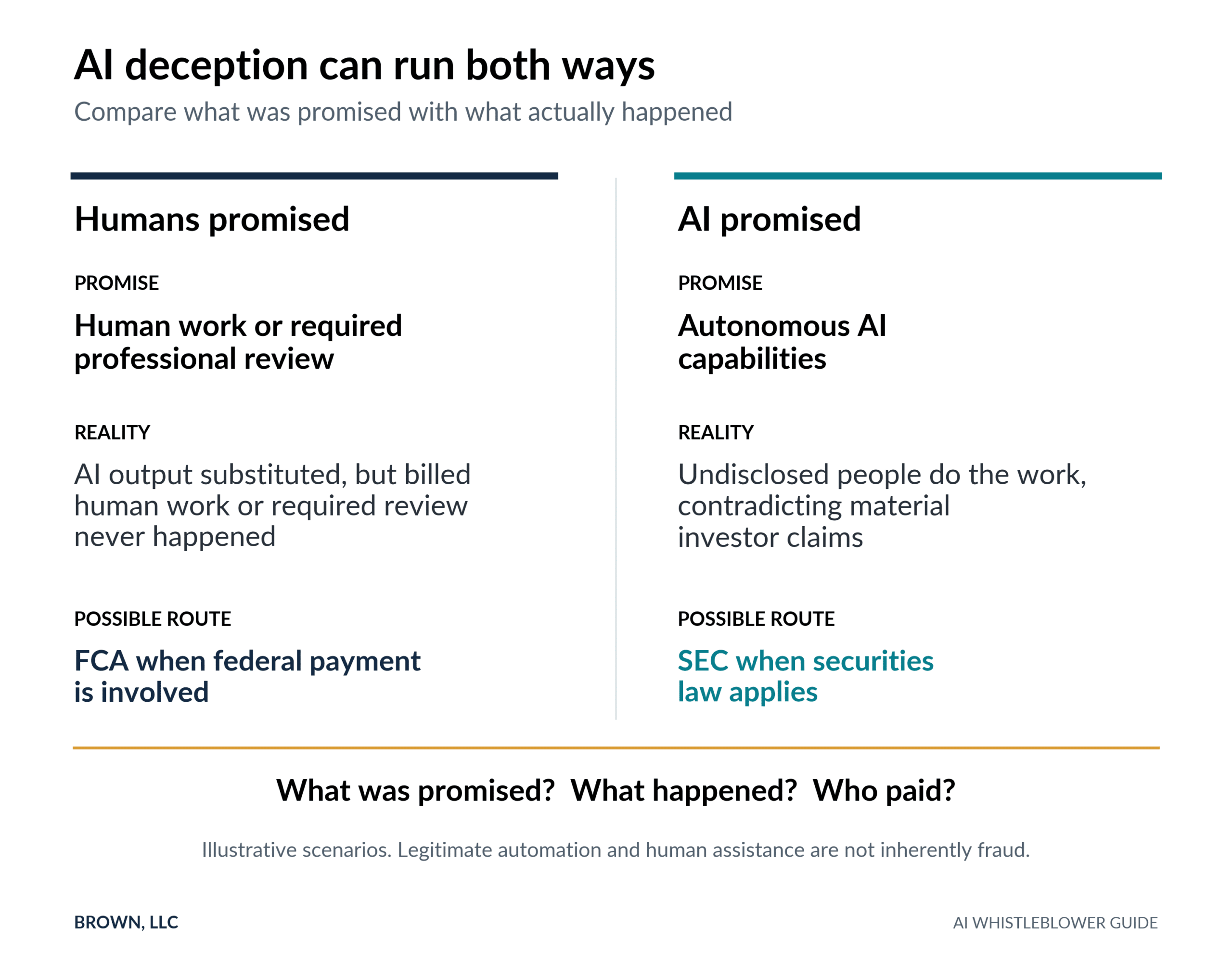
Figure 3. Two illustrative ways the promise can diverge from the actual work. The representation and payment context determine the legal analysis. Sources: [4], [5] and [10].
The second pattern appeared in the SEC’s 2025 complaint against the founder of the shopping app Nate. The SEC alleged that he raised more than $42 million through stock sales while misrepresenting the app’s AI capabilities, and that people manually entered transactions investors were told were automated. This describes the SEC’s allegations when it filed the case, not a finding of liability or a $42 million recovery. [10]
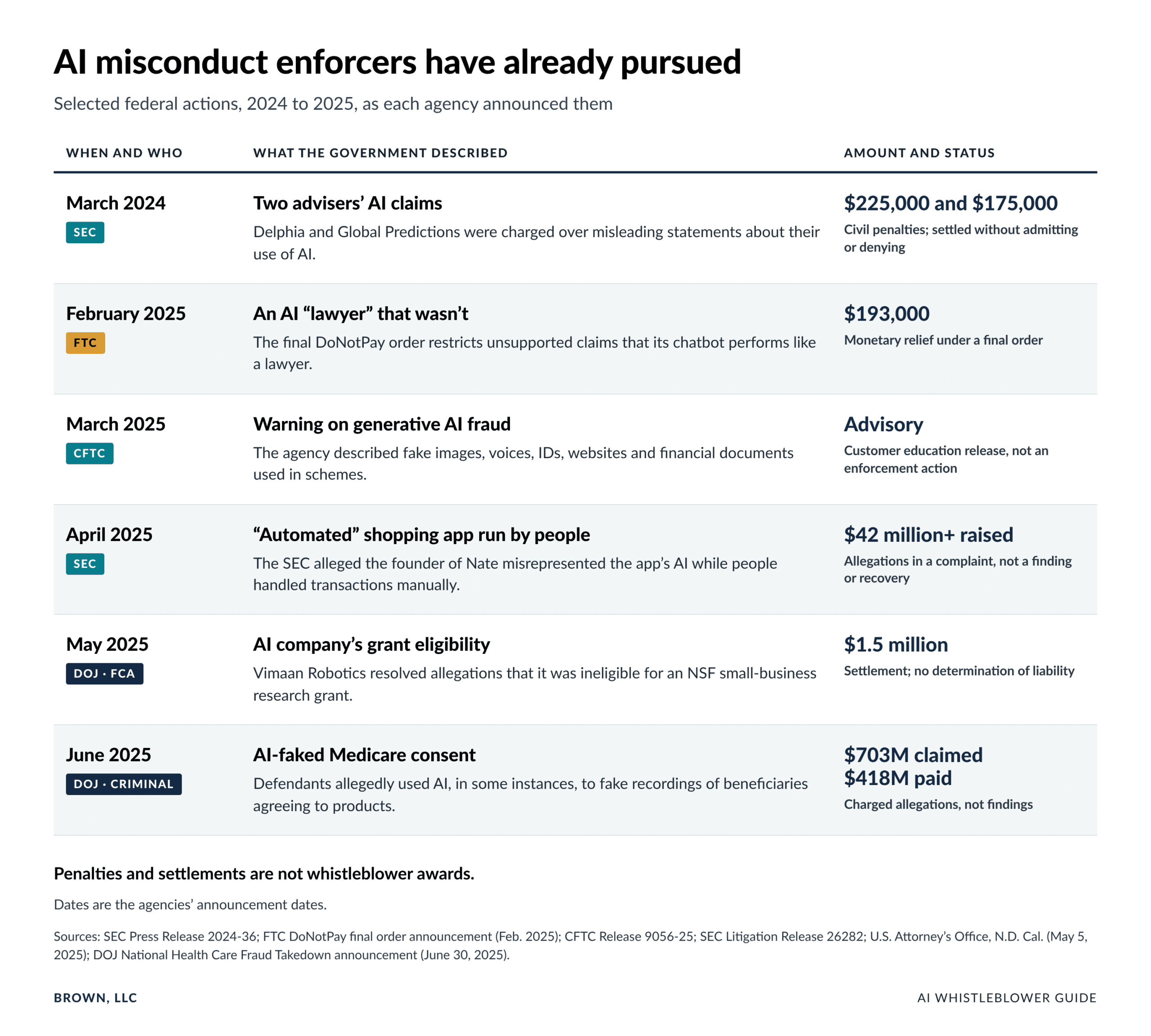
Figure 4. Selected federal actions involving AI claims or AI-enabled schemes. Amounts are as announced; allegations are not findings, and penalties are not whistleblower awards. Sources: [7], [8], [9], [10], [14] and [21].
Related: Brown, LLC secured two of the year’s largest individual recoveries — a $950M settlement against Raytheon and $350M against Walgreens. Learn about our False Claims Act practice →
Potential leads also include fabricated AI revenue, invented customer contracts, misleading performance testing, and internal findings that contradict material investor disclosures. A private startup can raise money through securities sales; being privately held does not place a stock offering beyond securities law. [10]
An eligible SEC whistleblower generally must voluntarily provide original information that leads to a successful covered action with more than $1 million in ordered monetary sanctions. The general award range is 10% to 30% of sanctions collected. The award process requires a submission in the prescribed form and manner, including the SEC’s TCR process. [11] [12]
CFTC Whistleblowers and the AI Trading Pitch
A trading system that supposedly guarantees profits should invite questions, especially when insiders can see fabricated results or missing customer money. Potential CFTC issues include fraud involving commodity pools, futures, swaps, or other products within its jurisdiction. The label “AI trading” does not decide which regulator has authority.
The CFTC has warned that generative AI can help fraudsters create convincing fake images, voices, identification, websites, and financial documents. A whistleblower may be able to show the gap between the marketed trading operation and what actually occurred. [14]
The CFTC whistleblower program generally offers 10% to 30% of collected sanctions in qualifying cases where voluntary, original information leads to a successful covered action resulting in more than $1 million in sanctions. Its rules and award application process are separate from the SEC’s. [13] [30]
IRS Whistleblowers and AI Tax Fraud
The IRS question is straightforward: what tax was underpaid, and what reliable information shows it? Possible examples include AI-generated invoices for expenses never incurred, fabricated payroll, concealed revenue, or invented research records used to support improper tax credits. These are hypothetical uses of AI to support tax noncompliance.
Real AI development can involve legitimate expenses and qualifying research. A large deduction or research credit is not proof of fraud. The stronger lead identifies the taxpayer, tax years, false records or treatment, and estimated underpayment. Company revenue and enterprise valuation are not substitutes for the disputed tax amount.
Under the qualifying mandatory award framework in 26 U.S.C. § 7623(b), the general range is 15% to 30% of proceeds collected attributable to the information. Proceeds in dispute must exceed $2 million. When the taxpayer is an individual, that person’s gross income must also exceed $200,000 in at least one relevant tax year. Smaller claims may fall within a discretionary program. [15] [17]
An IRS award claim requires Form 211 and the whistleblower’s identity and signed declaration. An anonymous tip is not an anonymous award claim. The federal FCA expressly excludes claims, records, or statements made under the Internal Revenue Code; tax information needs the appropriate tax route. [16] [3]
How Much Do Whistleblowers Get Paid? The Main Award Ranges Compared
The percentage is only part of the story. The legal route determines what money the percentage applies to, what must be collected, and who qualifies. A reported loss, a company’s valuation, and an award are three different numbers.
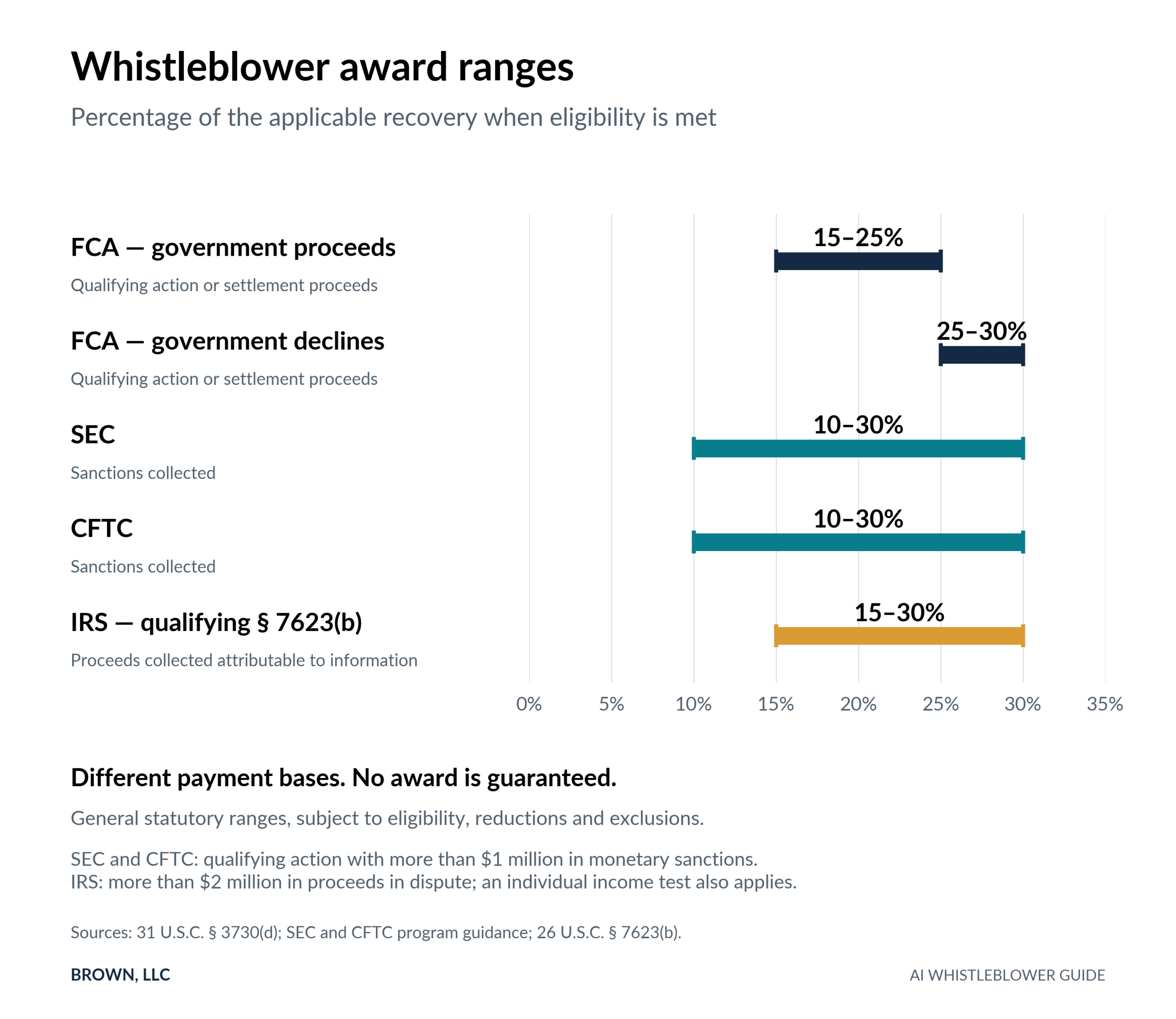
Figure 5. General statutory award ranges, subject to eligibility, reductions and exclusions. FCA shares ordinarily depend on whether the government proceeds; SEC and CFTC awards depend on qualifying collected sanctions; qualifying IRS awards depend on attributable collections. Sources: [25], [11], [13] and [15].
For FCA cases, a whistleblower generally brings a qui tam action on the government’s behalf. The ordinary share is 15% to 25% of action or settlement proceeds when the government proceeds, or 25% to 30% when it does not, subject to statutory qualifications. Filing, contribution, exclusions, and the actual outcome all affect the share. [25]
Other Routes for AI Whistleblowers: Fincen, DOJ, FTC and EEOC
Money laundering and sanctions. AI used to conceal sanctions violations or to falsify required anti-money-laundering records may implicate FinCEN’s whistleblower program. As of November 23, 2026, FinCEN’s published guidance says award processing and payment will begin after final implementing regulations. It has published a proposed rule. Keep that status in mind when discussing possible awards. [18]
Corporate criminal misconduct. DOJ’s Corporate Whistleblower Awards Pilot may apply to covered corporate crimes leading to more than $1 million in net forfeiture. Awards are discretionary. The July 2026 revision changed how the pilot interacts with other programs: eligibility elsewhere is no longer an automatic bar, but duplicate awards for the same or substantially the same misconduct are prohibited. [19]
Health care and government-program fraud charged criminally. In October 2026, DOJ’s National Fraud Enforcement Division launched the Fraud Whistleblower Incentive Program, or WHIP. It pays a discretionary $10,000 to $30,000 per qualifying tip, ordinarily after covered criminal charges are filed and unsealed. It covers federal health care offenses and fraud on programs run by eight federal agencies. A WHIP tip is not a qui tam complaint. Someone who sees an AI-enabled billing scheme should evaluate the False Claims Act route before relying on the smaller, earlier payment. [36] [37]
Consumer deception and discrimination. Unsupported AI product claims may belong with the FTC. Its final DoNotPay order required $193,000 in monetary relief and restricted unsupported claims about the chatbot performing like a lawyer. Employment discrimination involving AI may fall within the EEOC’s authority. Neither example creates a general percentage award for every person who reports an AI concern. [21] [20]
AI Safety Whistleblowers Deserve a Route Too
Some insiders are concerned about dangerous model capabilities, suppressed safety findings, misuse of sensitive data, or systems that harm people. They may not have an invoice or investor presentation. Their information can still be important. The question becomes which safety, privacy, civil-rights, employment, or sector-specific law applies.
Whistleblower tip: If you’ve witnessed Medicare or Medicaid billing fraud at your employer, you may qualify as a qui tam relator with a potential share of the government’s recovery. See our Medicare & Medicaid fraud practice →
Is There an AI Whistleblower Law?
Yes at the state level, and not yet at the federal level. California has an AI whistleblower statute in force. New York’s frontier-AI law takes effect January 1, 2027. In Congress, one bill would protect AI workers from retaliation, and another, which has already passed the Senate, would pay awards for reporting export-control violations such as chip smuggling. Neither federal bill is law as of November 23, 2026. [31] [23] [32] [34]
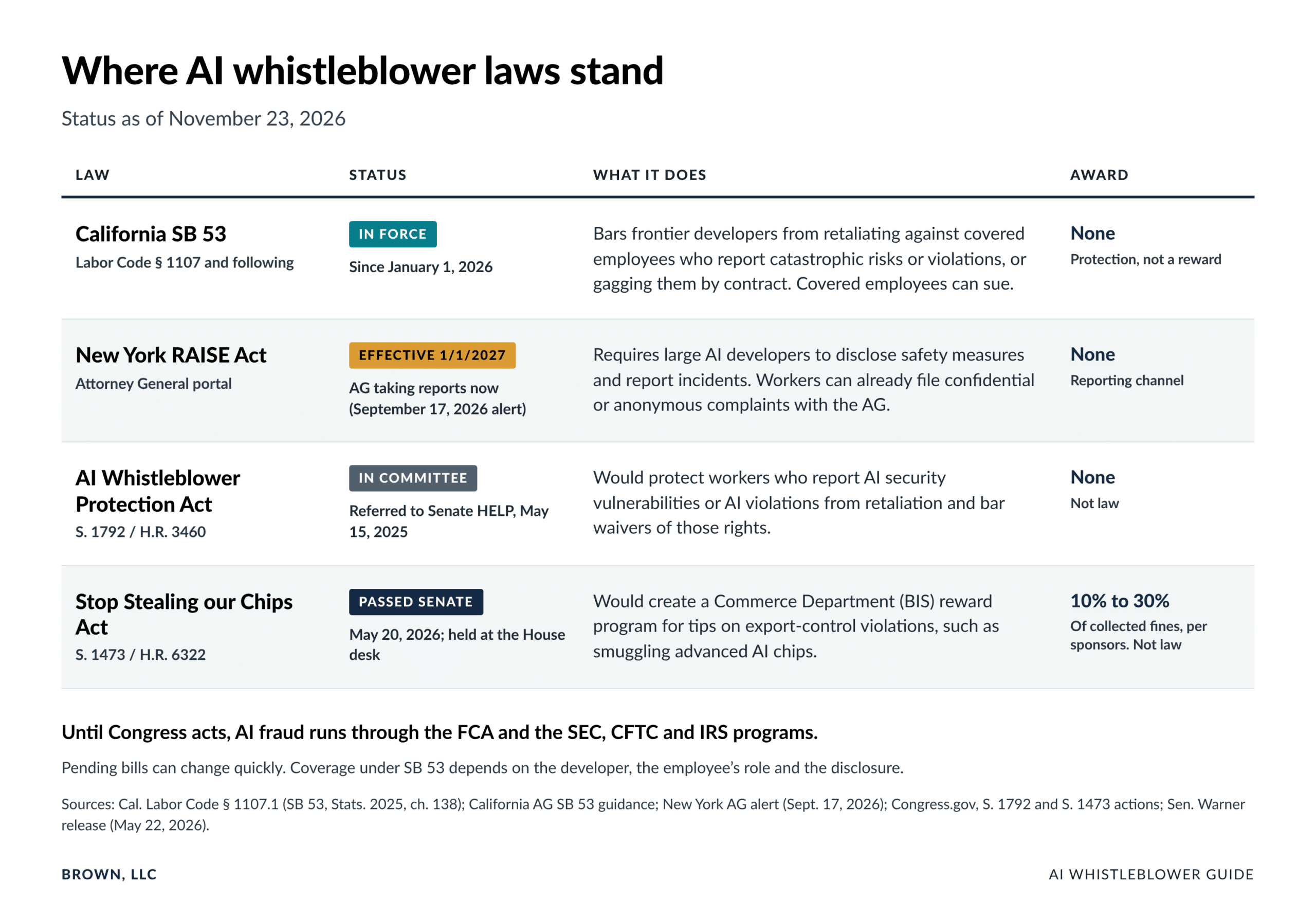
Figure 6. Status of AI-specific whistleblower laws and bills as of November 23, 2026. Sources: [23], [31], [32], [34] and [35].
California has a specific frontier-AI whistleblower statute. SB 53, in force since January 1, 2026, protects certain employees responsible for assessing, managing, or addressing critical safety risks in foundation models. Qualifying disclosures concern specified catastrophic dangers or violations of the Transparency in Frontier Artificial Intelligence Act. The protection depends on the developer, the employee’s role, the information, and the reporting channel. The whistleblower provisions are codified at California Labor Code § 1107.1, and a covered employee who suffers retaliation can bring a civil action. It is not a percentage award program for everyone who works with AI. [22] [31]
New York is seeking reports now. In September 2026, its attorney general invited confidential or anonymous reports of unsafe or unlawful AI activity. The state’s RAISE Act takes effect January 1, 2027, but workers can already use the attorney general’s reporting channel. [23]
Congress has proposed a federal , S. 1792, with a House companion, H.R. 3460, but it has not become law as of November 23, 2026. Senator Grassley introduced it in May 2025, and it was referred to the Senate HELP Committee. In September 2026, Politico reported that he was trying to pass it by unanimous consent; Congress.gov still lists the committee referral as the latest action. The bill would protect workers who report AI security vulnerabilities or AI violations from retaliation. It does not offer a percentage award. For now, workers need to identify the protections already available for their particular disclosure. [24] [32] [33]
One AI-related whistleblower bill has already passed the Senate. The Stop Stealing our Chips Act, S. 1473, passed by unanimous consent on May 20, 2026 and has been held at the desk in the House since May 21. A House companion, H.R. 6322, cleared the House Foreign Affairs Committee in April 2026. The bill would create a whistleblower incentive program at the Commerce Department’s Bureau of Industry and Security for export-control violations. Its sponsors describe it as a way to stop the smuggling of American-made semiconductors into China. Advanced chips are the hardware AI runs on, which is why the bill belongs in this discussion. According to the sponsors, it would pay whistleblowers 10% to 30% of collected fines and add confidentiality and anti-retaliation protections. It is not law as of November 23, 2026. [34] [35]
A reward question and a safety question should both get a serious answer. A person does not need to discover a billion-dollar invoice before a concealed threat deserves attention.
The Evidence That Makes an AI Whistleblower Report Useful
You do not necessarily need source code. The strongest starting point may be a contract, an invoice, a test report, a workflow record, or an email explaining why a public claim is false. The job is to connect the representation to what actually happened.
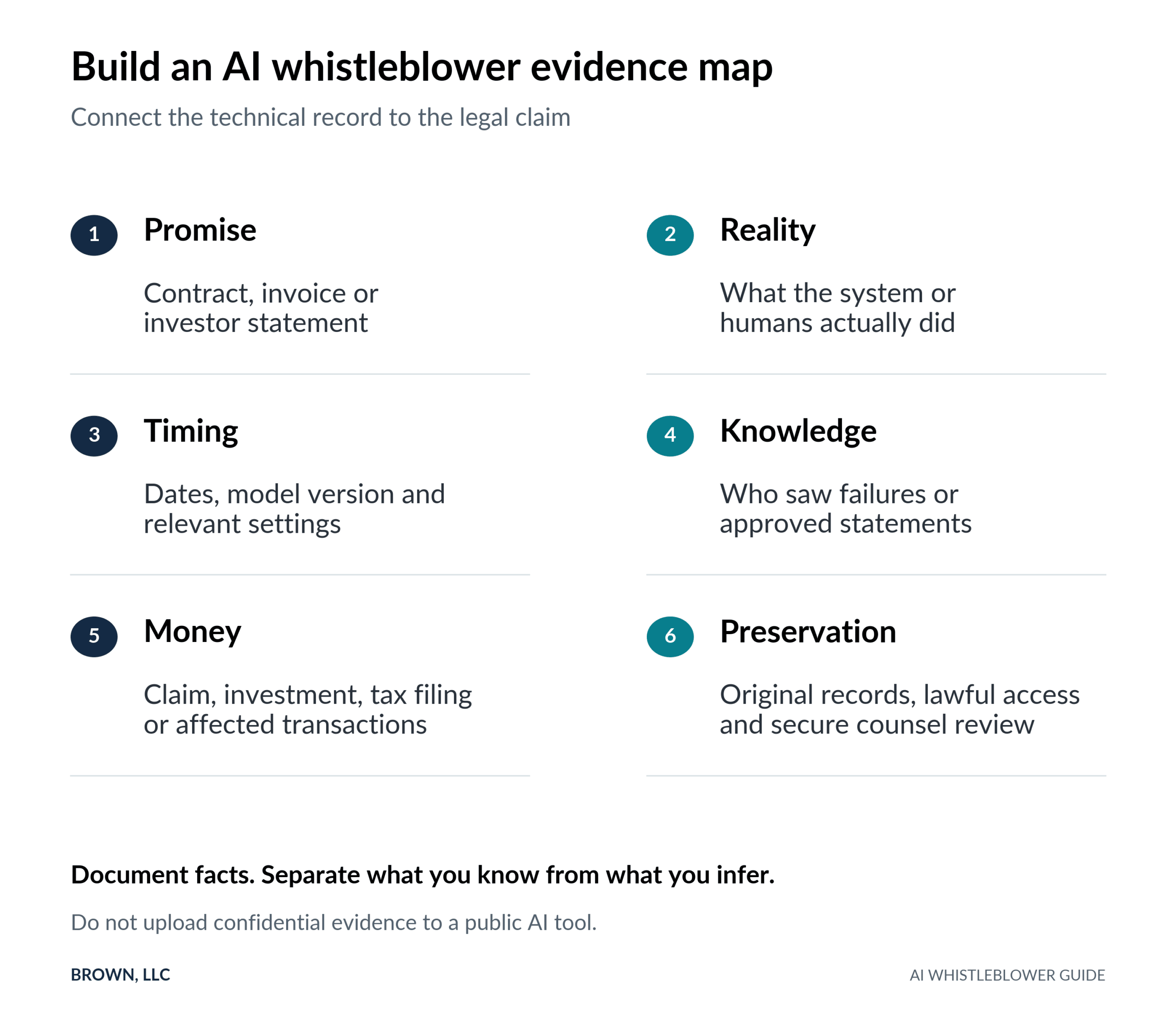
Figure 7. A practical preparation guide, not a list of statutory elements. Preserve context and seek advice about lawful handling of sensitive records.
For technical findings, record the model or product version, relevant date, input, output, and test conditions if you know them. A reproducible failure can be more useful than a screenshot stripped of context. Also identify whether the result was typical, exceptional, corrected, or already disclosed.
Speak with the Lawyers at Brown, LLC Today!
Over $1 billion in aggregate judgments and settlements for our clients in state and federal courts. We fight for maximum damages and results.
Write down what you personally observed, what another person told you, and what you inferred. Keep those categories distinct. If a useful record exists but you do not possess it, describe the record and its likely location. Be candid about the gaps. A chatbot cannot turn a missing document into evidence. The IRS expressly allows claimants to describe supporting records outside their possession. [17]
Preserve originals and dates. Do not alter logs, fabricate a demonstration, use someone else’s credentials, or access a system you are no longer authorized to use. Before transferring privileged communications, patient information, trade secrets, or classified material, get advice about the lawful reporting channel and handling rules. Do not paste confidential evidence into a public AI tool to ask whether you have a case.
You also do not have to conduct the entire investigation yourself. A clear account of the issue, the people involved, and where corroborating records can be found gives counsel a useful place to begin.
Can a Whistleblower Remain Anonymous? Identity and Confidentiality by Program
These terms are easy to blur, especially when someone is worried about a job, a professional license, or a career. Ask exactly who will know your identity, when disclosure could occur, and what procedure preserves your rights.
| Route | Identity and filing point |
| FCA | A qui tam complaint is initially filed under seal with a disclosure to the government. The initial seal is not permanent anonymity. [25] |
| SEC | Counsel is required to submit anonymously while preserving award eligibility. Follow the SEC’s submission rules. [12] |
| CFTC | An anonymous tip can be submitted with or without counsel. Counsel is required for an anonymous award application, and identity must ultimately be verified. [13] |
| IRS | An award claim requires identity information and Form 211. Confidential treatment and anonymity are different. [16] |
Reporting to a supervisor, a hotline, a journalist, and a regulator are different actions. An FCA tip is not the same as a properly filed qui tam complaint. A social-media post is not a substitute for a timely SEC award submission. Coordinate the route before assuming one report preserves every option. [25] [12]
Whistleblower Retaliation: Protect the Person as Well as the Case
Retaliation can include termination, demotion, threats, harassment, or other adverse treatment, depending on the law. Keep a dated account of what you reported, to whom, and what happened afterward. Award eligibility and retaliation protection are separate questions.
The FCA protects qualifying lawful efforts to stop violations and certain activity connected to an FCA action. Its retaliation provision covers employees, contractors, and agents. [25] For the SEC’s Dodd-Frank retaliation protection, a person generally must report possible securities violations to the SEC in writing before the retaliation. Other laws may protect internal reporting, but internal reporting alone does not satisfy that specific requirement. [26]
Deadlines can be short. For example, the Taxpayer First Act generally requires a retaliation complaint to the Department of Labor within 180 days of the violation. Do not wait for an award investigation to finish before addressing a job-related claim. Review severance terms and reporting restrictions promptly with a whistleblower retaliation lawyer. [27]
Questions AI Whistleblowers Often Ask
Is there a reward for reporting AI fraud?
There can be, and it depends on whose money was taken. A False Claims Act whistleblower reward generally runs 15% to 30% of the proceeds, depending on whether the government takes over the case. The SEC and CFTC programs generally pay 10% to 30% of collected sanctions when the sanctions top $1 million. Qualifying IRS whistleblower awards generally run 15% to 30% of the collected proceeds. A safety report with no fraud attached may carry legal protection and no percentage at all. [25] [11] [13] [15]
How do I report AI fraud?
Start by picking the route, because each one has its own front door. Fraud on a government program is reported by filing a qui tam lawsuit under seal with a disclosure to the government. Investor fraud goes to the SEC through its TCR process. Commodities and trading fraud goes to the CFTC whistleblower program. Tax fraud goes to the IRS on Form 211. A safety concern with no fraud attached may belong with a state attorney general. A call to the company hotline is none of those. [25] [12] [13] [16] [22] [23]
Is AI washing illegal?
No statute uses the phrase. AI washing becomes a legal problem when it crosses into a law that already exists. Material misstatements about AI to investors can violate the securities laws, which is what the SEC charged in its Delphia and Global Predictions cases. Unsupported AI claims to consumers can draw the FTC, which is what its DoNotPay order addressed. False statements about AI used to obtain government money can fall under the False Claims Act. A vague “AI-powered” label in a press release, with nothing more, is a much weaker lead. [9] [21] [3]
Is there a federal AI whistleblower law?
Not one written specifically for AI, as of November 23, 2026. The AI Whistleblower Protection Act is pending in Congress, and the Stop Stealing our Chips Act has passed the Senate but not the House. California’s SB 53 is a state statute already in force for certain frontier-AI employees. Until Congress acts, the False Claims Act and the SEC, CFTC and IRS whistleblower programs cover AI fraud the way they cover any other fraud. [32] [34] [31]
Can I report AI misconduct if I am not an engineer?
Yes. The information may come from billing, accounting, sales, clinical work, quality assurance, compliance, or operations. SEC eligibility does not require employment by the company. Your contribution may be knowing that a claim or invoice does not match the underlying records. [11]
Does using AI instead of an employee make billing fraudulent?
It depends on what was sold and billed. Automation can be legitimate. Invented human hours, nonexistent services, or a false statement that a required professional review occurred present a different question. Start with the contract, reimbursement rules, and actual work. [5]
Do I have to prove that executives intended to defraud anyone?
The standard depends on the claim. Under the FCA, actual knowledge, deliberate ignorance, or reckless disregard can satisfy the knowledge requirement; specific intent to defraud is not required. What people knew or believed when they submitted the claim is what counts. An honest error does not automatically satisfy that standard. [3] [29]
Can an AI safety concern qualify even without financial fraud?
It may qualify for reporting or protection under another law. California’s frontier-AI rules are one example with specific coverage requirements. Consumer protection, discrimination, privacy, and industry rules may also apply. A serious concern does not automatically carry a monetary award. [20] [21] [22]
Can an NDA stop me from reporting AI misconduct?
It depends on the law you report under and on what the agreement says. California’s SB 53 bars a frontier developer from using a contract to prevent a covered employee from making a protected disclosure. The pending federal AI Whistleblower Protection Act would bar contracts that waive its protections, but it is not law. For securities violations, SEC Rule 21F-17(a) already bars anyone from impeding a person’s direct communication with SEC staff, including by enforcing or threatening to enforce a confidentiality agreement. Have a lawyer read the NDA or severance agreement before you sign it, and before you send documents to anyone. [31] [32] [26]
Can I report AI fraud anonymously?
It depends on the program. The SEC lets you submit anonymously if a lawyer files for you. The CFTC requires a lawyer for an anonymous award application and will ultimately verify your identity. A False Claims Act case is filed under seal, which is not permanent anonymity. An IRS award claim requires your identity on Form 211. Ask who will know your name, and when, before you file anything. [12] [13] [25] [16]
Do I need a lawyer to report AI fraud?
For some routes, the rules answer that for you. An anonymous SEC submission has to come through counsel, and so does an anonymous CFTC award application. A qui tam case is a federal lawsuit filed under seal with a required disclosure to the government, which is not a do-it-yourself project. Even where a lawyer is optional, choosing the wrong program or reporting in the wrong order can cost you an award or a protection. Sorting that out is the job of a False Claims Act lawyer or an SEC whistleblower attorney. [12] [13] [25]
Should I wait until I have every document?
Get advice early. Originality rules, FCA filing bars such as the first-to-file rule, and separate retaliation deadlines can affect your options. Describe what you know and what records exist without crossing access boundaries to obtain more. A useful first conversation does not require a completed government investigation. [11] [25] [27]
While the World Spins We Have Work to Do
The useful question is what can be exposed and stopped now: a false bill, a fabricated consent, a misleading investment pitch, a concealed tax liability, or a safety report that someone does not want read.
At Brown, LLC, I bring my background as a former FBI Special Agent and Legal Advisor to that work. Our team also includes former DOJ fraud and federal civil-enforcement attorneys. [28] Lex Machina has ranked Brown, LLC We can examine what happened, which legal route may fit, and how to approach reporting and protection together.
If the company’s public story and your firsthand knowledge do not match, start with the facts. What was promised? What happened? Who paid? Who knew? Contact Brown, LLC to discuss your information and the appropriate way to provide supporting records. Call (877) 561-0000 for a free, confidential consultation with a whistleblower attorney. You do not have to solve artificial intelligence before you can expose an actual falsehood.
General information as of November 23, 2026. Outcomes, awards and protections depend on the facts and applicable law. Case allegations are identified as allegations; illustrative scenarios are not claims about a particular company.
Sources
Primary legal and enforcement sources, plus the screenplay and attorney background. Sources checked November 23, 2026. Click a numbered citation in the article or a source title below.
[1] Reagan address on defense and national security, March 23, 1983
[2] The Avengers screenplay, Joss Whedon, page 3
[3] 31 U.S.C. § 3729: False claims
[4] Universal Health Services v. Escobar, 579 U.S. 176 (2016)
[5] FAR 52.232-7: Payments under time-and-materials and labor-hour contracts
[6] CMS Medicare Advantage coverage and utilization-management FAQ, February 6, 2024
[7] DOJ healthcare fraud takedown announcement, June 30, 2025
[8] DOJ Vimaan Robotics FCA settlement announcement, May 5, 2025
[9] SEC Delphia and Global Predictions AI statements settlement, March 18, 2024
[10] SEC v. Albert Saniger: Nate allegations, April 11, 2025
[11] SEC whistleblower frequently asked questions
[12] SEC guidance on submitting a whistleblower tip
[13] CFTC whistleblower frequently asked questions
[14] CFTC advisory on fraud using generative AI, March 19, 2025
[15] 26 U.S.C. § 7623: Tax whistleblower awards and protections
[16] IRS guidance on submitting a whistleblower claim for award
[17] IRS Publication 5251: The Whistleblower Claim Process, revised August 2026
[18] FinCEN whistleblower program and implementation status
[19] DOJ Corporate Whistleblower Awards Pilot guidance, revised July 30, 2026
[20] EEOC explanation of AI and employment discrimination
[21] FTC final DoNotPay order announcement, February 2025
[22] California Attorney General guidance on frontier AI and SB 53 reporting
[23] New York Attorney General AI whistleblower alert, September 17, 2026
[24] Senate legislative status listing for S. 1792: AI Whistleblower Protection Act
[25] 31 U.S.C. § 3730: Qui tam actions, awards and retaliation
[26] SEC guidance on whistleblower protections
[27] OSHA Taxpayer First Act whistleblower protection guidance
[28] Brown, LLC attorney background and team announcement, September 2, 2026
[29] United States ex rel. Schutte v. SuperValu Inc., Supreme Court opinion, June 1, 2023
[30] CFTC whistleblower program overview
[31] California SB 53 (Chapter 138, Statutes of 2025): adds Labor Code § 1107.1
[32] Congress.gov: S. 1792, AI Whistleblower Protection Act, actions and related bills
[33] Politico: Senate Republican seeks to fast-track AI whistleblower bill, September 23, 2026
[34] Congress.gov: S. 1473, Stop Stealing our Chips Act, actions and related bills
[35] Sen. Warner announcement of Senate passage of the Stop Stealing our Chips Act, May 2026
[36] DOJ announcement of the Fraud Whistleblower Incentive Program (WHIP), October 20, 2026
[37] DOJ National Fraud Enforcement Division: Criminal Tip Rewards Pilot Program terms