
Kaiser Permanente Pays $556M in Record Medicare Advantage False Claims Act Settlement: Whistleblower Rewards & Implications

Table of Contents
The Department of Justice recently announced that affiliates of Kaiser Permanente agreed to pay $556 million to resolve allegations of Medicare Advantage upcoding and risk adjustment fraud in violation of the False Claims Act by submitting unsupported diagnosis codes to Medicare Advantage. (1)
According to federal prosecutors, Kaiser pressured physicians to retroactively alter medical records in order to make patients appear sicker than they were, which resulted in inflated reimbursements from the federal government.
The settlement is the largest Medicare Advantage fraud recovery to date and signals aggressive federal enforcement in the rapidly expanding Medicare Advantage program.
Key Takeaways
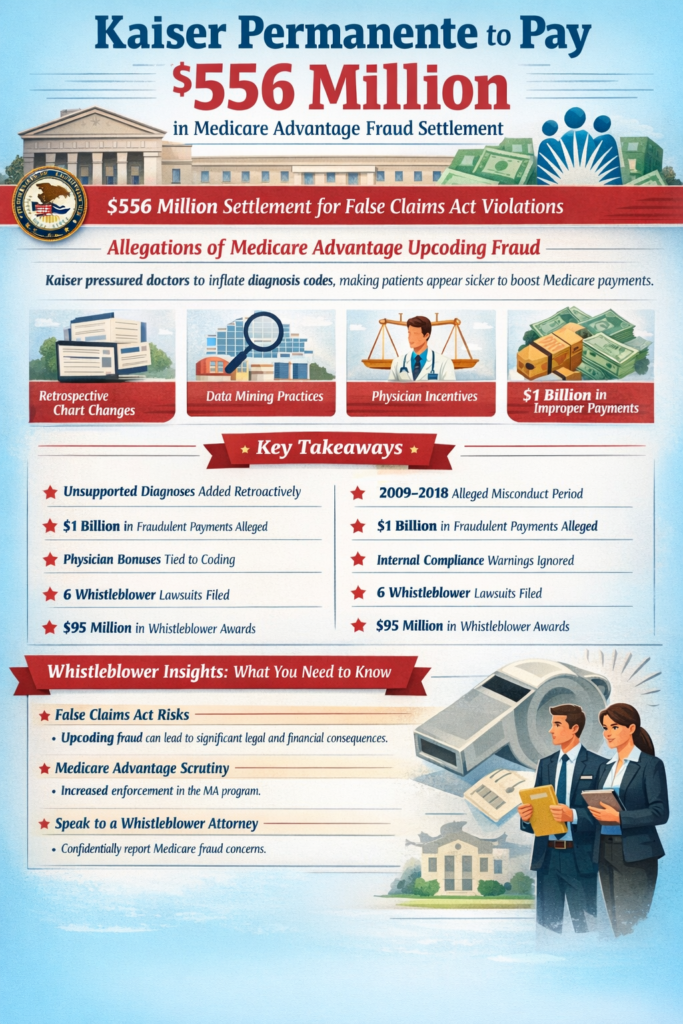
Core Allegation: Physicians were pressured to retroactively add unsupported diagnosis codes.
Mechanism: Post visit addenda and data mining of historical records.
Documentation Issue: Added diagnoses were often unrelated to care provided during the encounter.
Time Period: Alleged conduct occurred from 2009 through 2018. Original Case Filed in 2014.
Financial Scope: Government alleged approximately $1 billion in improper payments.
Physician Incentives: Compensation and performance metrics allegedly tied to diagnosis coding.
Compliance Warnings: Internal audits and physician complaints reportedly flagged concerns.
Whistleblowers: 6 qui tam lawsuits filed by former Kaiser physician leaders and coding staff.
Whistleblower Awards: Approximately $95 million allocated to relators.
Speak with the Lawyers at Brown, LLC Today!
Over $1 billion in aggregate judgments and settlements for our clients in state and federal courts. We fight for maximum damages and results.
Significance: Largest Medicare Advantage fraud recovery to date.
Medicare Advantage Upcoding: Allegations centered on unsupported diagnosis codes used to inflate CMS risk adjustment payments.
Risk Adjustment Fraud Theory: DOJ alleged that post-visit addenda violated CMS documentation requirements for Medicare Advantage risk adjustment.
False Claims Act Exposure: The alleged conduct formed the basis for FCA liability tied to improper Medicare Advantage reimbursements.
Background of the Allegations
Kaiser Permanente is an integrated healthcare consortium headquartered in Oakland, California that operates one of the largest nonprofit health systems in the United States. Its affiliated entities offer Medicare Advantage plans to millions of beneficiaries nationwide. (2) According to the DOJ, Kaiser-owned Medicare Advantage Organizations allegedly and knowingly submitted false and invalid diagnosis codes to the Centers for Medicare and Medicaid Services to increase monthly risk adjustment payments. (1)
Federal authorities alleged that Kaiser’s conduct undermined the integrity of the Medicare Advantage program, which now covers more than half of all Medicare beneficiaries nationwide. Federal officials emphasized that participation in the program carries an obligation to submit truthful and accurate medical information, particularly when public funds are at stake.
Alleged Scheme to Inflate Medicare Advantage Diagnosis Codes Through Risk Adjustment Addenda
Medicare Advantage risk adjustment fraud cases often focus on whether diagnosis codes submitted to CMS were clinically supported, evaluated, and documented in compliance with CMS guidance. FCA liability can arise when diagnoses are added retroactively without evidence that the condition was assessed or managed during the patient encounter.
Federal prosecutors alleged that Kaiser engaged in a systematic scheme to inflate diagnosis codes between 2009 and 2018. According to the DOJ, Kaiser developed internal mechanisms to mine patients’ historical medical records for potential diagnoses that had not previously been submitted to CMS for risk adjustment. (4) Kaiser then sent targeted queries to physicians urging them to add these diagnoses to patient charts through addenda, often months or even more than a year after the original visit. (3)
In many instances, the added diagnoses were unrelated to the patient visit in question and had not been evaluated, treated, or managed during that encounter. Prosecutors alleged that this practice violated CMS documentation rules and resulted in the submission of false claims to Medicare.
Financial Incentives and Internal Pressure on Physicians
The government further alleged that Kaiser set aggressive physician-specific and facility-specific goals for adding risk adjustment diagnoses. According to the complaint, Kaiser emphasized that failing to add diagnoses resulted in lost revenue for the organization, the facilities, and even the physicians themselves. Federal authorities alleged that Kaiser linked physician compensation, bonuses, and performance incentives to meeting diagnosis coding targets. (2)
The government further alleged that internal warnings were disregarded. Prosecutors stated that Kaiser physicians raised concerns that the addenda practices constituted false claims and that internal compliance audits identified inappropriate diagnosis additions. Despite these red flags, the government alleged that Kaiser allowed the practices to continue for years.
Scope, Timeline, and Financial Impact
According to government filings and reporting, Kaiser allegedly added roughly half a million unsupported diagnoses between 2009 and 2018. These diagnoses generated approximately $1 billion in improper Medicare Advantage payments, according to DOJ allegations cited in court documents and press coverage. (1) (3) Although the False Claims Act authorizes treble damages, cases involving damages of this magnitude are often resolved through negotiated compromises, particularly where defenses and evidentiary issues exist that may not be apparent from publicly released information.
The $556 million settlement resolves civil claims only and includes no admission of liability by Kaiser. The company stated that it chose to settle to avoid the cost, uncertainty, and delay associated with prolonged litigation and characterized the case as a dispute over how Medicare risk adjustment documentation requirements should be interpreted.
Whistleblower Contributions and Qui Tam Litigation
Medicare Advantage whistleblowers frequently include physicians, coding professionals, compliance personnel, and healthcare administrators with direct knowledge of upcoding, unsupported diagnoses, and CMS risk adjustment practices.
The case originated from six whistleblower lawsuits filed under the False Claims Act’s qui tam provisions. Two of the primary relators were a longtime Kaiser physician and former medical director of revenue cycle and coding in Colorado, and a former Kaiser employee who trained physicians on coding guidelines. (1)
The former medical director reportedly attempted to raise concerns internally before filing suit, believing the issues could be corrected without litigation. When those efforts failed, he filed a whistleblower complaint in 2014. The DOJ later intervened and consolidated the cases. Under the settlement, the whistleblowers will collectively receive $95 million for their role in exposing the alleged fraud.
What This Means for Healthcare and Medicare Advantage Insiders
If you work in healthcare or Medicare Advantage administration and have information about upcoding, risk adjustment fraud, or improper diagnosis coding, understanding how False Claims Act cases are evaluated can matter. Issues such as documentation standards, timing, and internal reporting often determine whether conduct gives rise to FCA exposure. Speak to a whistleblower law firm today.
1) DOJ Press Release – Kaiser Permanente Affiliates Pay $556M to Resolve False Claims Act Allegations
2) AP News – Kaiser affiliates will pay $556M to settle a lawsuit alleging Medicare fraud