
A $290M Customs Fraud Suit Over Cabinets, Quartz, and Tile
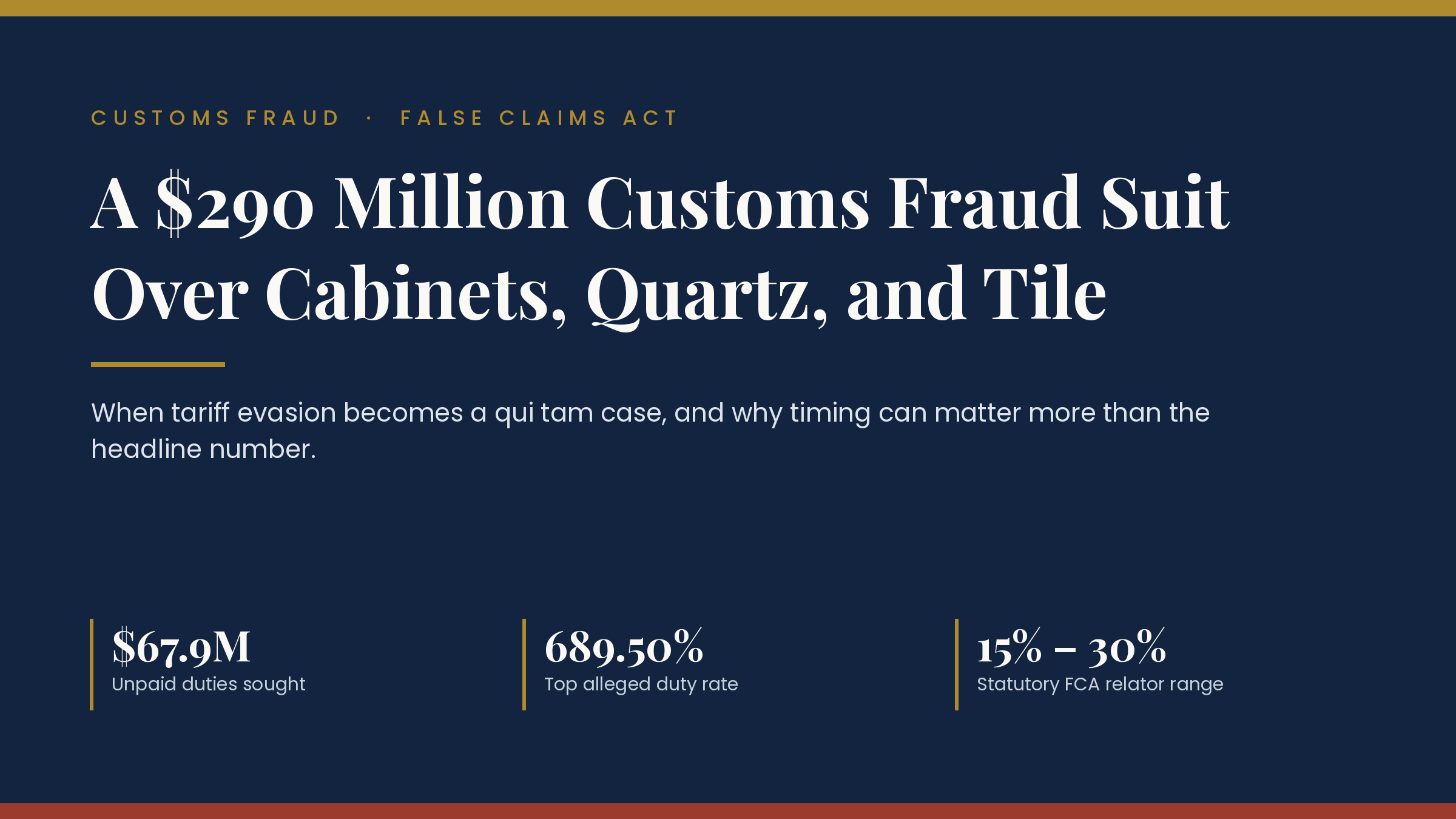
Table of Contents
Cabinets. Quartz countertops. Ceramic tile. Those ordinary building materials sit at the center of a federal lawsuit seeking more than $290 million under a statute empowered to give whistleblowers up to 30% of the recovery if the case succeeds. The government alleges that the importer changed the story it told U.S. Customs and Border Protection (CBP) about what the goods were, where they came from, and what they were worth.
Start with two numbers for the same container. One appears in the company’s internal records; another appears on the customs entry. A difference is not automatically fraud. Customs valuation and tariff classification can be complicated. But if a company knowingly reports a false value, origin, or product description to pay less in duties, I would want to know who approved the declaration, what the supplier actually charged, and where the original records are.
Speak with the Lawyers at Brown, LLC Today!
Over $1 billion in aggregate judgments and settlements for our clients in state and federal courts. We fight for maximum damages and results.
That leads to a question any potential customs fraud whistleblower should ask: could this conduct support a False Claims Act (FCA) whistleblower reward? In the right case, the answer can be worth tens of millions. But the legal route and the timing of the filing are every bit as important as the dollar amount. This particular lawsuit was brought by the government under 19 U.S.C. § 1592, not announced as a qui tam case. The public record does not identify a relator or an FCA whistleblower award.
How Much Could a Customs Fraud Whistleblower Receive?
The False Claims Act allows a private person, known as a qui tam relator, to sue on behalf of the United States for qualifying fraud. If the government intervenes and proceeds with a successful action, the ordinary relator share is 15% to 25% of the proceeds. If the government declines to proceed and the relator successfully pursues the action, the ordinary range is 25% to 30%. These are statutory ranges, not automatic guarantees.
Could someone simply multiply $290 million by 15% to 30% and announce a $43.5 million to $87 million whistleblower payday? No. Those figures describe the arithmetic of an entirely hypothetical $290 million qualifying FCA recovery. The actual $290 million here combines customs duties with a separate penalty demand under a different statute. No publicly identified relator is entitled to a percentage of that demand merely because the government filed suit.
The $290 Million Customs Lawsuit, by the Numbers
The government filed its complaint in the U.S. Court of International Trade on September 28, 2026, and the DOJ announced it on October 7, 2026. The complaint concerns approximately 503 entries of wooden cabinets and vanities, quartz surface products, ceramic tile, and other merchandise imported between September 2018 and August 2023. The following are amounts sought, not amounts recovered.
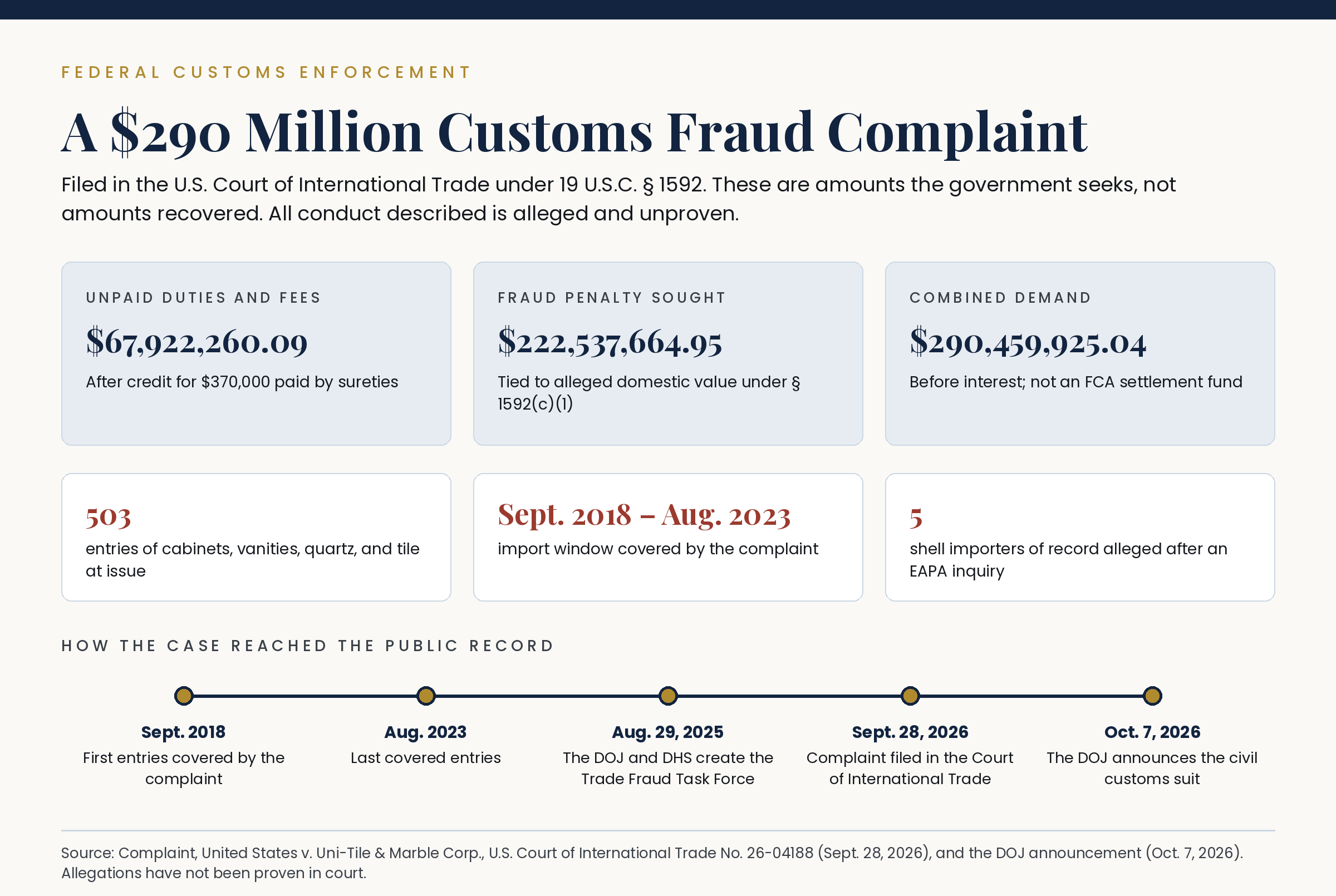
The complaint alleges $68,292,260.09 in actual lost revenue and credits $370,000 paid by sureties to reach the unpaid-duty amount. The $222.5 million fraud penalty is tied to the alleged domestic value of the merchandise, the relevant ceiling under § 1592(c)(1). It is not $222.5 million in additional lost customs duties, and it is not an FCA settlement fund.
Related: Brown, LLC secured two of the year’s largest individual recoveries — a $950M settlement against Raytheon and $350M against Walgreens. Learn about our False Claims Act practice →
The complaint also pleads gross negligence and negligence in the alternative, with smaller penalties and different limitations periods. Those are alternative theories, not sums to stack on top of the fraud demand.
Why the Alleged Tariff Evasion Was So Costly
The complaint identifies combined antidumping and countervailing duty (AD/CVD) rates of 689.50% for certain Chinese ceramic tile, 371.47% for quartz surface products, and 272.57% for wooden cabinets and vanities under the orders discussed in the pleading. Covered goods also faced Section 301 duties in applicable circumstances. These rates arise from particular orders and entry periods; they are not universal rates on every import.
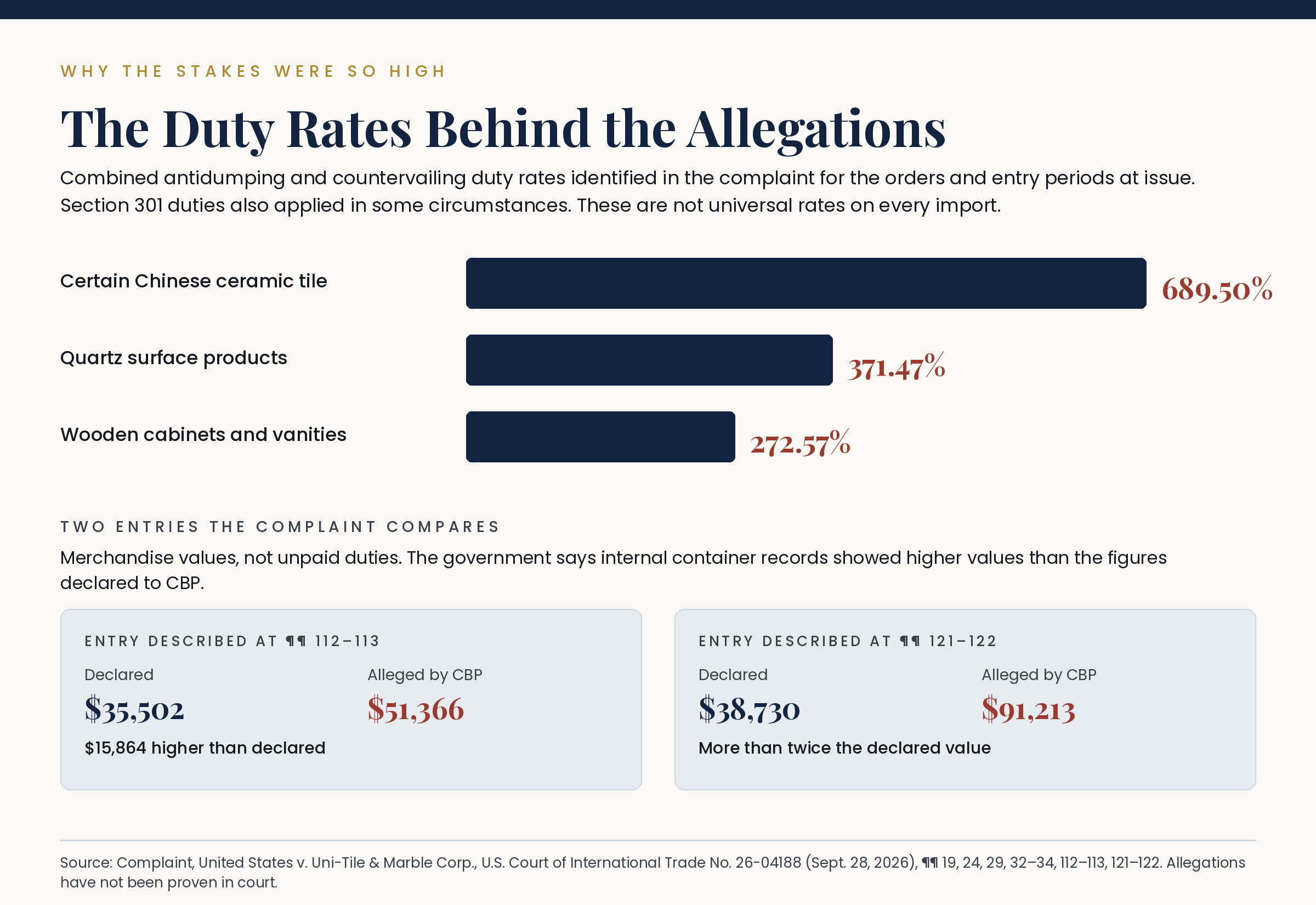
At rates like those, describing quartz as something else or declaring the wrong country of origin could dramatically change the bill. That helps explain the alleged incentive. It does not establish that any particular shipment was misclassified or undervalued; the government still must prove its allegations.
How the DOJ Says the Scheme Worked
1. Chinese goods allegedly passed through Malaysia
The complaint alleges that Chinese-made goods were routed through Malaysia and entered as if Malaysia were the country of origin. Two Malaysian entities were listed as manufacturers. CBP investigators allegedly found no evidence of manufacturing at the listed locations, and the entities shared people, owners, or addresses.
Shipping through another country is lawful. It does not, by itself, make that country the origin of the goods.
2. Quartz allegedly became “granite” or “artificial stone” on paper
The government alleges that quartz surface products were left off entry line items or grouped under descriptions for granite or other artificial stone. The complaint also identifies entries reported as type “01” rather than type “03”, a distinction relevant to AD/CVD reporting, and says some entries omitted duty case numbers and deposits. CBP laboratory examinations allegedly identified quartz in goods declared under different descriptions.
3. Shell importers allegedly replaced the original importer
According to the complaint, after CBP opened an Enforce and Protect Act investigation, the defendants stopped using the original company as importer of record and allegedly moved roughly 130 entries, plus one attempted entry, through five shell companies. One company was registered to a house in a Denver suburb; two allegedly used stolen identities. Yet the shipments, brokerage payments, and delivery instructions continued to point back to the same underlying business.
The importer’s name changed. The warehouse allegedly did not. That is exactly the kind of discrepancy I would want to examine. Who paid the customs broker? Who ordered the goods? Who ultimately received them? Those records may identify the true parties controlling a transaction even when the entry form names someone else.
4. The company’s own container records allegedly contradicted the entries
The government says the importer maintained detailed container value statements showing the contents of particular shipments and, in many instances, the amounts paid to manufacturers. CBP matched container identifiers to the entry paperwork. In nearly all comparisons described by the complaint, the internal values exceeded the declared values.
Two examples are particularly telling. These are merchandise values, not amounts of unpaid duties.
In the second entry, CBP’s alleged corrected value was more than twice the declaration. The records also identified different product line items, including quartz. The disagreement was not simply a fight over a percentage; the documents described different goods.
When Does Tariff Evasion Become a False Claims Act Case?
Under 31 U.S.C. § 3729(a)(1)(G), the FCA can reach a company that knowingly conceals or improperly avoids an obligation to pay money to the United States. Lawyers call this a reverse false claim. Unpaid customs duties can be the payment obligation. False origin declarations, improper product descriptions, omitted AD/CVD case numbers, or knowingly reduced invoice values may supply the evidence, but the particular statutory elements still must be established.
Whistleblower tip: If you’ve witnessed Medicare or Medicaid billing fraud at your employer, you may qualify as a qui tam relator with a potential share of the government’s recovery. See our Medicare & Medicaid fraud practice →
The FCA’s knowledge standard includes actual knowledge, deliberate ignorance, and reckless disregard; a specific intent to defraud is not always required. That still leaves a crucial distinction: a genuine dispute over customs rules is not the same as knowingly falsifying what a company tells the government. A sound investigation identifies the obligation, the entry documents, the unpaid duties, and the people who knew the representations were wrong.
The government itself is inviting these cases. The DOJ’s Trade Fraud Task Force has expressly encouraged whistleblowers to use the FCA’s qui tam provisions to report credible trade-fraud allegations. In July 2026, the DOJ said the task force had surpassed $1 billion in a combined measure of recoveries, penalties, forfeitures, and publicly charged losses; that figure should not be confused with $1 billion in collected FCA settlements.
Real Customs Fraud Cases Have Produced Real Whistleblower Awards
Allied Stone: $12.4 million settlement; approximately $2.17 million to the whistleblower
In August 2025, Allied Stone and its president agreed to pay $12.4 million to resolve FCA allegations of evading duties on Chinese quartz products. The government alleged that quartz was represented as other merchandise (including marble or crystallized glass) and that duties were not properly declared and paid when third parties acted as importers of record. The DOJ announced that the qui tam whistleblower would receive approximately $2,170,875. The settlement resolved allegations without a finding of liability.
Perfectus Aluminum: $549.5 million FCA settlement, with a relator share
In May 2026, the DOJ announced a $549.5 million FCA settlement involving allegations that imported Chinese aluminum extrusions were presented as finished merchandise to evade AD/CVD. Multiple qui tam relators had filed suit. The DOJ stated the relators’ share would equal 17.5% of the settlement proceeds returned to CBP. That qualification is important: the announcement does not justify multiplying 17.5% by the entire $549.5 million and calling the result a published relator payment.
What Evidence Helps Prove Customs Duty Evasion?
When I look at a potential customs fraud whistleblower claim, I want the records tied together shipment by shipment. An allegation about a company-wide practice becomes substantially more useful when the person can identify the actual container, the entry made to CBP, the supporting invoice, and the people responsible. The complaint offers a practical checklist:
- Product and classification. What physically entered the country? Compare purchase orders, specifications, packing lists, photographs, laboratory reports, and the actual entry description.
- Country of origin. Where was the merchandise manufactured? Does the claimed third-country manufacturing correspond with production records and the applicable origin rules?
- Real price versus declared value. Link the same container number to supplier invoices, internal costing statements, payment records, and customs documents.
- Entry type and AD/CVD treatment. Were relevant case numbers, entry types, or required duty deposits missing or changed?
- Control of the shipment. Who chose the importer of record, directed the customs broker, paid the broker, paid the supplier, and received the goods?
- Who approved the declarations? Were employees warned of discrepancies? Are there instructions to use a different description or company name?
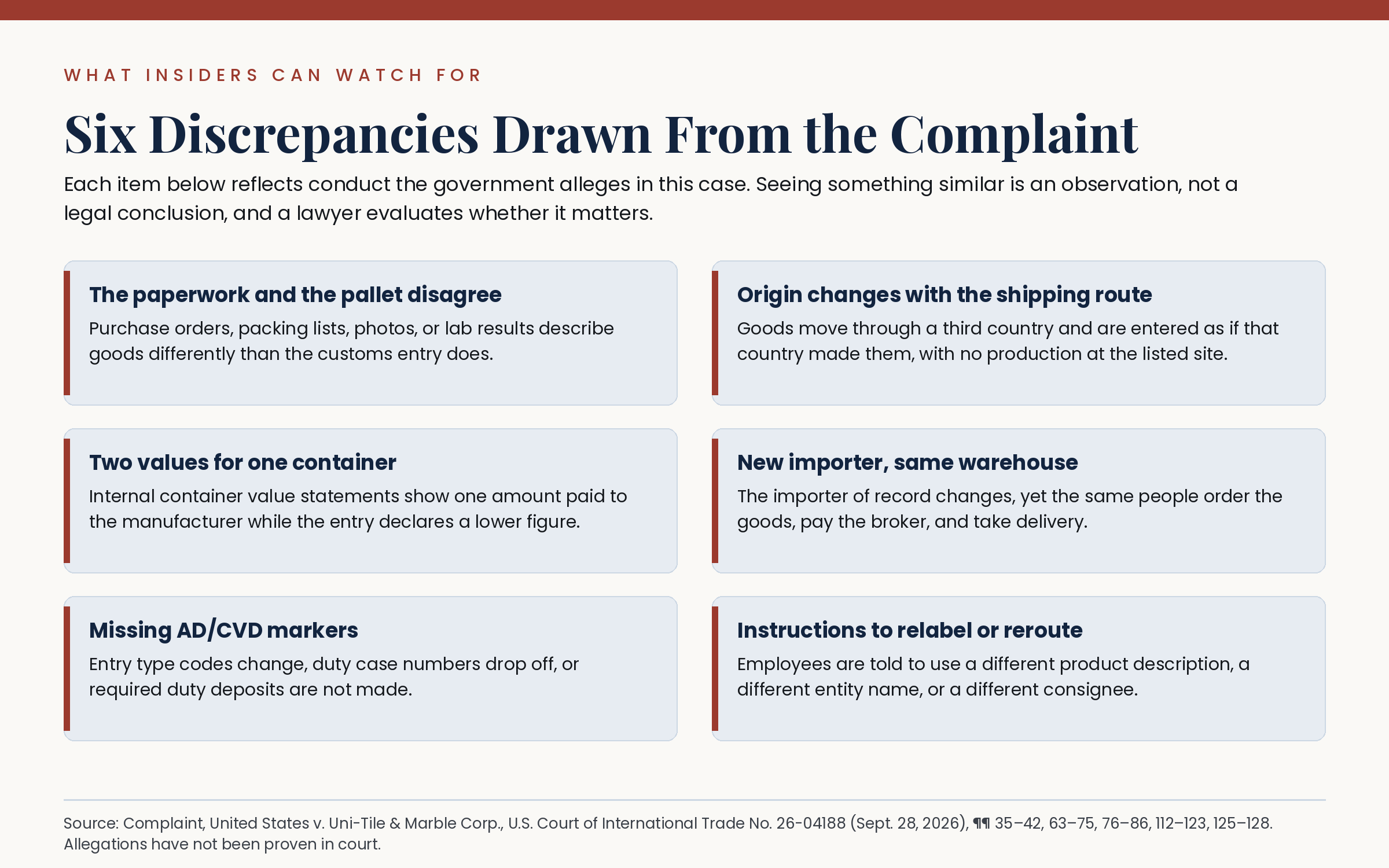
You do not need to memorize the tariff schedule to notice that the paperwork and the pallet disagree. But you do need an accurate account of what you observed and where the supporting information can lawfully be found. Do not access systems without authorization, alter records, or remove privileged or confidential information without legal advice.
How to Report Customs Fraud Without Sacrificing a Possible Qui Tam Claim
There are several reporting mechanisms, and they do not provide identical award rights:
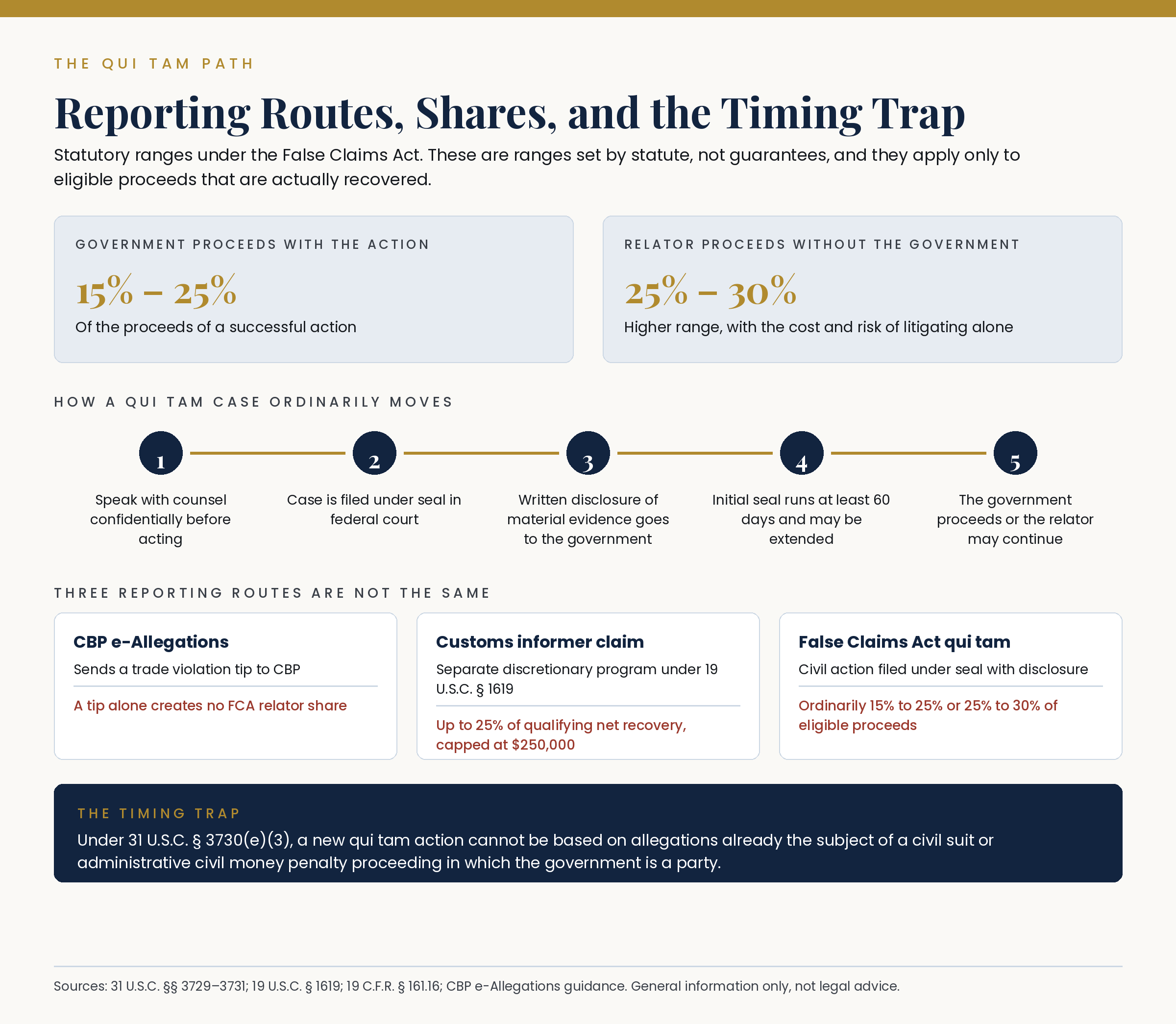
CBP expressly explains that a customs informer award is not automatic and that DHS Form 4623 is used to claim compensation; payment is considered after the related civil and criminal proceedings conclude. That separate program’s $250,000 cap is not an FCA award ceiling.
A qui tam lawsuit must be filed under seal, and the relator must give the government a written disclosure of substantially all material evidence and information in the relator’s possession. The statutory initial seal lasts at least 60 days and can be extended. It does not guarantee permanent anonymity. A tip to CBP or a prosecutor does not, by itself, reserve the right to a later qui tam share.
The Timing Trap: Can Someone File Now Over This $290 Million Lawsuit?
This is the issue I would not bury. Section 3730(e)(3) bars a new qui tam action based on allegations or transactions already the subject of a civil suit or an administrative civil-money-penalty proceeding in which the government is a party. Because the United States has already filed this customs lawsuit, a new relator cannot simply repackage the same public allegations in an FCA complaint and demand a percentage. An exception for certain original sources under the separate public-disclosure rule does not override that government-action bar.
Speak with the Lawyers at Brown, LLC Today!
Over $1 billion in aggregate judgments and settlements for our clients in state and federal courts. We fight for maximum damages and results.
A separate question can arise where a whistleblower validly filed a qui tam action earlier and the government later pursues an alternative legal remedy. Section 3730(c)(5) can preserve the relator’s rights in an appropriate alternate-remedy situation. The public record cited here identifies no such relator or entitlement in this case. Earlier related sealed actions, the FCA first-to-file rule, the public-disclosure bar, and applicable limitations periods also require individual analysis.
For potential whistleblowers, timing may determine whether a case is eligible for a substantial FCA share at all. It is not enough to be right after the government has already filed.
Customs Fraud Whistleblower FAQs
Can an importer’s employee report customs fraud without every document?
Yes. A witness may have useful firsthand facts even without a complete company file. Identify the entries, approximate dates, people, and documents that would confirm or refute the concern. Avoid copying records you are not entitled to access. A lead still needs legal evaluation; it is not automatically a viable qui tam claim.
Can an employer retaliate against a tariff-evasion whistleblower?
The FCA protects qualifying employees, contractors, and agents from retaliation for lawful conduct in furtherance of an FCA action or efforts to stop FCA violations. The statute permits remedies including reinstatement, double back pay, interest, and compensation for special damages when its requirements are met. Retaliation relief is different from a percentage of the government’s recovery.
What if the whistleblower helped prepare the false import paperwork?
Participation requires candid legal advice before any disclosure. The FCA allows a court to reduce a relator’s share if the relator planned and initiated the violation, and it excludes a share for a relator convicted of criminal conduct arising from the relator’s role in the violation. Whistleblowing does not confer immunity.
How long does someone have to file an FCA customs fraud lawsuit?
Under 31 U.S.C. § 3731(b), the general FCA framework considers six years after the violation or three years after the responsible federal official knew or reasonably should have known material facts, subject to a ten-year outside limit, whichever statutory period ends later. The application can be complicated. More importantly, first-to-file, government-action, and public-disclosure restrictions may prevent an otherwise timely new case. [3] [12]
Does a $290 million government demand mean a $290 million recovery?
No. The defendants can contest the allegations, damages, and penalties. A judgment may differ from the complaint’s demand; a settlement may be lower; and collection presents a separate issue. A whistleblower share, if one exists, depends on the eligible, actually recovered FCA proceeds, not a newspaper headline. [2] [3]
The best place to start is the record for one shipment
A company can argue over a tariff classification. It can raise legitimate questions about value and origin. But if purchase records, shipping records, and Customs entries describe the same container three different ways, the explanation deserves scrutiny.
I would begin with the invoice, the container number, the entry summary, the broker’s file, and the delivery record. Who knew the real product, the real origin, and the real price? Who changed the declaration? If those answers establish knowing avoidance of duties, the False Claims Act may provide a path for a properly timed qui tam case. The headline number comes later.
Sources
[1] DOJ, $280M+ civil customs suit announcement (Oct. 7, 2026)
[2] Complaint, United States v. Uni-Tile & Marble, Court No. 26-04188 (Sept. 28, 2026)
[3] 31 U.S.C. § 3730 — qui tam, shares, seal, bars and anti-retaliation
[4] 31 U.S.C. § 3729 — reverse false claims and FCA damages
[5] DOJ, Allied Stone $12.4M FCA settlement and relator share (Aug. 19, 2025)
[6] CBP, e-Allegations FAQs, including informant compensation
[7] 19 U.S.C. § 1619 — customs informer compensation and $250,000 cap
[8] 19 C.F.R. § 161.16 — filing customs informant claims
[9] DOJ, Trade Fraud Task Force $1B combined milestone (July 14, 2026)
[10] DOJ, Perfectus Aluminum $549.5M FCA settlement (May 12, 2026)
[11] 19 C.F.R. § 134.1 — rules defining country of origin for marking purposes
[12] 31 U.S.C. § 3731 — FCA limitations periods
[13] DOJ and DHS, creation of the Trade Fraud Task Force (Aug. 29, 2025)