 Skip to main content

SPRS Compliance Fraud: How Defense Contractors Fake NIST 800-171 and Face FCA Liability
Table of Contents
This article is general information, not legal advice. Do not remove classified information, CUI, CDI, trade secrets, privileged communications, or documents you are not authorized to access. If you have clearance, contractual, employment, or criminal-exposure concerns, speak with counsel before acting.
If you are reading this, there is a real chance you have already seen it: a perfect Supplier Performance Risk System score for a network that does not actually implement the controls behind the score. A System Security Plan that reads well but describes a system that does not exist. A Plan of Action and Milestones that has been open for years. A FedRAMP-equivalence claim for a cloud environment that anyone close to the architecture knows is not defensible.
That gap – between the cyber story told to the government and the technical reality inside the company – is where Civil Cyber-Fraud Initiative (CCFI) cases are born. The Department of Justice (DOJ) launched the Civil Cyber-Fraud Initiative in 2021 to use the False Claims Act against cybersecurity-related fraud by government contractors and grant recipients. DOJ has described the False Claims Act (FCA) as the government’s primary civil tool for redressing false claims for federal funds and property. [2]
Speak with the Lawyers at Brown, LLC Today!
Over $1 billion in aggregate judgments and settlements for our clients in state and federal courts. We fight for maximum damages and results.
DOJ’s FY 2025 False Claims Act materials reported more than $52 million recovered in nine cybersecurity fraud settlements, and said civil cybersecurity fraud settlements had more than tripled in each of the prior two years. [3]
This guide is written for cleared IT staff, ISSOs, ISSMs, security engineers, CMMC consultants, compliance leads, auditors, cloud administrators, subcontractor managers, and technical insiders who know the company’s public cyber posture does not match the truth.
Why This Topic Is Exploding Now
First, DOJ is openly using the False Claims Act as a cyber-enforcement statute. The initiative targets knowingly deficient cybersecurity products or services, knowing misrepresentations of cybersecurity practices, and knowing violations of obligations to monitor and report cybersecurity incidents. [2]
Second, the CMMC contract regime is no longer just a policy discussion. DoD’s 2025 DFARS final rule incorporated contractual requirements tied to the CMMC program and became effective November 10, 2025. [4] The current DFARS 252.204-7021 clause now defines current CMMC status, CMMC UIDs reflected in SPRS, and annual affirmations of continuous compliance for certain final statuses. [5]
Third, since contractors have been entering NIST SP 800-171 assessment data into SPRS, many false-score cases already have the government-facing statement, the internal technical reality, and the contract dollars. The False Claims Act does not require the relator to prove a dramatic, movie-style data breach. A false cybersecurity certification or misleading compliance assertion can be the fraud if it was material to federal payment.
The Legal Architecture in Plain English
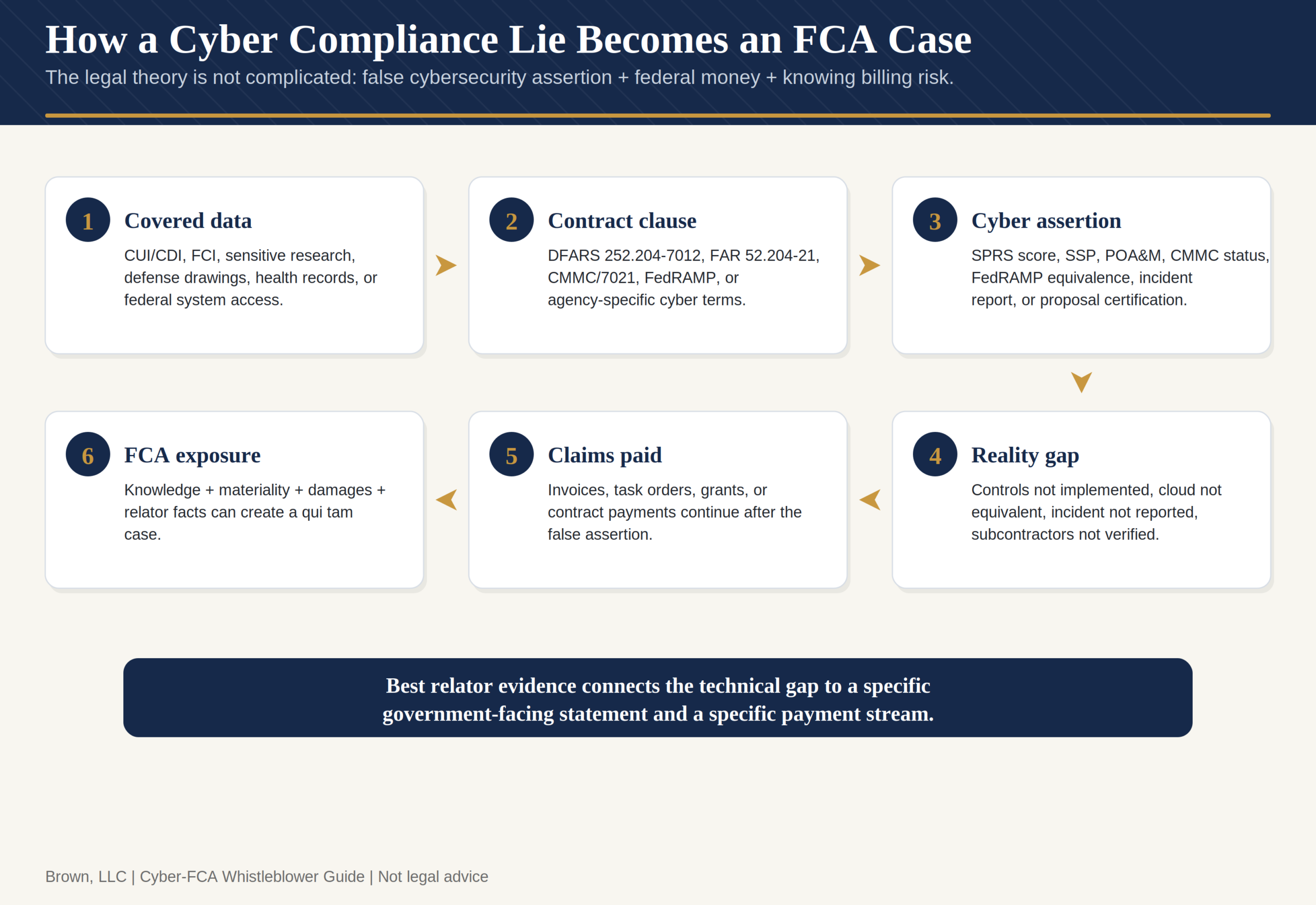
The core architecture is straightforward: DFARS 252.204-7012 requires adequate security on covered contractor information systems and, for covered contractor information systems not otherwise governed by government-operated IT requirements, requires NIST SP 800-171 protections. The same clause requires rapid reporting of cyber incidents to DoD, and the clause defines rapid reporting as within 72 hours of discovery. [6]
DFARS 252.204-7012 also says that if a contractor uses an external cloud service provider to store, process, or transmit covered defense information in performance of the contract, the contractor must require and ensure that the provider meets security requirements equivalent to FedRAMP Moderate and complies with cyber incident reporting and related requirements. [6]
Speak with the Lawyers at Brown, LLC Today!
Over $1 billion in aggregate judgments and settlements for our clients in state and federal courts. We fight for maximum damages and results.
Under the DoD assessment methodology, a perfect implementation of the 110 NIST SP 800-171 requirements produces a 110 score. The methodology uses point deductions for unimplemented requirements and allows scores below zero. [7]
A contractor that knowingly misstates its cybersecurity compliance, wins federal work, and submits claims for payment may face FCA liability. Whistleblowers, called “relators,” can file sealed qui tam lawsuits on behalf of the United States and may share in recovery. The FCA also contains anti-retaliation protections for lawful acts in furtherance of an FCA action or efforts to stop violations.
The Highest-Value Cyber-FCA Fact Pattern
The highest-value fact pattern is not merely: “our cybersecurity is bad.” Many companies have imperfect cybersecurity. The stronger case is: “the company made a specific cybersecurity representation to the federal government or a prime contractor; decisionmakers knew it was false or reckless; the representation was material to the contract, grant, or payment; and the company billed anyway.”
For example: a defense subcontractor enters a 110 SPRS score while internal gap analysis shows dozens of unimplemented NIST controls; leadership receives the gap analysis; the company continues to submit proposals and invoices on contracts involving CUI; and the public-facing SSP/POA&M presented to the prime or government does not match reality.
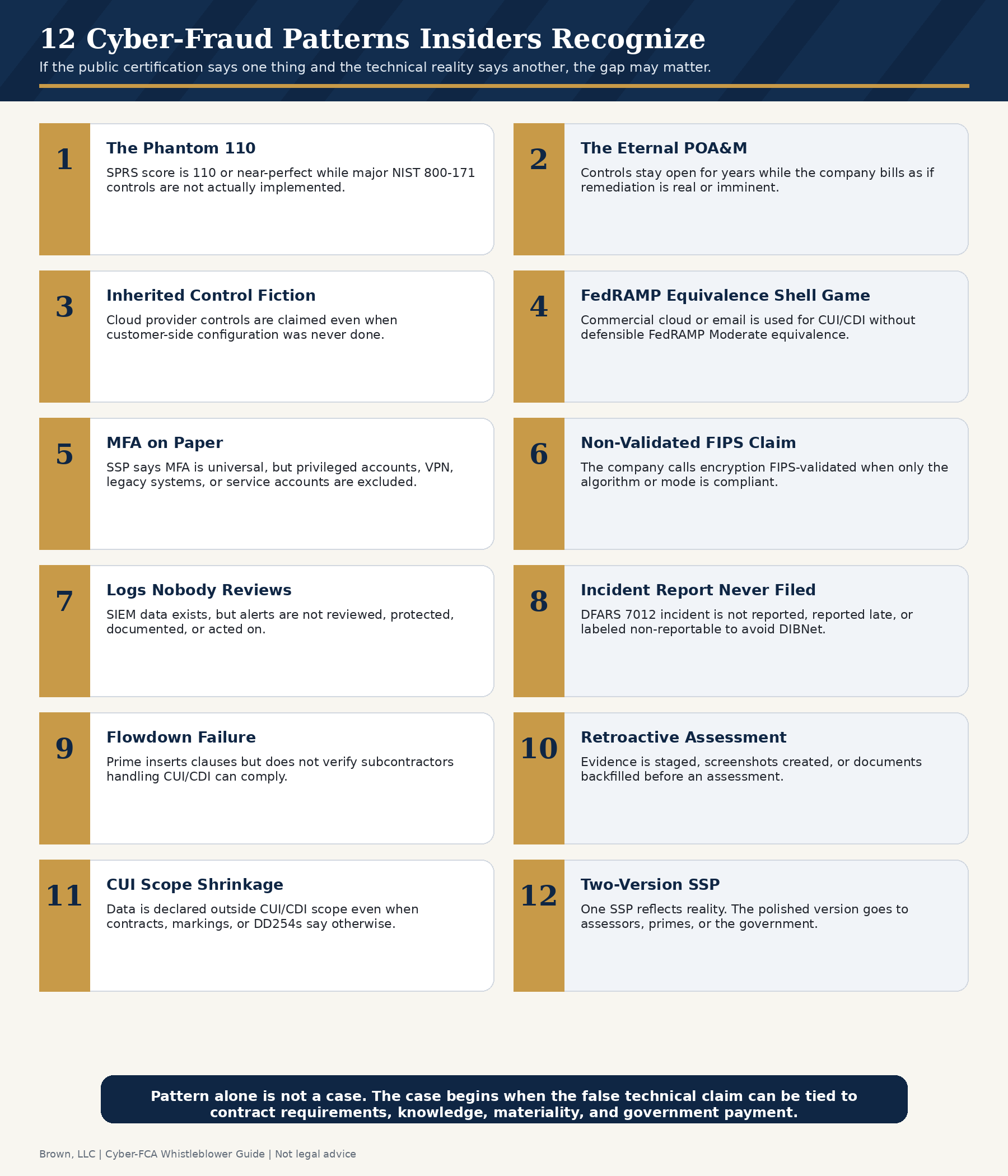
Cybersecurity compliance fraud usually does not look like a single dramatic lie. It looks like accumulated, quiet decisions to round up, look away, defer, sanitize, and submit anyway. These are the patterns insiders most often recognize.
What Public Cases Tell Us
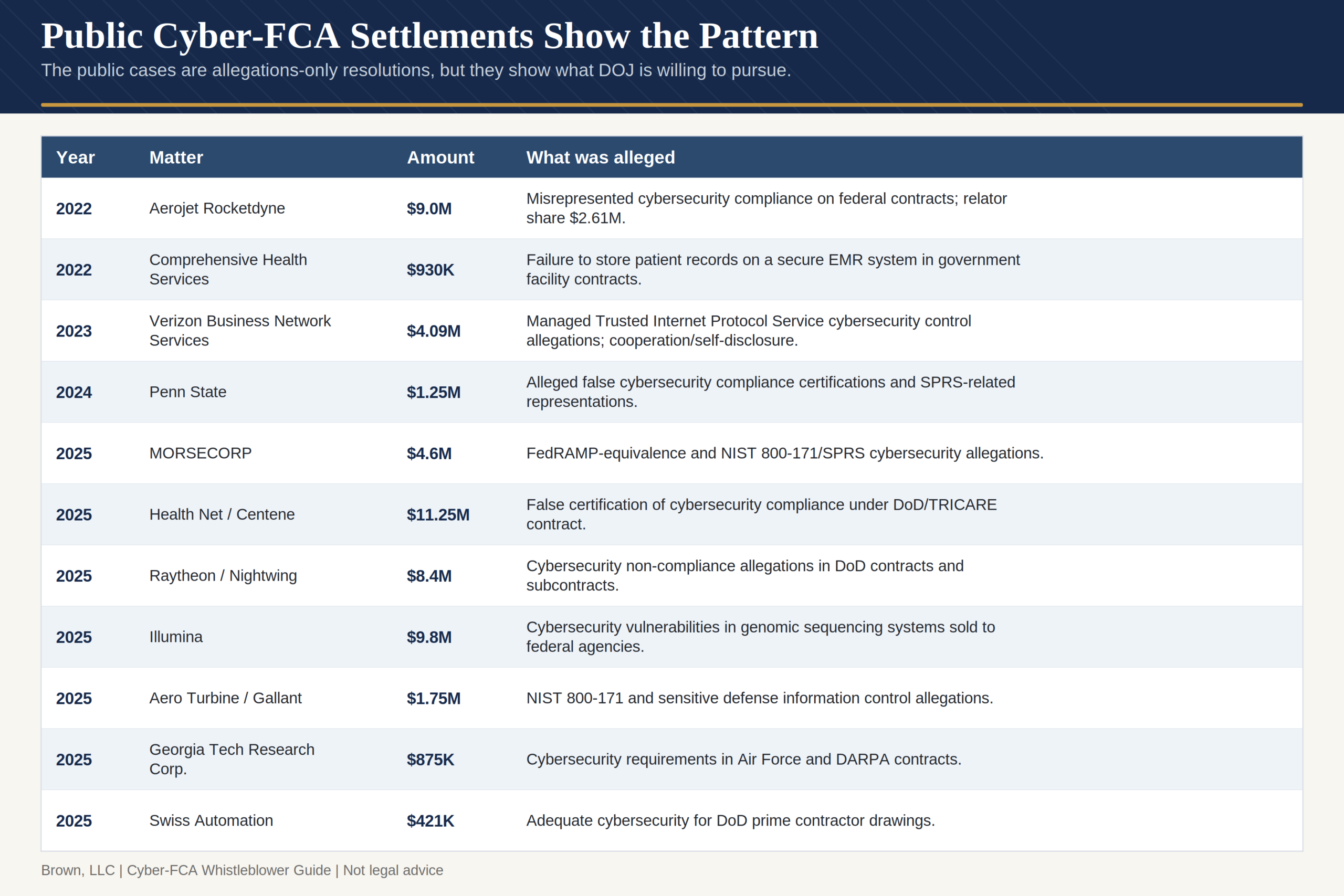
The public cases show that DOJ is not limiting cyber-FCA enforcement to one industry or one theory. Aerojet Rocketdyne paid $9 million to resolve allegations that it misrepresented compliance with cybersecurity requirements on federal contracts; DOJ reported that the relator received $2.61 million. [8] Comprehensive Health Services paid $930,000 in one of the first publicly announced CCFI settlements. [9] Verizon Business Network Services paid $4.09 million to resolve cybersecurity-control allegations involving a federal service offering. [10]
Penn State paid $1.25 million to resolve allegations relating to non-compliance with contractual cybersecurity requirements. [11] MORSECORP paid $4.6 million to resolve allegations of cybersecurity fraud involving Army and Air Force contracts. [12] Health Net Federal Services and Centene agreed to pay more than $11 million to resolve claims that HNFS falsely certified compliance with cybersecurity requirements in a DoD TRICARE contract. [13]
Speak with the Lawyers at Brown, LLC Today!
Over $1 billion in aggregate judgments and settlements for our clients in state and federal courts. We fight for maximum damages and results.
The 2025 enforcement wave continued across defense, health, research, and technology; DOJ announced cybersecurity settlements involving Raytheon/Nightwing, Illumina, Aero Turbine/Gallant, Georgia Tech Research Corporation, and Swiss Automation. [14][15][16][17][18] These resolutions are allegations-only settlements; they do not establish liability. But they show the range of cyber-FCA theories now being investigated.
Cyber-FCA cases are not limited to a data breach. The government is pursuing alleged misrepresentations of cybersecurity compliance, failures to implement required controls, failures to timely report incidents, deficient safeguarding of sensitive information, and products or systems sold to the government with cybersecurity vulnerabilities.
What Makes This a Strong Qui Tam Case Instead of Just a Compliance Complaint
Not every compliance failure is fraud. Not every cyber problem is a False Claims Act case. The strongest cases have five features.
Materiality: The cyber representation must matter to the government’s award, payment, security, or risk decision. A false SPRS score tied to a DoD contract involving CUI is much stronger than a typo in a private policy.
Knowledge: The FCA requires actual knowledge, deliberate ignorance, or reckless disregard. A relator should be able to point to emails, meetings, assessments, gap analyses, board presentations, audit findings, or management directives showing that decisionmakers knew the assertion was false or were reckless in making it.
Specificity: A strong complaint identifies the contract, solicitation, task order, clause, system, control, score, certification, invoice, and payment stream. “They are not secure” is not enough.
Damages: The size of affected contracts or grants matters. A false cyber representation on a $50 million defense contract is more consequential than the same misrepresentation on a subcontract with limited federal exposure.
Lawful evidence: The best relator is not the person who steals the most files. It is the person who can explain what happened, identify where the evidence lives, and preserve their own credibility.
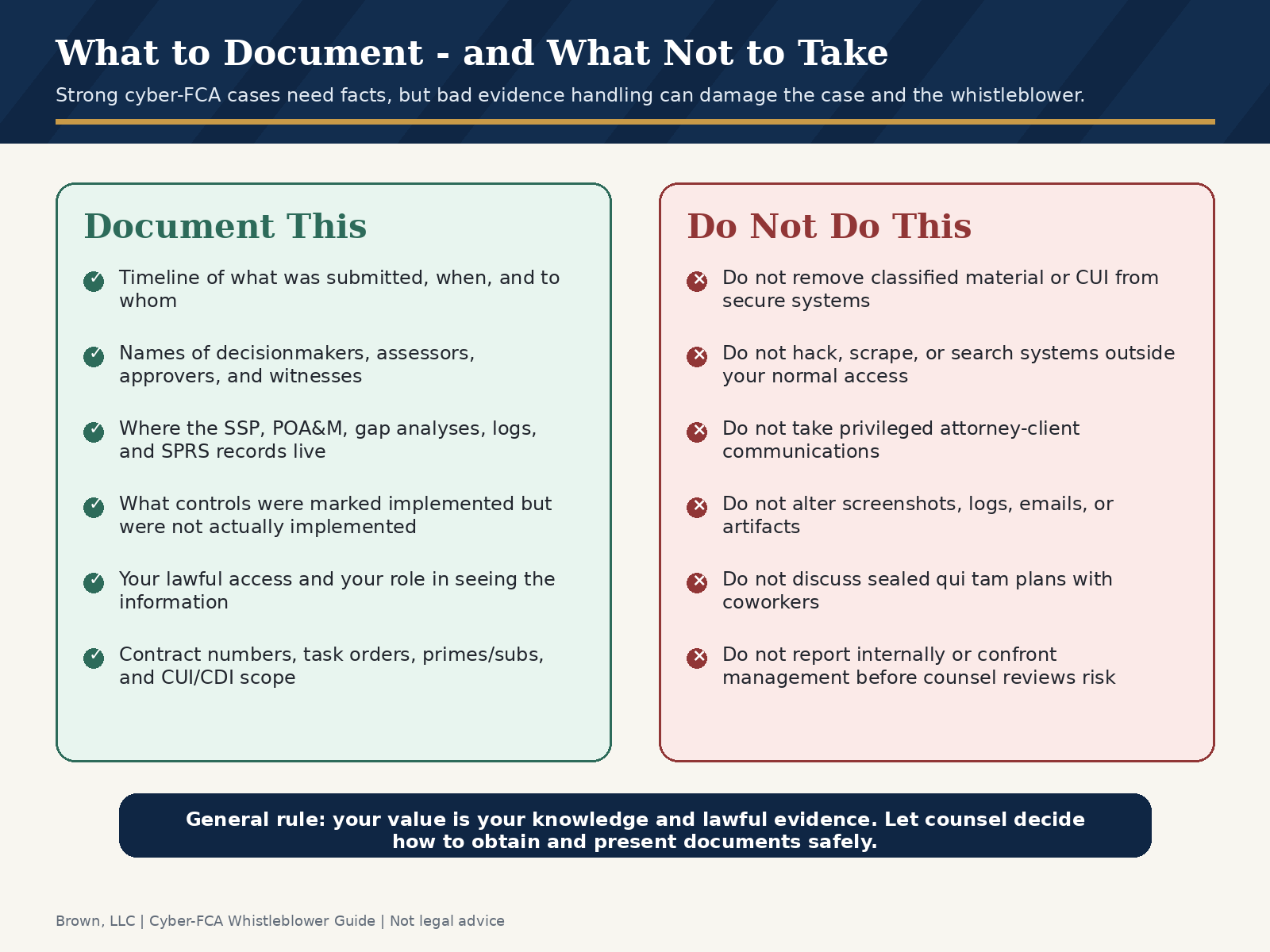
Generally useful information includes your timeline, the dates of assessments and submissions, names of decisionmakers, the systems involved, the contract or prime/subcontract relationship, the controls falsely marked implemented, the existence and location of SSPs, POA&Ms, gap assessments, incident reports, and witnesses who saw the same facts.
Generally dangerous conduct includes removing classified materials, downloading CUI/CDI outside approved channels, accessing systems outside your role, taking privileged communications, altering screenshots, sending company files to a personal account without advice, using work devices to contact counsel, posting online, confronting management, or discussing a potential sealed qui tam case with coworkers.
The practical rule: your value as a relator is your knowledge and lawful access to facts, not reckless document collection.
The Retaliation and Clearance Problem
Cyber-FCA whistleblowers often face a special retaliation risk because they may hold clearance, system access, admin privileges, security responsibilities, or customer-facing compliance roles. Retaliation can look like termination, demotion, suspension, loss of access, accusations of policy violations, clearance-related pressure, isolation, or sudden performance criticism.
The FCA has anti-retaliation protections, but those protections are not a substitute for strategy. If you confront management before counsel has evaluated first-to-file, seal, document-handling, clearance, and retaliation issues, the company may create a paper trail against you before you are protected in a useful way. The instinct to “give them a chance to fix it” is human. In serious cyber-FCA matters, it can be strategically dangerous.
Why Brown, LLC Is a Strong Fit for Cyber-FCA Whistleblower Cases
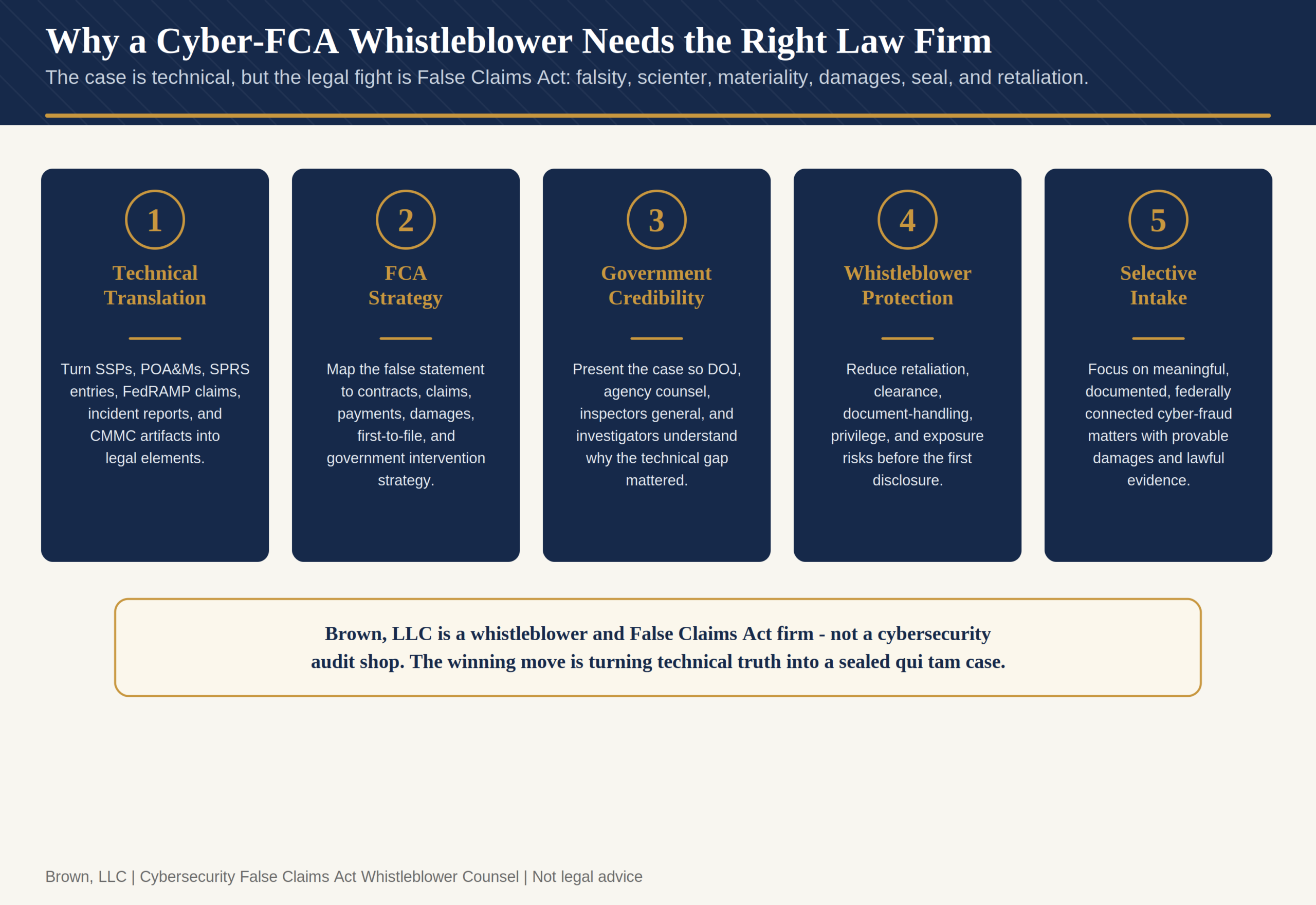
Cyber-FCA cases sit at the intersection of technical proof and False Claims Act litigation. A cybersecurity consultant may understand controls, but may not know how to build a sealed qui tam case. A general litigator may understand lawsuits, but may not know why a false SPRS score, inherited-control claim, FedRAMP-equivalence assertion, or stale POA&M matters. The law firm has to translate technical truth into FCA elements: falsity, knowledge, materiality, causation, and damages.
Brown, LLC is built for that kind of case. The firm represents whistleblowers nationwide in False Claims Act and other whistleblower matters and has existing content focused on DOJ’s Civil Cyber-Fraud Initiative. [20] Brown’s whistleblower platform is led by Jason T. Brown, a former FBI Special Agent and Legal Advisor, and the firm recently added Tom Morris, a former DOJ Civil Fraud Section Senior Trial Counsel with experience in defense contractor fraud and major FCA matters. [19]
For a cybersecurity insider, that background matters. The question is not merely whether a control failed. The question is whether the contractor knowingly sold the government a cybersecurity posture it did not have. A firm like Brown, LLC can evaluate the case from both directions: the technical record that proves the cyber gap and the FCA strategy that turns that gap into a credible government-facing whistleblower matter.
The strongest cyber-FCA cases usually involve a specific federal contract or grant, a clear cybersecurity requirement, a concrete misrepresentation, proof of knowledge, meaningful damages, and lawful evidence. A confidential review with Brown LLC will test those issues before a whistleblower reports internally, contacts an agency, or moves records.
When to Call a Lawyer
A reasonable trigger is the moment you can identify a specific government-facing cybersecurity assertion and a specific reason you know it was false or reckless. Examples include: “On this date, the company submitted this SPRS score, and this internal gap assessment showed these NIST controls were not implemented.” Or: “This proposal claimed FedRAMP-equivalent cloud handling for CUI, but the CUI was in a commercial tenant with no defensible equivalency analysis.” Or: “The company had a reportable cyber incident, but leadership decided not to submit the DIBNet report.”
Do not wait until an assessor arrives, a prime asks questions, management blames you, or another insider files first. The FCA first-to-file rule can bar later relators who try to bring the same essential fraud after someone else has already filed. Timing matters.
FAQ
Can a false SPRS score be a False Claims Act case?
Potentially, yes. A false SPRS score may support an FCA theory if it is tied to federal contracts, material cybersecurity requirements, knowledge or reckless disregard, and claims for payment. The score alone is not the whole case; the case is the false statement plus the federal payment stream.
Does there have to be a data breach?
No. A breach can strengthen a case, but many cyber-FCA theories are about false cybersecurity promises, deficient controls, and failure to report incidents. The fraud is the misrepresentation itself.
What is the difference between bad cybersecurity and cyber fraud?
Bad cybersecurity is an operational problem. Cyber fraud occurs when the contractor knowingly misrepresents compliance with a material cybersecurity obligation and bills or receives federal money anyway.
Should I report internally first?
Not before counsel reviews the facts. Internal reporting can help in some situations, but it can also trigger retaliation, document destruction, a blame campaign, or first-to-file risk. The sequence matters.
Can I take the SSP, POA&M, or SPRS evidence with me?
Do not assume you can take anything. Classified information, CUI, privileged communications, and records outside your authorization create serious risk. Talk to counsel before moving documents.
Who is the ideal cyber-FCA whistleblower?
Often an ISSO, ISSM, cleared engineer, security architect, CMMC consultant, cloud administrator, audit lead, compliance employee, subcontractor manager, or technical executive who can connect the submitted representation to the actual technical facts.
Bottom Line
The Civil Cyber-Fraud Initiative is producing real settlements, real relator shares, and real risk for contractors that sell the government a cybersecurity posture they do not have.
If you know that a SPRS score, SSP, POA&M, FedRAMP-equivalence claim, incident-reporting decision, CMMC assertion, or subcontractor flowdown representation is materially false, do not panic and do not freelance. Build a timeline. Preserve your lawful knowledge. Do not move classified or controlled information. Do not use company systems to contact counsel. Do not confront management before getting legal advice.
Speak with a whistleblower lawyer who understands both the False Claims Act and the cyber-compliance architecture. The case may begin with a technical lie. It succeeds only if that lie can be proven, connected to government money, and presented in a way that the government can use.
Sources
[1] Original uploaded draft supplied by user: Pasted text(24).txt
[2] DOJ Civil Cyber-Fraud Initiative announcement: https://www.justice.gov/archives/opa/pr/deputy-attorney-general-lisa-o-monaco-announces-new-civil-cyber-fraud-initiative
[3] DOJ FY 2025 False Claims Act Fact Sheet: https://www.justice.gov/opa/media/1424126/dl
[4] Federal Register, 2025 DFARS final rule implementing CMMC contractual requirements: https://www.federalregister.gov/documents/2025/09/10/2025-17359/defense-federal-acquisition-regulation-supplement-assessing-contractor-implementation-of
[5] Acquisition.gov, DFARS 252.204-7021 CMMC clause: https://www.acquisition.gov/dfars/252.204-7021-contractor-compliance-cybersecurity-maturity-model-certification-level-requirements
[6] Acquisition.gov, DFARS 252.204-7012 cyber incident reporting and NIST 800-171 requirements: https://www.acquisition.gov/dfars/252.204-7012-safeguarding-covered-defense-information-and-cyber-incident-reporting.
[7] DoD NIST SP 800-171 Assessment Methodology v1.2.1: https://www.acq.osd.mil/asda/dpc/cp/cyber/docs/safeguarding/NIST-SP-800-171-Assessment-Methodology-Version-1.2.1-6.24.2020.pdf
[8] DOJ, Aerojet Rocketdyne cybersecurity FCA settlement: https://www.justice.gov/archives/opa/pr/aerojet-rocketdyne-agrees-pay-9-million-resolve-false-claims-act-allegations-cybersecurity
[9] DOJ, Comprehensive Health Services cyber-fraud settlement: https://www.justice.gov/archives/opa/pr/medical-services-contractor-pays-930000-settle-false-claims-act-allegations-relating-medical
[10] DOJ, Verizon Business Network Services cybersecurity controls settlement: https://www.justice.gov/archives/opa/pr/cooperating-federal-contractor-resolves-liability-alleged-false-claims-caused-failure-fully
[11] DOJ, Penn State cybersecurity FCA settlement: https://www.justice.gov/usao-edpa/pr/penn-state-agrees-pay-125-million-resolve-false-claims-act-allegations-relating-non
[12] DOJ, MORSECORP cybersecurity fraud settlement: https://www.justice.gov/opa/pr/defense-contractor-morsecorp-inc-agrees-pay-46-million-settle-cybersecurity-fraud
[13] DOJ, Health Net / Centene cybersecurity FCA settlement: https://www.justice.gov/opa/pr/health-net-federal-services-llc-and-centene-corporation-agree-pay-over-11-million-resolve
[14] DOJ, Raytheon / Nightwing cybersecurity FCA settlement: https://www.justice.gov/opa/pr/raytheon-companies-and-nightwing-group-pay-84m-resolve-false-claims-act-allegations-relating
[15] DOJ, Illumina cybersecurity vulnerabilities settlement: https://www.justice.gov/opa/pr/illumina-inc-pay-98m-resolve-false-claims-act-allegations-arising-cybersecurity
[16] DOJ, Aero Turbine / Gallant cybersecurity voluntary self-disclosure settlement: https://www.justice.gov/opa/pr/california-defense-contractor-and-private-equity-firm-agree-pay-175m-resolve-false-claims
[17] DOJ, Georgia Tech Research Corporation civil cyber-fraud settlement: https://www.justice.gov/opa/pr/georgia-tech-research-corporation-agrees-pay-875000-resolve-civil-cyber-fraud-litigation
[18] DOJ, Swiss Automation cybersecurity FCA settlement: https://www.justice.gov/opa/pr/illinois-precision-machining-company-agrees-pay-421234-resolve-alleged-false-claims-act
[19] Brown, LLC, Tom Morris joins False Claims Act practice: https://ifightforyourrights.com/news/brown-llc-welcomes-former-doj-civil-fraud-section-senior-trial-counsel-to-false-claims-act-practice/
[20] Brown, LLC, DOJ Civil Cyber-Fraud Initiative blog: https://ifightforyourrights.com/blog/dojs-civil-cyber-fraud-initiative-where-the-false-claims-act-meets-cybersecurity/