Skip to main content

How to Report Corporate Fraud Before You Become the Fall Guy | Whistleblower Rewards
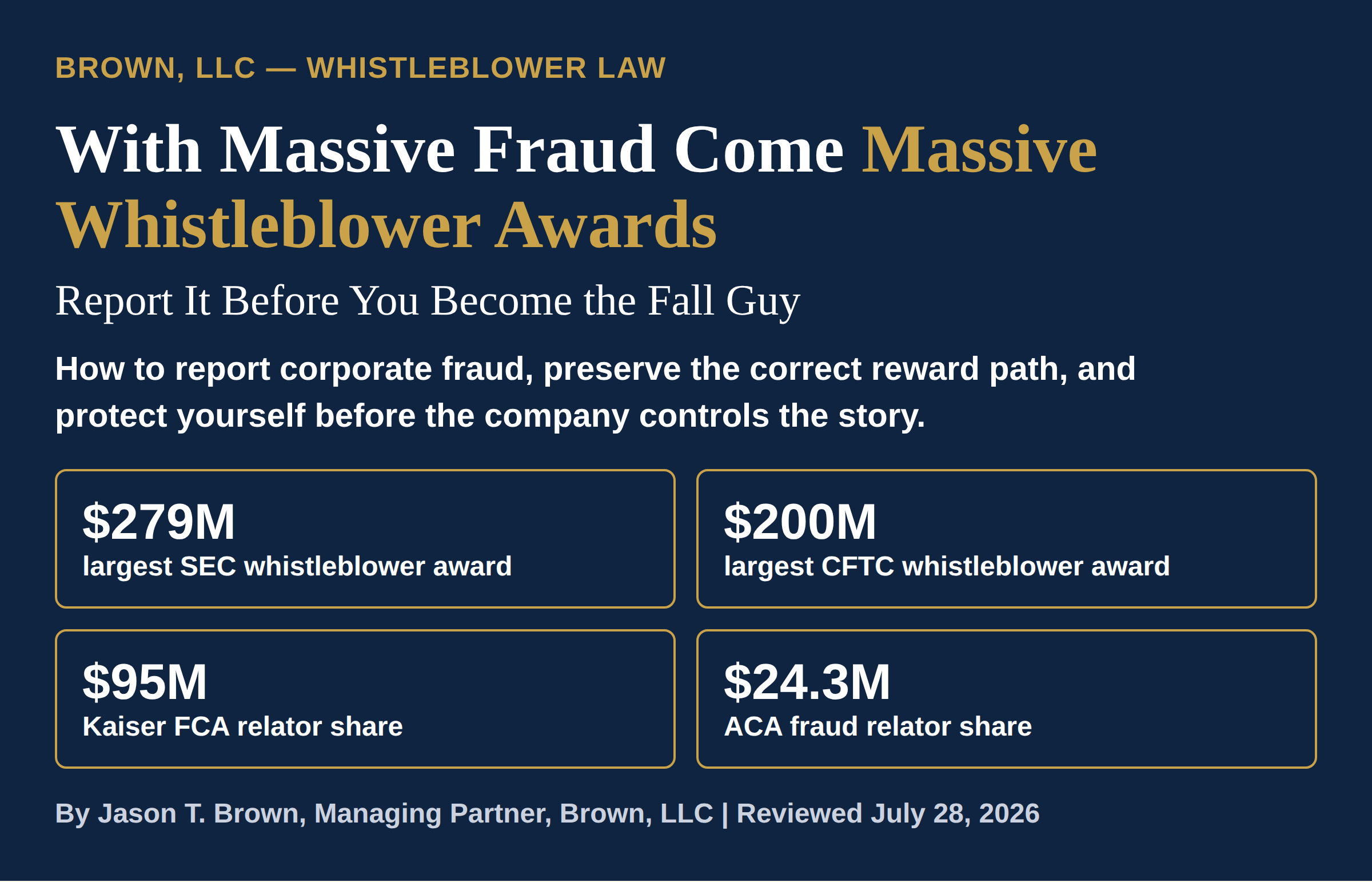
Table of Contents
Should I report corporate fraud before my company blames me for it? If you are being told to sign, code, certify, approve, book, transmit, conceal, or ignore something you believe is false, waiting is not neutral. Every additional claim, invoice, trade, tax return, customs entry, diagnosis code, certification, or compliance approval can deepen the scheme and put your name deeper into the record.
The corporation’s interests can separate from yours the moment an internal investigation begins. DOJ policy gives companies meaningful benefits for self-disclosure and cooperation. To receive cooperation credit, a company must identify the individuals involved or responsible and provide the relevant facts, regardless of title or seniority. The company may turn over emails, approvals, interview summaries, devices, access logs, and accounting records while arguing that misconduct was limited to particular employees or business units.
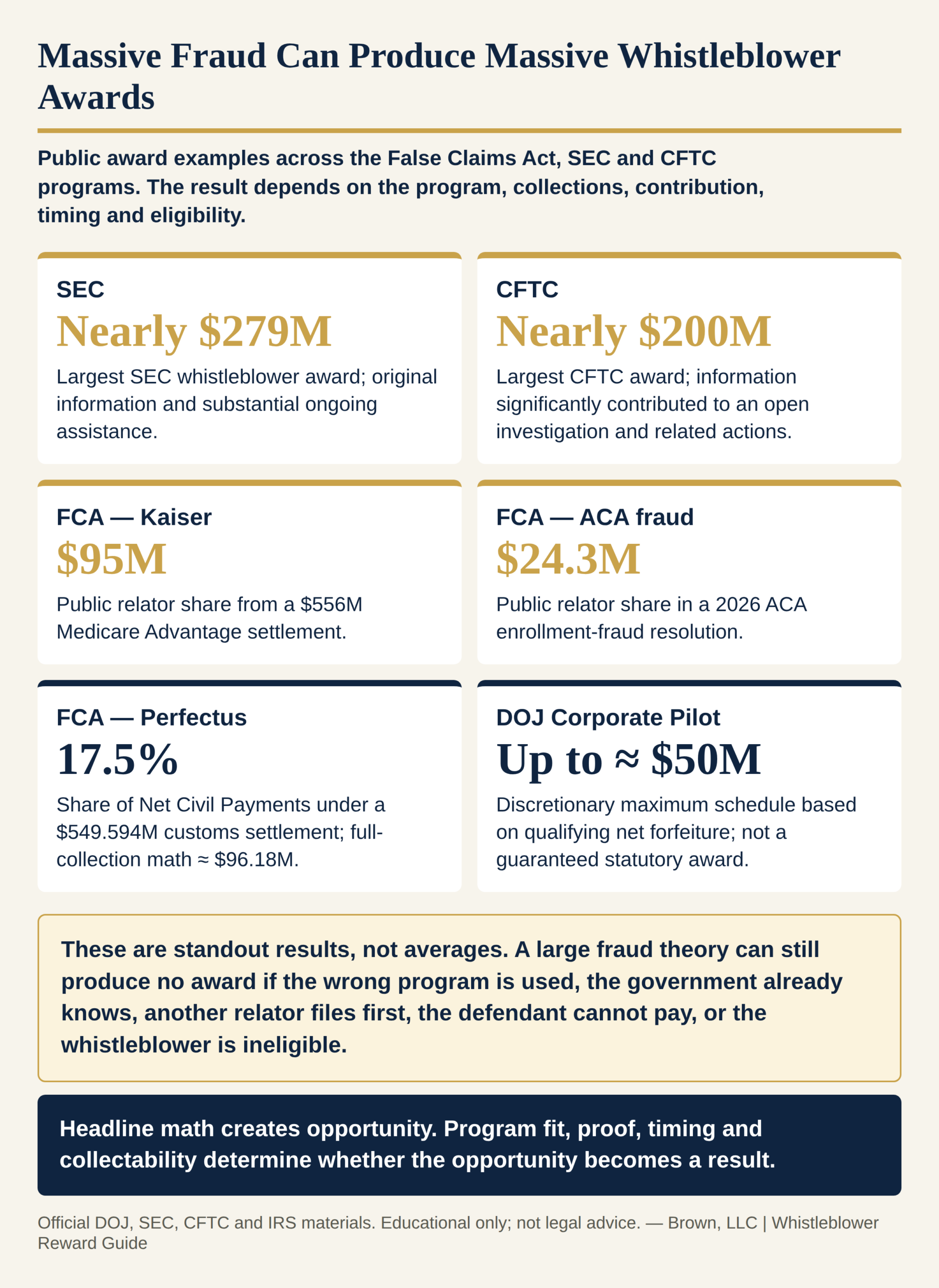
Massive fraud can also produce massive whistleblower awards. In 2026, former Kaiser employees were allocated a $95 million relator share from a $556 million Medicare Advantage settlement. A whistleblower in an Affordable Care Act enrollment-fraud matter was allocated $24.3 million. The SEC’s largest public award is nearly $279 million, and the CFTC’s largest is nearly $200 million.
Speak with the Lawyers at Brown, LLC Today!
Over $1 billion in aggregate judgments and settlements for our clients in state and federal courts. We fight for maximum damages and results.
The opportunity does not make the process automatic. The wrong filing route, a late submission, another whistleblower filing first, weak proof, poor evidence handling, an insolvent defendant, or the whistleblower’s own misconduct can reduce the case to nothing.
| Brown, LLC’s rule: If the company is running a serious fraud and your name is touching it, protect yourself before the company decides that its best defense is your name. Tell the truth, preserve lawful evidence, stop making the record worse, and develop the correct whistleblower strategy before you report. |
Massive Fraud Can Produce Massive Awards
The False Claims Act produced more than $6.8 billion in settlements and judgments in fiscal year 2025. Whistleblowers filed a record 1,297 qui tam actions, and more than $5.3 billion of the year’s reported recoveries came from qui tam matters filed that year or earlier. Successful FCA relators generally receive 15% to 30% of the government’s recovery.
| Program / matter | Public award or share | What the public record shows |
| SEC | Nearly $279 million | Largest SEC whistleblower award; the whistleblower provided information and substantial ongoing assistance |
| CFTC | Nearly $200 million | Largest CFTC award; the information significantly contributed to an existing investigation and related actions |
| FCA — Kaiser Permanente | $95 million | Relator share from a $556 million Medicare Advantage settlement |
| FCA — ACA enrollment fraud | $24.3 million | Relator share from a civil ACA enrollment-fraud recovery |
| FCA — Perfectus Aluminum | 17.5% of Net Civil Payments | A $549.594 million customs settlement; full-collection arithmetic is approximately $96.18 million, but actual payment follows collections |
| DOJ Corporate Pilot | Maximum schedule approximately $50 million | Discretionary award based on qualifying net forfeiture; no guaranteed statutory award |
These results establish that a whistleblower award can be life-changing. They do not establish an average. Most tips do not produce nine-figure recoveries, and many filed cases do not produce a result. The useful question is whether the information is original, specific, provable, timely, material, and connected to a solvent defendant or collectable government recovery.
Whistleblower tip: If you’ve witnessed Medicare or Medicaid billing fraud at your employer, you may qualify as a qui tam relator with a potential share of the government’s recovery. See our Medicare & Medicaid fraud practice →
Perfectus also shows why press-release arithmetic must be handled honestly. The settlement provides a 17.5% share of Net Civil Payments actually received. If the government ultimately collects the entire $549,594,030 as share-bearing proceeds, 17.5% equals approximately $96,178,955.25. The agreement does not establish that the full amount had already been collected or distributed when the settlement was announced.
The Fall-Guy Risk Is Built Into Corporate Cooperation
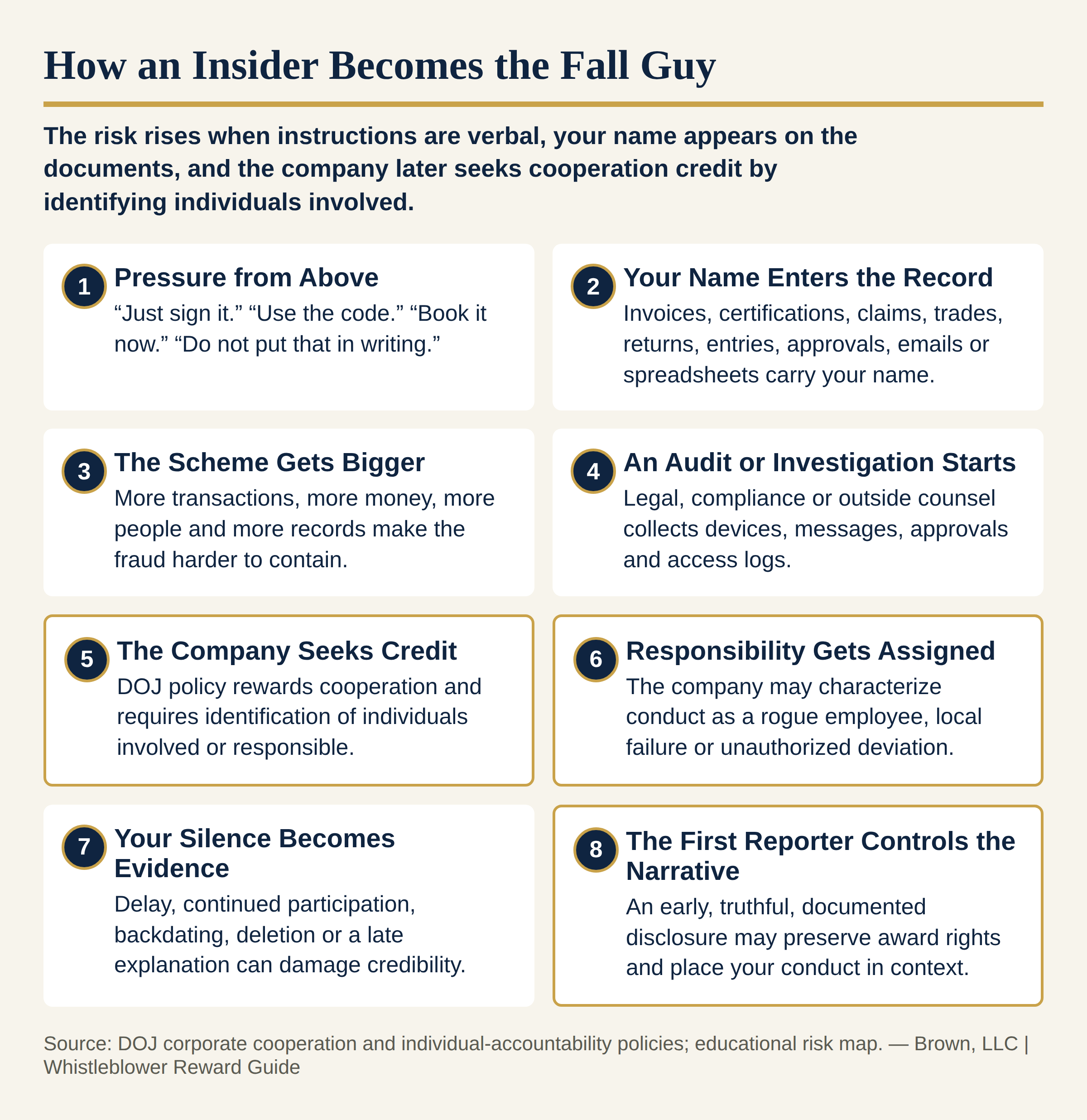
DOJ policy incentivizes companies seeking cooperation credit to identify the individuals involved or responsible for misconduct.
A corporation is a legal entity. It acts through people. When the government investigates, the company often seeks to preserve itself by showing that it discovered the misconduct, identified the individuals, cooperated, disciplined employees, and fixed the controls.
The Justice Manual states that a corporation seeking cooperation credit must identify all individuals involved in or responsible for the misconduct and provide the relevant facts. DOJ’s 2026 department-wide corporate enforcement policy further rewards voluntary self-disclosure, cooperation, and remediation.
That does not mean every company invents a scapegoat. It means the company has an institutional incentive to assign conduct to identifiable people. The people whose names appear on the claims, certifications, spreadsheets, trades, invoices, codes, returns, entries, and approvals are easy to identify.
Speak with the Lawyers at Brown, LLC Today!
Over $1 billion in aggregate judgments and settlements for our clients in state and federal courts. We fight for maximum damages and results.
The risk is especially acute when senior instructions were verbal, vague, or framed as business pressure while the employee created the written record. An executive may say “hit the number.” The finance employee books the entry. A supervisor may say “capture the diagnosis.” The coder submits it. A sourcing executive may say “use the Hong Kong paperwork.” The customs employee enters the origin. When the government arrives, the written acts are attached to the person who performed them.
Warning Signs That Responsibility Is Moving Toward You
No single fact proves that a company intends to blame an employee. A pattern should prompt an immediate confidential review:
- You are instructed to sign or certify something that senior management will not sign.
- Important directions are given orally, through disappearing messages, or outside normal systems.
- A manager refuses to confirm instructions in writing.
- You are asked to backdate records, alter descriptions, change codes, or create support after the fact.
- Legal or compliance interviews focus heavily on your actions while avoiding the people who gave the instructions.
- Your system access is limited shortly after you raise concerns.
- The company requests your device, messages, notes, or personal files.
- You are told not to communicate with coworkers about the issue.
- The company announces a self-disclosure or hires outside counsel.
- Your performance record suddenly deteriorates after years of acceptable work.
- You are offered severance, a release, or a resignation agreement during the investigation.
- Someone suggests the issue resulted from your misunderstanding or unauthorized deviation.
At that stage, an unstructured email to management can create more exposure. A confidential conversation with your own counsel is safer than assuming company counsel protects your interests.
Which Whistleblower Program Owns the Fraud?
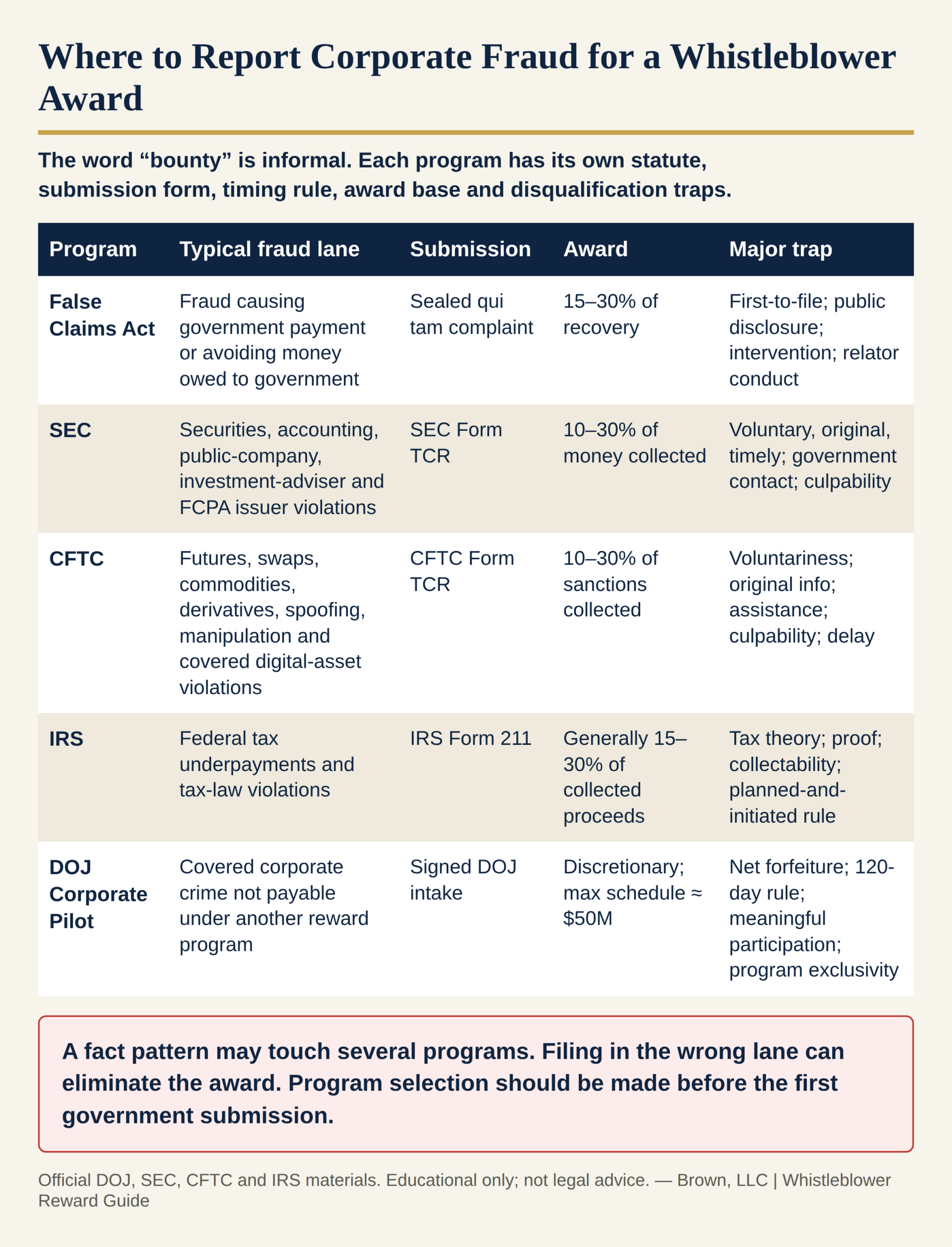
The same misconduct can touch more than one reward program. Filing in the wrong lane can eliminate the award. The word “bounty” is informal. The legal source of the award depends on the conduct, the victim, the regulator, and the money recovered.
False Claims Act
Use the FCA when the fraud causes the federal government to pay false claims or allows someone to avoid money owed to the United States. Common matters include Medicare and Medicaid fraud, defense and procurement fraud, grant fraud, PPP fraud, cybersecurity certification fraud, customs duty evasion, and other government-program schemes.
The case is filed under seal. First-to-file, public-disclosure, original-source, materiality, and pleading rules apply. A successful relator generally receives 15–25% if the government intervenes and 25–30% if the government declines and the relator successfully proceeds.
SEC
The SEC program covers federal securities-law violations, including accounting fraud, misleading disclosures, insider trading, market manipulation, investment-adviser misconduct, issuer FCPA violations, and certain digital-asset matters. Eligible whistleblowers may receive 10–30% of money collected when sanctions exceed $1 million.
The information generally must be voluntary, original, timely, and useful. Waiting until the government contacts you can damage voluntariness. SEC whistleblower status does not provide amnesty for the whistleblower’s own securities violations.
CFTC
The CFTC program covers Commodity Exchange Act violations involving futures, swaps, derivatives, commodities, spoofing, manipulation, misappropriation, false reporting, certain digital-asset conduct, and related actions. Eligible awards are 10–30% of sanctions collected.
Related: Brown, LLC secured two of the year’s largest individual recoveries — a $950M settlement against Raytheon and $350M against Walgreens. Learn about our False Claims Act practice →
The CFTC has awarded more than $430 million in total, associated with enforcement actions producing more than $3.7 billion in sanctions. Award factors include culpability, delay, and interference with internal compliance systems.
IRS
The IRS program covers federal tax underpayments and violations of laws the IRS administers. Eligible awards generally range from 15–30% of proceeds collected and attributable to the whistleblower’s information.
IRS cases require a tax theory, affected years, a reasoned underpayment analysis, proof, and collectability. A whistleblower who planned and initiated the tax misconduct may receive a reduced award, and certain criminal convictions require denial.
DOJ Corporate Whistleblower Awards Pilot Program
The DOJ pilot covers specified corporate crimes that fall outside other reward programs, including private-company foreign bribery, private health-insurance fraud, corruption, sanctions, trade and customs crime, certain financial-institution misconduct, and other covered conduct. Awards are discretionary and based on qualifying net forfeiture, with a maximum schedule of approximately $50 million.
The program is a gap-filler. If the same information qualifies for payment under the FCA, SEC, CFTC, IRS, FinCEN, or another reward program, the pilot may not pay. Program routing must occur before filing.
Timing Can Decide Whether You Receive an Award
Whistleblower programs reward early, useful information. Delay gives the company, another insider, a competitor, or the government time to move first.
- FCA first-to-file: another pending qui tam action based on the same essential facts can block a later relator.
- FCA public disclosure: government reports, litigation, hearings, audits, or news coverage can create a bar unless the relator qualifies as an original source.
- SEC and CFTC voluntariness: a government request concerning the same subject may come before the Form TCR and destroy the voluntary-submission theory.
- IRS: Form 211 is the award claim; a general tax-fraud referral is not the same filing.
- DOJ Corporate Pilot: an internal report starts a 120-day deadline for reporting to DOJ under the program’s internal-report exception.
- Corporate self-disclosure: the company may report the misconduct and identify individuals while seeking cooperation credit.
The right move is not always an immediate agency filing. A rushed, thin submission can waste the first opportunity to tell the story. The right move is an immediate confidential legal assessment followed by the correct filing sequence.
If You Participated in the Scheme, Do Not Hide It
Many whistleblowers touched the misconduct before understanding it. They processed claims, entered codes, prepared invoices, transmitted trades, built spreadsheets, signed reports, or followed directions.
Participation does not automatically end every whistleblower option. It changes the analysis.
- Under the FCA, a relator who planned and initiated the violation may have the share reduced. A relator convicted of criminal conduct arising from the violation is dismissed and receives no share.
- Under SEC rules, culpability can reduce an award, and whistleblower status is not amnesty.
- Under CFTC rules, culpability, scienter, financial benefit, delay, and compliance interference can reduce an award.
- Under IRS law, planned-and-initiated conduct can reduce the award, and certain criminal convictions bar it.
- Under the DOJ Corporate Pilot, meaningful participants generally are ineligible, although a person plainly among the least culpable may still qualify under limited circumstances.
The worst response is to minimize your role, delete messages, change the story, or blame someone else falsely. Credibility is the asset that carries across every program.
A Whistleblower Award Is Not Immunity
Reporting fraud does not create immunity. An award submission and a criminal cooperation strategy are different tracks. A person with exposure may need counsel to assess whether the immediate objective is a whistleblower award, a proffer, a non-prosecution agreement, cooperation credit, or a coordinated strategy that preserves all legitimate options. DOJ maintains a separate voluntary self-disclosure program for certain individuals who participated in corporate wrongdoing and provide complete cooperation.
Speak with the Lawyers at Brown, LLC Today!
Over $1 billion in aggregate judgments and settlements for our clients in state and federal courts. We fight for maximum damages and results.
This tradeoff is especially important when the person reports only after receiving a subpoena, interview request, target letter, or government inquiry. The information may still help the government, but the person may be treated primarily as a cooperator trying to avoid consequences rather than an award-eligible voluntary whistleblower.
| Protection first: If your conduct may be questioned, do not call the regulator alone. Your lawyer should evaluate exposure, voluntariness, privilege, document handling, possible immunity or NPA discussions, and the award program before the first government contact. |
What to Do Before You Report
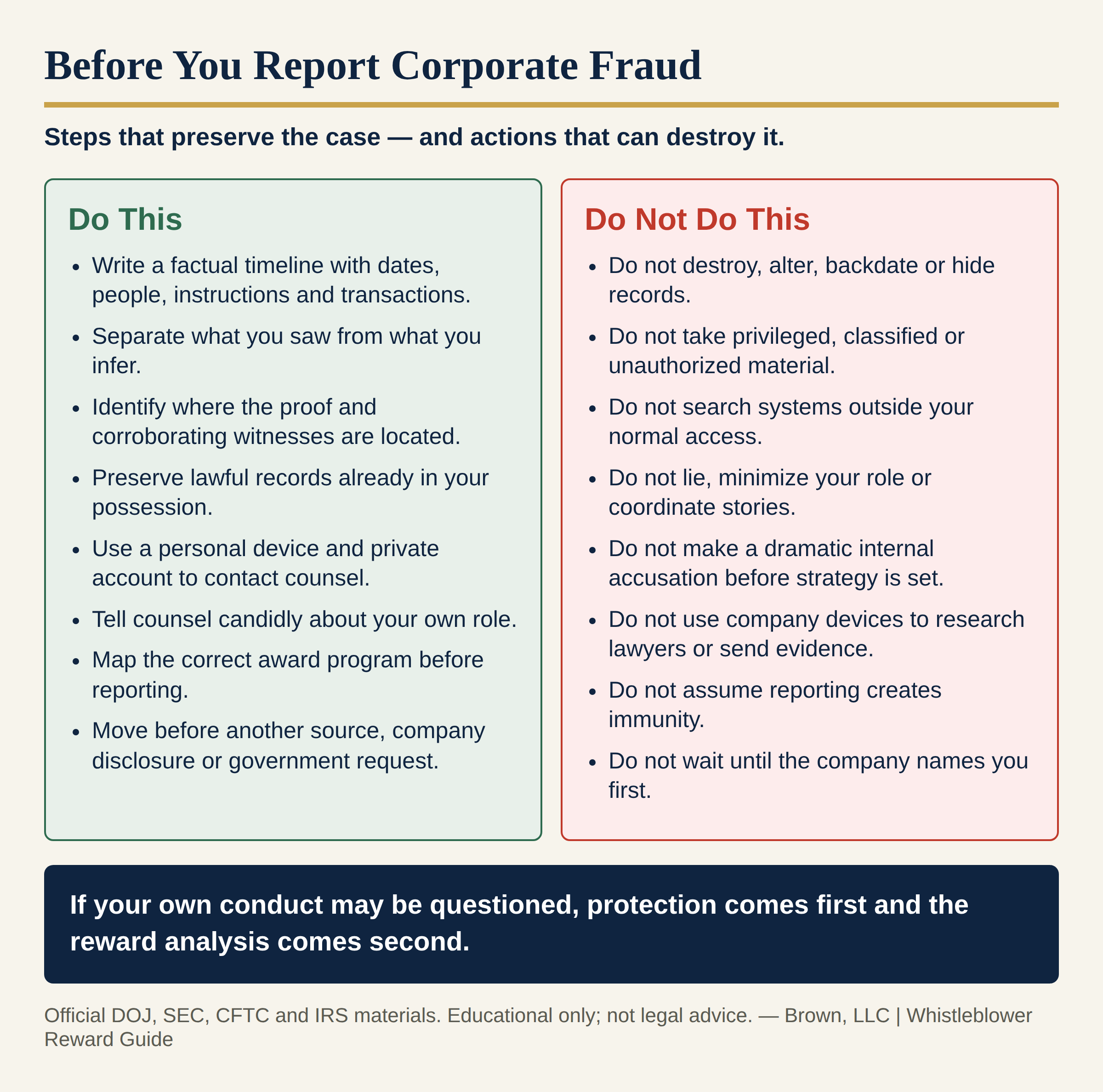
The first steps should preserve evidence, credibility, program options and personal protection.
A disciplined first week can preserve a case that might otherwise collapse.
- Build a factual timeline with dates, names, transactions, instructions, meetings, and amounts.
- Separate firsthand knowledge from assumptions.
- Identify the government program, regulator, investors, taxpayers, patients, customers, or markets affected.
- Identify the false statement, claim, certification, code, return, invoice, trade, or customs entry.
- List where the documents and data are stored and who controls them.
- Preserve records you already possess lawfully.
- Use a personal device and private account to contact counsel.
- Disclose your own role completely to your lawyer.
- Do not destroy, alter, backdate, conceal, or fabricate anything.
- Do not take privileged, classified, controlled, or unauthorized material.
- Do not access new files outside your ordinary permissions.
- Do not confront management or send a broad accusation before the filing strategy is set.
Massive Fraud Does Not Automatically Mean a Massive Award
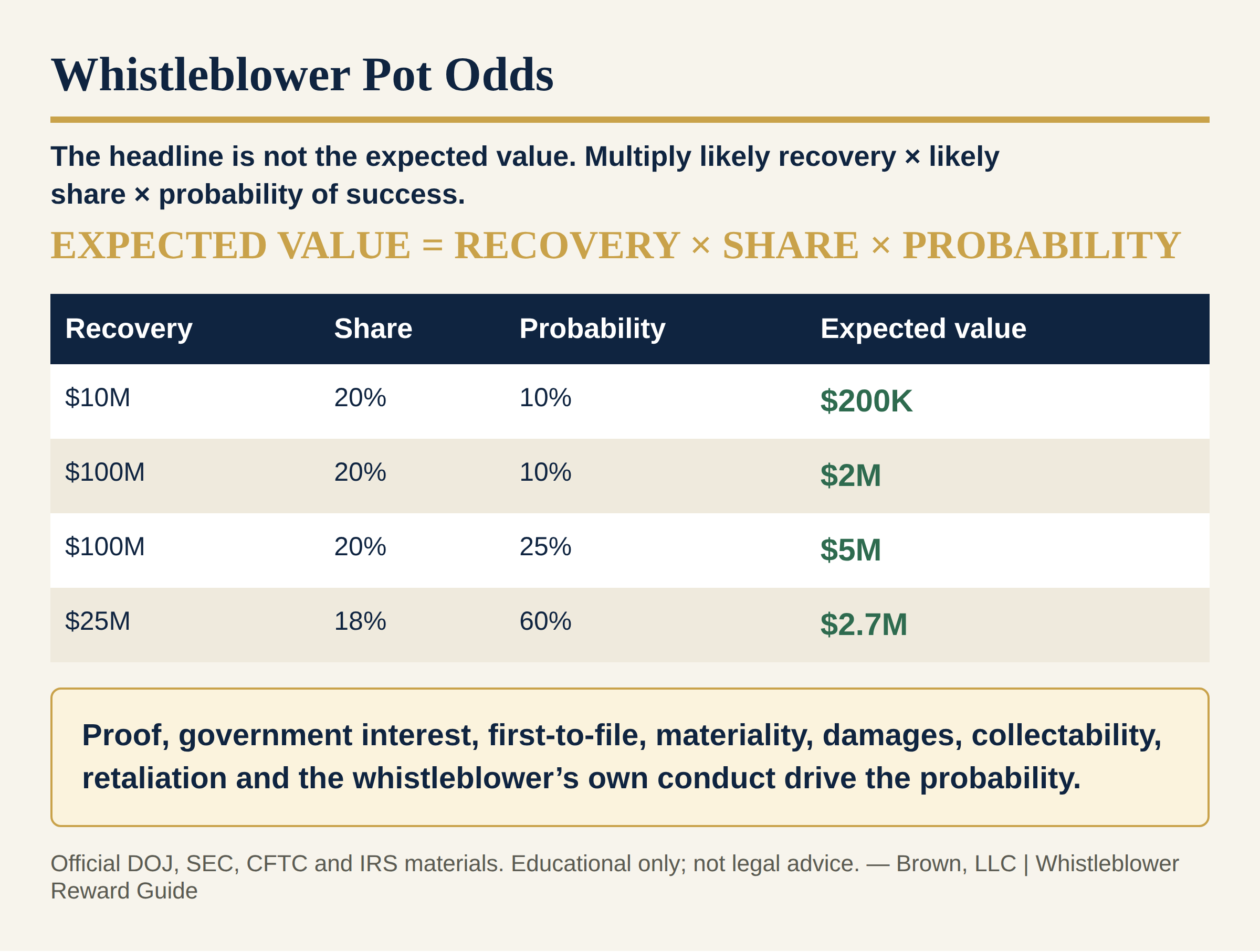
A headline damages number becomes useful only after adjusting for proof, legal risk, timing, government interest, collectability and the likely share. A serious whistleblower lawyer should evaluate expected value, not sell a fantasy.
The basic pot-odds formula is:
| Expected value: Likely government recovery × likely whistleblower percentage × probability of a successful, collectable result. |
A $10 million recovery at a 20% share equals a $2 million award if the case succeeds. If the realistic probability of a result is 10%, the risk-adjusted expected value is $200,000.
A $100 million recovery at a 20% share equals $20 million if successful. At a 10% probability, the expected value is $2 million. At a 25% probability, it becomes $5 million.
The probability depends on proof, falsity, scienter, materiality, damages, originality, first-to-file, government interest, defendant resources, collectability, whistleblower credibility, and the ability to litigate after a declination.
The case with the largest accusation is not always the most valuable. A $25 million case with clean documents, strong witnesses, government interest, and a solvent defendant can be worth far more than a speculative $500 million theory.
Situations That Should Trigger an Immediate Confidential Review
Healthcare billing or coding
You are directed to add unsupported diagnosis codes, bill for services not performed, certify medical necessity that does not exist, hide kickbacks, or keep overpayments after compliance identified them.
Government contracting and cybersecurity
You know a contractor submitted defective cost data, billed unallowable costs, falsely certified small-business status, concealed defective products, submitted a false SPRS score, or represented compliance with CMMC, DFARS, NIST or FedRAMP requirements that were not met.
Customs, tariffs and trade
You see false country-of-origin declarations, transshipment, double invoices, undervaluation, HTS misclassification, AD/CVD evasion, shell importers, relabeling, or instructions to hide facts from a customs broker or CBP.
Securities and accounting
Revenue is booked before delivery, side agreements are concealed, reserves are manipulated, public disclosures contradict internal records, investors are misled, or insiders trade on confidential information.
Commodities, swaps, trading and digital assets
You see spoofing, wash trading, benchmark manipulation, customer-fund misuse, false statements to the CFTC, unregistered activity, corrupt payments, or manipulation involving derivatives or covered digital assets.
Tax
You know about hidden income, sham deductions, offshore accounts, false basis, abusive partnership structures, payroll-tax diversion, transfer-pricing manipulation, or crypto concealment with substantial collectable tax loss.
AML, sanctions and corporate crime
Alerts are overridden, sanctioned parties are approved, suspicious transactions are cleared, shell companies conceal beneficial owners, bribes are routed through consultants, or private health-insurance fraud produces criminally forfeitable proceeds.
Why Brown, LLC for a Major Whistleblower Case
A massive fraud case should be screened by a firm that understands the entire federal reward map and is willing to litigate the case when the government does not take it over.
Brown, LLC is led by Jason T. Brown, a former FBI Special Agent and Legal Advisor, and includes former DOJ Civil Fraud experience. The firm handles False Claims Act, SEC, CFTC, IRS, customs, cybersecurity, healthcare, procurement, and other whistleblower matters nationwide.
Brown, LLC’s public results include involvement in the $950 million aggregate Raytheon resolution, including a major FCA component, and representation of a whistleblower in the Walgreens opioid resolution of up to $350 million. Past results do not guarantee future outcomes.
The firm’s role begins before filing:
- Identify the correct reward program and any parallel submission strategy.
- Pressure-test the legal theory, damages, evidence, originality, timing and collectability.
- Evaluate the whistleblower’s own conduct and potential exposure.
- Preserve confidentiality, voluntariness, first-to-file and privilege.
- Build a government-ready chronology, evidence map, witness list and damages model.
- Prepare the complaint, Form TCR, Form 211, DOJ intake or other required submission.
- Represent the whistleblower through investigation, interviews, litigation, resolution and award proceedings.
A reputable firm should also tell a potential client when the matter is too small, too speculative, already known, legally misrouted, uncollectable, or too dangerous to file as presented.
Frequently Asked Questions
Should I report corporate fraud before the company blames me?
If your name appears on false claims, certifications, trades, invoices, codes, returns or approvals, get independent legal advice promptly. DOJ policies incentivize cooperating companies to identify individuals involved or responsible.
How much can I receive for reporting corporate fraud?
The amount depends on the program. FCA shares generally range from 15% to 30%; SEC and CFTC awards generally range from 10% to 30%; IRS awards generally range from 15% to 30% of collected proceeds; the DOJ Corporate Pilot is discretionary and forfeiture-based.
Does reporting fraud give me immunity?
No. A whistleblower submission is not an immunity agreement. A person with potential exposure may need a coordinated criminal-defense, cooperation or non-prosecution strategy.
What if another whistleblower files first?
Under the FCA, a related pending qui tam action can bar a later filer. Other programs also reward original, timely information. Delay can destroy value.
What should I do today?
Stop making the record worse, preserve lawful evidence, write a factual timeline, use a personal device, do not destroy or alter anything, and speak confidentially with qualified counsel before reporting.
Bottom Line
Massive fraud creates two very different possibilities for an insider.
You may become the person the company identifies when it is trying to save itself. Or you may become the whistleblower who reports the scheme truthfully, protects the government or investors, and earns a share of the recovery.
The difference is usually timing, credibility, program selection, and evidence discipline.
Do not keep participating because someone above you said it was acceptable. Do not destroy records. Do not assume the company’s lawyer represents you. Do not wait for the subpoena, target letter, termination meeting, or severance agreement.
If you have specific information about major corporate fraud, speak with a whistleblower lawyer before the company controls the story.
Sources
[1] DOJ, False Claims Act Settlements and Judgments Exceed $6.8B in FY2025: https://www.justice.gov/opa/pr/false-claims-act-settlements-and-judgments-exceed-68b-fiscal-year-2025
[2] DOJ, Kaiser Permanente Affiliates Pay $556M; Relator Share $95M: https://www.justice.gov/opa/pr/kaiser-permanente-affiliates-pay-556m-resolve-false-claims-act-allegations
[3] DOJ, ACA Enrollment Fraud Resolution; Whistleblower Share $24.3M: https://www.justice.gov/opa/pr/justice-department-prosecutes-half-billion-dollars-healthcare-and-covid-fraud-schemes
[4] DOJ, Perfectus Aluminum $549.5M Customs FCA Settlement: https://www.justice.gov/opa/pr/perfectus-aluminum-inc-and-related-companies-agree-pay-5495m-settle-false-claims-act
[5] DOJ, Perfectus Aluminum Civil Settlement Agreement: https://www.justice.gov/opa/media/1440366/dl
[6] SEC, Largest-Ever Whistleblower Award of Nearly $279M: https://www.sec.gov/newsroom/press-releases/2023-89
[7] CFTC, Nearly $200M Award to a Whistleblower: https://www.cftc.gov/PressRoom/PressReleases/8453-21
[8] CFTC, Program Totals Exceed $430M in Awards and $3.7B in Sanctions: https://www.cftc.gov/PressRoom/PressReleases/9245-26
[9] IRS Whistleblower Office: https://www.irs.gov/compliance/whistleblower-office
[10] DOJ Justice Manual 9-28.700, Corporate Cooperation and Individual Accountability: https://www.justice.gov/jm/jm-9-28000-principles-federal-prosecution-business-organizations
[11] DOJ, First Department-Wide Corporate Enforcement Policy: https://www.justice.gov/opa/pr/department-justice-releases-first-ever-corporate-enforcement-policy-all-criminal-cases
[12] 31 U.S.C. § 3730, Qui Tam Actions, Relator Shares, First-to-File and Retaliation: https://uscode.house.gov/view.xhtml?edition=prelim&num=0&req=granuleid%3AUSC-prelim-title31-section3730
[13] SEC Whistleblower Program: https://www.sec.gov/enforcement-litigation/whistleblower-program
[14] CFTC Whistleblower Program: https://www.cftc.gov/consumerprotection/whistleblowerprogram/index.htm
[15] DOJ Corporate Whistleblower Awards Pilot Program: https://www.justice.gov/criminal/criminal-division-corporate-whistleblower-awards-pilot-program
[16] SEC Rule 21F-15, No Amnesty: https://www.ecfr.gov/current/title-17/chapter-II/part-240/section-240.21F-15
[17] CFTC Rule 165.9, Award Factors Including Culpability and Delay: https://www.ecfr.gov/current/title-17/chapter-I/part-165/section-165.9
[18] 26 U.S.C. § 7623, IRS Whistleblower Awards and Planned-and-Initiated Rule: https://uscode.house.gov/view.xhtml?edition=prelim&num=0&req=granuleid%3AUSC-prelim-title26-section7623
[19] DOJ Criminal Division Pilot Program on Voluntary Self-Disclosures for Individuals: https://www.justice.gov/criminal/criminal-division-pilot-program-voluntary-self-disclosures-individuals
[20] Brown, LLC Whistleblower Law Firm and Public Results: https://ifightforyourrights.com/
[21] Brown, LLC, Former DOJ Civil Fraud Senior Trial Counsel Joins FCA Practice: https://ifightforyourrights.com/news/brown-llc-welcomes-former-doj-civil-fraud-section-senior-trial-counsel-to-false-claims-act-practice/
Attorney advertising. This article is for informational purposes only and does not create an attorney-client relationship. Prior results do not guarantee a similar outcome.