Skip to main content
Abbott Infant Formula False Claims Act Settlement Reaches Nearly $385 Million Dollars

Table of Contents
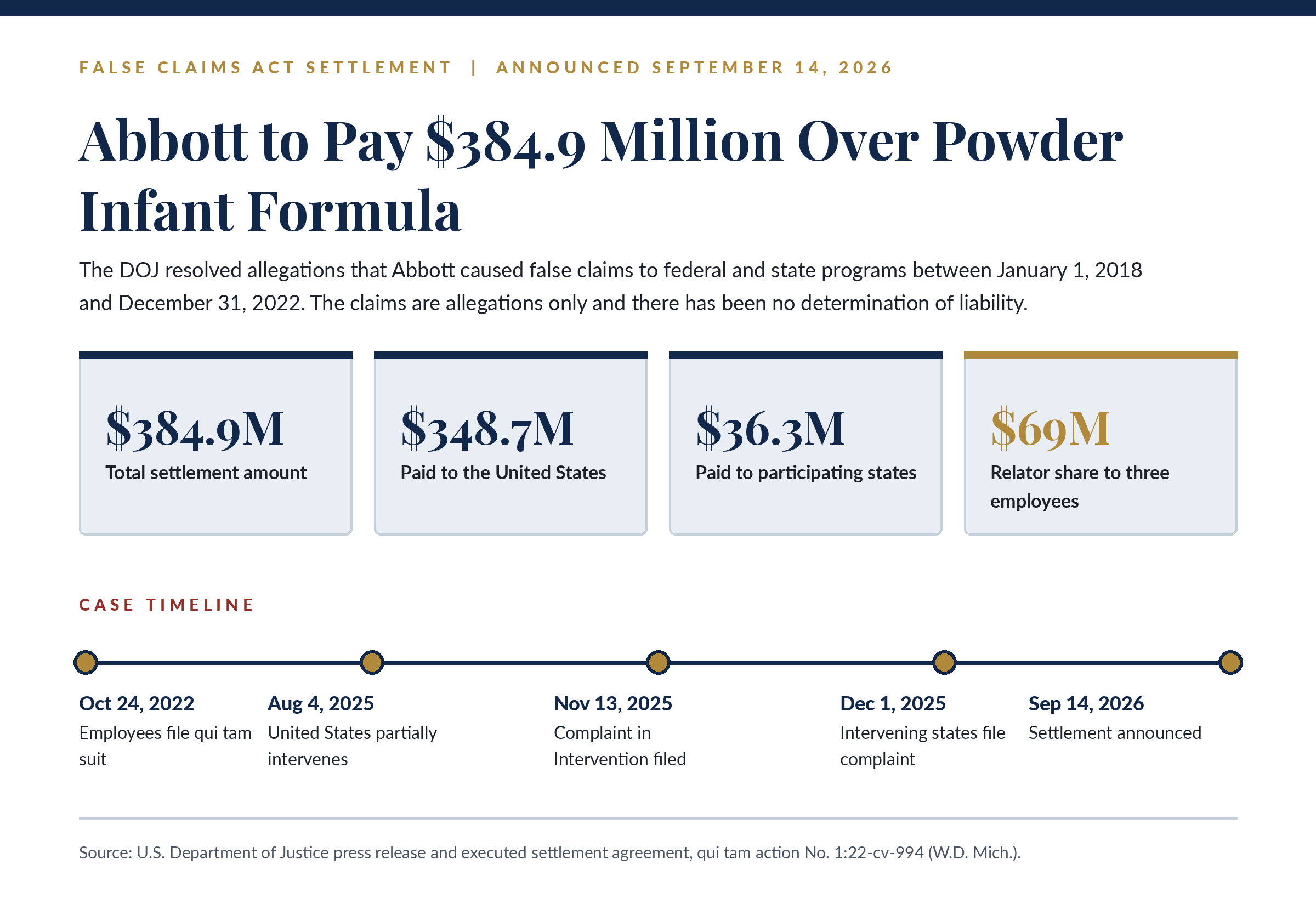
On September 14, 2026, the U.S. Department of Justice announced a $384,999,040 settlement with Abbott Laboratories to resolve False Claims Act allegations involving powdered infant formula and nutritional products made at Abbott’s Sturgis, Michigan, and Casa Grande, Arizona facilities. The government alleged that, from January 1, 2018, through December 31, 2022, Abbott misrepresented compliance with federal and state statutory, regulatory, and contractual requirements to the U.S. Department of Agriculture, agencies administering the USDA-funded Special Supplemental Nutrition Program for Women, Infants, and Children, known as WIC, and state Medicaid programs. Abbott must also pay interest under the settlement agreement.
The Abbott infant formula False Claims Act case began as a qui tam lawsuit filed on October 24, 2022, in the U.S. District Court for the Western District of Michigan by three Abbott employees. The United States later partially intervened. The three whistleblowers will receive $69 million from the federal recovery. The settlement compromises disputed claims, Abbott denies the allegations, and there has been no determination of liability.
“This is an excellent False Claims Act result. The $69 million relator share reflects the value that insiders can bring when they document alleged noncompliance tied to government-funded purchases,” said Jason T. Brown, Managing Partner of Brown, LLC. “The case also shows how alleged manufacturing and product-safety failures can become FCA matters when government payment depends on compliance representations.”
Key Takeaways
- Abbott agreed to pay $384,999,040.12 plus interest.
- The federal share is about $348.7 million, while participating state Medicaid and WIC programs receive about $36.3 million.
- The three employee whistleblowers will share $69 million, about 19.8 percent of the federal recovery.
- The case centered on allegations that Abbott misrepresented compliance requirements tied to government-funded purchases.
What the Government Alleged
The United States filed a Complaint in Intervention on November 13, 2025, alleging that Abbott caused government programs to purchase powdered infant formula made at the Sturgis facility even though the products did not meet statutory, regulatory, and contractual requirements. The government’s FCA theory tied Abbott’s alleged compliance misrepresentations to taxpayer-funded purchases. It was not a simple claim that the government paid too high a price.
Related: Brown, LLC secured two of the year’s largest individual recoveries — a $950M settlement against Raytheon and $350M against Walgreens. Learn about our False Claims Act practice →
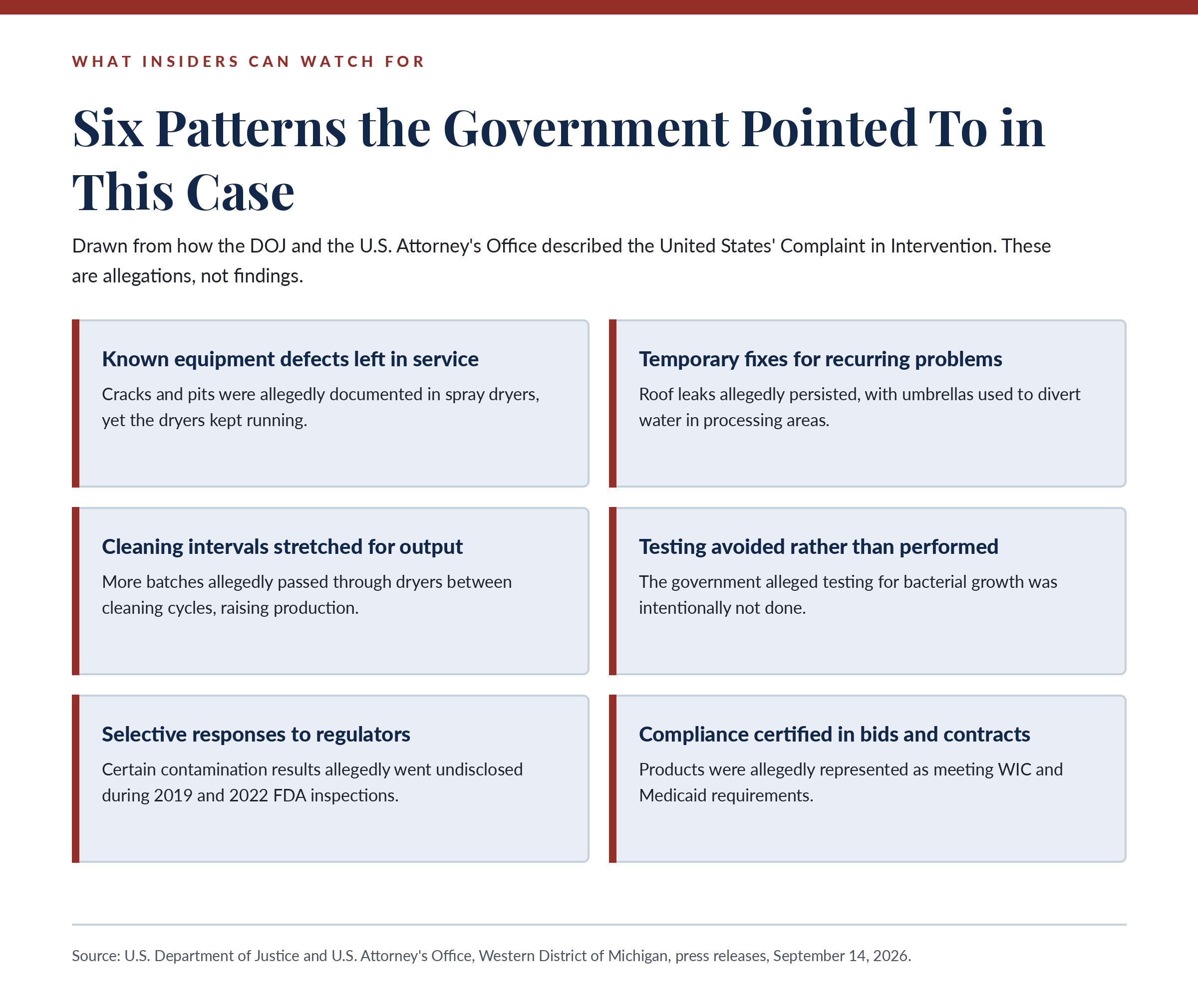
According to the complaint as described by the DOJ, roof leaks were a common occurrence at the Sturgis plant, with water running and dripping over equipment. Rather than permanently fixing the root causes, Abbott allegedly used temporary measures such as roof leak umbrellas to divert water in product processing areas, even though corporate leadership understood that a wet environment raised the risk of microorganism contamination. The government also alleged that Abbott kept running its spray dryers, which convert liquid formula into powder, after documenting cracks and pits in that equipment, conditions that further increased contamination risk in the presence of moisture.
The government also alleged facts directed to knowledge and concealment. Abbott allegedly lengthened the number of product batches run through the dryers between cleaning cycles, worsening dryer conditions while increasing production. DOJ further alleged that Abbott intentionally avoided testing for bacterial growth so it would not generate positive contamination results. According to the complaint, Abbott also failed in certain instances to disclose positive contamination results when responding to FDA requests during 2019 and 2022 inspections at Sturgis. The U.S. Attorney’s Office described the alleged pattern as a culture of concealment that failed to identify, document, investigate, and prevent potential contamination.
Abbott Settlement Payment Breakdown
The executed settlement agreement sets the total at $384,999,040.12 plus interest. The payment is allocated as follows.
- About $348.7 million to the United States to resolve the False Claims Act allegations, of which roughly $174.4 million is restitution, with interest at 4.375 percent per annum running from April 13, 2026.
- About $35.5 million to Medicaid participating states, of which roughly $17.7 million is restitution, with interest running from May 30, 2026.
- About $806,900 to Massachusetts as a supplemental WIC appropriation settlement amount.
Whistleblower tip: If you’ve witnessed Medicare or Medicaid billing fraud at your employer, you may qualify as a qui tam relator with a potential share of the government’s recovery. See our Medicare & Medicaid fraud practice →
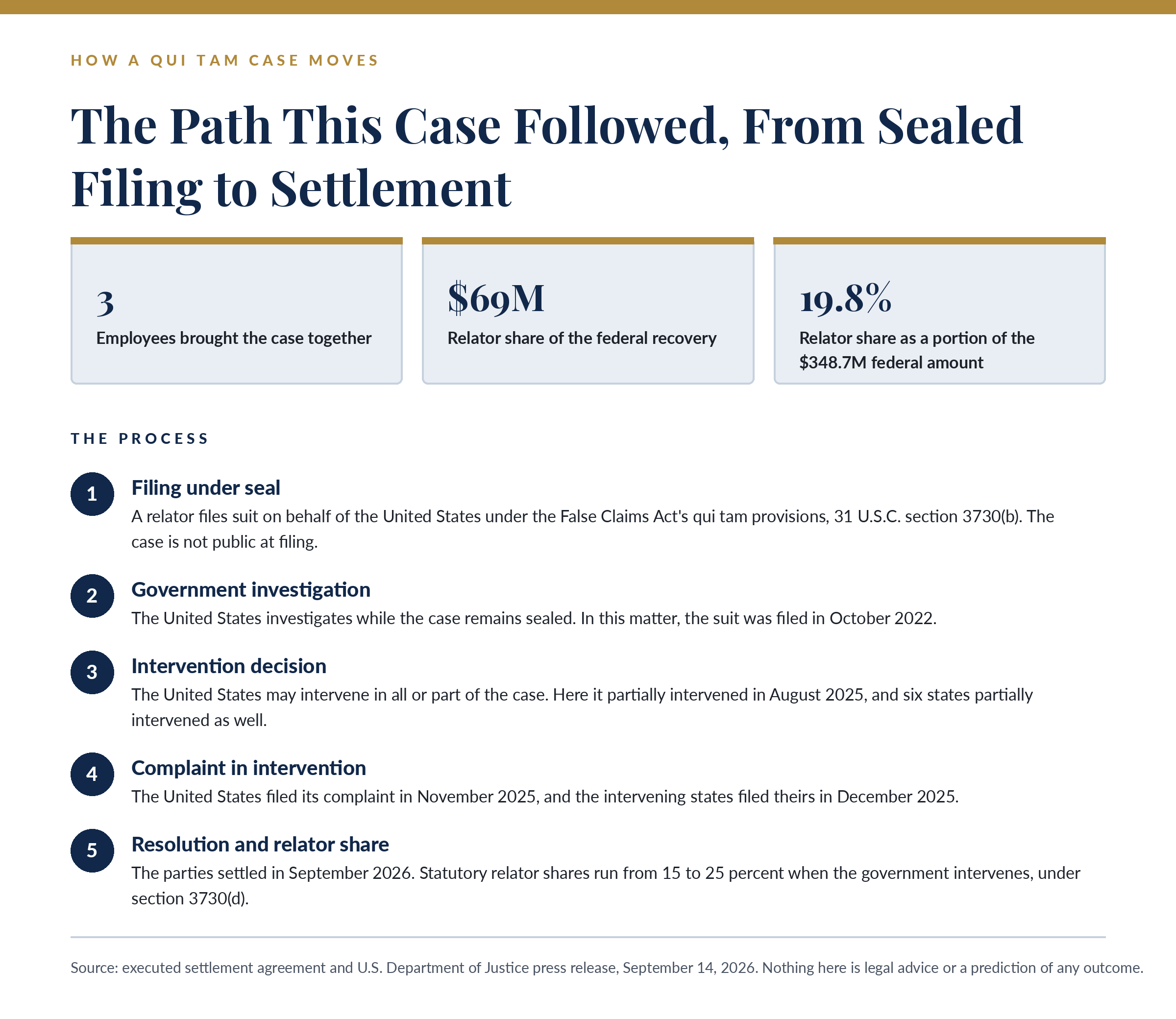
DOJ described the combined state recovery as about $36.3 million for claims settled by state Medicaid and WIC programs. The $69 million relator share is about 19.8 percent of the $348.7 million federal recovery. For claims in which the United States intervenes, 31 U.S.C. section 3730(d)(1) generally provides a relator share of 15 to 25 percent, depending in part on the relator’s contribution to the case.
Abbott Qui Tam Case Timeline
The timeline matters to prospective whistleblowers. This case remained under seal and government investigation for nearly three years before the United States partially intervened. Although the False Claims Act begins with a 60-day seal period, courts may extend that period for good cause while the government investigates.
- October 24, 2022: Three Abbott employees file the qui tam action under 31 U.S.C. section 3730(b) in the Western District of Michigan, No. 1:22-cv-994.
- August 4, 2025: The United States partially intervenes in claims involving Sturgis powdered infant formula purchased with USDA WIC funds. California, Maryland, and Tennessee partially intervene the same day in claims involving Medicaid-purchased products.
- November 12 and 13, 2025: The relators file an amended complaint on November 12, and the United States files its Complaint in Intervention the next day.
- November 21 and December 1, 2025: Massachusetts, New York, and Connecticut partially intervene. The intervening states file their Complaint in Intervention on December 1.
- September 14, 2026: DOJ announces the settlement.
Speak with the Lawyers at Brown, LLC Today!
Over $1 billion in aggregate judgments and settlements for our clients in state and federal courts. We fight for maximum damages and results.
Why the Abbott Allegations Supported an FCA Case
The payment connection was the federal nutrition program. USDA funds and regulates WIC, and DOJ reported that more than half of all infant formula purchased in the United States is paid for with USDA funds through WIC. State Medicaid programs also cover certain infant formula and nutritional products.
A regulatory violation alone does not automatically establish False Claims Act liability. The government must prove the FCA’s elements, including falsity, knowledge, materiality, and a connection to a claim for government payment. Here, the government alleged that Abbott misrepresented compliance with WIC and Medicaid requirements and thereby caused government-funded programs to purchase affected products. That alleged payment connection distinguished the case from a purely regulatory dispute.
Warning Signs for Manufacturing and Quality Insiders
The conduct alleged here may be recognizable to employees in manufacturing, quality assurance, laboratory, engineering, compliance, or regulatory affairs roles. Based on the government’s allegations, the warning signs included the following.
- Known equipment defects, such as cracks and pits in processing equipment, that were documented internally but kept in production.
- Repeated environmental problems, such as recurring water intrusion in product areas, addressed with temporary workarounds instead of permanent fixes.
- Changes to cleaning or sanitation intervals that increase throughput while increasing contamination risk.
- Testing decisions that appear designed to avoid generating a positive result rather than to detect a problem.
- Incomplete or selective responses to regulator document requests during inspections.
- Certifications of compliance in government bids and contracts that do not match what people inside the plant are seeing day to day.
A potential whistleblower does not need to decide whether the conduct legally violates the False Claims Act before consulting counsel. Evidence may include maintenance logs, test results, deviation reports, emails, inspection responses, and production schedules that the person lawfully possesses or is authorized to access. Counsel can assess whether the records show a knowing and material misrepresentation connected to government payment.
Questions for Manufacturing and Quality Whistleblowers
If your company sells products to WIC, Medicaid, Medicare, or another government-funded program, these questions may help identify facts that warrant a confidential legal review.
- Have you seen test results that were never reported, never repeated, or quietly closed out?
- Have you been told not to sample or test in a particular area, or during a particular window?
- Have you watched equipment stay in service after someone documented a defect?
- Have you seen production targets drive changes to cleaning, sanitation, or hold times?
- Has your company told a regulator something you knew to be incomplete?
- Did you report suspected fraud or try to stop it and then experience firing, demotion, threats, harassment, or another adverse action? The False Claims Act’s anti-retaliation provision, 31 U.S.C. section 3730(h), protects employees, contractors, and agents from retaliation for lawful acts in furtherance of an FCA action and other efforts to stop FCA violations.
The three people who brought the Abbott case were employees. Under the False Claims Act’s qui tam provisions, a private person called a relator may sue on behalf of the United States over false claims submitted to federal programs and may receive a share of a successful recovery.
Limits of the Abbott Settlement
The settlement is a compromise of disputed claims. It is not an admission of facts or liability by Abbott. Abbott denies the allegations of the United States, the relators, and the intervening states. For the covered conduct, the United States released specified civil and administrative monetary claims under the False Claims Act, the Civil Monetary Penalties Law, the Program Fraud Civil Remedies Act, and certain common-law theories.
Speak with the Lawyers at Brown, LLC Today!
Over $1 billion in aggregate judgments and settlements for our clients in state and federal courts. We fight for maximum damages and results.
The agreement expressly reserves criminal liability, federal tax liability, certain administrative enforcement rights, liability for conduct outside the covered conduct, individual liability, warranty and defective-product claims, claims for undelivered goods or services, and liability for personal injury, property damage, or consequential damages arising from the covered conduct. It also makes specified settlement-related costs unallowable for government contracting and Medicaid purposes and requires dismissal of the civil action after payment, with the scope stated in the agreement.
Frequently Asked Questions About the Abbott Infant Formula Settlement
How Much Abbott Agreed to Pay?
Abbott agreed to pay $384,999,040.12 plus interest to resolve the covered federal and state claims.
Whistleblower Share in the Abbott Settlement
The three Abbott employee whistleblowers will receive $69 million collectively from the federal settlement as a whistleblower award. That is about 19.8 percent of the federal recovery relator share.
Government Allegations Against Abbott
The government alleged that Abbott misrepresented compliance with statutory, regulatory, and contractual requirements tied to WIC and Medicaid purchases. The complaint also alleged sanitation, equipment, testing, and disclosure failures at the Sturgis facility.
Abbott Denial and No Liability Finding
Abbott denied the allegations. The settlement is a compromise of disputed claims, and there has been no judicial determination of liability.